
How soon will Google Ads start bringing in HVAC calls?
- How long after launch do Google Ads start making an HVAC company's phone ring?
- What happens between launching Google Ads and the first call?
- How long does Google take to approve a new HVAC ad?
- What does the "Learning" status mean, and does it stop my ads?
- How long until Google Ads produce good HVAC leads, not just calls?
- Why does call tracking decide how fast Google Ads get better?
- Does my budget change how soon the phone starts ringing?
- Does the season change how soon Google Ads work for an HVAC company?
- What slows down a new HVAC Google Ads account?
- What makes Google Ads bring HVAC calls faster?
- Will Google Ads bring calls faster than SEO or Local Services Ads?
- What's different about the Google Ads ramp for HVAC companies
- A worked example: a first month on a modest budget
- Frequently asked questions
- Key takeaways
- More in this section
- Sources
The short version
- Most new ads are reviewed within one business day, then start showing.
- A "Learning" status can last up to 7 days, but your ads keep running during it.
- Bidding settles over 1 to 2 conversion cycles; judge results over 2 cycles or 2 weeks, whichever is longer.
- Tracked calls, enough budget and answered phones are what make it faster.
For HVAC owners about to launch (or relaunch) Google Ads who want to know what happens in the first days and weeks, and what speeds it up or slows it down.
Get a free visibility audit · Book a growth call
How long after launch do Google Ads start making an HVAC company's phone ring?
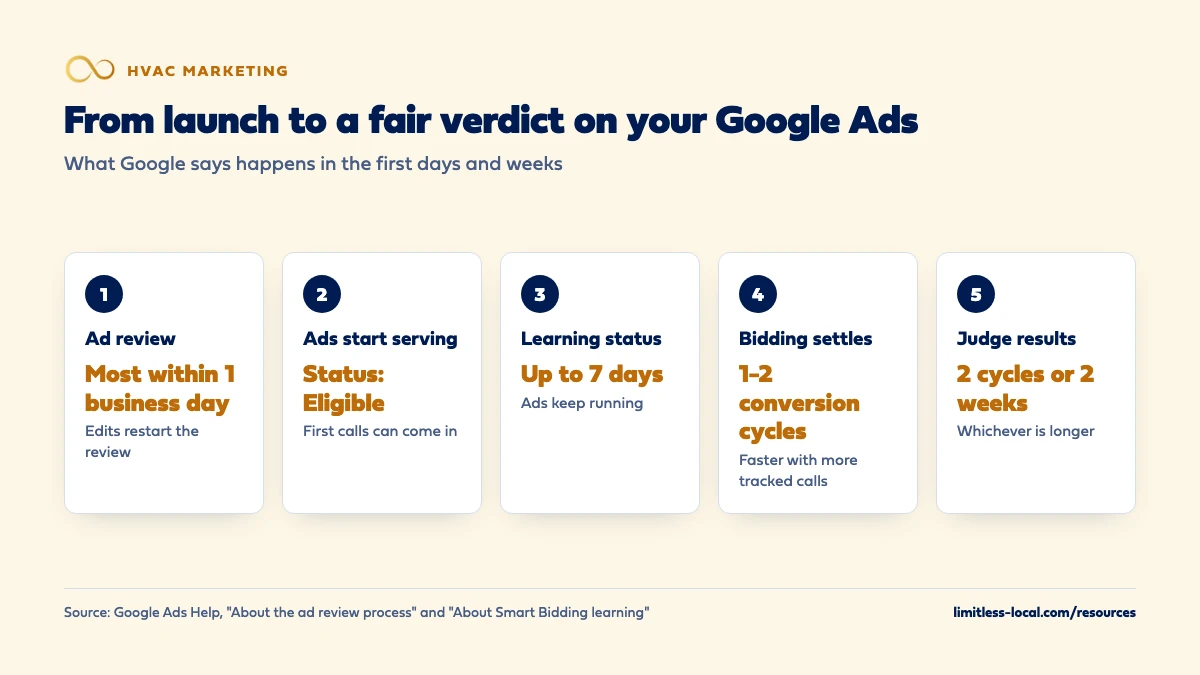
Google Ads can start bringing in HVAC calls within days of launch, because most new ads finish Google’s review within one business day and start showing as soon as they’re approved. Getting calls at a cost you’re happy with takes longer: automated bidding needs tracked calls to learn from, and Google says to judge results over two conversion cycles or two weeks, whichever is longer. How fast that happens depends on your budget against local competition, the season, whether someone answers the phone, and whether call tracking works from day one.
That’s the order we work in too: tracking and call routing first, then campaigns, which go live in weeks 1 to 2 after onboarding. Google Ads management is part of our local ads work and every one of our HVAC marketing packages. If you’re weighing ads against everything else, the HVAC marketing guide covers how long each channel takes, and the rest of the HVAC marketing questions library goes question by question.
What happens between launching Google Ads and the first call?
Three things happen, roughly in this order:
- Review. Google checks every new ad against its policies, including the headline, description, keywords, landing page, images and video. While that happens the ad shows as Under review.
- Serving. Once the ad passes, its status changes to Eligible and it starts running, as long as the campaign isn’t paused.
- Learning. If you use automated bidding (Google calls it Smart Bidding), a new campaign can show a Learning status while the system adjusts. Your ads still run and still take calls during that time.
So the first call can come as soon as the first ad is approved and someone in your area searches for what you do. What takes longer is the part owners care about: calls from the right jobs at a cost per booked job that makes sense. Sources: About the ad review process, About Smart Bidding learning.
How long does Google take to approve a new HVAC ad?
Google says most ads are reviewed within one business day, and some take longer when they need a more complex review. If an ad sits in review for more than 2 full business days, Google says to check its status; past a week, contact Google Ads support.
A few things restart or stall the review, and they’re easy to trip over in the first week:
- Editing the ad. Any change to an ad or its assets starts the review over.
- An unfinished landing page. If you’re launching a new page with the ads, Google says the page has to be complete before the ad can be reviewed.
- A phone number typed into the ad text. Google says that can get an ad disapproved; the number belongs in a call asset instead.
If you need ads running by a set date, say the week before a forecast heat wave, Google’s advice is to submit them several days early and keep the campaign paused until you’re ready. Paused ads are reviewed the same way as live ones (Google Ads Help).
What does the "Learning" status mean, and does it stop my ads?
It doesn’t stop them. Google describes Learning as a reminder that something structural changed recently: a new or restarted bid strategy, campaigns or keywords added or removed, or a big change to the conversion goal you’re bidding toward. It never lasts more than 7 days, and your ads keep entering auctions the whole time.
Two details matter for an HVAC owner:
- Budget changes don’t trigger it. Raising your daily budget when the first heat wave hits takes effect right away and doesn’t send the campaign back into Learning. Neither do location or ad changes, though new or edited ads still go through review.
- New campaigns without history can swing. Google warns that campaigns with no past conversion data may see performance go up and down until enough conversion data builds up.
Source: About Smart Bidding learning.
How long until Google Ads produce good HVAC leads, not just calls?
This is the real answer to “how soon,” and it’s measured in conversion cycles, not days. A conversion cycle is how long it usually takes from someone clicking your ad to the action you count, like a call. Google says Smart Bidding typically settles toward your goal within 1 to 2 conversion cycles, and that you should then judge performance over 2 conversion cycles or a 2-week window, whichever is longer, allowing for conversions that come in late.
Google names three things that decide how quickly that happens:
- Conversion volume. More tracked calls give the system more to learn from. Data from your past campaigns helps too.
- Conversion cycle length. If you count a phone call, the cycle is short. If you count a booked replacement job that takes a week of estimates and follow-up, it’s longer.
- Restrictive settings. Tight targets, low daily budgets or very narrow targeting slow the ramp.
In our judgement, that means most HVAC owners should look at the first two weeks as a check that calls are coming in and being tracked, and hold off on judging cost per booked job until after that. Source: About Smart Bidding learning.
Curious what your marketing is actually booking?
Get a free visibility audit — no obligation, no sales pitch.
Why does call tracking decide how fast Google Ads get better?
Because automated bidding can only chase what it can see. Google requires conversion tracking before you can use its Maximize conversions bid strategy (About Maximize conversions bidding). If calls aren’t counted, the system is bidding blind and you can’t tell which searches turned into work.
For most HVAC companies the phone call is the lead that matters, and Google offers several ways to count them:
- Calls from ads: calls placed straight from your ad. You set a minimum call length, and only calls at least that long count.
- Calls to the number on your website: calls from people who clicked an ad and then called a Google forwarding number shown on your site.
- Imported calls: calls tracked in another system and sent back to Google Ads, which lets you count only the calls that turned into sales.
Source: About phone call conversion tracking. Set the minimum call length high enough that wrong numbers and hang-ups don’t count as leads. Which setup fits your shop is covered in tracking whether marketing pays off.
Does my budget change how soon the phone starts ringing?
Yes, in two ways. First, a budget too small for your market means your ads show for only part of the day’s searches, so fewer people see them and fewer call. Second, Google lists low daily budgets among the settings that slow the ramp, because the system gets fewer conversions to learn from.
Google Ads budgets are set as an average per day. Google may spend less on slow days and more on busy ones, but for most campaigns it won’t charge more than two times your average daily budget on any single day, or more than 30.4 times it in a month. Google’s own example: a $304 monthly budget works out to $10 a day (About average daily budgets).
There’s no single budget that works for every HVAC market. What a click costs depends on how many other companies are bidding for the same searches in your towns, which is why a budget that fills the schedule in one metro barely shows up in another. If you’re still deciding where your first dollars should go, choosing LSAs, Google Ads or SEO lays out the trade-offs.
Does the season change how soon Google Ads work for an HVAC company?
In our judgement, yes, though Google’s help pages don’t speak to it directly. In peak cooling or heating season, more homeowners are searching for repairs, so a new campaign has more chances to show and more calls to learn from. In the spring and fall shoulder seasons there are fewer searches, the same budget buys fewer calls, and the learning takes longer.
That makes a reasonable argument for launching a few weeks before your busy season, not in the middle of it. The review and Learning periods are behind you by the time demand jumps, your tracking has been tested, and you can raise the budget when the heat arrives without triggering a new Learning period (Google Ads Help).

What slows down a new HVAC Google Ads account?
- Calls that don’t get answered. The ad can do its job and still produce nothing if calls ring out. How fast to respond to leads covers what that costs you.
- No conversion tracking, or tracking that counts the wrong thing. Automated bidding learns from what you count.
- Constant edits in the first weeks. Edited ads go back through review, and adding or removing keywords and campaigns can restart Learning.
- Unverified call-tracking numbers. If your website swaps phone numbers with third-party call tracking, Google’s automated check can’t verify the number by scanning your site, which can hold up your call asset until you verify your domain another way (About call assets).
- Too many small campaigns. Google recommends combining campaigns and ad groups where you can, so conversion data pools together.
- A landing page that doesn’t load or doesn’t say what you do. It can hold up review, and it loses the people who click instead of calling.
What makes Google Ads bring HVAC calls faster?
- Call assets with your business hours. They put a call button on your ad, and you can set the number to show only when someone can pick up (About call assets).
- Call reporting turned on from day one, so calls count as conversions and the bidding has something to learn from.
- Account history. Google says conversion data from past campaigns helps new ones settle faster, so an old account with clean tracking can be worth keeping instead of starting a new one.
- A budget with room to work. Google advises daily budgets big enough for the system to find conversions.
- One clear goal. Google recommends bidding to a single, consistent primary conversion goal.
If calls come in but jobs don’t, the hold-up may not be the ads at all. Sorting out ads, website or follow-up helps you find which part is leaking.
Will Google Ads bring calls faster than SEO or Local Services Ads?
Compared with SEO, almost always. Ads can generate leads within days of launch, while SEO typically takes 3 to 6 months to show meaningful organic growth; how long HVAC SEO takes explains why that ramp is slower.
Compared with Local Services Ads, the honest answer is that both can produce calls quickly, and they work differently: search ads charge per click and need keywords, a landing page and conversion tracking; LSAs charge per lead and are set up by job type and service area. Whether LSAs are worth it covers how those leads are charged.
Talk it through with someone who runs this every day
A 15-minute growth call: your market, your numbers, and what a realistic budget looks like. No pressure.
What's different about the Google Ads ramp for HVAC companies
Emergency calls at night. No-heat and no-cool calls don’t keep office hours. By default, campaigns show ads all day; you can limit them with an ad schedule, or keep ads running and set your call asset to show only when someone can answer. Google notes that with ad schedules, campaigns still pace toward 30.4 times the average daily budget in a month, so a shorter schedule packs the same monthly spend into fewer hours (About Ad Scheduling).
Repair calls and replacement jobs ramp at different speeds. A repair call often books the same day, so if you count it, the conversion cycle is short. A system replacement can take a week or more of estimates and follow-up, so bidding toward booked replacements learns more slowly. In our judgement, it’s usually better to count qualified calls first and add booked jobs once the volume is there.
Weather changes demand overnight. A forecast heat wave is a reason to raise the budget early. Budget changes take effect right away and don’t restart Learning, so there’s no reason to wait until the phones are already ringing.
A worked example: a first month on a modest budget
These numbers are made up to show the math, not a benchmark for your market. Say you set a $1,500 monthly budget. Divided by 30.4, that’s an average daily budget of about $49, and Google can spend up to two times that, about $99, on a busy day without passing the $1,500 monthly limit.
If clicks in your area cost $30, the month buys about 50 clicks. If 1 in 5 of those people calls, that’s 10 calls for the whole month. That’s a thin stream of data for automated bidding to learn from, which is why a small budget in a crowded market tends to ramp slowly, even though the first calls may come in the first week.
Now the number that matters: if 4 of those 10 calls book a job, each booked job cost $375 in ad spend. Whether that works depends on your average ticket. For comparison, our Essentials package is $3,500 a month and includes Google Ads management up to $2,500 a month in ad spend, with ad spend paid to Google separately. Running your own numbers through the same math is what a free visibility audit is for.
Frequently asked questions
Can I put my phone number in the ad headline?
Google says a phone number in the ad text may get the ad disapproved. Add it as a call asset instead, which puts a call button on the ad and lets you count calls (About call assets).
Does raising my budget during a heat wave reset the learning period?
No. Google says budget changes take effect in the next auction and never trigger a Learning status.
My ad has said "Under review" for days. What should I do?
Google says most reviews finish within one business day. After 2 full business days, check the ad’s status; after a week, contact Google Ads support.
Do calls from my ads count as leads automatically?
Only if call reporting is on and a call conversion is set up. Google creates a default “Call from ads” conversion when you choose to count call conversions in a call asset, and only calls that last at least your minimum call length count.
Should I start a new Google Ads account or use my old one?
If the old account has clean conversion tracking, Google says past conversion data helps new campaigns settle faster. If its tracking was wrong, that history is less useful, so fix the tracking either way.
Will Google Ads spend my whole budget right away?
Maximize conversions is built to try to spend your full average daily budget, so expect spend to track close to it. Google won’t charge more than 30.4 times your average daily budget in a month.
Key takeaways
- Most new ads clear review within one business day, so the first calls can come within days of launch.
- Learning lasts up to 7 days and doesn’t stop your ads; budget changes don’t restart it.
- Judge results over 2 conversion cycles or 2 weeks, whichever is longer, not on the first few days.
- Call tracking, an answered phone and a budget sized for your market decide how fast it gets better.
- Launch before peak season so review, learning and tracking checks are done when demand jumps.
Ready to compare options?
Book a short growth call and we'll walk through the math for your service area, including when we're not the right fit.
More in this section
- Do Google Ads work for a brand-new HVAC company?
- Do Facebook ads work for getting HVAC calls?
- Are Google Local Services Ads worth it for an HVAC company?
- How long does HVAC SEO take to bring in calls?
- What happens if competitors click on my HVAC Google Ads?
Sources
- About the ad review process — Google Ads Help
- About Smart Bidding learning — Google Ads Help
- About phone call conversion tracking — Google Ads Help
- About call assets — Google Ads Help
- About average daily budgets — Google Ads Help
- About Maximize conversions bidding — Google Ads Help
- About Ad Scheduling — Google Ads Help