
How should I split my HVAC budget: emergency, install, maintenance?
- How should I divide my HVAC marketing budget between emergency calls, installs and maintenance plans?
- Why not just split the budget evenly?
- What does each kind of HVAC job need from the budget?
- How should I fund emergency calls?
- How should I fund install and replacement leads?
- How should I fund maintenance-plan sign-ups?
- Should all three share one Google Ads budget?
- How do I tell Google an install is worth more than a repair?
- How should the split change through the year?
- How do I judge each bucket?
- What if I can only fund one bucket?
- Where do SEO and the website fit in the split?
- What's different about splitting an HVAC budget
- A worked example: splitting $5,000 a month in summer
- Frequently asked questions
- Key takeaways
- More in this section
- Sources
The short version
- Emergency repairs: fast payback, weather-driven; flexible ad budget.
- Installs and replacements: higher cost per lead, much higher value; separate campaign and budget.
- Maintenance plans: mostly past customers, so little ad spend.
- Rebalance monthly by cost per booked job and season.
For HVAC owners who want emergency repair calls, replacement leads and maintenance-plan sign-ups, and need to decide how much of the budget each one gets.
Get a free visibility audit · Book a growth call
How should I divide my HVAC marketing budget between emergency calls, installs and maintenance plans?
Split it by what each kind of job is worth and how fast you need it, not evenly. Emergency repair calls pay back fast but swing with the weather, so fund them with ads you can turn up and down quickly; install and replacement leads cost more each but are worth far more per sale, so give them their own campaign and budget so emergency clicks can’t eat it. Maintenance-plan sign-ups come cheapest from past customers, so most of that bucket is email, texts and office time, not ad spend. Then move money between the three each month based on cost per booked job and what the season is doing.
That’s how we set up HVAC budgets: separate buckets by job type, each judged on its own cost per booked job, with money moved as the season turns. Google Ads management is part of every one of our packages, with Local Services Ads added from the Growth tier, and it all sits inside our HVAC marketing. The HVAC marketing guide covers every channel, and the HVAC marketing questions library answers the rest one by one.
Why not just split the budget evenly?
Because the three kinds of HVAC work behave nothing alike. An emergency no-cool call is urgent, books the same day and is worth a few hundred dollars. A system replacement takes days or weeks to decide, often needs an in-home estimate and financing, and is worth many times more. A maintenance-plan sign-up is worth a modest amount up front and much more over the years.
An even split ignores all of that. It overfunds emergency ads in the shoulder months when nobody’s searching, underfunds replacements when they’re the most profitable thing you could be selling, and spends ad money chasing maintenance plans your past customers would sign up for with a phone call.
The right split starts with two questions for each kind of job: what’s a booked one worth to you, and how fast do you need it?
What does each kind of HVAC job need from the budget?
- Emergency repairs: speed. Homeowners call whoever shows up first and answers. The budget needs to be able to jump in a heat wave or cold snap and drop back when the weather turns mild.
- Installs and replacements: patience and a good landing page. Leads cost more and take longer to close, so the budget has to stay steady long enough to judge it fairly.
- Maintenance plans: reach to people who already know you. Most of the cost is the office’s time, a texting or email tool and a good offer, with a small ad budget for remarketing at most.
If you’re only funding one of these today, marketing replacements differently from repairs explains why the first two need different setups.
How should I fund emergency calls?
With ads that only run when you can answer and can scale fast. Two settings matter most:
- Ad schedule. Google Ads lets you set an ad schedule so ads are only eligible to show during the times you pick, up to 6 schedules per day for each campaign. If nobody takes calls after 8pm, don’t pay for 9pm clicks. If you run on-call around the clock, schedule for it and make sure the phone gets answered.
- A budget you can move. Keep emergency ads in their own campaign so you can raise the budget before a heat wave and cut it when the weather breaks, without touching your install budget.
Local Services Ads also fit here, since homeowners call straight from the ad. If you’re running emergency ads while your SEO builds, running emergency ads while SEO builds covers the mistakes to avoid.
How should I fund install and replacement leads?
Give them their own campaign, their own landing page and a steady budget. Replacement searches like “new AC system cost” or “heat pump installation” come from homeowners who will compare companies, so the ad should send them to a page about replacements, with financing, reviews and a clear way to book an estimate, not your home page.
Judge this bucket on a longer clock. A homeowner who clicks in May might sign in June. If you cut the budget after two slow weeks, you’ll never see the jobs it was about to close. Track estimates booked and systems sold, not just calls.
Because each sale is worth so much, this bucket can usually carry a much higher cost per lead than emergency calls and still be the most profitable money you spend.
How should I fund maintenance-plan sign-ups?
Mostly with your customer list, not ad spend. The cheapest maintenance plans come from people your techs already fixed something for. That bucket is mostly:
- Techs offering the plan on every service call, with a simple card or text link.
- A pre-season email or text to past customers about tune-ups and the plan.
- The office calling customers whose systems are getting older.
A small ad budget can help with remarketing, showing ads to people who’ve already visited your site. Cold ads aimed at strangers for a maintenance plan rarely beat a call to someone who already trusts you. Getting more repeat customers and referrals has more ideas for that list.
Curious what your marketing is actually booking?
Get a free visibility audit — no obligation, no sales pitch.
Should all three share one Google Ads budget?
Usually not. Google Ads offers shared budgets, a single daily budget split across several campaigns, which lets underspent budget automatically move to campaigns that are capped. That sounds handy, but it means a busy emergency campaign on a hot day can soak up money you meant for replacements.
Separate campaigns with separate budgets keep you in control: emergency gets what you give it, installs get what you give them, and you move money between them on purpose, not by accident. Shared budgets make more sense across campaigns with the same goal, like two emergency campaigns for different towns.
How do I tell Google an install is worth more than a repair?
With conversion values. Google Ads lets you assign values to your conversions so you can see the business value your ads brought in, not just the number of conversions, and Google suggests using different values when you offer services at different price points.
For HVAC, that means a booked replacement estimate gets a higher value than a booked repair call, and a call that turns into a sold system can be marked with its real value if your tracking connects to your field software. Once values are in place, you can compare buckets by value per dollar spent, and Google’s bidding can favor the work that’s worth more.
You don’t need this on day one. You do need it before you start judging the install bucket against the emergency bucket.
How should the split change through the year?
- Just before peak season: raise emergency budgets a bit early so campaigns are running well when the heat or cold arrives.
- Peak season: emergency gets the most money, as long as you can run the calls. Keep the install bucket running too; plenty of breakdowns turn into replacements.
- Shoulder months: shift money toward replacements and maintenance-plan pushes. Fewer emergencies, more time to sell.
Google sets your budget as an average daily budget: a day’s spend can run up to twice that amount, but your monthly charge for most campaigns won’t go above 30.4 times it. To turn a monthly plan into a daily budget, divide by 30.4. For more on timing, see how to scale up HVAC ads for peak season.
For a short promotion where you expect a big jump in conversion rates, like a three-day tune-up offer, Google’s seasonality adjustments can tell Smart Bidding to expect it. They’re meant for short events of 1 to 7 days, and Smart Bidding already handles normal seasonal swings on its own.

How do I judge each bucket?
On its own cost per booked job, against what that job is worth. Don’t compare the cost per lead across buckets; a replacement lead will always cost more than a repair lead and can still be the better deal.
- Emergency: ad spend divided by booked repair calls, checked monthly.
- Installs: ad spend divided by systems sold, checked over a longer window so slow decisions have time to close.
- Maintenance: total cost (tool, offer, office time) divided by plans sold.
Then move money toward whichever bucket returns the most per dollar and still has room on the schedule. What cost per booked call an HVAC company should aim for helps you set the target.
What if I can only fund one bucket?
Pick by what your business needs this season. If the schedule has holes this month, emergency calls fill them fastest. If you have install crews sitting idle in the shoulder months, replacements are worth more per sale. If cash is tight, maintenance plans from past customers cost the least to start.
Whichever you pick, set it up properly, track it, and add the next bucket once the first is booking jobs at a cost you’re happy with. Which one marketing channel should come first walks through that decision.
Where do SEO and the website fit in the split?
They sit underneath all three buckets. A strong replacement page helps both your ads and your organic rankings. A Google profile with plenty of reviews helps emergency calls from Maps. Service pages for repair, install and maintenance each pull their own searches over time.
So treat SEO and the website as a shared base, not a fourth bucket competing for the same dollars. The ad buckets move month to month; the base keeps building. SEO typically takes 3 to 6 months to show meaningful organic growth, which is why the ad buckets do most of the short-term work.
Not sure which of these is costing you jobs?
A free visibility audit checks the Google profile, reviews, site and tracking, and shows what to fix first.
What's different about splitting an HVAC budget
The weather sets the emergency budget. Few trades see demand jump as sharply as HVAC in the first heat wave or cold snap. Your emergency bucket needs room to grow fast, and someone needs to be watching the forecast, not just the calendar.
Repairs feed replacements. Plenty of emergency calls end with an old system that’s not worth fixing. Track how many repair calls turn into replacement estimates, because that changes what an emergency lead is really worth.
Maintenance plans smooth the year. Plan members fill the shoulder months with tune-ups and are the first people who call you when something breaks. A dollar spent signing them up keeps paying back long after the season that sold them.
A worked example: splitting $5,000 a month in summer
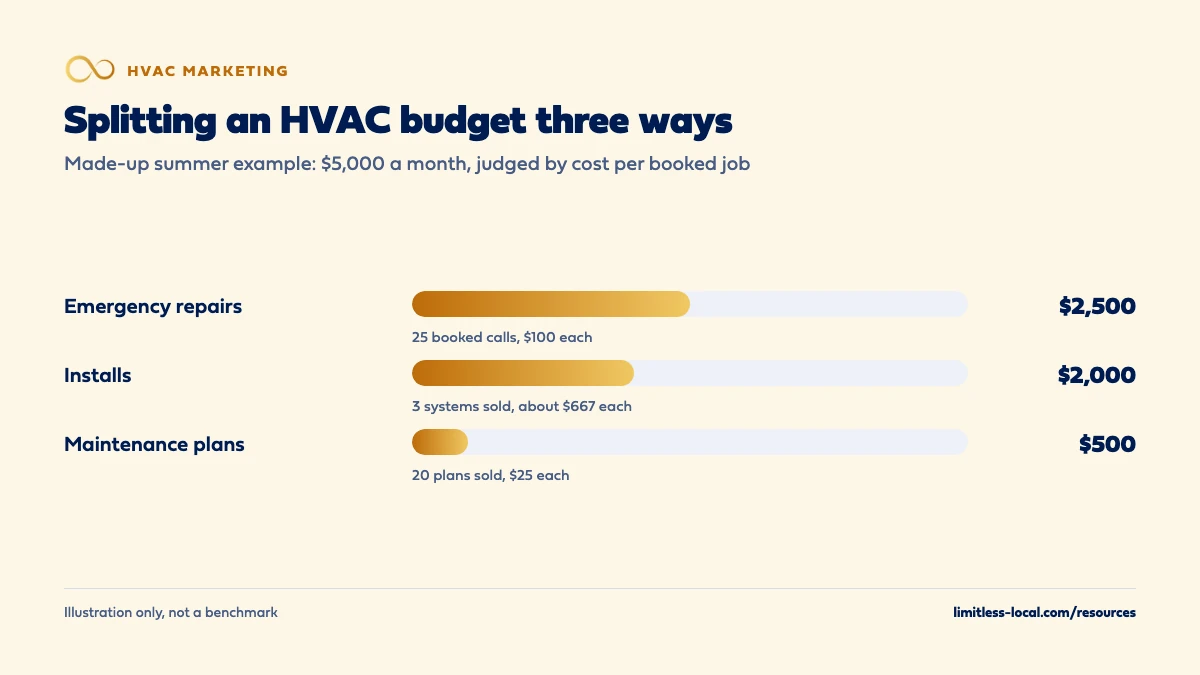
These numbers are made up to show the math, not a benchmark for your market. Say you have $5,000 a month for marketing in summer, split three ways:
- Emergency repairs, $2,500 in Google Ads: 25 booked repair calls, so $100 per booked job.
- Installs, $2,000 in Google Ads: 10 estimates booked, 3 systems sold, so about $667 per sold system.
- Maintenance plans, $500 for the texting tool and a tune-up offer: 20 plans sold, so $25 per plan.
The install bucket looks expensive per job, but if a sold system brings in far more than $667 in gross profit, it’s likely your best money. In October, you might move $1,000 from emergency to installs and maintenance, and judge again.
For management, our Growth package at $4,500 a month covers Google Ads spend at this level plus Local Services Ads; the ad spend itself is paid to Google separately.
Frequently asked questions
Should maintenance plans get any ad budget at all?
A little, for remarketing to people who’ve already visited your site or called you. Most of the work is your customer list and your techs offering the plan on every call.
Can one landing page serve emergency and install ads?
It works poorly. An emergency caller wants a phone number and a fast arrival time; a replacement shopper wants financing, reviews and an estimate. Give each its own page.
Do Local Services Ads belong in the emergency bucket?
Mostly, yes. Homeowners contact you straight from the ad, which suits urgent repair calls. Track whether some of those leads turn into replacements, too.
How often should I rebalance the buckets?
Look monthly, and move money when the season turns or one bucket’s cost per booked job clearly beats the others. Avoid reshuffling every week.
What about commercial HVAC work?
Treat it as its own bucket if you want it. It’s a different buyer and a longer sale, so it needs its own pages, ads and a longer window before you judge it.
Should I spend more on emergency calls in winter or summer?
Wherever your local demand peaks. In hot climates that’s summer AC; in cold ones, winter heating. Follow your own call history from last year.
Key takeaways
- Split by job value and urgency, not evenly.
- Give emergency, install and maintenance their own campaigns and budgets.
- Avoid shared budgets across different job types; emergency clicks can eat install money.
- Use conversion values so a booked replacement counts for more than a repair call.
- Judge each bucket on its own cost per booked job and rebalance as the season turns.
Want a second set of eyes on your setup?
We'll look at how you show up locally and where calls are leaking, then send you a plain-English breakdown.
More in this section
- How do I avoid wasting money on shared HVAC leads?
- Which HVAC services should I advertise first?
- How should an HVAC company split its marketing budget: ads vs website?
- Which HVAC marketing work should I outsource or keep in-house?
- When should I raise, lower or pause my HVAC ad spend?
Sources
- Set up an ad schedule — Google Ads Help
- About shared budgets — Google Ads Help
- About conversion values — Google Ads Help
- About average daily budgets — Google Ads Help
- About seasonality adjustments — Google Ads Help