
How should a pool builder advertise financing options?

- What's the right way for a pool company to promote financing in its ads?
- Why should a pool builder advertise financing at all?
- Step 1: What should I get from my lender before advertising financing?
- Step 2: Which financing phrases trigger extra disclosures?
- Step 3: If I show a payment, what else does the ad need?
- Step 4: How do I advertise "no interest" or "same as cash" offers?
- Step 5: What about home equity loans and other loans secured by the house?
- Step 6: What should a pool builder's financing page include?
- Step 7: What do Google and Meta require for financing ads?
- Step 8: When should financing come up in the sales process?
- What financing advertising mistakes should a pool builder avoid?
- What's different about financing ads for pool builders
- A worked example: a payment ad with and without the required terms
- Frequently asked questions
- Key takeaways
- More in this section
- Sources
The short version
- Lead with "financing available through [lender]", not a monthly payment.
- If an ad states a payment, a number of payments, a down payment or a finance charge, Regulation Z requires more terms, including the APR.
- "No interest" and "same as cash" offers need the deferred-interest conditions stated right next to them.
- Put full details on a financing page, use your lender's approved wording, and check Google's and Meta's financial ad rules.
For pool builders who want financing to open more conversations without putting a payment in an ad that breaks the disclosure rules.
Get a free visibility audit · Book a growth call
What's the right way for a pool company to promote financing in its ads?
A pool builder should advertise financing as a reason to start the conversation, not as the headline price: say financing is available through a named lending partner, explain how it works on a dedicated page, and raise it early in the sales process. Be careful with numbers, because under federal Regulation Z a credit ad that states a payment amount, the number of payments, a down payment or a finance charge must also state other terms, including the annual percentage rate, and “no interest” promotions carry their own disclosure rules. Get the exact wording from your lender, and check each ad platform’s rules for financial ads before you launch.
Financing messaging touches the ads, the landing page and the first call, which is why we plan them together. Our Google Ads and Meta ads work covers campaigns and the pages they send people to, and our pool builder marketing page shows how we approach a high-ticket, long-cycle sale. We don’t write credit disclosures or give legal advice; we build ads around the wording your lender approves. The rest of the pool builder marketing questions take the related steps one at a time.
Why should a pool builder advertise financing at all?
Because a pool is a large purchase and many households think about it as a monthly budget question, not a lump sum. In our view, a homeowner who doesn’t know financing is available may never call, and one who learns about it only after the proposal may stall for weeks while they figure it out.
Financing in your marketing does two jobs: it tells homeowners a pool may be within reach, and it starts the money conversation early. What it shouldn’t do is become the headline price, because a payment-led ad invites payment shoppers and carries disclosure rules. How to advertise a pool construction company covers where financing fits among your other channels; this page covers the wording.
Step 1: What should I get from my lender before advertising financing?
Their rules and their words. Before anything goes in an ad, ask your lending partner for:
- Approved marketing language, including any required disclosures and how their name and logo may be used.
- The terms they actually offer, and how often those change.
- How homeowners apply, so your website and your office can explain it the same way.
This matters because Regulation Z, in § 1026.24, says that if an ad for credit states specific credit terms, it may state only terms that actually are or will be arranged or offered by the creditor. Its official interpretation gives the example that a very low annual percentage rate that won’t actually be available can’t be advertised. A rate you saw in last year’s flyer, or a payment your lender stopped offering, doesn’t belong in this year’s ads.
This page is general information about published rules, not legal advice. Your lender or an attorney should approve the exact wording.
Step 2: Which financing phrases trigger extra disclosures?
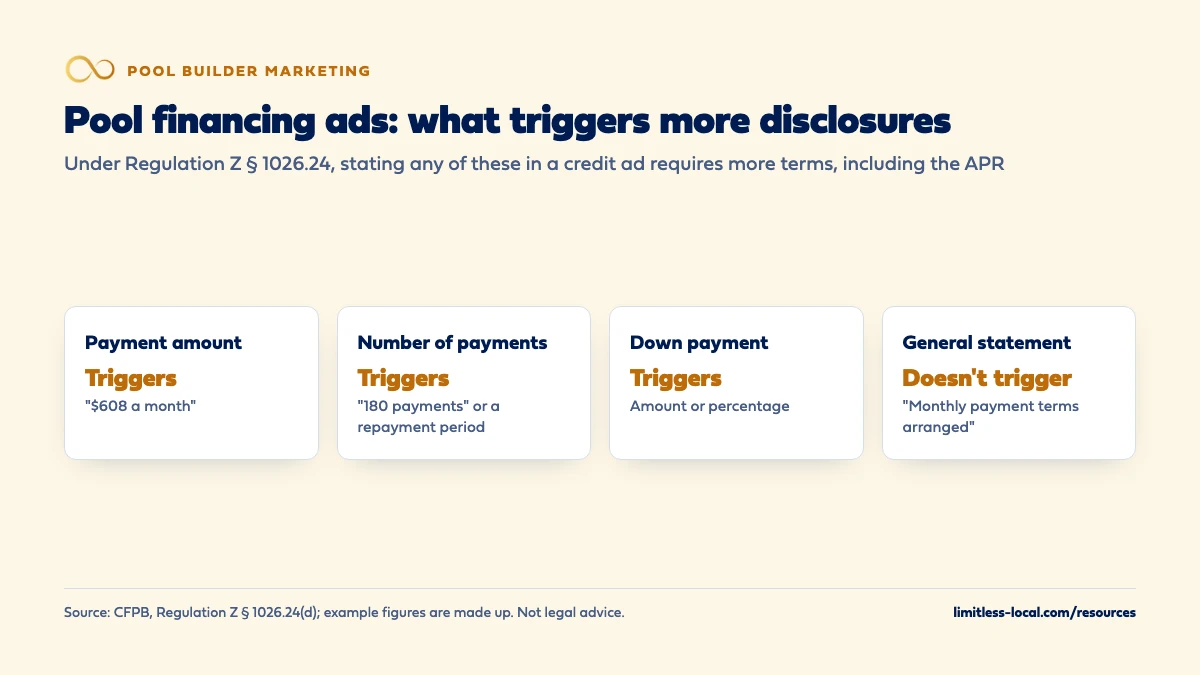
Under Regulation Z § 1026.24(d), four kinds of statements in a credit ad are “triggering terms” that require additional disclosures:
- the amount or percentage of any down payment
- the number of payments or period of repayment
- the amount of any payment
- the amount of any finance charge
The official interpretation adds two points pool builders should know. These rules apply even when a term isn’t stated outright but can be readily worked out from the ad. And general statements don’t trigger them: it lists phrases such as “monthly payment terms arranged” and “take years to repay” as not triggering, and says “regular monthly payments” is not a statement of a payment amount.
In practice, “Financing available through [lender]. Monthly payment options.” is a different kind of ad from “Your dream pool for a low monthly payment of” a dollar figure. The first starts a conversation. The second brings the full set of disclosures with it.
Step 3: If I show a payment, what else does the ad need?
The full set of terms the regulation lists. Under § 1026.24(d)(2), an ad that uses a triggering term must also state, as applicable, the amount or percentage of the down payment, the terms of repayment over the full term of the loan (including any balloon payment), and the “annual percentage rate,” using that term, along with the fact that the rate may increase after the loan is made, if it can.
The interpretation allows illustrative examples when a lender offers a range of terms, as long as each example includes all the applicable terms, is labeled as an example and reflects representative terms the creditor actually makes available. The worked example below shows what that looks like with made-up numbers.
In our judgement, most pool builders are better served keeping payment figures out of short ads altogether and putting a lender-approved example on the financing page, where there’s room to state it properly.
Curious what your marketing is actually booking?
Get a free visibility audit — no obligation, no sales pitch.
Step 4: How do I advertise "no interest" or "same as cash" offers?
Very carefully, because they come with their own rules. For open-end credit plans, such as a card or revolving line a lender may offer for a pool, Regulation Z § 1026.16(h) covers deferred interest offers. It says that if a deferred interest offer is advertised, the deferred interest period must be stated clearly and conspicuously, and if “no interest” or a similar phrase is used, the words “if paid in full” must come before the period. The ad must also say that interest will be charged from the date the homeowner became obligated if the balance isn’t paid in full within that period.
The official interpretation says that in written and electronic ads, that information has to sit in a prominent location close to the first “no interest,” “no payments,” “deferred interest” or “same as cash” statement, and that a footnote doesn’t count. It gives “no interest if paid in full within 6 months” as an example of compliant phrasing for the period. It also notes that for open-end credit, a negative reference such as “no interest” can itself trigger additional disclosures.
If your lender runs a promotion like this, use their wording exactly, and take it down the day the promotion ends.
Step 5: What about home equity loans and other loans secured by the house?
Expect stricter rules, and leave the wording to the lender. Some homeowners finance a pool with a loan secured by their home. Section 1026.24 has separate requirements for ads for credit secured by a dwelling, including extra disclosures when such an ad states a payment amount or a rate that will change over the loan, and a list of prohibited practices in those ads.
In our view, a pool builder has no reason to quote home equity rates or payments in its own marketing. Say that several ways to pay are available, name your lending partners if they allow it, and let the lender present its own products and disclosures.
Step 6: What should a pool builder's financing page include?
Everything a homeowner needs to understand how paying for a pool works with you, in plain words:
- Who the lending partners are, with links to their own terms and applications.
- How and when to apply, and how pre-approval fits with the design consultation and the proposal.
- How your payment schedule works: what’s due at signing and at each stage of the build.
- Any lender-approved example, with every required term, if you choose to show one.
Regulation Z also addresses longer and electronic ads. § 1026.24(e) says that a website ad can present the credit information in a table or schedule, as long as the table is clear and conspicuous and any triggering term elsewhere in the ad clearly points to where it is; the interpretation gives the example of a link that takes the homeowner straight to it. What a pool builder website should include covers where the financing page fits among your other pages.
Step 7: What do Google and Meta require for financing ads?
Check both before you launch, because each treats financial ads separately from ordinary pool ads.
- Google Ads. Google’s financial products and services policy says advertisers promoting financial products or services must comply with state and local regulations for every location their ads target, including disclosures required by local law, and must provide items such as the business’s physical address and all associated fees. Whether an ad that mentions a lender’s financing falls under it depends on what the ad promotes; when in doubt, ask Google support or your lender.
- Meta. Meta’s page on choosing a special ad category says that since January 21, 2025, the financial products and services category is required for those campaigns from advertisers based in, or showing ads to, the United States, and that ads may be rejected without it. Its page on audiences for those campaigns says you can’t target by ZIP code or exclude locations, and that city audiences in the US include a 15-mile radius.
That targeting limit matters for a pool builder who only builds in certain towns. In our judgement, a common answer is to keep regular Facebook and Instagram ads about your pools and process, and let financing appear on your site and in conversation. Whether Facebook and Instagram ads work for pool builders covers those campaigns more broadly.
Step 8: When should financing come up in the sales process?
On the first call, not after the proposal. Ask whether the homeowner plans to finance, and if they do, introduce your lending partner before the design consultation or right after it. A homeowner who gets pre-approved while you’re designing can sign when the proposal is ready; one who starts the application after the proposal often adds weeks to the decision.
Qualifying leads before the consultation covers how to ask about budget and financing without scaring anyone off, and turning consultations into signed contracts covers putting the payment schedule in the proposal.
What financing advertising mistakes should a pool builder avoid?
The ones we’d watch for most, in our judgement:
- A payment in the headline with no other terms. It’s the most common way a short ad picks up disclosure duties it doesn’t meet.
- “0%” or “no interest” without the conditions right next to it, or with the conditions in a footnote.
- Terms the lender doesn’t offer anymore, left running in an old ad, flyer or website banner.
- Promising approval. Never say everyone qualifies or that approval is guaranteed; that’s the lender’s decision, not yours.
- Leading every ad with financing. It can attract homeowners shopping for the lowest payment rather than the right builder. Stopping price shoppers covers that side.
The FTC’s advertising FAQ for small businesses is a useful reminder that additional laws apply to ads for specialized products, credit among them, and that every state has its own consumer protection laws for ads running there.
Not sure which of these is costing you jobs?
A free visibility audit checks the Google profile, reviews, site and tracking, and shows what to fix first.
What's different about financing ads for pool builders
The ticket is large and mostly one-time. Financing matters more for a pool than for a repair call, and homeowners often need it settled before they’ll sign.
You’re usually not the lender. Most pool builders work with one or more lending partners. That makes the lender’s approved wording, not your designer’s sales pitch, the source for any credit terms in an ad.
Home equity is often part of the picture. Loans secured by a home carry stricter advertising rules, which is one more reason to leave rates and payments to the lender.
Your service area is specific. Meta’s limits on targeting for financial products campaigns sit awkwardly with a builder who only works in a handful of towns, which shapes where financing messages belong.
Timing ties to the build calendar. A homeowner who wants to swim by summer needs financing settled well before the proposal is signed, so raising it early protects your schedule too.
A worked example: a payment ad with and without the required terms
These numbers are made up to show how the rule works, not any lender’s terms or a market rate. Say a lender offers a $60,000 loan with no down payment, 180 monthly payments and an 8.99% APR that doesn’t change. The monthly payment works out to about $608.
- Triggers disclosures but doesn’t meet them: “Your new pool for $608 a month.” It states the amount of a payment, a triggering term, and nothing else.
- States the terms the regulation lists: “Example: $608 a month for 180 months at 8.99% APR on a $60,000 loan with no down payment. Rate does not change. Subject to credit approval by [lender].” It labels the example and gives the down payment, the repayment terms and the APR.
- Doesn’t trigger: “Financing available through [lender]. Monthly payment options.”
The second version is long for a search ad or a yard sign, which is why, in our view, the third belongs in most ads and the second belongs on the financing page, in your lender’s wording. On our side, we build ads and landing pages around wording your lender approves; we don’t draft credit disclosures.
Frequently asked questions
Can I say "financing available" in my pool ads?
Yes. A general statement that financing is available, without a payment, number of payments, down payment or finance charge, isn’t one of Regulation Z’s triggering terms. Your lender may still have its own rules about naming them.
Does Regulation Z apply to me if I'm not the lender?
The rule is written about advertisements for credit, and the regulation’s examples refer to both creditors and sellers promoting credit terms. In our view, a pool builder should assume the rules apply to its ads and get wording from the lender or an attorney.
Can I put a monthly payment on a yard sign or truck wrap?
Only with the full set of required terms, which rarely fits. Under § 1026.24(d), a payment amount triggers disclosure of the down payment, repayment terms and APR. “Financing available” with a web address is the simpler choice.
Should financing be in my Google search ads?
It can appear as a general statement, if your lender agrees. Keep payment figures and “no interest” offers off short ads, and check Google’s financial products and services policy for anything that promotes the financing itself.
How do I tell whether advertising financing is bringing in contracts?
Record on each lead whether the homeowner planned to finance and where they came from, then compare signed contracts by source. Tracking which marketing produces signed contracts covers the setup.
Can I offer my own in-house payment plan?
A progress-payment schedule tied to stages of the build is common in contracting. If you’d be extending credit yourself, with interest or finance charges, get legal advice first; that brings lending rules into play that this page doesn’t cover.
Key takeaways
- Advertise financing as a conversation starter: “financing available through [lender]”, not a payment in the headline.
- Regulation Z’s triggering terms are a payment amount, number of payments, down payment or finance charge; any one requires the full terms, including the APR.
- “No interest” and “same as cash” offers need “if paid in full”, the period and the interest condition stated right next to them, not in a footnote.
- Put lender-approved details on a financing page, and raise financing on the first call.
- Meta requires a special ad category for financial products campaigns, with limited targeting; Google’s policy requires following local disclosure rules.
Want a second set of eyes on your setup?
We'll look at how you show up locally and where calls are leaking, then send you a plain-English breakdown.
More in this section
- How do I advertise a pool construction company?
- How can pool builders get referrals from landscapers and builders?
- How do pool builders stop attracting price shoppers?
- What should a pool builder website include to get more consultations?
- What keywords should a pool builder target?
Sources
- § 1026.24 Advertising (Regulation Z) — Consumer Financial Protection Bureau
- § 1026.16 Advertising (Regulation Z, open-end credit) — Consumer Financial Protection Bureau
- Financial products and services — Google Advertising Policies Help
- How to choose a Special Ad Category — Meta Business Help Center
- About audiences for housing, employment or financial products and services campaigns — Meta Business Help Center
- Advertising FAQ's: A Guide for Small Business — Federal Trade Commission