
How should a pool builder structure Google Ads campaigns?

- What's the right Google Ads campaign and ad group setup for a pool construction company?
- Why does campaign structure matter so much for a pool builder?
- How many campaigns should a pool builder run?
- How should I split ad groups inside a campaign?
- Which keyword match types should a pool builder use?
- Should each ad group send clicks to its own page?
- Should I split campaigns by town or service area?
- Where do negative keywords fit in the structure?
- Should a pool builder use Performance Max instead of Search campaigns?
- How should the budget be split across campaigns?
- How often should I change the structure?
- What's different about Google Ads structure for pool builders
- A worked example: one pool builder's account on paper
- Frequently asked questions
- Key takeaways
- More in this section
- Sources
The short version
- One Search campaign per line of work with its own budget: usually new construction and renovation.
- Split by area only when towns need a different budget or location setting.
- Ad groups with one narrow theme each, pointing to the matching page on your site.
- Phrase and exact match first; one shared negative keyword list across campaigns.
For pool builders setting up Google Ads, or untangling an account where new pools, renovations and service searches all run together.
Get a free visibility audit · Book a growth call
What's the right Google Ads campaign and ad group setup for a pool construction company?
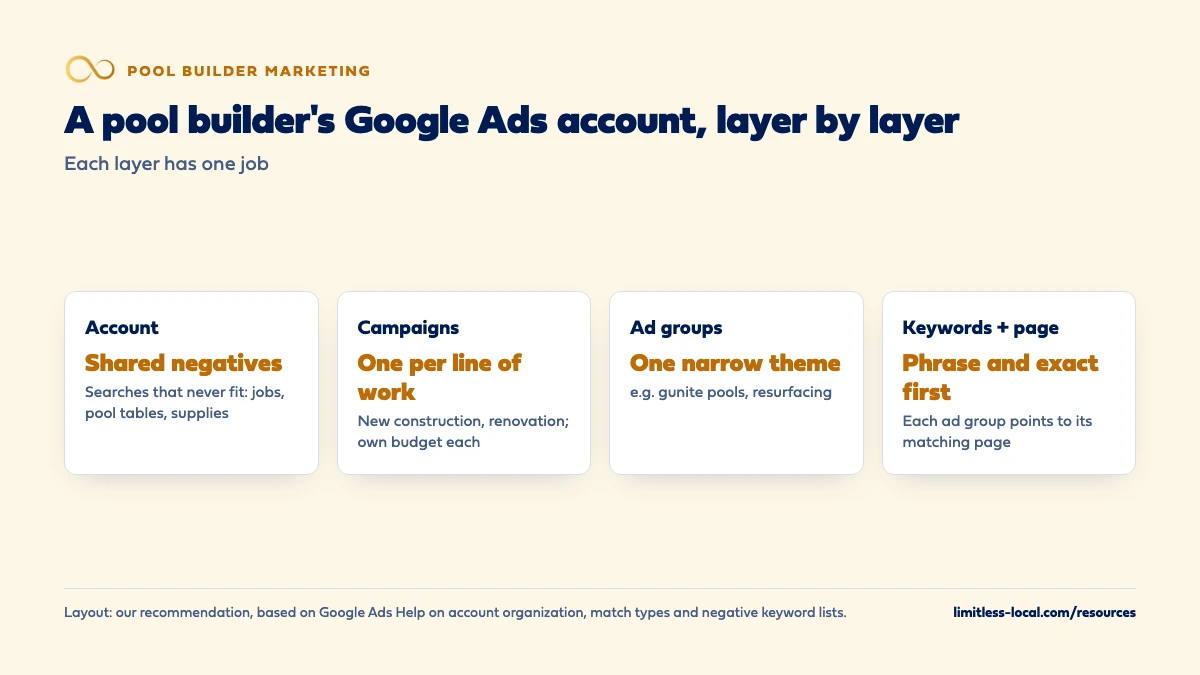
Build a separate Search campaign for each line of work that needs its own budget, which for most pool builders means new pool construction and renovation, and split a campaign by area only when a group of towns needs a different budget or location setting. Inside each campaign, keep ad groups to one narrow theme, such as pool builder searches with your town names, gunite pools or resurfacing, each sending clicks to the page that matches it. Start with phrase and exact match while your conversion data is thin, and keep the searches you never want in a negative keyword list shared across every campaign.
We set up and run Google Ads this way for local service businesses: campaigns built around the jobs you want, measured by consultations and signed contracts rather than clicks. Google Ads management is in every package on our local ads page: Essentials ($3,500 a month) covers up to $2,500 a month in ad spend and Growth ($4,500 a month) up to $5,000, with ad spend paid directly to Google. See how it fits with SEO and your website on our pool builder marketing page, or browse the rest of the pool builder marketing questions library.
Why does campaign structure matter so much for a pool builder?
Because the structure decides what you can control and what you can read. In Google Ads, budget and location targeting are set at the campaign level, so anything that needs its own budget or its own towns needs its own campaign. Ad groups sit inside campaigns and hold the keywords and ads for one theme.
For a pool builder the stakes are higher than for most trades. A campaign might produce a handful of signed contracts in a month, so if new pools, renovations and service searches are mixed in one campaign, you can’t tell which line of work is paying off. Google also warns that reorganizing campaigns and ad groups after you’ve built them wipes out the data you’ve accumulated, which can affect performance. It’s worth getting right before launch. Source: Organize your account with ad groups.
How many campaigns should a pool builder run?
As few as you can while still controlling the budget for each line of work. Google’s own rule of thumb: when you need a different budget or location targeting, create a separate campaign; when everything can share one budget and the same locations, one campaign is enough. Source: Organize your account with ad groups.
For most pool builders, in our judgement, that works out to:
- New pool construction. The main campaign and usually most of the budget.
- Renovation and resurfacing, if you do that work. Different searches, different pages, different contract values, so it gets its own budget.
- Your company name, optional. A small campaign for people searching your business by name, kept apart so it doesn’t make the other campaigns look better than they are.
- Research searches such as cost questions, only later and with a small budget, once the first campaign is working. Whether Google Ads are worth it covers why those come last.
If you don’t do service or repair, there’s no campaign for it at all; those searches belong in your negative keywords.
How should I split ad groups inside a campaign?
One narrow theme per ad group. Google recommends picking a narrow theme for each ad group, using keywords related to that theme, and mentioning at least one of the keywords in the ad’s headline. It also suggests using your website’s structure as a starting point, with each ad group representing a different page or category. Source: Organize your account with ad groups.
For a pool builder, that might look like this, using only the work you really do:
- New construction campaign: pool builder plus your town names, inground pool installation, custom gunite pools, fiberglass pool installation.
- Renovation campaign: pool resurfacing, pool remodel, pool tile and coping replacement.
Don’t build an ad group for a pool type you don’t install. The theme only works if the ad and the page can deliver what the search asked for, which is why a separate page per pool type helps; separate pages for each pool type covers when that’s worth it. For choosing the keywords themselves, see which keywords to target.
Which keyword match types should a pool builder use?
Google offers three. Broad match can show your ads on searches related to your keyword, including searches that don’t contain its direct meaning, and it’s the default. Phrase match shows ads on searches that include the meaning of your keyword. Exact match shows ads on searches with the same meaning or intent as the keyword, and Google says it gives you the most steering over who sees your ad while reaching the fewest searches.
Google also says it’s critical to use Smart Bidding with broad match, because broad match relies on bidding signals to compete only in the right auctions. That’s the catch for a pool builder: Smart Bidding learns from conversions, and a pool campaign produces few of them. In our judgement, start with phrase and exact match on your core ready-to-hire searches, watch the search terms report, and test broad match only once conversion tracking is solid and your bidding has enough consultations to learn from. Sources: About keyword matching options and About the search terms report.
Curious what your marketing is actually booking?
Get a free visibility audit — no obligation, no sales pitch.
Should each ad group send clicks to its own page?
Ideally, yes, or at least to the page that best matches the theme. A homeowner who searches for fiberglass pool installation and lands on a generic home page has to hunt for what they asked about. Google’s guidance to organize ad groups around the sections of your site points the same way: the ad group, the ad and the page should all be about the same thing. Source: Organize your account with ad groups.
Google also recommends at least three ads in each ad group with optimized ad rotation, so the system can test which message works. For a pool builder, in our judgement, the differences worth testing are the ones homeowners weigh: design process, financing, timeline and your own finished pools. Whether you need a dedicated landing page or can use your existing service pages is covered in landing pages for pool Google Ads.
Should I split campaigns by town or service area?
Only when the towns need different settings. Location targeting is set at the campaign level, so one campaign can cover every town you build in. In our judgement, a second campaign by area makes sense when:
- You have a second office or market with its own crews and its own budget.
- One area produces much bigger or more profitable builds and you want to fund it separately.
- One area needs a different location setting, such as reaching only people who are physically there.
Otherwise, splitting by town spreads a small number of conversions across many campaigns and makes each one harder to read. Put town names in your keywords and ads instead. The location settings themselves are covered in whether Google Ads are worth it. Source: Organize your account with ad groups.
Where do negative keywords fit in the structure?
At three levels, each for a different job:
- Account level, for searches that never fit any campaign. Google says an account-level negative keyword list applies to all eligible search and shopping inventory in your account, with a limit of 1,000 negative keywords.
- Shared negative keyword lists, for themes you apply to several campaigns. Google lets you add up to 5,000 negative keywords per list and create up to 20 lists, and a change to the list applies to every campaign that shares it.
- Campaign level, to keep your own campaigns apart. Adding renovation words such as resurfacing as negatives in the new construction campaign keeps those searches flowing to the renovation campaign and its page.
Google also notes that negative keywords don’t match close variants, so plurals and synonyms need adding by hand. Which terms belong on a pool builder’s lists is covered in negative keywords for pool builders. Sources: About negative keyword lists and About negative keywords.
Should a pool builder use Performance Max instead of Search campaigns?
Start with Search, in our judgement. Google describes Search campaigns as text ads on search results that reach people while they’re searching for what you offer, and suggests a leads goal if you have a longer sales cycle. Performance Max is a goal-based campaign type that reaches all Google Ads inventory from one campaign and is optimized by Google’s AI based on your conversion goals. Source: Choose the right campaign type.
Performance Max leans on conversion data to learn, and a pool builder’s data is thin, so it fits better once tracking is solid and Search is working. If you do run both, Google says a Search campaign’s exact match keyword that’s identical to the search is prioritized over Performance Max, and negative keywords at the account or campaign level apply to Performance Max on Search and Shopping inventory. Sources: About keyword matching options and Negative keywords in Performance Max campaigns.
How should the budget be split across campaigns?
By what each line of work is worth to you and how much of it you can build. Because each campaign has its own budget, the structure lets you fund new construction and renovation separately instead of letting one quietly eat the other. In our judgement:
- Give the new construction campaign enough to produce a steady number of consultations, since it usually carries the biggest contracts.
- Size the renovation campaign to the renovation work your crews can take on.
- Keep the company-name campaign small; those searchers already know you.
- Lower or pause a campaign when that crew’s calendar is full, rather than cutting everything.
There’s no honest national number for any of these, because click costs depend on your market. The whole-budget question is covered in whether Google Ads are worth it for pool builders.
How often should I change the structure?
Rarely. Change the keywords, ads and negatives inside it often. Because Google says reorganizing wipes out the data you’ve accumulated, set the campaigns up once around your lines of work and leave them. The ongoing work happens inside: adding negative keywords from the search terms report, pausing keywords that bring the wrong searches, and testing ads.
In our judgement, add a new ad group when the search terms report shows a theme you serve that’s getting enough searches to deserve its own ads and page, and add a new campaign only when a line of work or an area needs its own budget. The search terms report is also where you’ll spot the themes to block; Google notes that some low-volume search terms are left out of the report for privacy, so it won’t show you everything. Sources: Organize your account with ad groups and About the search terms report.
Not sure which of these is costing you jobs?
A free visibility audit checks the Google profile, reviews, site and tracking, and shows what to fix first.
What's different about Google Ads structure for pool builders
Few conversions, so fewer campaigns. A trade that books dozens of jobs a week can afford to split campaigns finely. A pool builder can’t; every split divides a small number of consultations into smaller piles that tell you less.
New builds and renovations are different businesses. Different searches, different pages and very different contract values. Keeping them in separate campaigns is the one split nearly every pool builder needs, in our judgement.
The word pool attracts everyone. Searches for cleaning, supplies, above-ground kits, jobs and pool tables all contain your main word, so the negative keyword lists are part of the structure, not an afterthought.
Seasons move the budget, not the structure. Demand shifts through the year, so expect to change campaign budgets by season. The campaigns themselves can stay the same year-round, which keeps the data comparable from one season to the next.
A worked example: one pool builder's account on paper
These numbers are made up to show the layout and the math, not a benchmark or a recommended budget. Say a builder does new gunite and fiberglass pools plus resurfacing in eight towns, and plans $3,000 a month in ad spend.
- Account-level negatives: jobs, pool tables, public pools, supplies and chemicals.
- Campaign 1, new pool construction, $2,100 a month: ad groups for pool builder plus town names, custom gunite pools and fiberglass pool installation, each pointing to its own page. Campaign negatives: resurfacing, remodel, replaster.
- Campaign 2, renovation, $750 a month: ad groups for pool resurfacing and pool remodel, pointing to the renovation page.
- Campaign 3, company name, $150 a month: one ad group for the business name.
That’s $2,100 + $750 + $150 = $3,000, or 70% of spend on new construction, 25% on renovation and 5% on the company name. If the renovation crew books out for the summer, the builder lowers campaign 2 and leaves campaign 1 alone. And because each campaign tracks its own consultations, the builder can see which line of work is producing signed contracts; tracking which marketing produces signed contracts covers how.
Frequently asked questions
Should I put every town in its own ad group?
Usually not. In our judgement, one ad group for pool builder plus town names keeps your data together; split a town out only if it needs its own ad or page.
Do I need a separate campaign for mobile phones?
Not as a starting point. Google’s rule of thumb for a separate campaign is a different budget or location targeting; in our judgement, device alone rarely justifies splitting a pool builder’s small number of conversions.
Should I bid on competitors' names?
We’d leave it out of a starting structure. It brings in people looking for a specific other builder, and in our judgement the money does more on your own ready-to-hire searches.
How many keywords should each ad group have?
Google doesn’t set a number. In our judgement, enough to cover the ways homeowners phrase that one theme, and no more; if a keyword needs a different ad or page, it belongs in a different ad group.
Can I copy the structure an HVAC or plumbing company uses?
Not directly. Those trades run many short jobs and lean on emergency calls. A pool builder has fewer, bigger contracts and a long sales cycle, which is why fewer, simpler campaigns usually read better.
What about Local Services Ads?
They’re a separate Google product with their own setup, outside this campaign structure. See whether Local Services Ads are worth it for pool builders.
Key takeaways
- Create a separate campaign only when something needs its own budget or location targeting.
- For most pool builders that means separate new construction and renovation campaigns.
- Keep each ad group to one narrow theme with ads and a page that match it.
- Start with phrase and exact match; test broad match only once conversion data is solid.
- Use account-level, shared and campaign-level negatives, and change the structure rarely.
Want a second set of eyes on your setup?
We'll look at how you show up locally and where calls are leaking, then send you a plain-English breakdown.
More in this section
- Are Google Ads worth it for pool builders?
- Do pool builders need a separate landing page for Google Ads?
- How should a pool builder set up its Google service area?
- What negative keywords should pool builders add in Google Ads?
- Which Google Business Profile categories should a pool builder use?
Sources
- Organize your account with ad groups — Google Ads Help
- About keyword matching options — Google Ads Help
- Choose the right campaign type — Google Ads Help
- About negative keyword lists — Google Ads Help
- About negative keywords — Google Ads Help
- About the search terms report — Google Ads Help
- Negative keywords in Performance Max campaigns — Google Ads Help