
How do I recover after a run of bad reviews on my HVAC company?
- What should an HVAC owner do after several bad Google reviews in a row?
- What should I do first when several bad reviews land at once?
- How do I tell a real complaint pattern from a review attack?
- Which bad reviews will Google actually remove?
- How do I report reviews that break Google's rules?
- What if someone wants money to take the bad reviews down?
- How should I reply to a run of bad reviews?
- Can I ask an unhappy customer to change their review?
- How do I fix what caused the bad reviews in the first place?
- How do I rebuild my rating without breaking Google's rules?
- What should I never do to recover from bad reviews?
- How will I know the recovery is working?
- What's different about bad reviews for HVAC companies
- A worked example: how many new reviews it takes to recover your rating
- Frequently asked questions
- Key takeaways
- More in this section
- Sources
The short version
- Sort the reviews into real complaints, unfair ones and fakes before you do anything.
- Google removes reviews only when they break its policies, not because you disagree.
- Reply calmly, fix the cause, and contact unhappy customers privately without offering anything for a change.
- Rebuild your average with new reviews from every customer, never bought or filtered ones.
For HVAC owners who just watched a handful of one-star reviews land on their Google profile and want a plan, not a panic.
Get a free visibility audit · Book a growth call
What should an HVAC owner do after several bad Google reviews in a row?
Sort the bad reviews first: real customers with a real complaint, real customers being unfair, and reviews that aren’t from customers at all. Reply calmly to the real ones and fix what caused them, report only the reviews that break Google’s policies, and use Google’s extortion report if someone is demanding money to take reviews down. Then rebuild by asking every customer on every job for an honest review, because a steady flow of new reviews is what moves your average back up. Buying reviews can get your profile restricted, and asking only happy customers breaks Google’s rules.
Recovering from a bad stretch is mostly operations and patience, and part of it is steady profile work: replying to reviews and keeping new ones coming in. Review response and review generation are part of our local SEO work in every HVAC marketing package. The HVAC marketing guide shows where reviews fit among the other channels, and the rest of the HVAC marketing questions library goes question by question.
What should I do first when several bad reviews land at once?
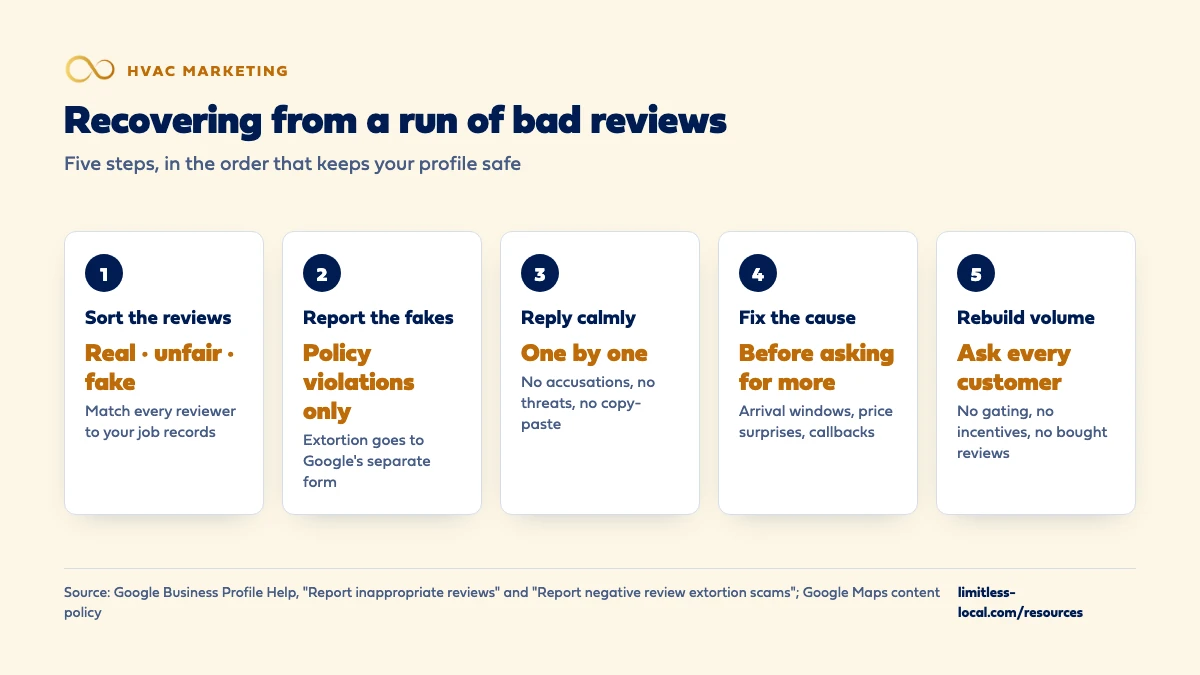
Don’t reply to anything yet. Read every new review, then check each reviewer’s name and details against your job software, whether that’s ServiceTitan, Housecall Pro or Jobber. In our judgement, almost every run of bad reviews breaks down into three piles, and each pile has a different fix:
- Real customers with a real complaint. A missed appointment, a surprise on the invoice, a callback that took a week. These need a reply and a fix in the business.
- Real customers being unfair. They’re angry about something outside your control, or the story is one-sided. These need a calm, factual reply, not a removal request.
- Not customers at all. No matching job, an ex-employee, a competitor, or a wave of one-star ratings followed by a message asking for money. These are the only ones worth reporting to Google.
Sorting first stops the two most common mistakes: arguing with real customers in public, and flagging honest reviews that Google will leave up anyway.
How do I tell a real complaint pattern from a review attack?
A real pattern usually repeats a specific problem from real jobs: the same week, the same kind of call, often the same complaint in different words. A review attack tends to look different. Google says negative review extortion scams may involve a sudden increase in 1-star and 2-star reviews, followed by someone demanding money, goods or services to remove them.
Signs worth a closer look, in our judgement: reviewers you can’t match to any job, several reviews posted within hours, and ratings with no details about the work. None proves a review is fake on its own, but together they’re the evidence you’d collect. Source: Report negative review extortion scams on your Business Profile.
Which bad reviews will Google actually remove?
Only reviews that break its policies. Google says you can report any review, but only those that violate its policies are eligible for removal, and it asks you not to report a review just because you disagree with it or dislike it. It also says plainly that it doesn’t get involved in conflicts between businesses and customers.
The policies that most often fit a bad run on an HVAC profile:
- Fake engagement. Content that isn’t based on a real experience, posted from several accounts by one person, or posted on a competitor’s business to undermine its reputation.
- Conflict of interest. Google’s policy says this can include current or former employment, so a review from a tech you let go qualifies.
- Off-topic. Personal rants or general commentary that aren’t about an experience with your business.
- Harassment. Threats against your staff, or posting someone’s private details.
A customer who says your tech was rude and your price was too high is describing an experience. That review is going to stay, and the reply is where you deal with it. Sources: Report inappropriate reviews on your Business Profile and Prohibited & restricted content.
How do I report reviews that break Google's rules?
Two routes. From your Business Profile, open your reviews, select Report next to the review and pick the reason, such as Spam. Or use Google’s Reviews Management Tool, which also lets you check the status of each report. Google says evaluation typically takes several days, and the status will read Decision pending or Report reviewed – no policy violation (or Escalated once you appeal).
If a report comes back with no violation found and you still disagree, Google allows a one-time appeal through the same tool, and you can select up to 10 reviews in that appeal. Save it for reviews where you have something new to show, such as no record of the person as a customer. Source: Report inappropriate reviews on your Business Profile.
What if someone wants money to take the bad reviews down?
That’s extortion, and Google treats it as a serious policy violation. Its instructions are direct: don’t engage with or pay the people involved, because paying can encourage more attempts and doesn’t guarantee the reviews come down, and don’t try to settle it yourself by offering money or services. Report it through Google’s merchant extortion report form instead.
Google asks for evidence, and the sooner you gather it the better:
- Screenshots of every demand, showing the date, time and sender details, whether it came by email, text, WhatsApp or social media.
- Direct links to each suspicious review. You can copy a link to any review from Google Maps.
- Any names, usernames, emails or phone numbers tied to the demand.
- When you first noticed the jump in bad reviews, and when the demand arrived.
This channel is only for cases with a real demand; spam reviews without one go through the normal report. Sources: Report negative review extortion scams and Manage customer reviews.
Curious what your marketing is actually booking?
Get a free visibility audit — no obligation, no sales pitch.
How should I reply to a run of bad reviews?
One at a time, in your own words, and after you’ve cooled off. Google’s own tips for replying to negative reviews, and how they apply on an HVAC profile, are covered in optimizing your HVAC Google profile. A bad run adds one risk of its own: in our judgement, six near-identical replies in one week read like a form letter, so write each one about that job.
Federal rules set a few hard lines too. The FTC says you can respond publicly to a negative review, but you shouldn’t falsely accuse the reviewer, use threats or intimidation to get it changed, or threaten legal action without a legitimate basis. For reviews you believe are fake, a short, neutral reply such as “We can’t find a record of this job; please call the office so we can look into it” is safer than calling the person a liar. That wording is our suggestion. Source: The Consumer Reviews and Testimonials Rule: Questions and Answers.
Can I ask an unhappy customer to change their review?
You can contact them and fix the problem. The FTC says its review rule doesn’t stop a business from contacting customers who post negative reviews to resolve the issue. Google says constructive replies and following up on concerns may even encourage the customer to update their review, and customers can still change their review after reading your reply.
What you can’t do is attach anything to the change. Google’s policy doesn’t allow offering incentives, such as payment, discounts or free service, in exchange for revising or removing a negative review. The FTC adds that paying customers to change or remove truthful negative reviews may violate federal law. So send the tech back, refund the diagnostic fee if it’s fair, and let the customer decide on their own whether to update the review. Don’t make the fix depend on the edit. Sources: FTC Consumer Reviews Rule Q&A, Tips to get more reviews and Google Maps content policy.
How do I fix what caused the bad reviews in the first place?
Treat the real complaints as a report on your operations. Pull the jobs behind them and look for the common thread. In our experience, HVAC complaints cluster around a short list:
- Arrival windows. No call when the tech is running late, or a no-show with no follow-up.
- Price surprises. The diagnostic fee wasn’t mentioned on the phone, or the repair quote landed well above what the office said.
- Callbacks. The same problem came back and the return visit took days.
- Communication on installs. Mess left behind, permits or rebates not explained, nobody calling after the job.
Fix the cause before you push hard for new reviews. Asking every customer for a review while the same problem is still happening just produces more of the same reviews. If the complaints are really about the phone, such as calls that went unanswered or nobody calling back, finding where leads are leaking is the next step.
How do I rebuild my rating without breaking Google's rules?
Volume of honest reviews. Your Google review score is the average of all ratings published on Google, so the only lasting way to move it is more ratings from real customers. Google lets you ask every customer, gives you a review link and QR code to share, and suggests putting them on receipts and in thank-you emails.
The rules matter more right after a bad stretch, because that’s when owners are tempted to cut corners. Google doesn’t allow businesses to discourage negative reviews or selectively ask only happy customers, to pressure customers to review on the spot, or to offer anything in exchange for a review. Ask every customer on every completed job, the same way. Getting your techs to ask for reviews covers the script, the timing and how to measure the ask. Sources: Understand review scores, Tips to get more reviews and Google Maps content policy.
What should I never do to recover from bad reviews?
A few shortcuts make a bad month much worse:
- Buying reviews or using a service that promises a flood of five-stars. Google removes fake reviews and can restrict the profile: blocking new reviews for a set period, unpublishing existing reviews for a set period, or showing customers a warning that fake reviews were removed.
- Having staff, family or friends post reviews. Google’s policy treats current or former employment and family relationships as a conflict of interest.
- Review gating. Sending the review link only to customers who said they were happy is selective solicitation, which Google doesn’t allow.
- Paying an angry customer to delete their review. It breaks Google’s incentive rule and, per the FTC, may violate federal law.
Each one can turn a rating problem into a profile problem. Sources: Business Profile restrictions for policy violations and Prohibited & restricted content.
How will I know the recovery is working?
Watch four numbers once a month, not every morning: new Google reviews, your average rating, how many of the new bad reviews repeat an old complaint, and the share of completed jobs where your team asked for a review. Google says a new review can take up to 2 weeks to show in your score, so day-to-day checks mostly measure noise.
The last two are the ones you control; the rating follows them. Whether the recovery is bringing the phone back is a separate question; how much reviews affect HVAC calls shows how to read profile views and calls side by side. And if you’re wondering where your review count should be once you’re back on track, how many reviews an HVAC company needs covers that. Source: Understand review scores for local places & businesses.
Not sure which of these is costing you jobs?
A free visibility audit checks the Google profile, reviews, site and tracking, and shows what to fix first.
What's different about bad reviews for HVAC companies
Peak season makes the bad runs. The first heat wave stretches arrival windows, swamps the office and pushes non-urgent calls back days. In our judgement, a cluster of bad reviews in June or January is often a capacity problem, not a quality one, and the fix is in scheduling and call handling before the next rush.
Replacement quotes sting. A homeowner who expected a repair and got a replacement quote may review the price, not the work.
No-heat and no-cool customers are stressed. Someone who waited all night for a tech writes a harsher review than someone whose tune-up ran late.
Maintenance members are a natural restart. In our judgement, customers you see twice a year are good people to ask first when review requests resume, as long as you ask every member, not just the ones you think are happy.
A worked example: how many new reviews it takes to recover your rating
These numbers are made up to show the math, not a benchmark for your market. Say your profile had 80 reviews averaging 4.6 stars, which works out to 368 total stars. Then a bad week brings six 1-star reviews. You now have 86 reviews and 374 stars, and your average drops to about 4.3.
To get back to 4.5, you need enough new reviews to lift the average. If every new review were five stars, it would take 26 more (374 plus 130 stars, divided by 112 reviews, is 4.5). New reviews won’t all be fives; if they average 4.8, it takes about 44. At ten new reviews a month, that’s somewhere around three to five months of steady asking.
Two things change that math. If any of the six were fake and Google removes them, the average recovers without new reviews. And if the problem behind the real ones keeps happening, more bad reviews keep landing while you rebuild. Review response and basic review generation are included in our Essentials package at $3,500 a month, which also covers Google Business Profile management; a free visibility audit is the place to see where your profile stands now.
Frequently asked questions
Can I delete a bad Google review myself?
No. A business can reply to a review and report it, but Google decides what comes down, and only reviews that break its policies are eligible for removal. The customer who wrote it can still change it after reading your reply.
How long does Google take to look at a review I reported?
Google says review evaluation typically takes several days. You can check each report’s status in the Reviews Management Tool.
Will a few bad reviews hurt my ranking in Maps?
Google says more reviews and positive ratings can help your local ranking, so a lower average doesn’t help. It doesn’t publish how much one bad stretch moves you. Source: Tips to improve your local ranking on Google.
Should I sue someone over a fake review?
That’s a question for a lawyer, not a marketing page. The FTC says a business can threaten legal action only when it has a legitimate basis, and can’t use groundless legal threats to get a review removed.
Can I start a new Google profile to get rid of the bad reviews?
No. Google’s guidelines say there should only be one profile per business. In our judgement it would also throw away every good review you’ve earned. Source: Guidelines for representing your business on Google.
Key takeaways
- Sort bad reviews into real complaints, unfair ones and fakes before replying or reporting.
- Google removes reviews only for policy violations; extortion has its own report form, and you should never pay.
- Reply calmly and contact unhappy customers privately, but never offer anything for a changed review.
- Fix the operational cause before pushing hard for new reviews.
- Your rating is an average, so honest volume from every customer is the only lasting recovery.
Want a second set of eyes on your setup?
We'll look at how you show up locally and where calls are leaking, then send you a plain-English breakdown.
More in this section
- How do I make my HVAC company look trustworthy online?
- How much do Google reviews affect calls to my HVAC company?
- How many Google reviews does my HVAC company need?
- How do I get my HVAC techs to ask customers for Google reviews?
- How do I fix my HVAC company's name, address and phone online?
Sources
- Report inappropriate reviews on your Business Profile — Google Business Profile Help
- Report negative review extortion scams on your Business Profile — Google Business Profile Help
- Prohibited & restricted content — Maps User Generated Content Policy Help
- Tips to get more reviews — Google Business Profile Help
- Manage customer reviews — Google Business Profile Help
- Understand review scores for local places & businesses — Google Business Profile Help
- Business Profile restrictions for policy violations — Google Business Profile Help
- The Consumer Reviews and Testimonials Rule: Questions and Answers — Federal Trade Commission