
How should a roofer split budget between Google Ads and LSAs?

- How much of a roofing ad budget should go to Local Services Ads versus Google search ads?
- Why not just split a roofing ad budget 50/50?
- How much should go to Local Services Ads first?
- What should the Google Ads share go after?
- How do I compare an LSA lead with a Google Ads click?
- When should I move money from Google Ads to LSAs?
- When should I move money from LSAs to Google Ads?
- How should the split change in storm season?
- What if my LSA campaign pauses or my account moves?
- Should LSAs and Google Ads share one budget?
- How often should a roofer change the split?
- What's different about splitting ad budget for roofers
- A worked example: reading a month and moving the split
- Frequently asked questions
- Key takeaways
- More in this section
- Sources
The short version
- Fund Local Services Ads first, to roughly the level Google's bidding help recommends, if you're verified and have reviews.
- Use search ads for the jobs and towns you want more of, because Local Services Ads target categories and areas, not keywords.
- Compare the two by cost per signed roof, never cost per lead against cost per click.
- Move money only toward a channel that is both cheaper per signed job and able to spend more.
For roofing owners running, or about to run, both Local Services Ads and Google search ads from one monthly paid budget.
Get a free visibility audit · Book a growth call
How much of a roofing ad budget should go to Local Services Ads versus Google search ads?
Give Local Services Ads enough budget to run properly in the towns you most want, then put the rest into Google Ads search campaigns aimed at the specific jobs Local Services Ads can’t target by keyword, such as full replacements. After that, move money toward whichever channel signs roofs at the lower cost, but only if that channel can actually spend more. No fixed percentage suits every roofer; the split should follow cost per signed job, not a rule of thumb.
Cost per signed roof is the number to split by, whoever runs the two channels. Local Services Ads and Google Ads management sit together in our local ads work in the Growth and Scale tiers of our roofing marketing packages. If you’re still deciding whether search ads belong in the mix at all, whether Google Ads are worth it for roofers covers that comparison, and the rest of the roofing marketing questions library goes question by question.
Why not just split a roofing ad budget 50/50?
Because the two channels charge differently and do different jobs, so an even split gives each one a number without a reason behind it. Local Services Ads charge per valid lead: an answered call, a missed call during business hours where the caller stays on more than 20 seconds, a message or a booking request (How leads work). Google Ads search campaigns charge per click, and only some of those clicks turn into a call or a form.
They also reach homeowners differently. Local Services Ads are targeted by service category, job type and area rather than keywords (Local Services Ads transition to Performance Max). Search ads let you choose the keywords you pay for and the page the homeowner lands on. A good split puts each dollar where it does its job best, then lets results move it.
How much should go to Local Services Ads first?
Enough for them to work, if you’re ready to run them. Google’s bidding help for Local Services Ads recommends a minimum budget of 10 leads per week when you use its Maximize leads setting, and says a higher budget means more leads you could get (How bidding works for Local Services Ads). Multiply 10 by what a lead costs in your area, and you have a weekly starting point for the LSA side. Google also says it takes about 2 weeks to see accurate results as its bidding model learns your business.
Two catches. First, after your account moves into Google Ads, weekly budgets become daily ones: Google divides your average weekly budget by 7, and your monthly spend is capped at the daily average times 30.4 (Local Services Ads transition to Performance Max). The bidding guidance was written for the old weekly setup, so treat it as a starting point. Second, you have to be screened before Local Services Ads run at all, and Google says that takes 3 to 4 weeks on average after you submit your documents (Business screening and verification requirements). Until then, search ads carry the whole budget. Whether LSAs are worth it for roofers covers what has to be in place first.
What should the Google Ads share go after?
The work you want more of that Local Services Ads can’t aim at precisely. In our judgement, for most roofers that means:
- Replacement searches, written into keywords and ads that say replacement, so the click is already the job you want.
- Specific roof types you install, like metal or flat roofs, where the homeowner searches by name.
- Towns you want to grow into, at a separate budget you can watch on its own.
Search ads also need guardrails Local Services Ads don’t. Every click costs money whether or not it’s a homeowner who needs a roofer, so add the searches you never want, like jobs, supplies and DIY how-tos, as negative keywords for roofing ads before you add budget.
How do I compare an LSA lead with a Google Ads click?
You don’t compare them directly. A lead and a click are different units, so take both down to the same one: cost per signed roof.
- Local Services Ads: spend divided by charged leads gives cost per lead. In Google Ads, Conversions shows the leads you were charged for and Cost / conv. shows your average cost per lead (Local Services Ads transition to Performance Max).
- Search ads: spend divided by the calls and forms those clicks produced gives cost per lead on the same footing.
- Both: divide each channel’s spend by the roofs it signed.
That last step needs every lead tagged with where it came from, and followed through inspection and estimate to a signature. If you can’t do that yet, tracking which leads become signed jobs comes before any change to the split.
Curious what your marketing is actually booking?
Get a free visibility audit — no obligation, no sales pitch.
When should I move money from Google Ads to LSAs?
When both of these are true:
- Local Services Ads are signing roofs at a lower cost than search ads, over a period long enough to trust.
- The LSA campaign is spending its full budget, so more budget can buy more leads.
The second test matters. If the campaign isn’t spending what you’ve already given it, there may not be more leads to buy at your settings in your area, and extra budget will sit unused. Also move money toward Local Services Ads when search clicks aren’t turning into calls; why ads get clicks but no calls covers the usual causes, and it’s worth fixing those before you decide search can’t work.
When should I move money from LSAs to Google Ads?
Shift the other way when:
- Local Services Ads can’t spend more in the areas you serve. Google says tightening service areas, job types and categories to cut unwanted leads could reduce the number of leads you receive (About Automated Local Services Ads lead credits), so a well-trimmed account can hit a ceiling.
- Your LSA leads skew toward small repairs while you want replacements, and job type settings haven’t fixed it.
- Search campaigns that are signing roofs show Limited by budget, which Google uses when a campaign is underperforming because its budget is limited (Fix “Limited by budget” status).
In each case, the next dollar does more on the search side than it would on the LSA side.
How should the split change in storm season?
Raise the total before you change the split. After hail or high wind, both channels get busier at once. On the LSA side, daily spend can run higher on high-demand days while the month stays capped at your daily average times 30.4 (Local Services Ads transition to Performance Max). On the search side, storm-damage searches can arrive faster than a small campaign can pay for.
What not to do is widen your LSA service area to chase a storm two counties over. Google no longer gives credits for leads about a job type you don’t service or an area you don’t serve (About Automated Local Services Ads lead credits), so those leads are yours to pay for. If you want storm work outside your normal towns, a separate search campaign with its own budget is easier to switch on and off. How roofing ad budgets change from storm season to winter covers the full seasonal swing.
What if my LSA campaign pauses or my account moves?
Plan for gaps. After the move into Google Ads, your business name, address and hours sync one way from your Google Business Profile, and significant updates to your business name, storefront address or primary category trigger a verification review that typically takes 24 to 48 hours, during which your campaign may pause (Local Services Ads transition to Performance Max). Your old performance reports also don’t carry over, so save them before the move if you want to keep comparing.
While the LSA side is paused, in our judgement it makes sense to let the search side carry more of the budget for those days rather than leave the money idle, then move it back once leads resume.
Should LSAs and Google Ads share one budget?
In our judgement, keep them separate. Each campaign in Google Ads has its own average daily budget, and keeping the Local Services Ads campaign and your search campaigns on separate budgets means you can see exactly what each spent, which is the only way to work out cost per signed roof by channel. A single pot hides which side earned the next dollar.
Separate budgets also make seasonal moves cleaner. You can raise the search budget for storm-damage searches without changing what Local Services Ads spend, or pause one channel while the other keeps running.
How often should a roofer change the split?
Monthly at most, and one change at a time. Google says Local Services Ads take about 2 weeks to show accurate results after a bidding change (How bidding works for Local Services Ads), and a roofing lead can take weeks more to become a signed contract after the inspection and estimate. Changing the split every week means judging each change before it has had time to show anything.
A steadier routine: review cost per signed roof by channel once a month, move a modest share of budget toward the stronger channel if it can spend more, then leave it alone until the next review. For a small budget, whether $1,000 a month is enough explains why one channel at a time is often the better start.
Talk it through with someone who runs this every day
A 15-minute growth call: your market, your numbers, and what a realistic budget looks like. No pressure.
What's different about splitting ad budget for roofers
Repairs and replacements arrive through the same door. Google describes roofing professionals as installing, repairing and maintaining shingles, gutters and venting (Business screening and verification requirements). Local Services Ads will send you all of it unless you set job types deliberately. Search ads are where a roofer can aim money squarely at replacements.
“Roofer near me” searches. Local Services Ads opt you into your industry’s general category searches by default, the ones that don’t name a specific service, and you can opt out (Edit your industries, service areas, and job types). Those broad searches can bring volume and a mixed bag of jobs; whether to keep them on is a split decision in itself.
Reviews move the LSA side. Your rating, number of reviews and response time feed Local Services Ads profile quality, and Google says higher-quality profiles may rank higher and may pay lower costs per lead (About ad rankings). A roofer with few reviews may find search ads do more with the next dollar until the reviews catch up.
Long sales cycles. Inspections, estimates and sometimes insurance adjusters stretch the time from lead to signature, so judge the split over months, not weeks.
A worked example: reading a month and moving the split
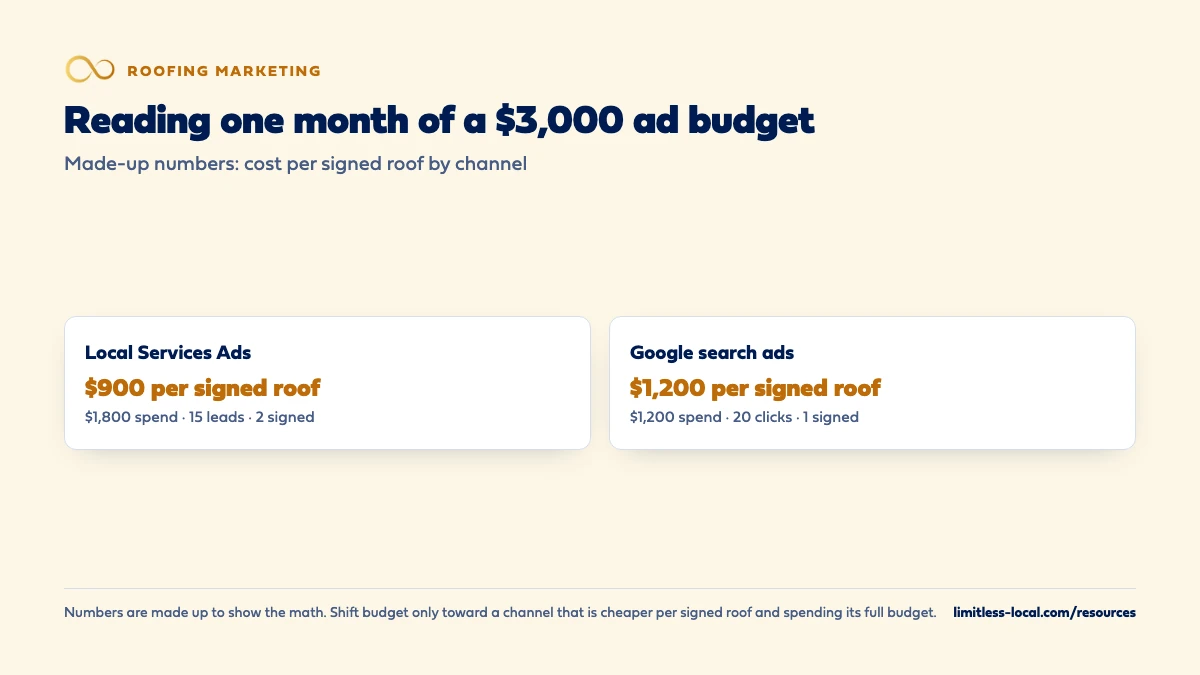
These numbers are made up to show the math, not a benchmark for your market. Say a roofer has $3,000 a month for paid ads and starts with $1,800 on Local Services Ads and $1,200 on search ads.
- Local Services Ads: 15 charged leads at $120 each. Two sign. Cost per signed roof: $1,800 divided by 2, or $900.
- Search ads: 20 clicks at $60 each bring 4 calls and forms. One signs. Cost per signed roof: the full $1,200.
Local Services Ads look cheaper per signed roof. Before moving money, check the second test: did the LSA campaign spend its full budget? If it did, moving $300 from search to Local Services Ads next month is a reasonable test. If it spent less than its budget, more money won’t buy more leads, and the search side is where to improve instead, starting with which searches the clicks came from.
One month this small is a thin sample; a single signed roof either way flips the answer. Run the comparison over a few months before making bigger moves. A free visibility audit runs the same math on your own accounts.
Frequently asked questions
Can I run search ads before my Local Services Ads are verified?
Yes. Search campaigns don’t wait on Local Services Ads screening, which Google says takes 3 to 4 weeks on average after you submit documents. You can run search ads first and add Local Services Ads once you’re verified.
Can I still set a maximum price per Local Services Ads lead?
Not after your account moves into Google Ads. Google is retiring manual bidding for these campaigns as part of the move, so budget and bidding targets become your main controls.
Should a new roofing company with few reviews start with LSAs?
Reviews feed Local Services Ads ranking, so a profile with few reviews may rank lower. In that case search ads can carry more of the budget while you collect reviews after each roof.
Do Local Services Ads and search ads compete with each other?
Both can show on Google Search, so the same homeowner may see both. That’s another reason to judge each by the roofs it signed rather than by how many leads it reported.
Can I pause one channel and keep the other running?
Yes. In Google Ads, you can set the Local Services Ads campaign to Paused and back to Enabled when you want leads again, and search campaigns can be paused on their own.
What if both channels cost more per signed roof than I can afford?
Then the split isn’t the problem. Look at answer speed, follow-up on estimates and the jobs you’re targeting before moving money between two channels that both lose.
Key takeaways
- There’s no right percentage; split by cost per signed roof.
- Fund Local Services Ads to roughly Google’s recommended level first, if you’re verified and have reviews.
- Use search ads for replacements, roof types and towns that Local Services Ads can’t target by keyword.
- Move money only to a channel that is cheaper per signed job and spending its full budget.
- Keep separate budgets, change the split monthly at most, and don’t widen LSA areas to chase storms.
Ready to compare options?
Book a short growth call and we'll walk through the math for your service area, including when we're not the right fit.
More in this section
- Are Google Local Services Ads worth it for a roofing company?
- How long should I run roofing Google Ads before judging them?
- How do I get commercial roofing leads with Google Ads?
- Do Local Services Ads help a roofer rank on Google Maps?
- Which negative keywords should a roofer add to Google Ads?
Sources
- How bidding works for Local Services Ads — Google Local Services Help
- How leads work — Google Local Services Help
- Local Services Ads transition to Performance Max campaigns with pay-per-lead goals — Google Ads Help
- Business screening and verification requirements — Google Local Services Help
- Edit your industries, service areas, and job types — Google Local Services Help
- About Automated Local Services Ads lead credits — Google Local Services Help
- About ad rankings — Google Local Services Help
- Fix “Limited by budget” status — Google Ads Help