
Is a separate testing website worth it for a plumbing business?

- Should a plumber test offers on a second website or on the main site?
- What do owners usually mean by a separate testing website?
- What does a second website cost me that a page on my main site doesn't?
- Can a second plumbing website hurt my Google rankings?
- Can I link the test site from my Google Business Profile?
- How do I test an offer on my main site instead?
- How do I split ad traffic between two versions without a second site?
- How do I keep a test from hurting my main site in search?
- How much traffic does a plumbing test need to mean anything?
- What's worth testing on a plumbing website?
- Is it safe to test prices or coupons on two versions?
- When does a separate website make sense for a plumbing company?
- What's different about testing for plumbing companies
- A worked example: why a short test can fool you
- Frequently asked questions
- Key takeaways
- More in this section
- Sources
The short version
- A second site starts from zero and splits your name and your effort.
- Near-copy sites can run into Google's doorway rules.
- Test offers on landing pages of your main site, fed by ad traffic.
- Judge each test on booked jobs, not clicks.
For plumbing owners who want to try a new offer, price or page without risking the website that already brings in calls.
Get a free visibility audit · Book a growth call
Should a plumber test offers on a second website or on the main site?
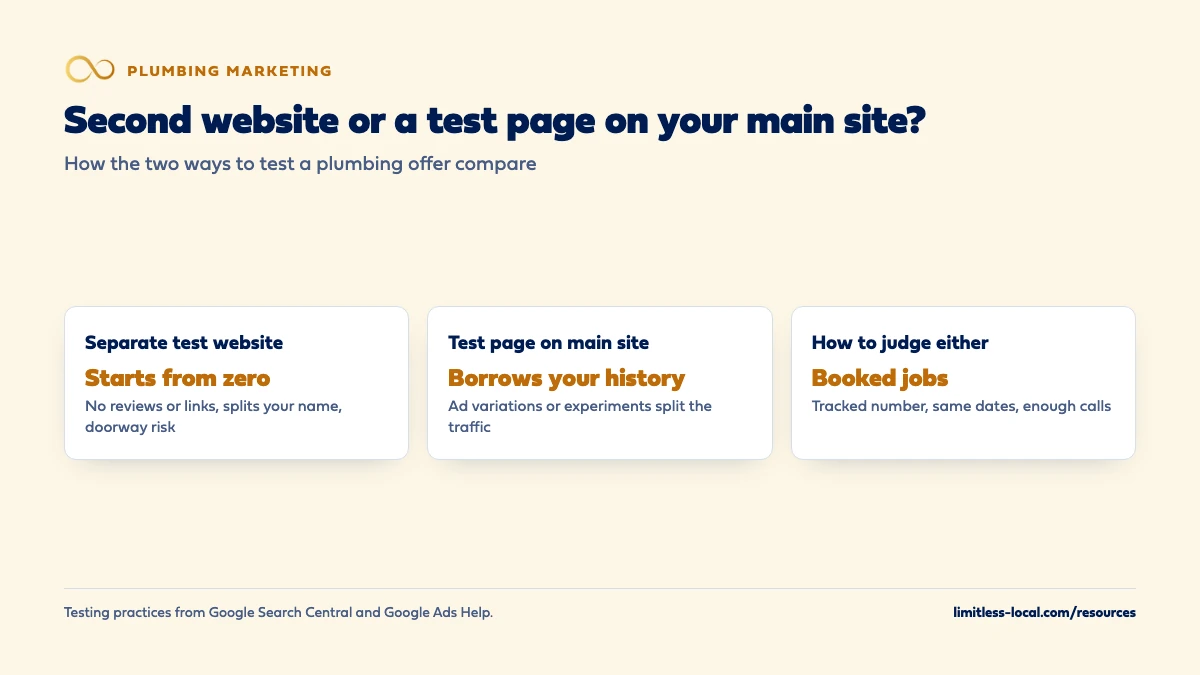
For most plumbing businesses, no. A second website starts with no reviews, no links and no history, splits your effort and your name, and can look like a doorway site to Google, while rarely getting enough visits to prove anything. Test on your main site instead: build a landing page for the offer, send part of your ad traffic to it with Google Ads ad variations or experiments, give it a tracked phone number, and compare booked jobs. A separate site only earns its keep when it’s a genuinely separate business.
Testing on your own site is part of how we run campaigns. Essentials ($3,500 a month) includes a landing page, call, web and form tracking with basic attribution, and Google Ads management, so an offer can be tried and judged on booked jobs without a second domain. If the main site itself is what’s holding you back, our local SEO work starts there. See the plumbing marketing page, or keep reading the plumbing marketing questions library.
What do owners usually mean by a separate testing website?
It tends to come up in one of three ways:
- A sandbox for offers. A second domain where you can try a coupon, a flat price or a new headline without touching the main site.
- A new-service trial. A site just for water softeners, trenchless sewer work or commercial jobs, to see if there’s demand before you add it to the main site.
- A second name. A different-sounding company that catches calls you’d otherwise miss, often pitched by someone selling the site.
The first two are reasonable goals with a better tool available. The third is the one most likely to cause trouble with Google.
What does a second website cost me that a page on my main site doesn't?
More than the domain and hosting fee:
- It starts from zero. No reviews tied to it, no links pointing at it, no history with Google. Your main site has years of that, and a test page there borrows all of it on day one.
- It splits your name. Homeowners who see two plumbing sites with different names, or the same name and different prices, start to wonder which one is real.
- It splits your time. Every page, plugin update and form on the second site is one more thing to keep working.
- It’s another set of logins to own. If someone else registered the domain, the test site and any calls it collects can walk away with them. Who should own your website and ad accounts covers why that matters.
For a test, the main cost is the first one. A brand-new site rarely ranks well enough to get organic visits, so any traffic you test on has to be paid for anyway.
Can a second plumbing website hurt my Google rankings?
It can, depending on how it’s built. Google’s spam policies describe doorway abuse as sites or pages created to rank for specific, similar searches, and the examples include having multiple websites with slight variations to the URL and home page to maximize their reach, and having multiple domain names targeted at specific regions or cities that funnel users to one page.
A plumbing test site that copies the main site’s service pages, or a set of city-name domains that all send calls to one number, fits those descriptions closely. The safer test is one that never pretends to be a separate business: a page on the site you already have.
Can I link the test site from my Google Business Profile?
Keep your profile pointed at your main website. Google’s guidelines for representing your business ask for a website that represents your business location, and say not to use URLs that redirect or refer users to landing pages other than those of the actual business. Swapping the profile link to a test site also muddies the one free source of calls you can measure cleanly.
If you want to try an offer on Maps traffic, put it on a page of your main site and mention it in a Google Business Profile post or update, rather than changing the website link itself.
How do I test an offer on my main site instead?
Build a landing page on your own domain for the thing you’re testing, and change one thing at a time. A clean setup looks like this:
- Pick one job and one question. For example: does a free water heater estimate bring more booked replacements than a dollar-off coupon?
- Build the page on your main site, matching the job: what you do, the towns you serve, your reviews, a tap-to-call number and a short form.
- Give it its own tracked phone number, so calls from the test page don’t blend with the rest of the site.
- Send it traffic you control, usually Google Ads, so both versions get similar visitors.
- Write down the start date and the booked jobs each version produced.
What a good landing page conversion rate looks like for a plumber helps you read the results page by page.
Curious what your marketing is actually booking?
Get a free visibility audit — no obligation, no sales pitch.
How do I split ad traffic between two versions without a second site?
Google Ads has two built-in ways to do it:
- Ad variations. Google’s page on setting up an ad variation says variations can change headlines and descriptions and can also be applied to the final URL, so one group of searchers lands on version A and another on version B. Visitors are split by cookies, so a person may see only one version of your ad no matter how many times they search.
- Custom experiments. A custom experiment copies a campaign and shares its traffic and budget, so you can test changes to the campaign itself and compare the two over time. You can only run one experiment at a time, and changes made to either side mid-test make the results harder to read.
Either way, both versions live on your own domain, and the ad account stays the single place you look for the numbers.
How do I keep a test from hurting my main site in search?
Google’s page on A/B testing and Search sets out a short list:
- Don’t show Google one version and people another. That’s called cloaking, and it’s off-limits whether you’re testing or not.
- If a test uses extra URLs for the same page, point them back to the original with a
rel="canonical"link. Google recommends that over a noindex tag for test variations. - If you redirect some visitors to a test version, use a temporary 302 redirect, not a permanent 301.
- End the test when it’s done and remove the extra URLs and scripts. Google warns that running an experiment for an unnecessarily long time may be treated as an attempt to deceive.
The same page notes that small changes, such as a button or the call-to-action wording, often have little or no impact on rankings. That’s another point in favor of testing on the main site.
How much traffic does a plumbing test need to mean anything?
More than most owners expect. A test needs enough calls on each side that the difference isn’t just a lucky afternoon, and how long that takes depends on how many visitors the page gets and how many of them call.
For a plumbing shop, that usually means:
- Test big differences, like an offer versus no offer, not two shades of a button.
- Run it for weeks, not days, and through the same kind of weather for both versions.
- Count booked jobs, not clicks or form fills. A version that brings more calls from price-shoppers can book fewer real jobs.
- Don’t stop at the first lead. Early numbers swing a lot.
The worked example below shows how a small test can fool you.
What's worth testing on a plumbing website?
The changes most likely to move booked jobs:
- The offer. A free estimate on replacements, a waived trip fee or a seasonal check. What offer gets more people to call a plumbing company has ideas worth trying.
- The first screen on a phone. What you fix, where you work and a tap-to-call button above everything else.
- Call first or book online first. Some customers would rather tap a booking button than talk.
- The form. Fewer fields often means more requests, though not always better ones.
- Proof. Real photos of your techs and trucks, and reviews near the call button.
Test one of these at a time. Change three things at once and you won’t know which one did the work.
Is it safe to test prices or coupons on two versions?
Be careful with it. Homeowners compare, and a neighbor who saw a lower price on the other version will mention it. Two prices for the same job, live at the same time, can cost you more in trust than the test earns.
A safer approach is to test how the offer is framed, not the price itself: a free estimate versus a set amount off, or a written promise versus a coupon. If you do test a price, keep it to a time window and honor the better deal for anyone who asks. Whether coupons attract good plumbing customers covers the bigger question of discounting at all.
When does a separate website make sense for a plumbing company?
When it’s a separate business in the real world, not a test. Examples:
- You bought another plumbing company that keeps its own name, phone number and customers.
- You run a different line of work under a different brand, with its own address and its own reviews.
In those cases each site represents its own business, so it isn’t a doorway, and each can earn its own reviews and rankings. If the reason for the second site is to catch more searches or try an idea, a page on your main site does the job with none of the downside.
Not sure which of these is costing you jobs?
A free visibility audit checks the Google profile, reviews, site and tracking, and shows what to fix first.
What's different about testing for plumbing companies
Emergencies don’t wait for a test. Someone with a burst pipe calls the first plumber who looks trustworthy. Keep your emergency pages steady during busy stretches and run tests on planned-work pages, like water heater replacements, repipes and sewer lines, where visitors compare before calling.
Weather skews results. A freeze during week two of a test can double calls on whichever version happened to be live. Compare versions over the same dates, and restart the test if a cold snap lands on one side only.
Small towns mean small numbers. A shop serving a few towns may only get a few calls a week from one page. That’s not a reason to skip testing, but it is a reason to test bigger changes and wait longer before calling a winner.
A worked example: why a short test can fool you
These numbers are made up to show the math, not a benchmark. Say your water heater ads send 300 visitors a month to a landing page, and you split them evenly between two versions: 150 see the current page and 150 see a version with a free-estimate offer.
After one month, the current page brought 6 calls and the new one brought 9. That’s 4% against 6%, and it looks like the new page wins by 50%. But it’s three calls. One busy Saturday could explain it.
Run it for three months instead. Now each version has had 450 visitors: the current page brought 18 calls and the new one 30. That gap is harder to put down to luck. Then check what matters: the current page’s calls became 8 booked jobs and the new page’s became 13. The new page wins on booked jobs too, so it becomes the main page, and the old version gets removed.
Frequently asked questions
Can I use a free website builder for a quick test site?
You can, but it has the same problem as any second site: no history and no reviews, so the only traffic is what you pay to send. A page on your main site gets the same paid traffic plus everything your domain has already earned.
Will a landing page that isn't in my menu still work?
Yes. Ad landing pages don’t need to sit in your site menu. What matters is that the page loads fast on a phone, matches the ad and has a tracked number.
Should my test landing page show up in Google search?
If it’s a variation of an existing page, point it back to the original with a canonical link. If it’s a page built only for ads, keeping it out of search is a common choice so it doesn’t compete with your main service page.
Can I test on Local Services Ads?
Not in the same way. Local Services Ads send contacts straight from the ad to your phone or messages, so there’s no landing page to swap. Test offers on Google search ads and your website instead.
How do I know which version a caller saw?
Give each version its own tracked phone number and its own form label. Your call tracking or job software then shows which version each booked job came from.
What do I do with the losing version?
Remove it and its test settings once you’ve picked a winner, and fold anything useful into the main page. Leaving old test pages live clutters your site and your reports.
Key takeaways
- A separate testing website starts from zero and splits your name, time and accounts.
- Near-copy sites and city-name domains can run into Google’s doorway rules.
- Test offers on landing pages of your main site, with Google Ads ad variations or experiments splitting the traffic.
- Use canonical links and temporary redirects, and clean up when the test ends.
- Run tests long enough to count booked jobs, not just calls.
Want a second set of eyes on your setup?
We'll look at how you show up locally and where calls are leaking, then send you a plain-English breakdown.
More in this section
- Would a purpose-built website help my plumbing marketing?
- How much does a plumbing company website cost?
- Is it worth paying for plumbing leads?
- Are Google Local Services Ads worth it for plumbers?
- How do I judge a local SEO package for my plumbing company?
Sources
- Spam policies for Google web search — Google Search Central
- Guidelines for representing your business on Google — Google Business Profile Help
- Set up an ad variation — Google Ads Help
- Set up a custom experiment — Google Ads Help
- Minimize A/B testing impact in Google Search — Google Search Central