
Should a pool builder make a page for every city it serves?
- How many city pages should a pool construction company have?
- Why is this question harder for a pool builder than for most trades?
- What does Google say about city pages?
- Which towns earn their own page?
- What can a pool builder say about a town that's actually different?
- Where do the towns without a page go?
- How many city pages is too many?
- Can I use one template or AI to write the town pages?
- Will a city page get my pool company into that town's map pack?
- Should I make pages for towns I want to expand into?
- How should town pages connect to the rest of my site?
- What if my site already has a page for every town?
- What's different about city pages for pool builders
- A worked example: sorting fourteen towns into pages
- Frequently asked questions
- Key takeaways
- More in this section
- Sources
The short version
- Only towns with real projects, local reviews and something specific to say get their own page.
- Every other town goes on one service-area page, written for people, not as a block of names.
- Copies with only the town name swapped can match the doorway examples in Google's spam policies.
- A city page won't put you in that town's map pack; that comes down to relevance, distance and popularity.
For pool builders who serve a dozen or more towns and are wondering whether each one needs its own page, or whether that’s how sites end up looking like spam.
Get a free visibility audit · Book a growth call
How many city pages should a pool construction company have?
No. A pool builder should make a page only for the towns where it has built enough pools to say something true and specific: real projects there, reviews from homeowners there, and what building in that town is actually like. Google’s spam policies name pages targeted at specific cities that funnel visitors to one page as doorway abuse, so a page per town with the name swapped is a risk, not a strategy. The other towns belong on one service-area page, and they can earn their own pages later as your builds there add up.
Deciding which towns to build pages for is part of the local SEO work we do for pool builders, where we work on the three places you need to show up: the regular Google results, the map pack and AI answers. The pool builder marketing page shows how that fits with ads and your website, and the pool builder marketing questions library covers the rest one question at a time.
Why is this question harder for a pool builder than for most trades?
Because a pool builder does far fewer jobs per town. A busy HVAC or plumbing company might run hundreds of calls in its home town every year, so it has jobs, reviews and photos to put on a page for almost every town it serves. A pool builder might finish a few pools a year in a given town, and none at all in some of the towns on its service list.
That changes the math. A city page is only as good as the local material on it, and in our judgement most pool builders can support real pages for a handful of towns, not every town they’d drive to. The rest of this page is about finding which ones.
What does Google say about city pages?
Three parts of Google’s guidance matter here. Its spam policies define doorway abuse as pages created to rank for specific, similar searches that lead people to intermediate pages that aren’t as useful as the final destination, and the examples include multiple pages targeted at specific regions or cities that funnel users to one page, and substantially similar pages that are closer to search results than a clearly defined, browseable hierarchy.
The same policies list blocks of text that list cities and regions a page is trying to rank for as keyword stuffing. And under scaled content abuse, they give the example of using generative AI or similar tools to generate many pages without adding value for users.
None of that says city pages are banned. It says pages that exist only to catch a town’s searches, without being useful to someone from that town, are the problem. Source: Spam policies for Google web search.
Which towns earn their own page?
In our judgement, a town is ready for its own page when you can tick all four:
- Several finished pools there, with photos you’re allowed to use.
- Reviews or testimonials from homeowners there, so the page can quote neighbors, not strangers.
- Something true to say about building there that isn’t true everywhere you work.
- You want more work there, and your crews can get there without wrecking the schedule.
For most builders, the towns that pass are the ones that already bring the most work, plus the occasional town you’ve deliberately pushed into and built a few pools in. If you’re still deciding where you want to win, settle that first; then build pages for the towns that pass.
What can a pool builder say about a town that's actually different?
More than most trades, if you’ve built there. Things a good town page can include:
- Your projects there. Two or three builds from that town, linked to their project pages. Setting up a project gallery page covers how those pages work.
- The yards you see. Small lots in an older neighborhood, sloped lots that need retaining walls, tight side-yard access that limits equipment. Whatever is true from your own jobs.
- How approvals usually go. In your experience, how long permits take there and whether most neighborhoods have an HOA review. Describe what you’ve seen and link to the town’s own permit office; don’t state rules you haven’t confirmed with the town.
- The pools people there choose. If most of your builds in one town are fiberglass and most in another are custom gunite, say so.
- Reviews from homeowners there, quoted with permission.
A page with those things on it is hard to confuse with a page that only swapped the town name.
Where do the towns without a page go?
On one service-area page, linked from your main menu. Name the towns and areas you build in, grouped in a way homeowners understand (by county, or by side of the metro), explain how far you travel and whether some areas have a longer wait, and link to each town page you do have.
That’s a normal, useful page, not keyword stuffing, in our judgement. What Google’s keyword-stuffing example describes is different: a block of town names pasted into a footer or the bottom of every page to catch searches. Project pages help these towns too. A finished pool in a town without a page can still name the town on its own project page, which is honest local proof without a thin page behind it. Source: Spam policies for Google web search.
Curious what your marketing is actually booking?
Get a free visibility audit — no obligation, no sales pitch.
How many city pages is too many?
Google doesn’t give a number, but it does describe the warning signs. Its guidance on helpful content lists producing lots of content on many different topics in the hope that some of it performs well in search, and using extensive automation to produce content, as signs of search engine-first content.
Its guide to ranking systems also explains why near-copies don’t multiply your chances. When results are very similar, its deduplication systems show only the most relevant ones, and its site diversity system generally won’t show more than two listings from the same site in the top results, though it may when that’s especially relevant. In our judgement, the right number of city pages for a pool builder is the number of towns that pass the test above, and for most builders that’s a short list. Sources: Creating helpful, reliable, people-first content, A guide to Google Search ranking systems.
Can I use one template or AI to write the town pages?
A shared layout is fine. Every town page can have the same sections: projects, the yards you see, approvals, the pools people choose, reviews, and how to book a consultation. The problem is identical or near-identical words inside them.
Watch the page titles as well. Google’s title link guidance warns against long titles that vary by only a single piece of information, calling them boilerplate, because they make pages hard to tell apart. “Custom Pool Builder in [Town] | Best Pools in [Town]” repeated across twenty pages is exactly that. Give each page a plain, specific title, such as the town name and the kind of pools you build there. Source: Influencing title links in Google Search.
Will a city page get my pool company into that town's map pack?
Not on its own. The map pack comes from your Google Business Profile, and Google’s local ranking help says local results are mainly based on relevance, distance and popularity, and that how well-known a business is depends partly on how many websites link to it and how many reviews it has. A web page doesn’t move your yard closer to a homeowner in the next town, and Google says there’s no way to request or pay for a better local ranking.
Google’s Business Profile guidelines also say a service-area business should have one profile for its central office with a designated service area, and that a rented mailing address you don’t operate from isn’t eligible. Its service-area help allows up to 20 service areas and says your overall area shouldn’t be more than about 2 hours of driving time from where you’re based. Setting up your Google service area covers that side, and getting your pool company to rank in Google Maps covers the levers that do move map results. Sources: Tips to improve your local ranking on Google, Guidelines for representing your business on Google, Manage your service areas.
Should I make pages for towns I want to expand into?
Not before you’ve built there. A page for a town where you have no projects, no reviews and nothing local to say is the kind of page Google’s doorway examples describe, however much you want the work.
A better order, in our judgement: target the new town with ads first, using location targeting, because ads can bring leads within days while SEO typically takes 3 to 6 months to show meaningful growth. Build the first few pools there, photograph them, collect the reviews, and then write the page. Which keywords a pool builder should target covers how town names fit into your ads versus your site.
How should town pages connect to the rest of my site?
As a clear branch, not a side door. Link each town page from the service-area page in your main menu, give them clean addresses such as /service-areas/town-name/, and connect them to the rest of the site: each town page links to its projects and to the pool types you build there, and each project and type page links back. Separate pages for each pool type covers the type side, and why a page for every type in every town is a bad trade.
Google’s doorway example about pages that are closer to search results than a browseable hierarchy is the reason structure matters. Town pages that are only reachable from a sitemap, or from nowhere, look like they exist for search engines. Town pages linked from your menu and your projects look like part of the site, because they are.
What if my site already has a page for every town?
Clean them up rather than adding more. Sort them into towns that pass the four-part test and towns that don’t. Rewrite the keepers with projects, local detail, reviews and distinct titles. For the rest, Google’s SEO Starter Guide suggests redirecting pages that repeat the same information to the URL that best represents it, and deleting content that’s no longer relevant; for a thin town page, that’s usually your service-area page.
Do it in one pass if you can, and keep a list of the old addresses and where each now points. Then watch Search Console’s performance report over the next few months for the towns you kept. Source: SEO Starter Guide.
Not sure which of these is costing you jobs?
A free visibility audit checks the Google profile, reviews, site and tracking, and shows what to fix first.
What's different about city pages for pool builders
Few jobs per town. A pool builder’s local proof builds slowly, a few pools a year in a given town. That’s why the threshold for a town page sits higher than for an emergency trade, and why project pages that name the town do so much of the work in between.
Building conditions really do vary. Lot sizes, slopes, access, HOAs and how permitting goes can differ from one town to the next. In our judgement, that’s the most useful local content a pool builder can write, because it’s true, specific and hard to fake.
Homeowners research for months. A homeowner may read your page about their town long before asking for a consultation. Seeing pools built a few streets away, with reviews from neighbors, is the kind of proof that keeps you on their short list.
Long drives cost real money. A pool build means many crew trips and inspections. A town page invites work from that town, so build pages only for towns your schedule can actually serve well.
A worked example: sorting fourteen towns into pages
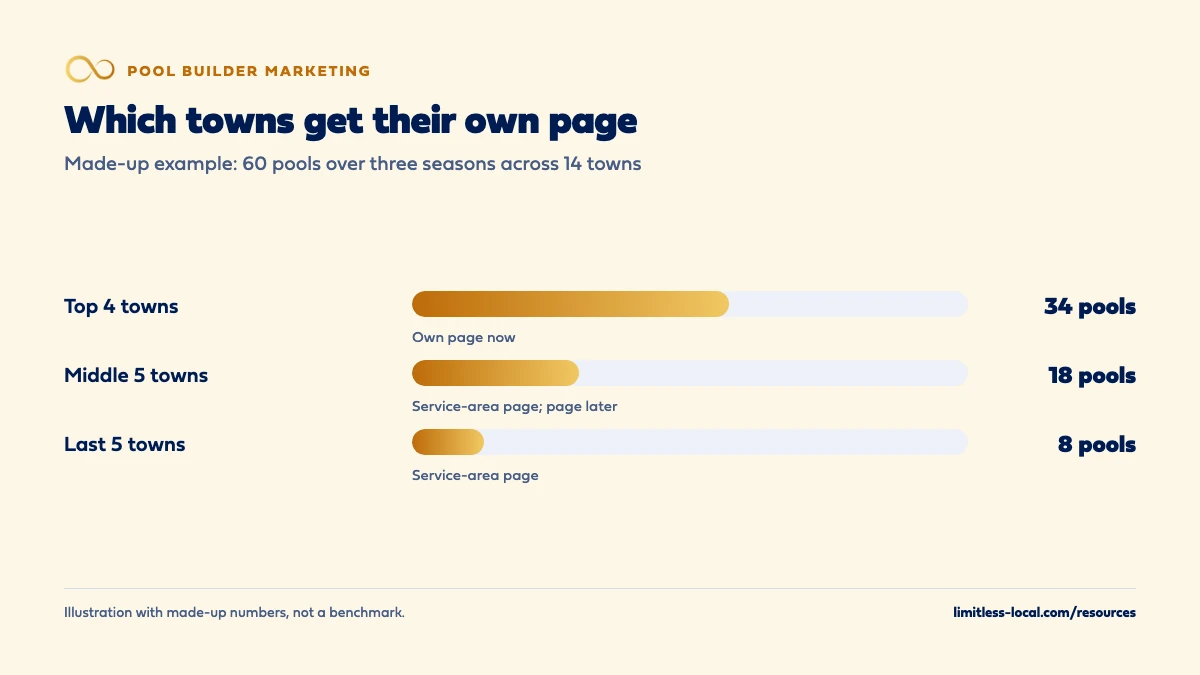
These numbers are made up to show the math, not a benchmark. Say you’ve finished 60 pools over the last three seasons across 14 towns. When you sort them, 4 towns account for 34 of those pools, a middle group of 5 towns accounts for 18, and the last five towns account for 8.
The first 4 towns get pages now: more than half of your builds came from them, so you have projects, photos and reviews to fill each page. The middle group goes on the service-area page for now, with each town’s projects still named on their project pages; any of them that you want to grow becomes a page once a few more builds and reviews come in. The last five stay on the service-area page.
That’s 4 city pages instead of 14, each with real material behind it, which is a much stronger site than 14 pages saying the same thing.
Frequently asked questions
Can I list all my towns in the footer of every page?
We wouldn’t. Google’s spam policies give blocks of text listing the cities and regions a page is trying to rank for as an example of keyword stuffing. Put the towns on one service-area page instead.
Should I make neighborhood pages inside a big city?
Only for neighborhoods where you’ve built enough pools to say something specific, which is rare. A page for the city, with projects tagged by neighborhood, usually serves homeowners better.
Do city pages help me show up in AI answers?
In our judgement, the same rule applies: specific, useful pages about where and how you build give AI tools something real to draw on, and thin town pages don’t become more useful because an AI is reading them.
Should my city pages have a different phone number for each town?
No. Use the same main number everywhere so your name, address and phone match across the web. If you want to know which page produced a call, use call tracking set up to keep your main number consistent on your Google profile.
How long until a new city page brings consultations?
There’s no set timeline. SEO typically takes 3 to 6 months to show meaningful growth, and consultations from that town follow at the pace of your sales cycle.
Key takeaways
- Build a page only for towns with real projects, local reviews and something specific to say.
- Put every other town on one service-area page, never as a block of names on every page.
- Pages with only the town name swapped match the doorway examples in Google’s spam policies.
- A city page doesn’t put you in that town’s map pack; your Google profile, reviews and distance do.
- Build in a new town first, then write its page; ads are the faster way to test new territory.
Want a second set of eyes on your setup?
We'll look at how you show up locally and where calls are leaking, then send you a plain-English breakdown.
More in this section
- Should a pool builder have separate pages for each pool type?
- Should a pool builder offer pool service as a side business?
- What should a pool builder website include to get more consultations?
- How should a pool builder set up its Google service area?
- What should a pool builder post on Instagram and Facebook?
Sources
- Spam policies for Google web search — Google Search Central
- Creating helpful, reliable, people-first content — Google Search Central
- A guide to Google Search ranking systems — Google Search Central
- Influencing title links in Google Search — Google Search Central
- SEO Starter Guide: The basics — Google Search Central
- Tips to improve your local ranking on Google — Google Business Profile Help
- Guidelines for representing your business on Google — Google Business Profile Help
- Manage your service areas for service-area & hybrid businesses — Google Business Profile Help