
Does my pool company website need a redesign before marketing?
- Should a pool builder rebuild its website before spending on ads or SEO?
- How do I tell if my pool website really needs a rebuild?
- What can I fix in a few weeks without a redesign?
- Does an old-looking website hurt my Google rankings?
- Can I run Google Ads before the new site is ready?
- Should SEO wait until the redesign is done?
- What can a redesign break?
- When is the best time for a pool builder to launch a redesign?
- How do I find out what my current site is already earning?
- Is a redesign a better use of money than marketing?
- What should I insist on if I do redesign?
- What's different about this decision for pool builders
- A worked example: the cost of waiting for the new site
- Frequently asked questions
- Key takeaways
- More in this section
- Sources
The short version
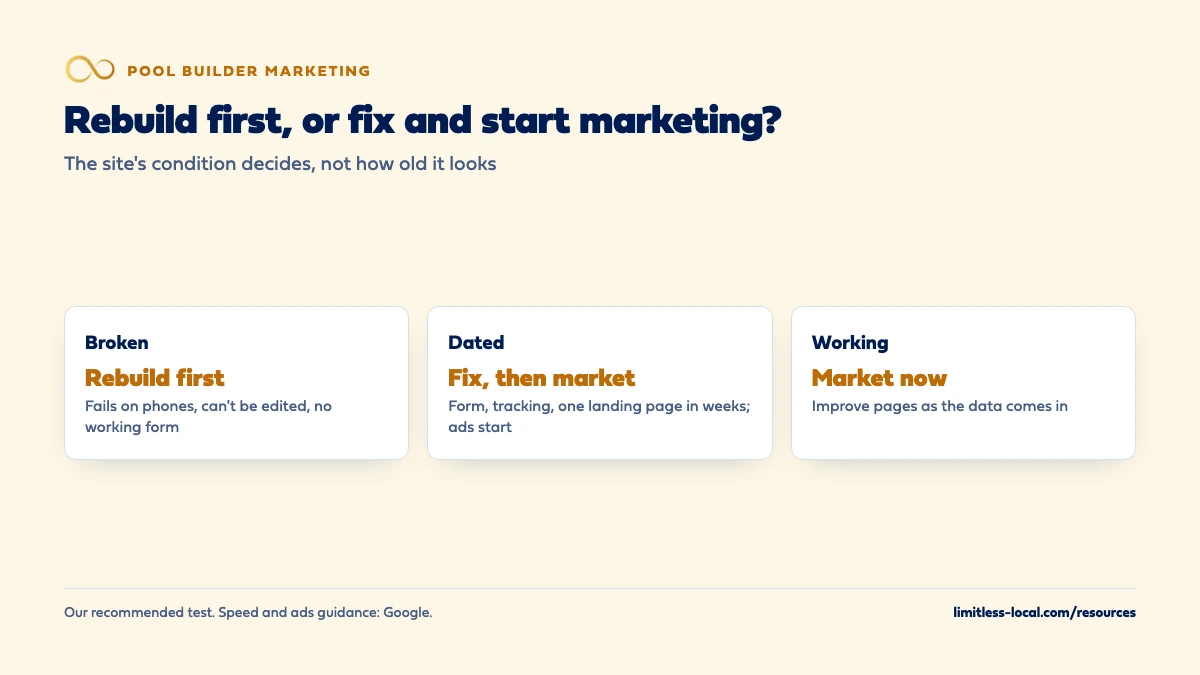
- Rebuild first only if the site is broken on phones, can't be edited, or has no working consultation form.
- A dated but working site can be fixed in weeks while ads run; redesign later if it still holds you back.
- Google shows the most relevant content even when page experience is weak, so looks alone rarely block rankings.
- If you do redesign, map every old address to a new one and launch in your slow season.
For pool builders who are embarrassed by their website and wondering whether to fix it, rebuild it, or start marketing with what they have.
Get a free visibility audit · Book a growth call
Should a pool builder rebuild its website before spending on ads or SEO?
Usually not. A pool company website needs rebuilding before marketing only if it’s broken in ways that would waste the money: it doesn’t work properly on a phone, it loads so slowly or so badly that Google could disapprove ads pointing to it, nobody can update it, or there’s no working way to request a consultation. A site that works but looks dated can be fixed in weeks while ads start, and redesigned later. Rebuilding first can mean months without marketing bringing in new consultations, and a redesign that changes page addresses can cost you search traffic for a while if it isn’t planned carefully.
This is the call we help pool builders make before any spend: the first phase of our process is building the foundation (tracking, follow-up and a clean online presence) before turning on lead flow. When a rebuild is the right answer, our website design page lays out the options; themed sites are $3,750, or $3,000 with any of our marketing packages. The pool builder marketing page shows how the pieces fit, and the pool builder marketing questions library covers the rest one question at a time.
How do I tell if my pool website really needs a rebuild?
Ask whether the site is broken or just dated. In our judgement, a site is broken for marketing purposes if any of these is true:
- It doesn’t work on a phone. Text you have to pinch to read, buttons you can’t tap, a gallery that won’t load.
- It’s painfully slow, especially the pages with photos.
- Nobody can change it. The person who built it is gone, you don’t have the logins, or the platform makes adding a project a two-week job.
- There’s no working way to ask for a consultation. No form, a form that goes to an inbox nobody reads, or a phone number that isn’t tappable.
- You don’t control it. The domain or the hosting is in someone else’s name.
If none of those is true, the site is dated, not broken. Dated sites can be marketed while you improve them. Broken ones waste every dollar you send to them.
What can I fix in a few weeks without a redesign?
More than most owners expect. On most pool builder sites, these changes do more for consultations than a new look:
- The consultation form. Short, on every page, and tested so you know where it goes.
- A tappable phone number at the top of every page on a phone.
- Recent projects. Replace the oldest photos with your last season’s builds, with the town and pool type named.
- Where you build. Your service area stated plainly, so homeowners outside it don’t waste a consultation.
- Your process, from consultation to first swim, on one page.
- Tracking, so every form and call records where it came from.
- Image sizes. Oversized photos are the usual reason a pool site is slow, and resizing them doesn’t need a redesign.
What a pool builder website should include covers what each of those pages should say.
Does an old-looking website hurt my Google rankings?
Less than you’d think. Google’s page experience guidance says Google Search always seeks to show the most relevant content, even if the page experience is sub-par, and that a great page experience can contribute to success when there’s lots of helpful content available for a search. It says Core Web Vitals are used by its ranking systems, but that beyond Core Web Vitals, other page experience aspects don’t directly help a site rank higher.
Two things matter more than looks. Google uses the mobile version of a site’s content for indexing and ranking, so a site that works on a desktop but hides content on phones has a real problem. And speed matters: Google’s Web Vitals guidance sets good targets as the main content loading within 2.5 seconds, a response to taps within 200 milliseconds, and little layout shift, measured at the 75th percentile of page loads. An old design that meets those is a design problem, not a search problem. Sources: Understanding Google page experience, Mobile-first indexing best practices, Web Vitals.
Can I run Google Ads before the new site is ready?
Yes, if the page the ads point to works. Google’s destination requirements say the page an ad sends people to must be functional, useful and easy to navigate, and they list websites that don’t load quickly on most popular browsers and devices among the things that lead to disapproval. Google Ads also rates landing page experience for each keyword, and its definition says pages with higher ratings are usually well organized and have text that relates to a person’s search terms.
So the minimum is one good page per kind of pool you advertise, with real projects, your service area and a short consultation form, even if the rest of the site is old. That page can live on your current site or be built separately while the redesign happens. Whether pool builders need a separate landing page for Google Ads covers that choice. Sources: Destination experience, Landing page experience: Definition.
Curious what your marketing is actually booking?
Get a free visibility audit — no obligation, no sales pitch.
Should SEO wait until the redesign is done?
Part of it should, and part shouldn’t. In our judgement, the work that doesn’t depend on your website should start now: your Google Business Profile, your reviews and your listings across the web. Optimizing your pool builder Google Business Profile covers the first of those.
The work that lives on the website is different. If the redesign will change your page structure, writing a stack of new pages on the old site means doing it twice or redirecting it later. Plan the new structure first, then write content that moves straight into it. Keep in mind that SEO typically takes 3 to 6 months to show meaningful growth, while ads can bring leads within days, so every month SEO waits is a month added to the ramp.
What can a redesign break?
Your search traffic, for a while, if page addresses change and nobody plans for it. Google’s site move guidance says to expect temporary ranking fluctuations while it recrawls and reindexes, and that for medium-sized sites it can take a few weeks or more for Google to start showing the new addresses instead of the old ones.
Its steps for keeping the damage small:
- Map every old address to its new one, and set up permanent redirects from old to new. Google says 301 and other permanent redirects don’t cause a loss in PageRank.
- Let removed pages return a proper error. Content you aren’t moving should return a 404 or 410, not quietly send people to the home page.
- Change one thing at a time. Google’s example is moving to a new domain first and changing the layout after, rather than doing everything at once.
- Watch Search Console during and after the move.
A pool builder’s project pages and town pages are the ones to protect most, in our judgement, because they’re often what homeowners find. Source: How to move a site.
When is the best time for a pool builder to launch a redesign?
In your slow season, with the new site live before the spring rush. Google’s site move guidance suggests timing a move to coincide with lower traffic if your traffic is seasonal, so fewer people are affected if something goes wrong. For many pool builders that’s late fall and winter, but check your own Search Console numbers to see when your traffic actually dips.
Work backward from there. Our own timeline is concept to launch in 100 days or less, with themed sites around 60 days, and that’s deliberately buffered because waiting on the owner’s feedback is usually the slowest part. A redesign started in the middle of building season, when you’re on job sites all day, tends to drag. Preparing your marketing before peak season covers what else belongs in the off-season plan.
How do I find out what my current site is already earning?
Before you replace anything, look at what it does now. Search Console’s Performance report shows the searches your site appears for and the pages that get clicks, with clicks, impressions and average position. Export the list of pages with clicks: those are the addresses your redesign has to keep or redirect carefully.
Then check where consultations come from. If your forms and calls are tracked, you’ll know which pages produced requests, and those pages are the ones to improve rather than throw out. If they aren’t tracked, set that up first, because without it you can’t tell whether the new site did better than the old one. Tracking which marketing produces signed contracts covers how. Source: Performance report (Search results).
Is a redesign a better use of money than marketing?
It depends on what’s broken, which is why the test at the top of this page matters. A website is a one-time cost with a long life; marketing is a monthly cost that brings consultations as long as it runs. For reference, our themed sites are $3,750, custom sites start at $5,000, and our Essentials marketing package is $3,500 a month with ad spend paid separately to Google.
In our judgement, a pool builder with a working site usually gets more from starting marketing now and improving the site as the data comes in, because the marketing shows you which pages and projects homeowners respond to. A pool builder with a broken site should fix that first, because every dollar of marketing goes through it.
What should I insist on if I do redesign?
Not features; process. Whoever builds it, in our judgement, the plan should include:
- You own the domain and the site, with admin access in your name.
- A written map of old addresses to new ones, with redirects tested before launch.
- Tracking carried over, so you can compare consultations before and after.
- A gallery your office can update without calling a developer; setting up a project gallery page covers how it should work.
- Speed checked on a real phone, against Google’s Web Vitals targets.
- A test consultation request from every form, the day it launches.
Not sure which of these is costing you jobs?
A free visibility audit checks the Google profile, reviews, site and tracking, and shows what to fix first.
What's different about this decision for pool builders
The website does more of the selling. A homeowner may visit a pool builder’s site many times over months before asking for a consultation, and most of what they look at is your project photos. That makes a slow or outdated gallery more costly for a pool builder than for an emergency trade, and it’s the part of the site most worth fixing first.
Seasons set the calendar. Most pool builders have a slow season that’s the natural time to rebuild, and a spring rush when a half-finished website is the last thing anyone has time for.
The cost of waiting is measured in contracts. One signed pool is a large job. In our judgement, a few months of consultations lost while waiting for a perfect site is usually a bigger cost than running marketing on a site that’s merely dated.
A worked example: the cost of waiting for the new site
These numbers are made up to show the math, not a benchmark or a forecast. Say ads pointed at one solid landing page would bring 12 consultation requests a month, and one in four of those turns into a signed contract over the following months.
If you wait three months for a redesign before starting, that’s 36 consultation requests you never get, and at one in four, 9 contracts that go to someone else or don’t happen.
Compare that with the alternative: fix the form, the tracking and one landing page in a few weeks, start the ads, and run the redesign in the background. You lose a few weeks instead of three months, and by the time the new site launches, the ads have told you which pool types and towns homeowners are asking about, which is exactly what the new site should be built around.
Frequently asked questions
My site is on a builder platform. Do I have to move it before marketing?
Not if it works on phones, loads quickly and you can edit it. Moving platforms is a site move with its own risks, so do it when there’s a reason, not as a default.
Will changing my domain name help my pool company rank?
Not by itself, and it adds risk. Google’s site move guidance treats a domain change as a site move and recommends changing one thing at a time, so don’t combine a new domain with a full redesign.
Should I redesign before or after starting SEO?
Start the off-site work, such as your Google profile and reviews, now. Hold big new page-writing projects until the new structure is decided, so the work isn’t done twice.
How long will my rankings dip after a redesign?
Google says that for medium-sized sites it can take a few weeks or more for Google to start showing the new addresses, with temporary fluctuations while it recrawls. Careful redirects keep the dip small; there’s no guaranteed length.
Can I keep my old site live while the new one is built?
Yes, and you should. Build the new site on a private staging address, test it, and switch over in one planned launch with the redirects ready.
Key takeaways
- Rebuild first only when the site is broken: fails on phones, can’t be edited, or has no working consultation form.
- A dated but working site can be fixed in weeks while ads start; redesign it later.
- Google shows the most relevant content even when page experience is weak; speed and mobile matter more than looks.
- If you redesign, map every old address to a new one and launch in your slow season.
- Start the work that doesn’t depend on the website, like your Google profile and reviews, right away.
Want a second set of eyes on your setup?
We'll look at how you show up locally and where calls are leaking, then send you a plain-English breakdown.
More in this section
- Should I hire a pool marketing agency or do it myself?
- What should a pool builder website include to get more consultations?
- What should a pool builder ask before hiring a marketing agency?
- Should pool builders market renovations separately from new pools?
- How do I know if my pool marketing agency is working?
Sources
- Understanding Google page experience — Google Search Central
- Mobile-first indexing best practices — Google Search Central
- Web Vitals — web.dev (Google Chrome team)
- How to move a site — Google Search Central
- Destination experience — Google Advertising Policies Help
- Landing page experience: Definition — Google Ads Help
- Performance report (Search results) — Search Console Help