
What is a good cost per signed pool contract?

- How much marketing cost per signed pool contract is too much?
- How do I calculate my cost per signed pool contract?
- Is there an industry benchmark for cost per pool contract?
- What makes a cost per contract good for my business?
- Why can a cheap cost per lead still mean an expensive contract?
- Which contracts should count, and over what period?
- Should I judge each marketing channel separately?
- Should new builds and renovations have different targets?
- Can Google Ads aim for a cost per signed contract?
- What should I do if my cost per contract is too high?
- How often should I check cost per signed contract?
- What's different about cost per contract for pool builders
- A worked example: what you count changes the answer
- Frequently asked questions
- Key takeaways
- More in this section
- Sources
The short version
- Good means comfortably under the ceiling your profit per pool can carry.
- Count everything: ad spend, agency fees, software, photos, shows.
- Measure over a full season, giving late signers time to sign.
- Compare channels and job types against their own ceilings, not a borrowed benchmark.
For pool builders who know roughly what they spend on marketing and want to know whether what each signed contract costs them is good, bad or fine.
Get a free visibility audit · Book a growth call
How much marketing cost per signed pool contract is too much?
A good cost per signed pool contract is one that sits comfortably under the ceiling you set from what an average pool leaves you after materials, labor, subs and overhead, so marketing takes a modest share of each job’s profit rather than most of it. There’s no reliable published benchmark for pool builders, so calculate your own: everything marketing cost over a full season, including ad spend and agency fees, divided by the contracts it signed. Then judge each channel and each job type against its own ceiling, because the same figure can be healthy for a new build and too high for a renovation.
Cost per signed contract is the number we’d want to be judged on too. Every package includes monthly performance reports with a cost-per-lead breakdown, call tracking and source tagging, so you can carry each lead’s source through to the contract in your own records. Essentials, at $3,500 a month, includes Google Ads management for up to $2,500 a month in ad spend, which is paid directly to Google. The local ads page covers how we run paid search, our pool builder marketing page covers the trade, and the pool builder marketing questions library covers the rest.
How do I calculate my cost per signed pool contract?
Add up what marketing cost over a period, then divide by the contracts that marketing signed. The cost side should include everything you paid to find buyers:
- Ad spend paid to Google, Meta or anyone else.
- Agency or freelancer fees.
- Website hosting and upkeep, call tracking and other marketing software.
- Photography and video of your builds.
- Home shows, print and sponsorships.
Then decide whether to include sales costs. Canada’s Business Development Bank (BDC) calculates cost of acquisition as sales costs plus marketing costs, divided by the number of new customers. For a pool builder, that would mean adding the designer or salesperson who runs consultations. In our judgement, track both: marketing cost per contract tells you whether the marketing is working, and full acquisition cost tells you what winning a pool really costs. Just don’t mix them from month to month. Source: Do you know the lifetime value and cost of acquisition of your customers? (BDC).
Is there an industry benchmark for cost per pool contract?
Not one we’d trust. We couldn’t find a reliable, published figure for what pool builders pay in marketing per signed contract, and in our judgement it would mislead you even if one existed. Contract sizes vary several-fold between a fiberglass install and a custom build with a spa and outdoor kitchen; competition varies by market; and one builder’s “marketing cost” leaves out things another includes.
The benchmark that matters is your own ceiling: the most you can pay in marketing per signed pool and still make the profit you want. How much you can afford to spend to win one pool customer walks through setting that number from your margin. Once you have it, “good” stops being a guess.
What makes a cost per contract good for my business?
In our judgement, three things together:
- It’s comfortably under your ceiling. Not right at it. Some months will run high, and a number that only works in a good month will hurt in a bad one.
- It comes with enough contracts. A very low cost per contract on two pools a year isn’t good if your crews could build twelve. Volume against your capacity matters as much as the price of each one.
- It holds up over time. One great season can be luck. A cost per contract that stays in range across a year or more is one you can plan around.
If the number is well under your ceiling and your calendar still has gaps, that’s usually a sign you can spend more, not that you’ve found a bargain to protect.
Why can a cheap cost per lead still mean an expensive contract?
Because the lead is only the start. A source that brings in lots of inexpensive inquiries can be full of people who want an above-ground pool, live outside your area or are years from buying, and almost none of them sign. A source with fewer, pricier leads can sign more pools for less in the end.
In our judgement, the most useful middle number is cost per design consultation held. It shows up within weeks rather than months, and it filters out most of the people who were never going to buy. Watch it monthly, and save the verdict for cost per signed contract. Tracking which marketing produces signed pool contracts shows how to carry each lead’s source through to the contract so you can see this by channel.
Curious what your marketing is actually booking?
Get a free visibility audit — no obligation, no sales pitch.
Which contracts should count, and over what period?
Count the contracts that came from the leads you paid for in the period, and give them time to sign. Pool buyers often sign months after their first inquiry, so if you divide this month’s spend by this month’s contracts, you’re dividing one season’s money by another season’s buyers.
Google Ads has the same problem built in. Its default conversion window is 30 days, and Google says longer windows suit businesses whose buying cycle doesn’t fit that default; anything that converts after the window isn’t recorded. Google also says conversion lag can make cost per acquisition look inflated for recent periods, because conversions that haven’t happened yet aren’t in the numbers. In our judgement, judge each season’s marketing once most of its consultations have reached a decision, and keep a rolling twelve-month figure so one slow month doesn’t scare you. Sources: About conversion windows and About conversion lag reporting.
Should I judge each marketing channel separately?
Yes, once you have enough contracts to read. A blended number tells you whether marketing as a whole pays; a channel number tells you where to move money. In our judgement, the usual pattern looks like this:
- Referrals and past customers cost little in cash, so keep them out of your paid numbers or they’ll make paid channels look better than they are.
- Google Ads costs show up month by month, and contracts can be traced back if you record the source.
- SEO and your Google profile cost a steady amount while the results ramp up over months, so judge them over a year, not a quarter.
- Home shows are one big cost on one weekend, so count every contract from that show’s leads before deciding.
With only a handful of contracts a year from a channel, a single contract swings the number a lot. Give small channels a longer look before you cut them. Whether Google Ads are worth it for pool builders covers the paid search side in more depth.
Should new builds and renovations have different targets?
Yes. A renovation usually leaves you less profit than a new build, so it can carry less marketing cost per contract. If you mix them, a run of renovation contracts can make your cost per contract look great while your profit after marketing shrinks. Record the job type on every lead and work out each line’s cost per contract against its own ceiling. Marketing renovations separately from new pools covers how to split the pages, ads and budgets as well as the numbers.

Can Google Ads aim for a cost per signed contract?
Partly. Google Ads can only aim at what it can see. A signed contract happens in your office, not on your website, so Google offers offline conversion imports, now steered toward enhanced conversions for leads, to bring offline outcomes like a sale back into Google Ads. Google says this lets you measure what happens in the offline world after an ad starts a customer down the path to a sale.
With conversion tracking in place, Google’s Target CPA bidding tries to get as many conversions as possible at your target cost per conversion. Google says some conversions will cost more than the target and some less, but overall it tries to keep the average at your target, using your campaign’s history. In our judgement, most pool builders sign too few contracts a month for a campaign to learn from contracts alone, so the practical setup is to bid toward an earlier step, such as qualified consultation requests, and import signed contracts so you can see the real cost per contract alongside it. Sources: About offline conversion imports and About Target CPA bidding.
What should I do if my cost per contract is too high?
Work backward from the contract, because the cheapest fixes are usually at the bottom of the funnel. In our judgement, check in this order:
- Consultations to contracts. If consultations are happening but few sign, look at the proposal, pricing and follow-up. Following up through a long sales cycle is often where contracts are lost.
- Leads to consultations. If plenty of leads come in but few book, look at response speed and how you qualify them.
- Who the marketing reaches. If the leads are mostly out of area, the wrong pool type or wrong budget, tighten the keywords, locations and pages.
- The budget itself. Only after the first three are sound.
Cutting spend is the fastest way to lower the cost, but if the leak is in follow-up, cutting spend just signs fewer pools at the same poor rate.
How often should I check cost per signed contract?
In our judgement, look at the leading numbers monthly and the contract number seasonally. Each month: spend, new leads, consultations held and cost per consultation, by channel. Each season, and as a rolling twelve months: signed contracts, cost per signed contract by channel and job type, and how that compares with your ceiling.
Write the ceiling down where you’ll see it at every review. The point of the number isn’t to admire it; it’s to decide whether to spend more, spend less or fix something before the next season starts.
Talk it through with someone who runs this every day
A 15-minute growth call: your market, your numbers, and what a realistic budget looks like. No pressure.
What's different about cost per contract for pool builders
A few big numbers, not many small ones. A service trade can judge cost per job across hundreds of jobs a month. A pool builder may sign a few dozen contracts a year, so each one moves the average, and patience matters more than precision.
The lag. Money spent in winter can sign contracts in spring. Any cost per contract measured over a short window will be wrong in one direction or the other.
Higher ceilings. Because each contract carries more profit, a pool builder can afford a much higher marketing cost per contract than a trade selling small jobs. A figure that would alarm a plumber can be healthy for a builder.
Capacity. A low cost per contract is only good if it fills the build calendar you actually have.
A worked example: what you count changes the answer
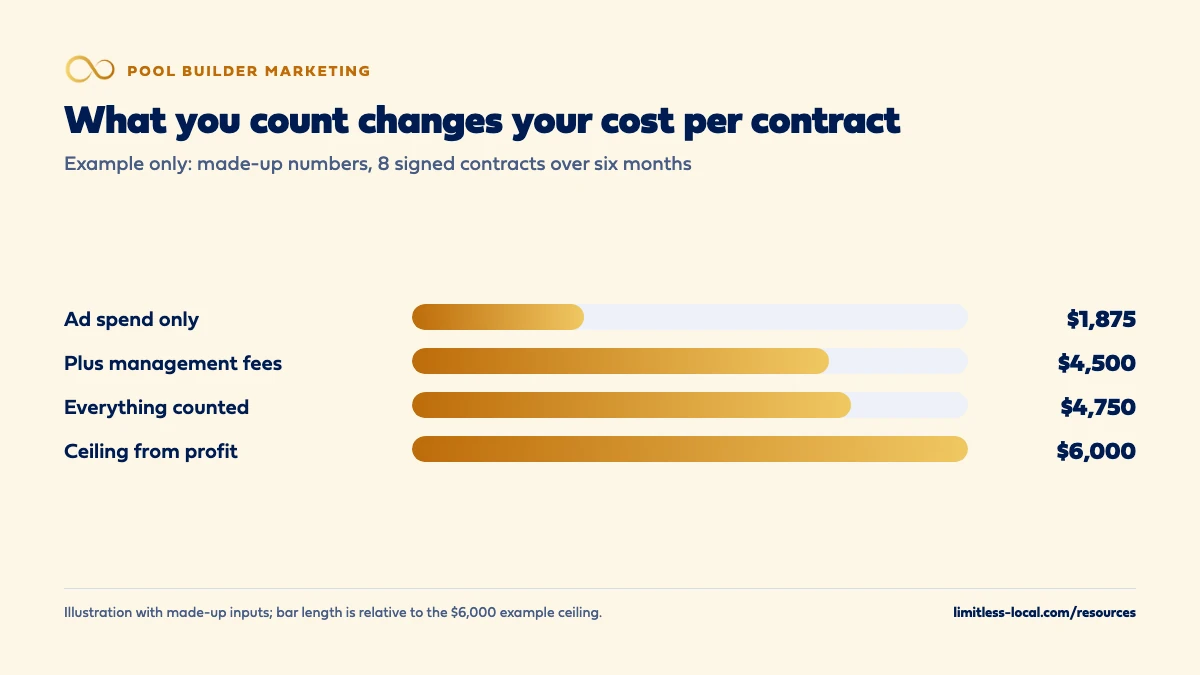
These numbers are made up to show the math, not a benchmark for your market. Say over a six-month season you spend $2,500 a month on Google Ads ($15,000), pay a $3,500-a-month agency fee, the price of our Essentials package ($21,000), and spend $2,000 on build photos and software. That’s $38,000 in marketing. The leads from those channels, not referrals, sign 8 contracts.
- Ad spend only: $15,000 / 8 = $1,875 per contract.
- Plus management fees: $36,000 / 8 = $4,500 per contract.
- Everything: $38,000 / 8 = $4,750 per contract.
Now say your ceiling, set from your profit per pool, is $6,000. The full $4,750 is under it, with $1,250 of headroom on each contract, so this is a good result for this builder. If you’d only counted ad spend, $1,875 would have looked like a bargain and you might have pushed spend harder than the real numbers support. Note too that Essentials covers SEO and profile work as well as ads, which is why the fee belongs in the all-channel number rather than the ads-only one.
Frequently asked questions
Should my design consultant's pay count toward cost per contract?
Count it in a separate, full acquisition cost. BDC’s cost of acquisition adds sales costs to marketing costs; in our judgement, keep marketing cost per contract as its own number too, so you can see which side needs work.
Do referral contracts count?
Track them, but keep them out of your paid marketing math. They cost little in cash, so mixing them in makes your paid channels look cheaper than they are.
What if a homeowner found me through two channels?
Pick one rule, such as first source or the source they name on the first call, and apply it every time. In our judgement, consistency matters more than which rule you choose.
How many contracts do I need before the number means anything?
There’s no fixed count. With only a few contracts from a channel, one more or one fewer swings the number a lot, so read small channels over a longer period.
What about contracts that cancel?
Take them out. In our judgement, a contract only counts once the deposit clears and the job is going ahead; otherwise your cost per contract will look better than it is.
Is cost per signed contract the same as return on ad spend?
No. Cost per contract is spend divided by contracts; return on ad spend compares the value those contracts brought in with what you spent. They answer related questions, and both need your contract data.
Key takeaways
- A good cost per signed contract sits comfortably under the ceiling your profit per pool can carry.
- There’s no reliable published benchmark for pool builders; your own ceiling is the benchmark.
- Count every marketing cost, and keep referrals out of the paid numbers.
- Give contracts time to sign before you judge a season’s marketing.
- Judge channels and job types separately, and fix follow-up before cutting budget.
Ready to compare options?
Book a short growth call and we'll walk through the math for your service area, including when we're not the right fit.
More in this section
- How do I track which marketing produces signed pool contracts?
- How much can I afford to spend to win one pool customer?
- How do pool builders turn design consultations into signed contracts?
- How much should a pool builder spend on marketing?
- How do pool builders stop attracting price shoppers?
Sources
- Do you know the lifetime value and cost of acquisition of your customers? — BDC (Business Development Bank of Canada)
- About conversion windows — Google Ads Help
- About conversion lag reporting — Google Ads Help
- About offline conversion imports — Google Ads Help
- About Target CPA bidding — Google Ads Help