
How much can I afford to spend to win one pool customer?

- What's the most a pool builder should pay in marketing to land one new customer?
- Why work from profit per pool instead of the contract price?
- How do I work out the most I can spend to win one pool customer?
- Should I spend right up to that ceiling?
- Do sales costs come out of the same number?
- Can I count what a pool customer is worth over the years?
- Is there a rule of thumb for what a customer should cost?
- Should the ceiling be different for renovations and different pool types?
- How does the ceiling turn into a marketing budget?
- How do I check that I'm staying under it?
- What if my ceiling is too low to compete for customers?
- What's different about acquisition cost for pool builders
- A worked example: setting the ceiling for one pool
- Frequently asked questions
- Key takeaways
- More in this section
- Sources
The short version
- Work from profit per pool, not the contract price.
- Ceiling = gross profit per pool, minus overhead per pool, minus the profit you want to keep.
- Plan to spend below the ceiling, with a buffer for slow seasons.
- Add lifetime value from renovations, service and referrals only when your records prove it.
For pool builders who want a number, worked out from their own margins, for the most they can pay in marketing to sign one more pool.
Get a free visibility audit · Book a growth call
What's the most a pool builder should pay in marketing to land one new customer?
Start from what an average pool leaves you, not what it sells for: take the contract price, subtract materials, labor, subcontractors and permits to get gross profit, then set aside each pool’s share of overhead and the net profit you want to keep, and what’s left is the most you can afford to spend to win that customer. Plan to spend well under that ceiling, so a slow season or a run of lost proposals doesn’t wipe out the profit. If past customers reliably come back for renovations, service or referrals, you can justify a little more, but count that extra value only once your own records show it.
Whatever you pay an agency belongs in this same math, so our prices are public: Essentials is $3,500 a month and Growth is $4,500 a month, with ad spend paid directly to Google or Meta on top. We ask for three months in the contract, but if you want to leave, we won’t make you stay. The packages page lists what each tier includes, our pool builder marketing page covers how we approach the trade, and the pool builder marketing questions library goes through the rest.
Why work from profit per pool instead of the contract price?
Because the contract price isn’t yours to spend. Most of it goes to materials, equipment, labor, subcontractors and permits before you see a dollar of profit. If you set your marketing limit as a share of the contract price, you can end up paying for a customer with money that was already spoken for.
Gross profit is the better starting point. Canada’s Business Development Bank (BDC) defines gross profit margin as net sales minus the cost of goods sold, divided by net sales; for a pool builder, the cost of goods sold is the direct cost of building that pool. That’s the money that has to cover your office, your salaried people, your trucks, your marketing and your own profit. Source: Gross profit margin (BDC).
How do I work out the most I can spend to win one pool customer?
Four steps, using your own books for the last year or two:
- Average contract price for the kind of pool you want more of.
- Gross profit per pool: that price minus the direct costs of the build, such as materials, equipment, labor, subcontractors and permits.
- Overhead per pool: a year’s overhead, other than marketing, divided by the pools you build in a year.
- The profit you want to keep on each pool after everything.
Gross profit, minus overhead per pool, minus the profit you want to keep, is your ceiling: the most one new customer can cost you in marketing before the pool stops earning what you need it to. In our judgement, it’s worth writing down even if the inputs are rough, because a rough ceiling beats spending with none.
Should I spend right up to that ceiling?
No. The ceiling is the point where the pool still makes your target profit, not the amount you should plan to spend. In our judgement, set a working target a good way below it, for three reasons:
- Marketing costs swing. Some months bring a run of good consultations and some bring none.
- Proposals get lost. A season where fewer consultations sign raises the cost of every contract that does.
- Jobs run over. If a build costs more than planned, the profit you were counting on to absorb the marketing shrinks.
The SBA’s break-even calculator is a useful check on the other side of the same math: it divides fixed costs by the difference between price and variable costs to tell you how many units, here pools, you must sell before you make anything. Every dollar of marketing you count per pool raises that number. Source: Break-even point calculator (U.S. Small Business Administration).
Do sales costs come out of the same number?
They should, if you pay them per contract. BDC calculates cost of acquisition as sales costs plus marketing costs, divided by the number of new customers, and its example includes a salesperson’s pay and expenses alongside the marketing. For a pool builder who pays a designer or salesperson a commission on each signed contract, that commission is part of what it costs to win the customer.
In our judgement, the simplest way to handle it is to subtract per-contract sales costs, such as commission, before you set the marketing ceiling, and to keep a salaried designer in overhead. Either way, count it once, not twice. Source: Do you know the lifetime value and cost of acquisition of your customers? (BDC).
Curious what your marketing is actually booking?
Get a free visibility audit — no obligation, no sales pitch.
Can I count what a pool customer is worth over the years?
Yes, carefully. BDC describes lifetime value as the revenue or profit a customer brings over the whole relationship, not just one sale, and says to take maintenance and after-sale service into account. Its worked example is a company selling commercial heating and air conditioning systems, whose customers keep using it for maintenance for years after the original purchase.
For a pool builder, lifetime value can include service plans, equipment replacements, a renovation years later and referrals to neighbors. In our judgement, two cautions apply. First, much of that value arrives years after you’ve paid to win the customer, and some customers move or never call again. Second, only count what your records show: if you can see that past customers really do come back for repairs and remodels, add a conservative amount of that profit to the ceiling. If you can’t see it yet, leave it out. If you’re thinking about a service line to capture that value, whether to offer pool service as a side business covers the trade-offs. Sources: Do you know the lifetime value and cost of acquisition of your customers? and Customer lifetime value (BDC).
Is there a rule of thumb for what a customer should cost?
There is a loose one. BDC, describing it as a very general guideline that depends on the benchmark you look at, says that for businesses in general, not pool builders specifically, a customer’s lifetime value should be 2.5 to 3 times what it cost to acquire them. Its example: a customer worth $100 over the relationship shouldn’t cost more than $40 to win.
In our judgement, use it as a sanity check, not a target. For a pool builder, it only means something if “lifetime value” is measured as profit, not contract revenue; measured against revenue, the rule would allow a marketing cost that eats the whole margin. Your own ceiling, built from your own profit and overhead, is the better number. Source: BDC.
Should the ceiling be different for renovations and different pool types?
Yes. Each kind of job has its own price and its own profit, so each gets its own ceiling. A renovation usually carries a smaller ceiling than a new build; a high-end custom build with a spa and outdoor kitchen can carry a bigger one than a basic install. If you use one ceiling for everything, you’ll overpay for the smaller jobs and may underbid for the ones you most want.
Record the job type on every lead so you can check each line against its own number. Marketing renovations separately from new pools covers how to split the budgets and tracking.

How does the ceiling turn into a marketing budget?
Multiply your working target per customer by the number of new contracts you want from marketing in a year. That gives the most the year’s marketing should cost, and from there your close rate and consultation rate tell you how many consultations and leads it has to produce. How much a pool builder should spend on marketing walks through that backward math and the seasonal timing.
One thing the ceiling doesn’t show is cash flow. You’ll pay for marketing months before the deposits come in, so make sure you can carry a season of spend before it pays back. In our judgement, that’s the most common reason builders cut marketing that was working: the money ran short before the contracts arrived.
How do I check that I'm staying under it?
Compare it with what each signed contract actually cost. Add up everything you spent on marketing over a season, divide by the contracts it signed, and set that next to your ceiling and your working target, by channel and job type if you can. What a good cost per signed pool contract looks like covers how to count it, including which contracts belong in which season.
If you advertise on Google, you can also tell Google Ads what a conversion is worth. Google says conversion values let you measure the total business value your campaigns produced rather than just a count, and that its Target ROAS bidding can work toward values such as sales revenue or profit margins. In our judgement, if you use values, use profit-based ones, for the same reason this page starts from profit. Source: About conversion values (Google Ads Help).
What if my ceiling is too low to compete for customers?
Then the fix is usually in the business, not the ad account. In our judgement, the levers, roughly in order:
- Close more of the consultations you already get. A better close rate lowers what each customer costs without spending a dollar more.
- Lean on the cheaper channels: past customers, referrals, your Google profile and reviews, before paying for clicks.
- Narrow where you market to the towns where you win most often and build most efficiently.
- Look at your pricing. If competitors can afford to pay more for each customer, they may be charging more for each pool. Positioning a pool company as a premium builder covers that side.
What we wouldn’t do is spend past the ceiling and hope volume makes up for it. More contracts at a loss per contract is a bigger loss.
Talk it through with someone who runs this every day
A 15-minute growth call: your market, your numbers, and what a realistic budget looks like. No pressure.
What's different about acquisition cost for pool builders
One customer, one big sale. A service trade can win a customer cheaply and earn from them over many small visits. A pool builder earns most of a customer’s value in one contract, so the ceiling comes mostly from that one job’s profit.
A higher ceiling than most trades. Because each contract carries so much profit, a pool builder can afford to pay far more to win a customer than a trade selling small jobs, as long as the math is done on profit.
Spend now, deposit later. Marketing money goes out months before the contract signs, so cash flow limits what you can spend as much as the ceiling does.
Value after the build. Service, equipment and renovation work years later are real, but slow and uncertain; count them only once you can see them in your records.
A worked example: setting the ceiling for one pool
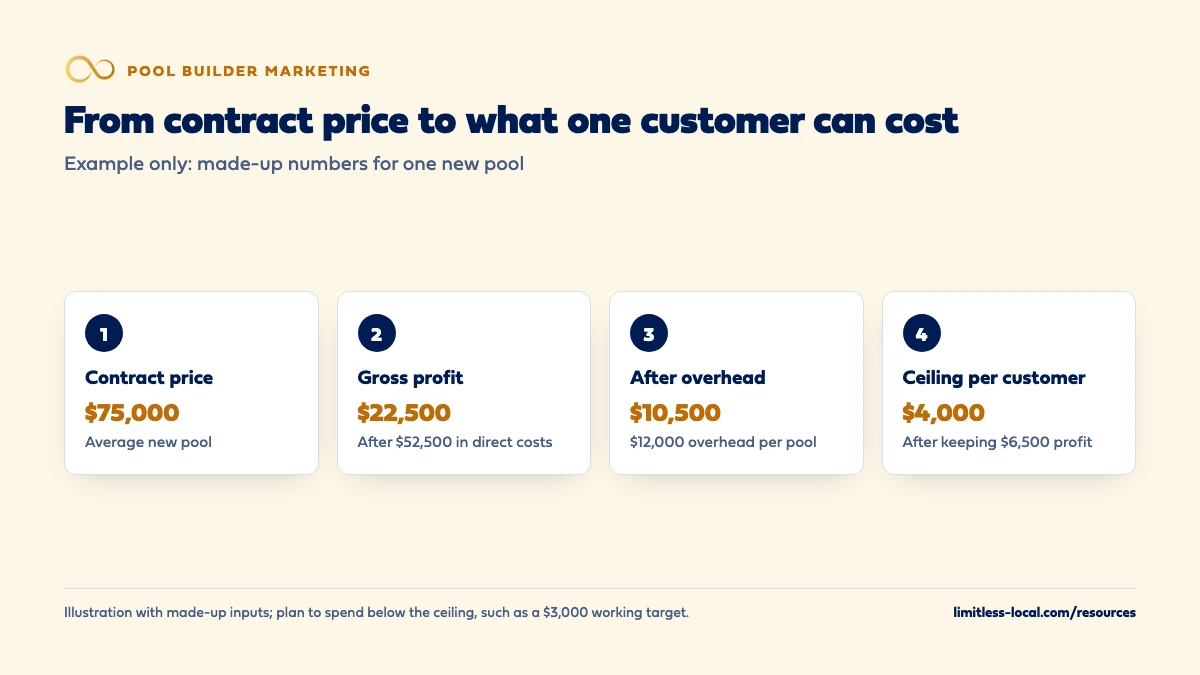
These numbers are made up to show the math, not a benchmark for your market. Say your average new pool sells for $75,000 and the direct costs of building it, materials, equipment, labor, subs and permits, come to $52,500. That leaves $22,500 in gross profit per pool, a 30% gross margin.
Your overhead, other than marketing, is $288,000 a year, and you build 24 pools a year, so each pool has to carry $12,000 of overhead. That leaves $10,500. You want to keep $6,500 per pool as profit, so your ceiling is $4,000: the most one new customer can cost in marketing before the pool earns less than you need.
Plan below it. A working target of $3,000 per customer leaves a $1,000 buffer for a slow month or a lost proposal. Measured against the contract price, $3,000 looks tiny, 4%. Measured against the $10,500 left after overhead, it’s about 29%, which is why the contract price is the wrong yardstick. If you want all 24 pools from marketing at that target, the year’s marketing, including any agency fee, should cost no more than $72,000.
Frequently asked questions
Should I use last year's numbers or this year's prices?
Use this year’s prices and costs if they’ve changed, checked against last year’s actual results. In our judgement, a ceiling built on old costs will be too generous if materials or labor went up.
Does the ceiling include my agency's fee?
Yes. Count everything you pay to find customers: ad spend, agency or freelancer fees, software, photos and shows. Otherwise marketing looks cheaper than it is.
What about customers who come from referrals?
They cost little in cash, so keep them out of the paid-marketing math. In our judgement, budget paid marketing for the contracts you need beyond what referrals already bring.
How often should I recalculate the ceiling?
At least once a year, and whenever your prices, costs or overhead change noticeably. A price increase raises the ceiling; a jump in material or labor costs lowers it.
Can I spend more to win a customer in the off-season?
The ceiling doesn’t change with the season, because the pool’s profit doesn’t. What changes is how many leads you need and when, so the spend can rise or fall while the cost per customer stays under the same ceiling.
Is a financed pool worth less to me?
Not if the lender pays you the contract price. If financing costs you anything, such as a fee you absorb, subtract it from the contract price before working out the ceiling.
Key takeaways
- Work your limit from profit per pool, not the contract price.
- Ceiling = gross profit, minus overhead per pool, minus the profit you want to keep.
- Plan to spend well below the ceiling and keep a buffer.
- Count per-contract sales costs and every marketing cost, once.
- Add lifetime value from service, renovations and referrals only when your records show it.
Ready to compare options?
Book a short growth call and we'll walk through the math for your service area, including when we're not the right fit.
More in this section
- How much should a pool builder spend on marketing?
- What is a good cost per signed pool contract?
- How do pool builders stop attracting price shoppers?
- How should a pool builder advertise financing options?
- Are Google Ads worth it for pool builders?
Sources
- Gross profit margin — BDC (Business Development Bank of Canada)
- Do you know the lifetime value and cost of acquisition of your customers? — BDC (Business Development Bank of Canada)
- Customer lifetime value — BDC (Business Development Bank of Canada)
- Break-even point calculator — U.S. Small Business Administration
- About conversion values — Google Ads Help