
How does a pool builder show up in AI search results?

- How can my pool company get mentioned by ChatGPT and Google's AI answers?
- How do AI search tools decide which pool builders to mention?
- Do I need to do anything special for AI search?
- Step 1: Can Google, Bing and ChatGPT read my website?
- Step 2: Is my site in the index and switched on for AI features?
- Step 3: What should my pool pages say so AI search can use them?
- Step 4: Are my business listings complete and consistent?
- Step 5: Do reviews and mentions elsewhere matter for AI search?
- Should I add schema markup or an llms.txt file?
- How do I check whether my pool company shows up in AI search?
- What should a pool builder avoid when chasing AI search?
- How long until a pool builder shows up in AI answers?
- What's different about AI search for pool builders
- A worked example: the same page, commodity and non-commodity
- Frequently asked questions
- Key takeaways
- More in this section
- Sources
The short version
- AI search tools find pool builders through search indexes, so the SEO basics still decide it.
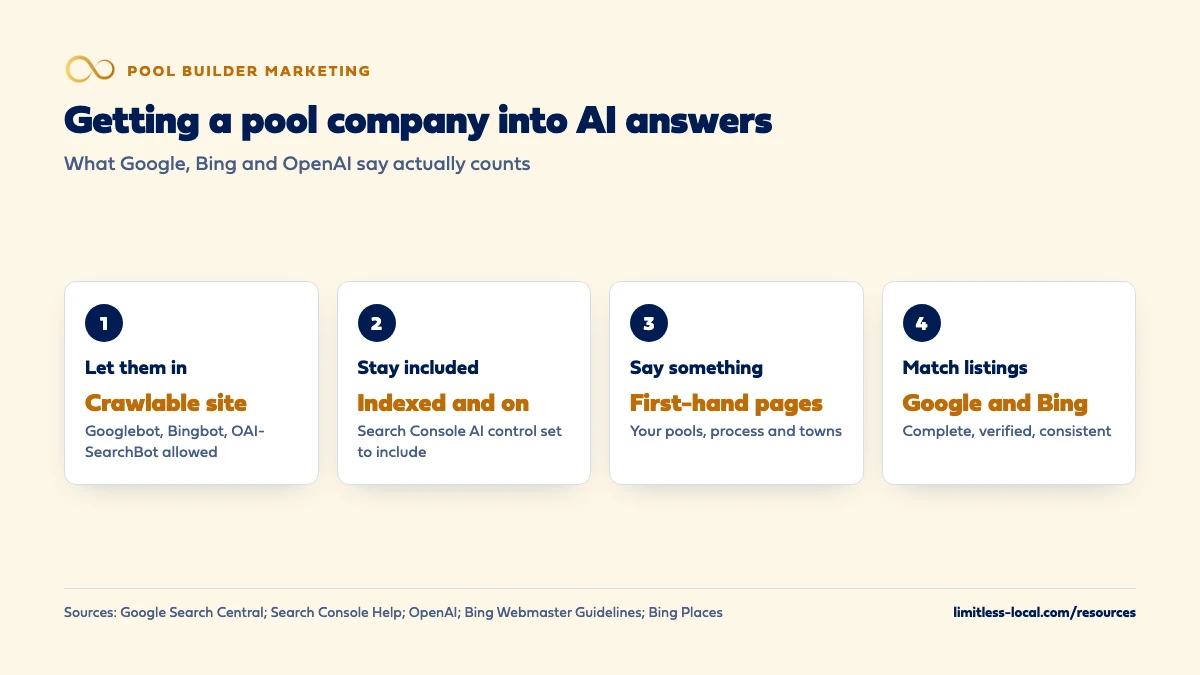
- Let Google, Bing and ChatGPT's search crawler read your site, and check the Search Console AI control.
- Publish specific, first-hand pages about your pools, process and towns, with real project photos.
- Keep your Google and Bing listings complete and consistent, and earn real reviews.
For pool builders who want their company named when homeowners ask ChatGPT, Google’s AI Overviews or Copilot about building a pool.
Get a free visibility audit · Book a growth call
How can my pool company get mentioned by ChatGPT and Google's AI answers?
A pool builder shows up in AI search results by doing the work regular search rewards, because tools like Google’s AI Overviews, AI Mode, ChatGPT search and Copilot find and cite pages through search indexes. Make sure your site can be crawled and indexed by Google, Bing and ChatGPT’s search crawler, publish specific pages about the pools you build and the towns you build in, and keep your Google Business Profile and Bing Places listing complete and consistent. Google says no special files, markup or AI-only rewrites are needed.
At Limitless Local, we optimize for the three places owners need to show up: the regular Google results, the Maps 3-pack, and AI answers such as ChatGPT, Google AI Overviews and Siri. For pool builders that work lives in our local SEO service, and the pool builder marketing page shows how it fits with ads and follow-up. More questions like this are in the pool builder marketing questions library.
How do AI search tools decide which pool builders to mention?
Mostly by searching the web the way a search engine does, then writing an answer from what they find. Google says its generative AI features, such as AI Overviews and AI Mode, are rooted in its core Search ranking and quality systems. They retrieve relevant pages from the Search index to ground the answer, and they use “query fan-out”, running a set of related searches to gather more results. Source: Optimizing your website for generative AI features on Google Search.
ChatGPT works in a similar way when it searches: it can search the web for current information, cite sources with links, and use an approximate location from your IP address to find local results. It may also share location with third-party providers that supply information such as nearby business listings. Source: Searching the web with ChatGPT. Bing says its search and Copilot experiences rely on the same crawling, indexing and ranking foundation as regular search. Source: Bing Webmaster Guidelines.
So for a homeowner asking an AI tool which builders to talk to about a fiberglass pool in their town, the pool companies it can mention are, in practice, the ones whose websites and listings it can find, read and trust. That’s our reading of the sources above, not a published formula.
Do I need to do anything special for AI search?
Less than you’d think. Google says that to appear as a supporting link in AI Overviews or AI Mode, a page must be indexed and eligible to be shown in Google Search with a snippet, and that there are no additional technical requirements. Source: AI features and your website.
Google’s guide on generative AI search goes further and lists things you can ignore for Google Search: llms.txt and other AI text files or special markup, which Google Search doesn’t use; breaking content into tiny “chunks”; rewriting content in a special style for AI; and chasing inauthentic mentions. It also says structured data isn’t required for generative AI search and there’s no special schema.org markup to add. Source: Optimizing your website for generative AI features on Google Search.
That matters when someone sells you “AI search optimization”. The steps below are the work that actually counts, and most of it is the same work that helps you in regular Google results and Maps.
Step 1: Can Google, Bing and ChatGPT read my website?
- Google: Google lists allowing crawling in robots.txt, and by any CDN or hosting setup, among the SEO basics that still count for AI features. Source: AI features and your website.
- ChatGPT: OpenAI says OAI-SearchBot is the crawler used to surface websites in ChatGPT’s search features, and sites that block it won’t be shown in ChatGPT search answers, though they can still appear as navigational links. It recommends allowing OAI-SearchBot in robots.txt. GPTBot is a separate setting, used for training models; you can block one and allow the other. Source: Overview of OpenAI Crawlers.
- Bing and Copilot: Bing warns that some page settings limit Copilot. A noarchive tag keeps content out of Copilot responses and grounding results, and nocache limits Copilot to the URL, title and snippet. Source: Bing Webmaster Guidelines.
In our judgement, the most common problem on a small pool builder’s site isn’t a policy choice; it’s a robots.txt line, security plugin or hosting setting someone added years ago and nobody checked. Ask whoever manages your site to confirm these three in writing.
Step 2: Is my site in the index and switched on for AI features?
Google Search Console now has a Search generative AI control. The default is to include your site’s links and content in AI Overviews, AI Mode and generative AI features in Discover. If a site is excluded, links to it and its content won’t appear in those features, and content from other sites will still be available there. Google says the control isn’t used as a ranking signal for the rest of Search. Source: Search generative AI control.
Check the setting under Settings in Search Console, especially if a previous web company set up your property. On the Bing side, Bing recommends sitemaps and IndexNow so it can find new and changed pages, and says timely notifications reduce outdated or incorrect URL references in Copilot responses. Source: Bing Webmaster Guidelines.
Step 3: What should my pool pages say so AI search can use them?
Google’s answer is “non-commodity” content. It says creating content people find unique, compelling and useful will likely influence your presence in generative AI search more than any other suggestion in its guide, names a unique point of view, such as a first-hand take, as one sign of it, and contrasts that with commodity content built on common knowledge. It also recommends clear paragraphs and headings, and high-quality images and video where they make sense. Source: Optimizing your website for generative AI features on Google Search.
For a pool builder, in our judgement, that means writing what only a builder in your area can say:
- How your design and build process actually runs, step by step, and how long each stage tends to take for you.
- What you build and what you don’t: gunite, fiberglass, vinyl, renovations, small yards, slopes.
- What’s specific to your towns: permits, soil, access, HOA reviews, the season you build in.
- Real projects, with photos, the town and what the homeowner wanted.
Bing adds that pages are more likely to be cited when they stand on their own, with facts stated plainly and important information visible on the page itself. Source: Bing Webmaster Guidelines. Which pages a pool site needs in the first place is covered in what a pool website should include, and how to use build photos is in using project photos and videos.
Curious what your marketing is actually booking?
Get a free visibility audit — no obligation, no sales pitch.
Step 4: Are my business listings complete and consistent?
Google’s guide says generative AI responses can include information about local businesses, and that Google Business Profiles can help your services be visible in AI responses and other results. Its AI features page lists keeping Business Profile information up to date among the basics. Sources: Optimizing your website for generative AI features and AI features and your website. The field-by-field setup is in optimizing your Google Business Profile.
Don’t stop at Google. Bing says Bing Places is one of the primary sources for its local listings, and recommends including your name, address, phone, category, website and hours, adding photos, and, most importantly, verifying the listing. Source: Bing Places for Business. Bing also asks for clear and consistent naming of organizations and locations. In our judgement, a pool company listed under three slightly different names across the web is harder for any system to treat as one business.
Step 5: Do reviews and mentions elsewhere matter for AI search?
Google says its generative AI features can show what’s being said about products and services across the web, including blogs, videos and forum discussions, but that seeking inauthentic mentions isn’t as helpful as it might seem, because its ranking and spam systems apply to AI features too. Source: Optimizing your website for generative AI features on Google Search.
In our judgement, the honest version for a pool builder is the slow one: steady Google reviews from real customers, finished projects featured by the suppliers, landscapers or designers you work with, and local coverage when you earn it. Building the review habit is covered in getting more Google reviews.
Should I add schema markup or an llms.txt file?
Neither is a shortcut. Google says structured data isn’t required for generative AI search and there’s no special markup to add, though it’s still worth using as part of your overall SEO because it helps with eligibility for rich results. It also says Google Search doesn’t use llms.txt or similar AI text files. Source: Optimizing your website for generative AI features on Google Search. Bing says structured data may support clearer grounding but doesn’t guarantee visibility, and markup must match the visible content. Source: Bing Webmaster Guidelines.
If your site already has accurate local business markup, keep it accurate. If someone is charging you mainly to add AI files, ask them to show you where a search engine says it uses them.

How do I check whether my pool company shows up in AI search?
- Search Console’s Generative AI performance report shows how often links to your site appeared in Google’s generative AI features, which pages got those impressions, and by device and country. If you don’t see it, Google says it usually means the site hasn’t had enough impressions in those features yet, or the site has been excluded. Source: Generative AI performance report (Search).
- Ask the tools yourself. Once a month, ask ChatGPT and Google’s AI Mode the questions a homeowner would, with your town in the question, and note who gets named and which pages are cited. OpenAI itself says search results and citations can be incomplete, outdated or incorrect, and suggests including your city or postal code for local questions. Source: Searching the web with ChatGPT.
- Ask your leads. Add “an AI tool like ChatGPT” as an option when your office asks how a homeowner found you.
In our judgement, treat the manual checks as a direction, not a scoreboard: answers vary by person, place and wording.
What should a pool builder avoid when chasing AI search?
- A page for every phrasing. Google says creating separate content for every variation of how people search, mainly to manipulate rankings or AI responses, violates its spam policies and is ineffective. Source: Optimizing your website for generative AI features on Google Search. One strong page per real service or town beats dozens of near-copies.
- Bought or fake mentions and reviews. See Step 5.
- Accidentally switching yourself off, through the Search Console control, a blocked crawler or a nosnippet setting.
- Mass-produced AI text. Google says content made with generative AI tools still has to meet its Search Essentials and spam policies.
How long until a pool builder shows up in AI answers?
Nobody can promise a date, and anyone who guarantees AI placement is guessing. Because Google’s AI features draw on the same index and ranking systems as regular Search, in our judgement AI visibility tends to follow the same ramp as SEO, which typically takes 3 to 6 months to show meaningful organic growth. Listings and crawler fixes can count sooner; content and reputation take longer. The SEO timeline for pool companies is laid out in how long pool builder SEO takes.
Not sure which of these is costing you jobs?
A free visibility audit checks the Google profile, reviews, site and tracking, and shows what to fix first.
What's different about AI search for pool builders
Pool buyers ask long, specific questions. A homeowner planning a pool asks about pool types, yard size, timelines, permits and financing, the kind of multi-part question AI tools are built to answer. In our judgement, that gives pool builders who publish real process and project detail more chances to be cited than trades whose customers just need someone today.
The research phase is long. A homeowner can spend a season comparing builders before booking a consultation. An AI answer that mentions you early can be the reason your name is on the shortlist months later, which also makes AI search hard to credit in your lead log.
Your best evidence is visual. Finished pools sell pools. Google says its AI features can bring in relevant images and video, so project photos with clear descriptions on your own pages do double duty.
A worked example: the same page, commodity and non-commodity
This is an illustration, not a real client page. Picture two versions of a fiberglass pool page for a builder in a made-up town.
Version one lists the general benefits of fiberglass pools that appear on thousands of sites: quick installs, smooth surfaces, low maintenance. It’s accurate, and it’s exactly the kind of common-knowledge content Google calls commodity.
Version two says which fiberglass shells this builder installs and why, what the access requirements are for getting a shell into a typical backyard in its towns, how its permit and install steps run, what it’s learned about local soil and drainage, and shows three finished installs with the town and the homeowner’s goal for each.
Only version two answers the question a homeowner actually asks an AI tool, something like “who installs fiberglass pools in my town, and what’s involved?”, with information nobody else has. In our judgement, that’s the page an AI answer is more likely to draw on, and it’s also the page that turns a reader into a consultation.
Frequently asked questions
Can I pay to be recommended by ChatGPT or Google's AI answers?
There’s no sign-up for the organic answers: Google, Bing and OpenAI each describe them as drawing on web search results. Ads are a separate product with their own placements.
Does my Google Business Profile affect AI search?
Google says Business Profiles can help your services be visible in AI responses and lists keeping that information up to date among the basics for its AI features.
Should I block AI crawlers from my pool website?
That’s your choice, but know the trade-off. OpenAI says sites that block OAI-SearchBot won’t be shown in ChatGPT search answers; blocking GPTBot only affects model training.
Will FAQ pages help my pool company show up in AI answers?
Pages that answer real homeowner questions with your own specifics can help. Google warns against making separate pages for every variation of a question, so answer each one well, once.
Does AI search replace Google Maps for pool builders?
No. In our judgement, Maps, regular results and AI answers draw on overlapping signals, so the same work on your profile, site and reviews supports all three.
How do I know if a lead came from AI search?
Ask every new lead how they found you and include AI tools as an option. Search Console’s Generative AI performance report shows impressions, but not who called you.
Key takeaways
- AI search tools find pool builders through the same search indexes, so SEO basics come first.
- Allow Googlebot, Bingbot and OAI-SearchBot, and check the Search Console generative AI control.
- Publish first-hand pages about your pools, process and towns; skip llms.txt and AI-only rewrites.
- Keep Google Business Profile and Bing Places complete, verified and consistent.
- Track it with Search Console’s Generative AI report, monthly manual checks and asking your leads.
Want a second set of eyes on your setup?
We'll look at how you show up locally and where calls are leaking, then send you a plain-English breakdown.
More in this section
- What keywords should a pool builder target?
- How long does pool builder SEO take to bring in leads?
- How should a pool builder set up its Google service area?
- What should a pool builder website include to get more consultations?
- How can pool builders get referrals from landscapers and builders?
Sources
- Optimizing your website for generative AI features on Google Search — Google Search Central
- AI features and your website — Google Search Central
- Search generative AI control — Search Console Help
- Generative AI performance report (Search) — Search Console Help
- Overview of OpenAI Crawlers — OpenAI
- Searching the web with ChatGPT — OpenAI Help Center
- Webmaster Guidelines — Bing Webmaster Tools
- Bing Places for Business: Manage your listing — Bing Places for Business