
How does Quality Score affect an electrician’s Google Ads costs?
- Does a low Quality Score make an electrician pay more per click?
- What is Quality Score in Google Ads?
- Does Quality Score decide what I pay per click?
- How does ad quality change what an electrician pays per click?
- What do the three Quality Score parts mean for an electrical ad?
- Why is my Quality Score low on panel upgrade or EV charger keywords?
- How do I fix a below-average landing page experience?
- How do I raise my expected clickthrough rate without attracting the wrong calls?
- What does a dash in the Quality Score column mean?
- Does Quality Score affect Local Services Ads?
- Should I try to get every keyword to a 10?
- What's different about Quality Score for electricians
- A worked example: the page matters more than the click price
- Frequently asked questions
- Key takeaways
- More in this section
- Sources
The short version
- Quality Score is a 1-10 diagnostic per keyword, not a bill or an auction input.
- The ad quality it summarizes does affect cost: better ads typically pay less per click.
- Three parts: expected clickthrough rate, ad relevance and landing page experience.
- Fix it by giving each electrical job its own ad group, ad and page, then judge on cost per booked job.
For electrical contractors running Google Search ads who want to know what that 1-to-10 number in the keywords table really does to what they pay.
Get a free visibility audit · Book a growth call
Does a low Quality Score make an electrician pay more per click?
Quality Score doesn’t set an electrician’s cost per click directly: Google calls it a diagnostic, rated 1 to 10 per keyword, and says it isn’t an input in the ad auction. What does affect cost is the ad quality behind it, meaning how likely your ad is to be clicked, how well it matches the search, and how useful your landing page is, because Google says higher quality ads typically pay less per click and can show higher on the page. For an electrician, the usual fix is matching each kind of job, such as panel upgrades, EV chargers or service calls, to its own ad and its own page.
Cost per click is only the first number we look at. The one that decides whether Google Ads is working is what each booked job cost, and that’s how we run Google Ads for local service businesses. It’s part of our electrical contractor marketing, and the rest of the electrical marketing questions library goes question by question.
What is Quality Score in Google Ads?
Quality Score is a number from 1 to 10 that Google Ads gives each keyword in a Search campaign. Google describes it as a diagnostic tool showing how your ad quality compares to other advertisers: a higher score means your ad and landing page are more relevant and useful to someone searching that keyword than other advertisers’ are.
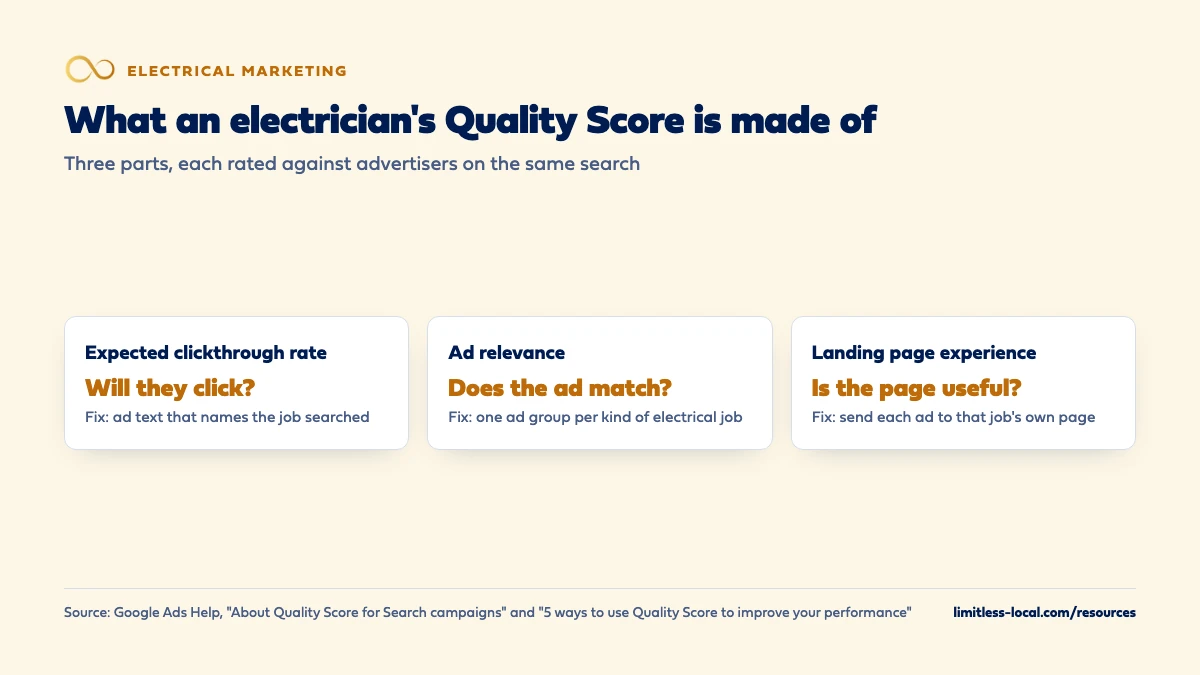
It’s built from three parts, each rated Above average, Average or Below average:
- Expected clickthrough rate: how likely your ad is to be clicked when it shows.
- Ad relevance: how closely your ad matches the intent behind the search.
- Landing page experience: how relevant and useful the page is to people who click.
The comparison is against other advertisers whose ads showed for the exact same search over the last 90 days. So a 4 on your “panel upgrade” keyword means other advertisers’ ads and pages looked more useful for that search than yours. Source: About Quality Score for Search campaigns.
Does Quality Score decide what I pay per click?
Not directly, and Google is unusually clear about it: Quality Score is not a key performance indicator, shouldn’t be optimized for its own sake, and is not an input in the ad auction.
What the auction does use is ad quality measured at the moment of each search. Google lists six factors in Ad Rank, the score that decides whether your ad shows and where: your bid, the quality of your ads and landing page, the Ad Rank thresholds, how competitive the auction is, the context of the search (words, location, device, time), and the expected impact of assets such as a call button. Auction-time quality includes expected clickthrough rate, ad relevance and landing page experience, the same three things Quality Score reports on.
So Quality Score is a reading on the thing that affects your costs. A low score doesn’t add a charge; it warns that your ads and pages are probably costing you more than they need to. Sources: About Quality Score for Search campaigns and About Ad Rank.
How does ad quality change what an electrician pays per click?
Through the way Google prices a click. Your actual cost per click is often less than your maximum bid: you pay what’s needed to clear the Ad Rank thresholds and beat the Ad Rank of the advertiser just below you. Because quality is part of Ad Rank, a better ad can win the same spot for less, and Google says higher quality ads typically cost less per click.
Quality also moves the bar you have to clear. Google says lower quality ads have higher Ad Rank thresholds, and spots higher on the page have higher thresholds too. Two consequences for an electrical shop:
- With low-quality ads, Google says your actual cost per click may sit close to your maximum bid even when there’s little competition.
- With no other electrician in the auction, you still pay the reserve price, which depends on your ad quality and thresholds, so a weak ad can be expensive with nobody bidding against it.
Quality also decides whether your ad can show at all and whether assets like your call button appear. Sources: Actual cost-per-click (CPC): Definition, Ad Rank thresholds: Definition and About ad quality.
What do the three Quality Score parts mean for an electrical ad?
Each part points to a different fix, which is why Google suggests reading the three statuses rather than the single number.
Expected clickthrough rate predicts whether someone will click your ad for that keyword, adjusted to remove the effect of ad position and assets, so it isn’t the CTR column in your account. Google says a below-average status suggests rewriting the ad to relate more closely to your top keywords. An ad reading “Licensed Electrician, Fast Service” under a search for “Level 2 EV charger installation” doesn’t tell that searcher you install chargers.
Ad relevance asks whether the ad matches what the person meant. One ad group holding “outlet repair”, “whole house rewire” and “generator installation” can’t have one ad that fits all three.
Landing page experience asks whether the page is useful to the person who clicked. A generator search landing on a home page about lighting makes the visitor start over.
In our judgement, check the parts even when the number looks fine, because each one points to a different fix. Sources: Expected clickthrough rate: Definition and 5 ways to use Quality Score to improve your performance.
Curious what your marketing is actually booking?
Get a free visibility audit — no obligation, no sales pitch.
Why is my Quality Score low on panel upgrade or EV charger keywords?
In our judgement, three set-ups cause most low scores on electrical accounts, and all three come down to the job not matching:
- Everything in one ad group. Service calls, panel upgrades, EV chargers and generators share one ad. Google’s fix is to split ad groups with many different keywords into smaller ones grouped by service.
- Every ad points to the home page. The panel upgrade searcher lands on a page built for every visitor, with the panel information three scrolls down, if it’s there at all.
- Keywords the ad can’t answer. Broad keywords pull in searches like “how to wire a subpanel” or “electrician apprentice jobs”. Those searchers rarely click a contractor’s ad, which can drag expected clickthrough rate down, and the ones who do click cost you money.
Which keywords an electrician should bid on covers selection, and negative keywords to add first covers the searches to block. Source for Google’s ad-group advice: 5 ways to use Quality Score to improve your performance.
How do I fix a below-average landing page experience?
Send each ad to the page about that job. Google’s example: someone who clicks an ad for flannel shirts should land on a page showing flannel shirts. For an electrician, a panel upgrade ad lands on your panel upgrade page, an EV charger ad on your EV charger page, and an urgent repair ad on a page with your phone number at the top.
Google’s other suggestions from the same page:
- Keep the message consistent from ad to page.
- Make the page easy to use on a phone.
- Make it load fast.
- Watch conversion rate as a stand-in for landing page quality. It doesn’t change the status, but it shows whether the page works.
The page doesn’t need the word-for-word search phrase on it, Google says; it needs to give the person what they came for. If you don’t have a page for each kind of work you advertise, build that first: which service pages an electrical site needs lays out the list. Source: 5 ways to use Quality Score to improve your performance.
How do I raise my expected clickthrough rate without attracting the wrong calls?
Be specific. Google’s suggestions for a below-average expected clickthrough rate include matching the ad’s details to the intent of your keywords, highlighting what’s different about your service, being more specific in the ad text, and using a clear call to action such as “Get a Quote”.
Google adds a caution worth taking seriously in a trade: a more specific ad can get a lower clickthrough rate and a higher conversion rate. An ad saying you install Level 2 home chargers with free estimates may get fewer clicks than a vague “Electrician Near You” ad, but those clicks are people who want a charger. Since you pay for every click, in our judgement fewer, better clicks can lower your cost per booked job even if the clickthrough rate dips.
Assets such as a call button and sitelinks to your service pages help too; Google counts their expected impact in Ad Rank. Sources: 5 ways to use Quality Score to improve your performance and About Ad Rank.

What does a dash in the Quality Score column mean?
A dash (“—”) means there aren’t enough searches that exactly match the keyword for Google to calculate a score. Electricians in smaller towns see this often: “generator transfer switch installation” may rarely be searched word for word across a few small towns.
Google suggests using Keyword Planner to find related keywords people search more often, or broadening the match type so the keyword enters more auctions and gathers exact-match data. Changing match types doesn’t change how the score is calculated, because it’s based on historical impressions for exact searches of your keyword.
A dash isn’t a penalty, and Google says some quality factors aren’t captured by Quality Score at all, including device, location, time of day and assets. Judge low-volume keywords on booked jobs, not on whether they have a score. Source: About Quality Score for Search campaigns.
Does Quality Score affect Local Services Ads?
No. Quality Score is a Search campaign diagnostic, reported for keywords, and Local Services Ads don’t use keywords. They’re ordered by an auction that weighs your bid and your overall profile quality, and Google lists what goes into that:
- Responsiveness: missed calls may hurt it.
- Relevance: the job and location searched, the time of the search, and how well your services and business bio match.
- Profile quality: your rating, number of reviews, average response time, good photos and the verification checks you’ve completed.
The idea is similar: Google says higher quality profiles may rank higher and may also pay lower costs per lead. But the levers are different. On LSAs, in our judgement, an electrician works on ranking and lead cost by answering calls, collecting reviews and completing verification, not by rewriting ad text. Whether LSAs are worth it for electricians covers how those leads are charged. Source: About ad rankings.
Should I try to get every keyword to a 10?
No. Google says to treat Quality Score as a general indicator of where to focus, not a score to be optimized, and to read it alongside clickthrough rate, conversion rate and site engagement: check which of your best keywords might do even better with a better ad or page, and use low scores to spot weak patterns across the account.
For an electrical contractor, we’d work in this order. First, make sure calls and form fills are tracked and you know which ones booked. Then check the three Quality Score parts on the keywords spending the most. A keyword with a 5 that books panel upgrades at a cost you’re happy with beats one with an 8 that brings in DIY questions. The measure that settles it is cost per booked job; what a good cost per booked job looks like covers setting your own target. Source: 5 ways to use Quality Score to improve your performance.
Want to see where your company stands?
A free visibility audit shows where you show up on Google, Maps and AI answers, and what it's costing you in calls.
What's different about Quality Score for electricians
One trade, very different searches. “Breaker keeps tripping”, “200 amp panel upgrade” and “Tesla charger installer” are different jobs with different customers. In our judgement, electrical accounts suffer more than most from lumping them into one ad group, because no single ad or page fits all of them.
Lots of do-it-yourself searches. Electrical keywords attract homeowners looking up how to do the work themselves and people looking for electrician jobs. They rarely book, so blocking them protects the budget.
Small service areas. Many electrical shops work a handful of towns, so specific job keywords may get few exact searches. Expect more dashes in the Quality Score column, and judge those keywords on booked jobs.
Your license is a reason to click. Homeowners don’t always know a licensed electrician from a handyman. In our view, saying you’re licensed and insured in the ad, and showing it on the page, gives searchers a reason to pick your ad.
A worked example: the page matters more than the click price
These numbers are made up to show the math, not a benchmark for your market. Say an electrician’s panel upgrade ad group spends $1,200 in a month at an average actual cost per click of $24, which buys 50 clicks.
Version one: the ads go to the home page. Of the 50 clicks, 3 call and 1 books a panel upgrade. That job cost $1,200 in ad spend.
Version two: the same ads go to a panel upgrade page with the phone number at the top, real panel photos and a short quote form. Say 6 of the 50 clicks call and 2 book. Each booked job now cost $600, and the cost per click didn’t move at all.
A better landing page is also one of the three things Quality Score measures, so cheaper clicks may follow. Google doesn’t publish how much a quality change moves a price, so plan around the booking rate, which you can measure.
For reference: our Essentials package is $3,500 a month and includes Google Ads management up to $2,500 a month in ad spend, and Growth is $4,500 a month with Google Ads up to $5,000 a month in spend. Ad spend is paid to Google separately. Which Google Ads campaigns work best covers how to set up campaigns around those jobs.
Frequently asked questions
Will raising my bid improve my Quality Score?
No. Google says your bid can affect your Ad Rank, but it doesn’t affect the assessment of your ad quality.
Can I be charged more than my maximum bid because of a low Quality Score?
Not with manual bidding. Google says you’ll never be charged more than your maximum cost per click, no matter how low your ad quality, unless you use automated bidding.
Do my booked jobs or conversions raise my Quality Score?
No. Google says reported conversions don’t affect ad quality. Conversion rate is still a useful sign that a landing page is working.
Does my landing page need to repeat the exact search phrase?
No. Google says the word-for-word search term doesn’t need to be on the page; the page needs to give the person what they were looking for.
Where do I find my Quality Score?
In Google Ads, open Keywords under Campaigns, edit the columns, and add Quality Score plus Exp. CTR, Ad Relevance and Landing Page Exp. Historical versions of each are available too.
Key takeaways
- Quality Score is a 1-10 diagnostic per keyword; Google says it isn’t an input in the ad auction.
- The ad quality behind it does affect cost: Google says higher quality ads typically pay less per click.
- Low-quality ads face higher thresholds, so they can pay close to their maximum bid even with little competition.
- For electricians, the fix is one ad group, one ad and one page per kind of job.
- Local Services Ads don’t use Quality Score; responsiveness, reviews and verification drive their ranking.
- Judge keywords on cost per booked job, not on the score.
Not sure what's working right now?
Start with a free visibility audit: rankings, Google profile, reviews and tracking, checked against your service area.
More in this section
- How much should an electrician spend on Google Ads each month?
- Which keywords should an electrician bid on in Google Ads?
- What Google Ads campaigns work best for electricians?
- Are Google Local Services Ads worth it for electricians?
- How do electricians get verified for Google Local Services Ads?
Sources
- About Quality Score for Search campaigns — Google Ads Help
- About ad quality — Google Ads Help
- About Ad Rank — Google Ads Help
- Actual cost-per-click (CPC): Definition — Google Ads Help
- Ad Rank thresholds: Definition — Google Ads Help
- 5 ways to use Quality Score to improve your performance — Google Ads Help
- Expected clickthrough rate: Definition — Google Ads Help
- About ad rankings — Google Local Services Help