
How long should I run roofing Google Ads before judging them?
- How many weeks of roofing Google Ads do I need before I decide to fix, scale or stop?
- Why can't I judge roofing ads after the first week?
- What does Google say about the learning period?
- What is a conversion cycle, and how long is a roofer's?
- What should I check in the first two weeks?
- How many leads do I need before the numbers mean something?
- When can I judge cost per signed roof?
- What shouldn't I change while I'm waiting?
- How do I know whether to fix, scale or stop?
- How do storms and seasons change when I should judge?
- Does Quality Score tell me sooner whether the ads are working?
- What's different about judging roofing ads
- A worked example: how long a roofer needs to reach a fair read
- Frequently asked questions
- Key takeaways
- More in this section
- Sources
The short version
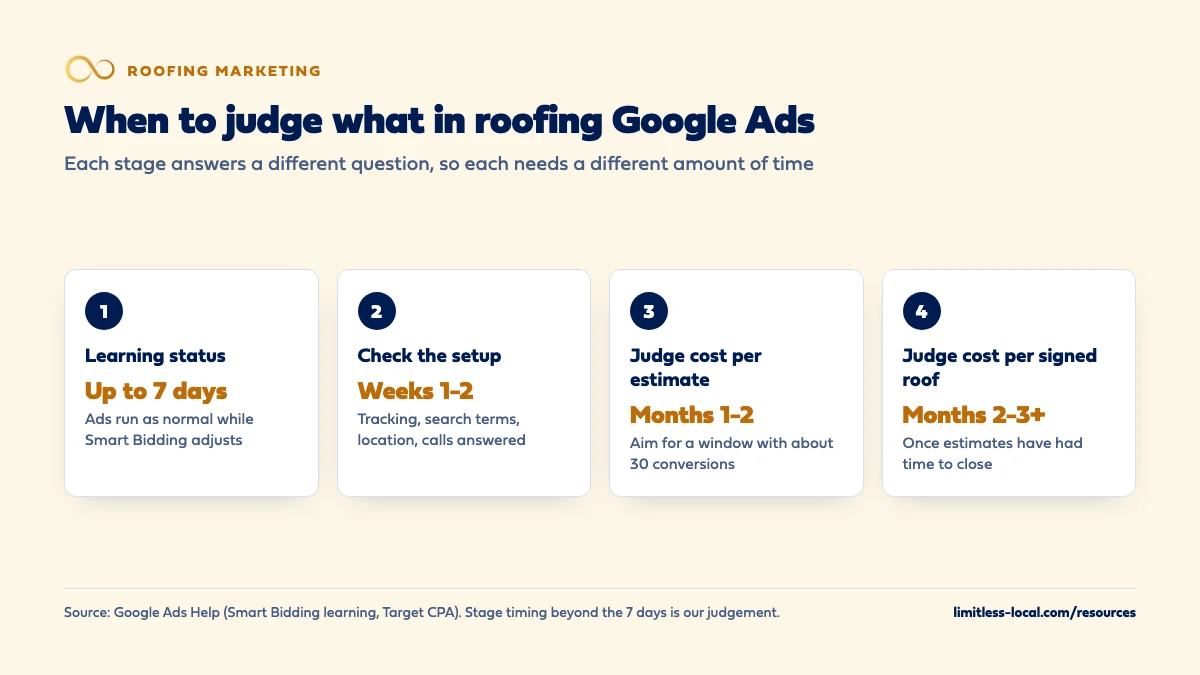
- Weeks one and two: judge the setup, such as tracking, search terms and whether calls get answered.
- Month one to two: judge estimate requests and cost per estimate.
- Later: judge cost per signed roof, once estimates have had time to close.
- Google suggests at least 30 conversions for a fair read, which takes most roofers more than a month.
For roofing company owners a few weeks into a Google Ads campaign who want to know when the numbers mean something and what to judge at each stage.
Get a free visibility audit · Book a growth call
How many weeks of roofing Google Ads do I need before I decide to fix, scale or stop?
Judge roofing Google Ads in stages: check the setup in the first one to two weeks, judge leads and cost per estimate after a month or two, and judge cost per signed roof only once those estimates have had time to close. Google says a bid strategy’s Learning status lasts up to 7 days, that performance settles over one to two conversion cycles, and that you should then evaluate over two conversion cycles or two weeks, whichever is longer. For Target CPA it recommends measuring the last 30 days with at least 30 conversions, and in our judgement most roofers need more than a month of normal demand to reach that many estimate requests, so a storm week or a slow week shouldn’t decide anything.
Judging in stages only works if every call and form is tracked, which is why call, web and form tracking comes with Google Ads management in our roofing marketing packages. For the break-even test itself, how to tell whether a month of ads paid for itself, see our guide on whether Google Ads is worth it for a roofing company, and the roofing marketing questions library covers the rest one question at a time.
Why can't I judge roofing ads after the first week?
Because a week tells you whether the ads are running, not whether they work. Ads can bring in leads within days of launch, but a few days of a roofing budget is a small number of clicks, and a handful of clicks can swing either way on luck alone.
There’s also a reporting delay. Google says conversion lag is the gap between someone clicking an ad and converting, and because Google Ads reports conversions by the date of the search rather than the date of the conversion, recent numbers aren’t complete yet. Google says that can make cost per conversion look inflated for the most recent days. For a roofer, the bigger delay is the one Google can’t see: the weeks between an estimate and a signed contract.
What does Google say about the learning period?
If your campaign uses an automated bid strategy, such as Maximize conversions or Target CPA, Google’s page on Smart Bidding learning sets out the timeline:
- A Learning status can show for up to 7 days after a new bid strategy, a change in which campaigns, ad groups or keywords it covers, or a significant change in conversion goals. Ads run as normal during it.
- Performance typically settles on the new goal within one to two conversion cycles.
- After that, Google recommends evaluating performance over two conversion cycles or a two-week window, whichever is longer, allowing for conversion delay.
Google also says new campaigns without much conversion history may see temporary swings as Smart Bidding ramps up, and that very restrictive settings, such as tight targets, low daily budgets or narrow targeting, can slow the ramp. Many roofing campaigns have at least one of those, which is one reason the wait is longer than the Learning label suggests.
What is a conversion cycle, and how long is a roofer's?
Google defines a conversion cycle as the time it takes for a click to result in a conversion. If you import conversions into Google Ads, it also includes the time it takes for them to be reported. Google says you can see how long your customers take to convert in the bid strategy report.
For a roofer, it depends on what you count as the conversion. A call or estimate request often comes the same day as the click. A signed roof replacement can come weeks later, after the inspection, the estimate, maybe an insurance adjuster and a few follow-ups. If you send signed jobs back into Google Ads, your conversion cycle is that longer stretch, and every rule of thumb that says one to two conversion cycles gets longer with it.
What should I check in the first two weeks?
The setup, not the results. In the first week or two, look for things that are broken, because those don’t need more data to spot:
- Tracking: calls from the ad and from your website, and form fills, are all being counted. Compare against your phone log.
- Search terms: the searches you’re paying for are homeowners, not job seekers, do-it-yourselfers or supply shoppers. Negative keywords for roofing ads covers the list.
- Location: clicks are coming from the towns you serve.
- The phone: calls are being answered, and missed calls get a call back.
If clicks are coming in with no calls at all, don’t wait out the month. Roofing ads getting clicks but no calls walks through the checks in order.
Curious what your marketing is actually booking?
Get a free visibility audit — no obligation, no sales pitch.
How many leads do I need before the numbers mean something?
Google’s guidance for Target CPA is to measure performance over the last 30 days, and over periods with at least 30 conversions, for more accurate results. That’s a useful yardstick even if you don’t use Target CPA, because it’s about how much data it takes before a cost per conversion settles down.
Our judgement: most roofing campaigns won’t produce that many estimate requests in their first month, especially in a smaller market or a slower season. That doesn’t mean you can’t judge anything. It means you should judge on a longer window, two or three months rather than one, and treat early cost-per-estimate numbers as a range, not a verdict. The smaller the budget, the longer it takes to reach a number you can trust.
When can I judge cost per signed roof?
Later than cost per estimate, and only if you track it. Estimates take time to close, so the roofs signed this month partly came from last month’s ads. Our rule of thumb is to look at cost per signed roof over at least two to three months, and to count signed jobs by the month the lead came in, not the month the contract was signed.
Two Google settings matter here. The conversion window, which defaults to thirty days, decides how long after a click a conversion still counts; Google notes it can be changed for businesses whose buying cycle doesn’t fit the default. And offline conversion imports let you send what happens off the website, such as a signed contract, back into Google Ads, so it can see which clicks turned into jobs. Tracking which roofing leads turn into signed jobs covers the setup.
What shouldn't I change while I'm waiting?
Not everything resets the clock, which is good news. Google says changes to budgets, targets, ads or targeting settings such as location take effect right away and never trigger a Learning status. A new bid strategy, adding or removing campaigns, ad groups or keywords from it, or a significant change to your conversion goals can.
Google also advises against making several target changes within one conversion cycle unless there’s a clear business reason. In practice, change one thing at a time, note the date, and give it a couple of weeks of normal demand before deciding whether it helped. Changing the keywords, the bid strategy and the landing page in the same week leaves you with no way to tell which one moved the numbers.

How do I know whether to fix, scale or stop?
Look at where the leads stop, because that tells you which decision you’re actually making:
- Clicks but no calls or forms: fix the ads, the search terms or the page. That’s a setup problem, and more time won’t solve it.
- Calls but few estimates booked: look at the phone and the follow-up before blaming the ads.
- Estimates but few signed roofs: that’s the sales stage. Following up on unsigned roofing estimates covers it.
- Signed roofs at a cost well under what a job earns, two or three months running: that’s the time to consider a bigger budget. Google notes daily budget changes take effect immediately without a Learning status, so you can raise it in steps.
- Signed roofs costing more than a job earns after the fixes above: that’s when stopping, or moving the money elsewhere, is a fair call.
How do storms and seasons change when I should judge?
A lot. A hailstorm can fill a month with calls that have nothing to do with how good your campaign is, and a slow winter can make a well-built campaign look weak. In our judgement, roofers should compare like with like: a storm month against the last storm month, a winter month against the last winter, or cost per signed roof across a full season rather than a single month.
If your campaign launches into a storm, enjoy the calls, but don’t take that cost per estimate as the baseline. If it launches in the off-season, expect slower numbers and give it longer. Changing your roofing ad budget from storm season to winter covers how to plan around both.
Does Quality Score tell me sooner whether the ads are working?
Not really. Google describes Quality Score as a diagnostic that compares your ads and pages with other advertisers over the last 90 days, built from expected clickthrough rate, ad relevance and landing page experience rather than from your calls or booked jobs. It can point to a weak ad or landing page early, but it can’t tell you whether the campaign is booking roofs. Quality Score for roofing Google Ads explains what it does tell you.
The early numbers worth watching are the ones closest to the money: calls answered, estimate requests, and the share of search terms that came from homeowners in your area.
Talk it through with someone who runs this every day
A 15-minute growth call: your market, your numbers, and what a realistic budget looks like. No pressure.
What's different about judging roofing ads
A long road from click to contract. A roof replacement often involves an inspection, a written estimate, financing or an insurance adjuster, and a homeowner comparing several bids. In our judgement that takes weeks, not days, which is why a roofer has to judge leads first and signed roofs later, while a trade with same-day jobs can judge both at once.
Repairs and replacements move at different speeds. A leak repair often books within a day or two of the call. A replacement may take a month or more to sign. If one campaign covers both, early results will look like a repair campaign. Judge them separately if you can.
Weather drives demand more than most trades. Storm weeks and dry spells can swing the numbers more than any change you make to the ads. That’s why the comparison window for a roofer needs to be longer, and why a single month is rarely a fair test.
A worked example: how long a roofer needs to reach a fair read
These numbers are made up to show the math, not a benchmark for your market. Say your campaign spends $2,400 a month at an average of $20 a click. That’s 120 clicks a month.
- If one in eight clicks becomes a call or form that turns into a booked estimate, that’s 15 estimates a month, at $160 each.
- To reach the 30 conversions Google suggests for a reliable read takes two full months of spend, $4,800 in total.
- If one in three of those estimates signs, that’s 10 signed roofs, or $480 per signed roof. But estimates booked in month two may not sign until month three, so the signed-roof number for those two months isn’t final until weeks later.
So for this made-up roofer, a fair first verdict on cost per estimate comes after about two months, and a fair verdict on cost per signed roof after about three. With half the budget, it would take twice as long. The same math with your own budget, click cost and close rate tells you how long your own campaign needs.
If you’d rather hand this off, our Essentials package is $3,500 a month and includes Google Ads management up to $2,500 a month in ad spend, plus call, web and form tracking. Ad spend is paid to Google separately.
Frequently asked questions
Should I pause my roofing ads if the first week is quiet?
Not because of the week alone. Check that tracking works, the search terms are homeowners and calls are answered. If the setup is sound, give it the month or two it needs to produce enough estimates to judge.
Does changing my budget restart the learning period?
No. Google says changes to budgets, targets, ads or targeting settings take effect right away and never trigger a Learning status. A new bid strategy or a big change in conversion goals can.
Is it fair to judge ads during storm season?
It’s fair to judge them against other storm months, but not to treat storm-month results as your normal baseline. Compare like with like, or look across a full season.
What if I don't have enough budget to get a fair read?
Then the read takes longer, or you narrow the campaign to the one job and the towns that matter most, so the budget you have produces enough estimates to judge.
Can an agency tell me sooner whether my ads will work?
It can tell you sooner whether the setup is sound, which is the first stage. Nobody can honestly tell you what a campaign will book before it has run long enough to produce real estimates.
Should I count calls that didn't book an estimate?
Count them, but separately. Calls show the ads are reaching people; booked estimates and signed roofs show whether they’re the right people and whether your follow-up is working.
Key takeaways
- Judge in stages: setup in weeks one and two, cost per estimate after a month or two, cost per signed roof after that.
- Google’s Learning status lasts up to 7 days; performance settles over one to two conversion cycles.
- Google suggests at least 30 conversions for a fair read, which takes most roofers more than a month.
- Count signed roofs by the month the lead came in, and send them back to Google Ads if you can.
- Change one thing at a time; budget changes don’t restart learning.
- Compare storm months with storm months, and slow months with slow months.
Ready to compare options?
Book a short growth call and we'll walk through the math for your service area, including when we're not the right fit.
More in this section
- How do I get commercial roofing leads with Google Ads?
- Are Google Local Services Ads worth it for a roofing company?
- How should a roofer split budget between Google Ads and LSAs?
- Why are my roofing ads getting clicks but no calls?
- Do Facebook ads work for getting roofing leads?
Sources
- About Smart Bidding learning — Google Ads Help
- Conversion cycle: Definition — Google Ads Help
- About conversion lag reporting — Google Ads Help
- About conversion windows — Google Ads Help
- About Target CPA bidding — Google Ads Help
- About offline conversion imports — Google Ads Help
- About Quality Score for Search campaigns — Google Ads Help