
What should I look for in a plumbing marketing agency contract?

- Which clauses matter most in a plumbing company's marketing agency agreement?
- What should a plumbing marketing agency contract spell out?
- What exactly does the monthly fee pay for?
- Does the contract cover Local Services Ads now that they're moving into Google Ads?
- Whose name should the ad account be in?
- What should the contract say about the phone numbers on my vans and Google profile?
- Should the contract say when my ads run and who answers?
- How should the contract define a lead?
- What reporting should the contract promise?
- How long should a plumbing marketing contract be?
- Can I cut ad spend in a slow month without breaking the contract?
- Which promises in a marketing contract are red flags?
- What's different about agency contracts for plumbing companies
- A worked example: what a "lead" really cost
- Frequently asked questions
- Key takeaways
- More in this section
- Sources
The short version
- Scope item by item, and your ad spend billed to you separately from the agency's fee.
- The ad account, Google profile, domain and tracking numbers in your business's name.
- Ad hours, call routing and what counts as a lead, written down.
- Reports in booked jobs, plus a clear term, notice period and handover list.
For plumbing owners about to sign with a marketing agency, or rereading the one they already signed, who want to know which clauses protect the phones, the accounts and the budget.
Get a free visibility audit · Book a growth call
Which clauses matter most in a plumbing company's marketing agency agreement?
A plumbing marketing agency contract should spell out exactly what the monthly fee covers, keep your ad spend as a separate line billed to you, put the Google Ads account, Google Business Profile, domain and tracking phone numbers in your business’s name, and say how you leave and what gets handed back. For a plumbing company, also get in writing which hours the ads run, where calls ring, what counts as a lead, and that results are reported in booked jobs. No one can honestly guarantee rankings or lead counts, so treat a contract that promises them, or offers to supply reviews, as a reason to walk away.
Whoever you hire, the contract should make it easy to judge them on one number: what each booked job cost. Our marketing packages list what each tier includes, with ad spend paid to Google separately, and every package includes reporting and attribution with call tracking and a monthly cost-per-lead breakdown. See how we work with plumbing companies, or browse the rest of the plumbing marketing questions library.
What should a plumbing marketing agency contract spell out?
A good agreement answers seven questions in plain words:
- Scope: what the monthly fee buys, item by item, and what costs extra.
- Money: the agency’s fee and your ad spend as two separate lines, with any markup written as a number.
- Ownership: whose name the Google Ads account, Google Business Profile, website, domain and tracking phone numbers are in.
- Calls: which hours the ads run and which phone the calls ring, including nights and weekends.
- Leads: what the agency counts as a lead, and how junk calls are separated out.
- Reporting: what you see every month, measured in booked jobs, and what you can check any day.
- Exit: the term, notice, cost of leaving and the handover.
If a draft is silent on any of them, ask in writing and get the answer into the agreement itself, not a follow-up email. This is general guidance for owners, not legal advice; on a long or large agreement, a business attorney’s review is worth the cost.
What exactly does the monthly fee pay for?
The scope section should read like a parts list, not a brochure: the channels included, how many locations, how many pages or posts a month, and the most ad spend the fee covers managing. Then look for what isn’t included, because that’s where surprise invoices come from: landing pages, ad design, call tracking fees, after-hours answering and setup.
Scope differences are real. As one example, our Essentials package is $3,500 a month and covers Google Ads management up to $2,500 a month in ad spend for one location, but doesn’t include Local Services Ads. Growth is $4,500 a month and adds Local Services Ads management, Meta remarketing and Google Ads up to $5,000 a month in spend. A plumber who mostly wants LSA calls would be on the wrong tier with the first, and a contract that just says “digital marketing” wouldn’t tell you that.
Plumbing adds one more scope question: which jobs. If you want more water heater replacements, repipes and sewer lines, the onboarding notes should say so, along with the towns you want to drive to.
Does the contract cover Local Services Ads now that they're moving into Google Ads?
Check, because last year’s contract may describe a dashboard that no longer exists. Google is moving Local Services Ads into the Google Ads platform as Performance Max campaigns with pay-per-lead goals, and plumbing is named in the first phase, which began in August 2026 for select home and storefront service advertisers. You still pay per lead, and the ads still show on Search and Maps.
Three details there matter for a contract:
- Who gets the notice. The account administrator listed on your profile gets an email 14 days before migration. If that’s the agency’s address, you may not hear about it.
- Old reports don’t move. Google says past Local Services Ads performance reports won’t carry over to Google Ads, though past leads and call recordings will. Put in writing that the agency saves those reports for you.
- Where leads ring is now editable. In Google Ads you can change the phone number call and message leads route to in real time. The contract should say that number is yours, or at least that you’re told before it changes.
Whose name should the ad account be in?
Yours, with the agency working inside it on its own login. The reason is how Google handles agency-created accounts: when a manager account creates a new client account, Google’s page on ownership of client accounts says that manager automatically becomes the owner. The client account still owns its data, and its users can always unlink a manager that owns it, but that only helps if you can log in to the account yourself. So the clause to look for is simple: the account is opened in your business’s name, billed to your card, and you hold admin access from day one.
The same goes for your Google Business Profile, website and domain; hiring an agency or doing it yourself covers what should stay in your name. The contract’s job is to make it binding: name each account, its owner, and what happens to it when the agreement ends.
What should the contract say about the phone numbers on my vans and Google profile?
This is the clause plumbers most need to read twice. Tracking numbers show which ad or listing a call came from, and they can end up on your Google profile, your website, your vans and the stickers you leave on water heaters. If they sit in the agency’s call tracking account, the agency decides what happens to them.
CallRail, a widely used call tracking tool, says on its porting page that you own the numbers you create there, porting a U.S. number away is free, and it typically takes 4-6 weeks, but the request has to be approved by an administrator on the account. Its page on deactivating a tracking number says a deactivated number is released, callers hear “This number is no longer in service,” and after four weeks it can’t be brought back. For a plumber, a dead number on a van is lost emergency work.
The phone company side is more forgiving. The FCC’s guide to keeping your number when you change providers says your old company can’t refuse to port your number once you’ve requested service elsewhere, even if you owe a termination fee. So write it down: tracking numbers are ported to you or transferred to your account when the agreement ends, and nothing gets deactivated until you confirm the move is done. Whether they affect rankings is covered in call tracking numbers and rankings.
Curious what your marketing is actually booking?
Get a free visibility audit — no obligation, no sales pitch.
Should the contract say when my ads run and who answers?
Yes, at least in the onboarding notes. Google Ads campaigns are set to show ads all day by default, according to its page on ad scheduling, and an advertiser can limit them to certain hours or days. For a plumber, that setting is a business decision, not a technical one. Ads running at 2 a.m. make sense if someone answers a burst-pipe call at 2 a.m., and waste money if the phone rolls to a full voicemail box.
Get three things written down: the hours you can answer live, where calls go outside those hours, and who tells whom when that changes. If after-hours coverage is the weak spot, sort it out before you sign anything: stopping lost after-hours calls covers the options.
How should the contract define a lead?
Tightly, because it’s the number most reports lead with. A plumbing company’s phone gets plenty of calls that aren’t jobs: people asking how to fix a running toilet themselves, job seekers, vendors, wrong numbers and callers outside your service area. If every ring counts, the lead count looks great while the schedule stays thin.
Ask how the agency separates real leads from the rest. Tools exist for it: CallRail, for example, lets you qualify leads by scoring a call on the keypad when it ends, marking it qualified in the app, or setting automation rules that tag calls by what was said. The contract or reporting appendix should say which method is used, who does the marking, and that the monthly numbers show qualified leads separately from total calls. If junk is already a problem, cutting down on junk leads covers the fixes.
What reporting should the contract promise?
Write down what the report contains, not just that there will be one. For a plumbing company, the useful version shows:
- Calls and form leads by source, with qualified leads split out.
- Booked jobs by source, split by type, so an emergency drain call and a water heater replacement aren’t averaged together.
- Cost per booked job, with the agency’s fee and the ad spend both counted.
- Call recordings you can listen to, and read-only access to the ad account any day, not just at the monthly meeting.
Booked jobs have to come from your own software, such as ServiceTitan, Housecall Pro or Jobber, and any agency connection to it should be removed when you part ways. Tracking which marketing books jobs explains how to tag each job’s source.

How long should a plumbing marketing contract be?
Long enough for the work to have a fair chance, and no longer. Ads can generate leads within days of launch, so a long commitment for ads alone is hard to justify. SEO is a ramp: it typically takes 3-6 months to show meaningful organic growth, and nobody can honestly promise a date. In our judgement, a short starting commitment while the foundation gets built is fair; a year you can’t leave isn’t.
Read the term together with the clauses that can stretch it:
- Automatic renewal into another full term. If it renews, it should roll to month-to-month.
- Early termination fees equal to the rest of the term, which turn a bad month into a bad year.
- Notice windows that have to land well before an end date.
- Price increases mid-term without your written OK.
For what it’s worth, we don’t do long-term contracts; month-to-month means we earn the business every month. The standard ask is three months, written into the contract, but we won’t make you stay.
Can I cut ad spend in a slow month without breaking the contract?
You should be able to. Ad spend is paid to Google, not the agency, and Google’s page on the Local Services Ads move notes you can temporarily stop receiving leads at any time by pausing the campaign and turn it back on later. What the contract decides is whether the agency’s fee changes when your spend does, and whether there’s a minimum spend.
Plumbing demand doesn’t arrive evenly. A hard freeze can bury you in burst-pipe calls for a week, and a mild stretch can leave gaps in the schedule. In our judgement, the contract should let you change ad spend on short notice in writing, with the fee terms spelled out. preparing for a winter freeze covers planning for the busy side.
Which promises in a marketing contract are red flags?
- Promised rankings or lead counts. No one can honestly guarantee either, because Google and customers decide them, and platforms change how they work. A contract can promise what the agency will do and report, not what Google will do.
- Review packages. The FTC’s rule on consumer reviews and testimonials, in effect since October 2024, lets courts impose civil penalties for knowing violations. Its staff Q&A says businesses and the people they hire can be liable for writing or selling fake reviews, or for incentives conditioned on reviews expressing a particular sentiment. An agency offering to supply reviews is offering risk.
- A fee to get your own accounts back, or an unwritten website buyout.
- Vague work descriptions. If the agency won’t say what it will do each month, you can’t tell whether it did it.
Want to see where your company stands?
A free visibility audit shows where you show up on Google, Maps and AI answers, and what it's costing you in calls.
What's different about agency contracts for plumbing companies
Your emergency line can’t go dark. Burst pipes and sewer backups don’t wait for a contract dispute to settle. Any clause that lets tracking numbers be deactivated or released before your numbers are safely moved is a bigger risk for a plumber than for most businesses, because the calls that pay best are the ones that can’t wait.
Weather can flatter or hide results. A starting term that ends right after a freeze looks like a success almost whatever the agency did; one that ends in a mild month may look like a failure. Judge the agency on normal weeks and booked jobs, and don’t switch agencies mid-rush.
A worked example: what a "lead" really cost
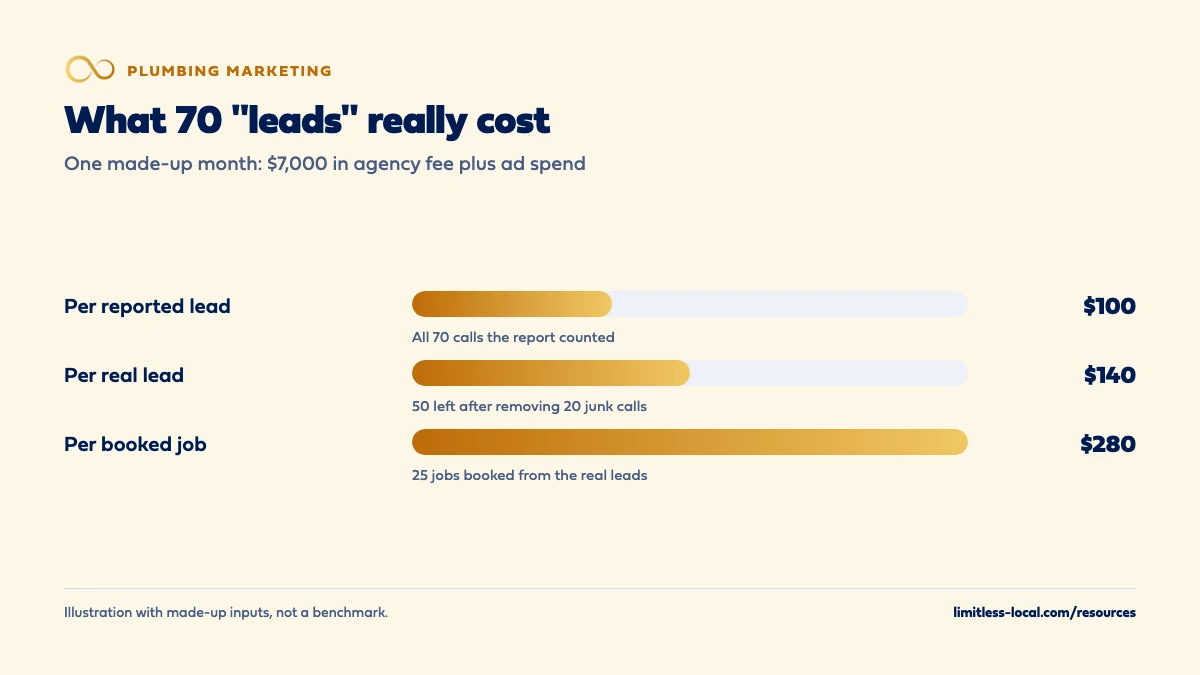
These numbers are made up to show the math, not typical prices or results. Say a plumbing company pays an agency $3,000 a month and spends $4,000 a month on ads, so $7,000 in all. The monthly report says the agency delivered 70 leads.
- Per reported lead: $7,000 / 70 = $100.
- Per real lead: listening to the recordings shows 20 of the 70 were job seekers, vendors, do-it-yourself questions or callers outside the service area. $7,000 / 50 = $140.
- Per booked job: the office booked 25 of the real leads. $7,000 / 25 = $280.
Same month, same spend, and the honest number is nearly three times the headline one. That’s why the contract should define a lead and promise booked jobs in the report. Whether $280 a job is good depends on what those jobs are worth to you.
Frequently asked questions
Is a month-to-month plumbing marketing contract always better?
Not always. A short starting commitment can be fair while the foundation gets built. What matters more is leaving without losing your accounts or phone numbers, and any renewal rolling to month-to-month.
Should the agency's fee be a percentage of my ad spend?
It can be, as long as it’s written down and you can see the spend in your own account. A percentage fee rises when you spend more in a freeze, so check how it works in your busiest month before you sign.
Can I keep my old tracking numbers if I leave an agency?
Often, if the contract says so and the numbers are ported before anything is deactivated. CallRail says porting a U.S. number away is free and typically takes 4-6 weeks, and the account administrator has to approve it.
What if I already signed a contract that leaves the accounts with the agency?
Ask in writing, now, for admin access to the ad account and ownership of your Google profile, and ask who holds the tracking numbers and domain. It’s easier to fix while the relationship is friendly.
Do I need a lawyer to review a marketing contract?
For a short month-to-month agreement, many owners use a checklist like this one. For a long term, a big setup fee or a website build, it’s worth it. This page isn’t legal advice.
Key takeaways
- Get scope, money, ownership, call routing, lead definitions, reporting and the exit in writing.
- Check what “LSA management” means now that Local Services Ads are moving into Google Ads, and who gets Google’s notices.
- Tracking numbers on your vans and Google profile should be ported or transferred to you before anything is deactivated.
- Ask for reports in booked jobs by job type, with fee and ad spend both counted.
- Read the term with its renewal, notice and early-exit clauses, and walk away from promised rankings or review packages.
Not sure what's working right now?
Start with a free visibility audit: rankings, Google profile, reviews and tracking, checked against your service area.
More in this section
- Should I hire a plumbing marketing agency or do it myself?
- How much should a plumbing company spend on marketing each month?
- How should a plumbing company market to commercial customers?
- How do I track which plumbing marketing books jobs?
- Which plumbing services should I advertise first?
Sources
- Local Services Ads transition to Performance Max campaigns with pay-per-lead goals — Google Ads Help
- Manager Accounts (MCC): About ownership of client accounts — Google Ads Help
- About Ad Scheduling — Google Ads Help
- Port a phone number away from CallRail — CallRail Help Center
- Deactivate a tracking number — CallRail Help Center
- How to qualify leads in CallRail — CallRail Help Center
- Porting: Keeping Your Phone Number When You Change Providers — Federal Communications Commission
- The Consumer Reviews and Testimonials Rule: Questions and Answers — Federal Trade Commission