
How can a small HVAC company compete with the big companies in town?
- How does a small HVAC shop win jobs against bigger HVAC companies with bigger budgets?
- Can a small HVAC company really compete with the big companies in town?
- Where do bigger HVAC companies have the edge, and where don't they?
- How do I beat bigger companies in the map pack near my shop?
- How can my reviews stand out against a company with far more of them?
- Can a small shop win on Google Ads against a much bigger budget?
- Do Local Services Ads favor the bigger companies?
- How much does answering the phone faster help a small HVAC company?
- Should a small HVAC company specialize instead of doing everything?
- How do I use being owner-run as a selling point?
- What should a small HVAC company not try to match?
- What's different about competing with bigger HVAC companies
- A worked example: going narrow instead of broad
- Frequently asked questions
- Key takeaways
- More in this section
- Sources
The short version
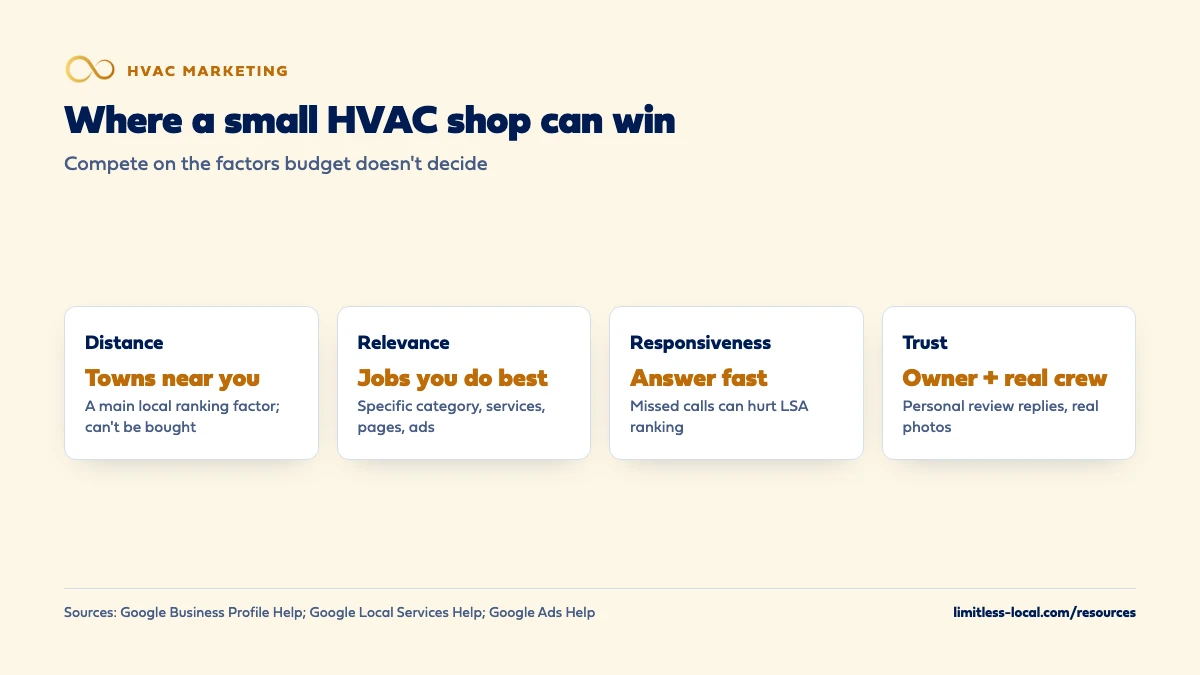
- Compete hardest in the towns closest to your shop, where distance works for you.
- Pick the jobs you do best and make your profile, pages and ads specific to them.
- Answer every call fast; responsiveness counts in how Local Services Ads rank.
- Make the owner and real crew visible, and never fake being bigger than you are.
For owners of smaller HVAC shops, a few trucks and the owner still on calls, competing in a town where bigger companies outspend them.
Get a free visibility audit · Book a growth call
How does a small HVAC shop win jobs against bigger HVAC companies with bigger budgets?
A small HVAC company competes by not fighting on budget: it wins the towns closest to its shop, the jobs it does best, and the calls it answers faster than anyone else. Google’s local results weigh relevance, distance and popularity, and nobody can pay for a better map ranking, so a tight service area, a specific Google profile and a steady flow of genuine reviews can beat a bigger name in your own neighborhoods. On the paid side, Google Ads and Local Services Ads also weigh ad quality, relevance and responsiveness, not just the bid, which gives a well-run small shop room to win calls at a lower cost.
That’s the approach we’d take with a smaller HVAC shop: put the money where the shop is closest, best and fastest, and judge it by cost per booked job. It’s how our HVAC marketing packages are built, starting with one location. For the full picture of the channels a small shop can use, the HVAC marketing guide walks through all five, and the rest of the HVAC marketing questions library goes question by question.
Can a small HVAC company really compete with the big companies in town?
Yes, in specific places and for specific jobs. A small shop rarely wins by trying to be everywhere at once, because that’s the game where budget decides. It wins where the things Google and homeowners care about are on its side.
On the free side of Google, that’s mostly built into how local search works. Google’s page on improving your local ranking says local results are mainly based on relevance, distance and popularity, and that there’s no way to request or pay for a better local ranking. A bigger company can’t buy its way to the top of the map pack in the neighborhoods around your shop. On the paid side, Google’s ad auctions look at quality and relevance as well as the bid, which the sections below cover.
Where do bigger HVAC companies have the edge, and where don't they?
It helps to be honest about both sides.
Where they’re ahead:
- Budget. They can outbid you on the most competitive searches and stay on top in every town at once.
- Review count. Years of volume usually means more reviews, and Google counts review volume as part of popularity.
- Name recognition. Radio, billboards and wrapped fleets put their name in front of homeowners before anyone searches.
Where you can be ahead:
- Distance. In the towns closest to your shop, you’re closer to the person searching than they are.
- Speed. A shop where the owner or a dispatcher picks up on the second ring beats a call center queue.
- Focus. You can be the obvious choice for a few jobs instead of a general option for all of them.
- The owner. Homeowners can meet the person who runs the company, which a big operation can’t offer.
Everything below is about pressing those four advantages.
How do I beat bigger companies in the map pack near my shop?
Start where distance is on your side. Google defines distance as how far each business is from the person searching, so the towns around your shop are where your profile has its best chance. Draw your service area around them instead of stretching it to match a bigger competitor’s map. Google’s service area help asks you to be as specific and accurate as possible when you set it.
Then work on relevance, which Google describes as how well your profile matches what someone searched for:
- Choose the most specific primary category that fits, and as few categories as it takes to describe your core business, which is what Google’s guidelines ask for.
- List the services you want calls for in the services editor, including custom services if Google’s suggestions miss the work you do. Google says a service you list may be highlighted on your profile when someone searches for it.
- Keep your business name your real name, with no keywords added, because Google’s guidelines don’t allow them and a suspended profile can’t compete at all.
Optimizing your HVAC Google profile covers the rest of the setup.
How can my reviews stand out against a company with far more of them?
Don’t try to match their total this year. Make yours more recent, more specific and better answered. Google says popularity is based partly on how many reviews you have and that more reviews and positive ratings can help your local ranking, so volume matters, and the way to build it is to ask after every job. Google’s tips to get more reviews suggest a review link or QR code, and they rule out offering anything in exchange.
The same page gives a small shop a few things it can do better than a big one:
- Reply personally. Google suggests addressing the reviewer by name and signing off with your name or initials. An owner’s reply reads differently from a call center’s template.
- Reply to the bad ones well. Google notes that a mix of positive and negative reviews often feels more trustworthy, and that honest, polite replies can even lead a customer to update a review.
- Say something real. Google advises against sending everyone the same thank-you.
How much reviews affect HVAC calls goes deeper on what they’re worth.
Curious what your marketing is actually booking?
Get a free visibility audit — no obligation, no sales pitch.
Can a small shop win on Google Ads against a much bigger budget?
On narrow ground, yes. Google’s page on how the Google Ads auction works lists the factors that decide which ads show and in what order: your bid, the quality of your ad and landing page, the expected impact of ad assets like a call button, quality thresholds, the context of the search, and how competitive the auction is. It also says that even if competitors have higher bids, you can still win a higher position at a lower price with highly relevant keywords, ads and assets.
What that means for a small shop:
- Bid on the jobs you most want, not every HVAC search in the metro.
- Send each ad to a page that matches it: a heat pump ad goes to your heat pump page, not your homepage.
- Target the towns you can reach quickly, and run ads during the hours someone answers the phone.
Google also notes that in a competitive auction the higher-ranking ad may pay a higher cost per click for that certainty. Let the big company pay for the top spot on the broadest searches. Which HVAC services to advertise first covers how to pick your ground.
Do Local Services Ads favor the bigger companies?
Not by budget alone. Google’s Local Services ad rankings page says the order is set by your bid and by how likely your ad is to result in a lead. That second part includes how responsive you are, how relevant your services and business bio are to the search, and your profile quality: your rating, number of reviews, average response time, good photos and the verification checks you’ve completed. Google says higher-quality profiles may rank higher and may also pay lower costs per lead.
Google also says the ranking takes into account the overall health and diversity of Local Services Ads and gives all providers enough opportunity, which in our reading means the biggest bidder doesn’t simply take every lead. A small shop that answers every call and keeps its rating high is competing on the factors it controls.
How much does answering the phone faster help a small HVAC company?
More than most owners expect, and it’s the advantage a big company has the hardest time copying. Google says missed calls can hurt your responsiveness in Local Services Ads, and in our experience a homeowner with a dead furnace often calls more than one company. The first one to pick up, or to call back in minutes, often gets the job.
One of our HVAC clients got 47% more booked estimates from speed to lead, automated reminders and better follow-up. That’s one client’s past result, not a forecast, but it points to where a small shop’s edge often is: not in finding more leads, but in booking more of the ones it already gets. How fast to respond to new leads lays out the targets and the follow-up schedule.
Should a small HVAC company specialize instead of doing everything?
Usually, at least in its marketing. You can still take every kind of call, but a small budget stretched across every service in every town buys a little visibility everywhere and a lot of it nowhere. Pick a few jobs where you’re genuinely strong and the ticket is worth winning, and make them the center of your profile’s services, your website pages and your ads.
Good candidates are the work bigger companies treat as routine or skip: heat pumps and ductless systems, older homes with tricky ductwork, a particular brand you know inside out, light commercial rooftop units, or same-day repairs in the towns closest to you. Being the clear answer for one of those beats being the fifth option for everything.
How do I use being owner-run as a selling point?
Show it. Homeowners hiring for a repair in their house want to know who’s coming, and a small company can answer that in a way a large one can’t.
- Photos of the real crew, trucks and owner on your Google profile and website, not stock images.
- An about page in the owner’s words: how long you’ve been doing this, what you won’t do to a customer, and who answers the phone.
- Pages that show you’ve done the work. Google’s guidance on creating helpful content asks whether content shows first-hand expertise, such as expertise from actually using a product or service. Write your service pages from what your techs see on real jobs.
- Signed review replies from the owner.
Making your HVAC company look trustworthy online covers the rest.
What should a small HVAC company not try to match?
- Their footprint. Covering every town in the metro spreads a small budget too thin to win any of them.
- Their prices, downward. A price war is a fight the company with the bigger margin wins. Compete on speed, trust and the work instead, and attract fewer price shoppers in the first place.
- Their size, on paper. Extra Google profiles for addresses you don’t staff, keyword-stuffed business names and paid-for reviews break Google’s rules and put the profile you do have at risk.
- Their brand spending. Radio and billboards build a name over years. Put your money where it books jobs this season.
Not sure which of these is costing you jobs?
A free visibility audit checks the Google profile, reviews, site and tracking, and shows what to fix first.
What's different about competing with bigger HVAC companies
Heat waves and cold snaps level the field. When demand spikes, the bigger companies’ schedules fill up too. A small shop that can still offer a same-day or next-day visit wins calls on availability alone, so make sure your ads and your profile hours make that clear during the peaks, and that someone is answering.
Replacements are decided on trust. A homeowner spending thousands on a new system often wants to meet the person behind the estimate. An owner who does the estimate, explains the options plainly and follows up personally is a real advantage over a sales rep on commission.
Maintenance agreements keep you off the auction. Every customer on an agreement is a repair or replacement you don’t have to win in an ad auction later. For a small shop, that list is the best protection against a bigger competitor’s budget.
A worked example: going narrow instead of broad
These numbers are made up to show the math, not a benchmark for your market. Say a small shop spends $1,500 a month on broad HVAC ads across the whole metro and books 10 jobs, mostly small service calls averaging $400. That’s $150 per booked job against a $400 ticket.
Now say it moves the same $1,500 into ads for heat pump replacements in the towns nearest the shop, sent to a page about that work. It books 5 jobs instead, at $300 per booked job, but each is a replacement averaging $8,000. Fewer calls, a higher cost per job and far more revenue: that’s what competing on your own ground looks like on paper.
For the management side: our Essentials package is $3,500 a month for one location and includes Google Ads management up to $2,500 a month in ad spend, Google Business Profile management and review generation. Growth adds Local Services Ads management. Ad spend is paid to Google separately, and we won’t guarantee rankings or a lead count, because nobody honestly can.
Frequently asked questions
Should I lower my prices to compete with the big HVAC companies?
In our view, rarely. The company with the larger margin can usually outlast you in a price war; competing on speed, availability and trust protects your margin instead.
Can I pay Google to rank above a bigger company in Maps?
No. Google says there’s no way to request or pay for a better local ranking. Ads show separately from the free map results.
Do more Google reviews always beat better reviews?
Both count. Google says popularity is based partly on how many reviews you have, and that more reviews and positive ratings can help your local ranking.
Is it worth running Local Services Ads if the big companies already do?
It can be. Google ranks them on responsiveness, relevance and profile quality as well as the bid, and says higher-quality profiles may pay lower costs per lead.
Can I make my company look bigger than it is online?
Not safely. Google’s guidelines require a real-world business name and one profile per business, and its review rules ban incentives for reviews. Being clearly owner-run is the better story anyway.
Key takeaways
- Don’t fight on budget: compete in the towns closest to you, on the jobs you do best.
- Google’s local ranking weighs relevance, distance and popularity, and can’t be bought.
- Google Ads and Local Services Ads weigh quality, relevance and responsiveness, not just the bid.
- Answering fast is the advantage a big company finds hardest to copy.
- Show the owner and real crew, and never fake size with extra profiles or paid reviews.
Want a second set of eyes on your setup?
We'll look at how you show up locally and where calls are leaking, then send you a plain-English breakdown.
More in this section
- What should I do when a new HVAC competitor opens near me?
- What's the simplest marketing setup for a small HVAC company?
- How should a commercial HVAC company market itself?
- How do I attract fewer price shoppers to my HVAC company?
- How do I market my HVAC company in a new city where nobody knows us?
Sources
- Tips to improve your local ranking on Google — Google Business Profile Help
- Guidelines for representing your business on Google — Google Business Profile Help
- Manage your service areas for service-area & hybrid businesses — Google Business Profile Help
- Manage your services on your Business Profile — Google Business Profile Help
- Tips to get more reviews — Google Business Profile Help
- How the Google Ads auction works — Google Ads Help
- About ad rankings — Google Local Services Help
- Creating Helpful, Reliable, People-First Content — Google Search Central