
What happens to roofing leads if I stop paying for ads?

- What happens to my roofing lead volume if I stop paying for Google Ads or LSAs?
- How fast do roofing leads drop when I stop paying for ads?
- Will my organic roofing leads drop too when I stop ads?
- What keeps producing roofing leads after the ads stop?
- Should I pause or remove my roofing ad campaigns?
- What happens to Local Services Ads when I stop paying?
- Will turning ads back on bring leads back right away?
- Is it better to lower my roofing ad budget than to stop?
- How do I know what my ads were actually producing before I stop?
- How long does it take SEO to replace ad leads for a roofer?
- Should a roofer ever stop ads completely?
- What's different about stopping ads for roofing companies
- A worked example: a month after stopping Google Ads
- Frequently asked questions
- Key takeaways
- More in this section
- Sources
The short version
- Paid leads stop within days of stopping ads; there's no long tail.
- Organic calls from your Google profile, website and reviews keep coming, at whatever level you've built.
- Pause rather than remove campaigns, so settings and history are kept for a restart.
- Before cutting ads, check how many signed roofs they produced, not just how many leads.
For roofing owners thinking about cutting ad spend, who want to know how fast the calls drop, what keeps coming in, and what it takes to turn ads back on later.
Get a free visibility audit · Book a growth call
What happens to my roofing lead volume if I stop paying for Google Ads or LSAs?
When a roofer stops paying for Google Ads or Local Services Ads, the leads those ads produced stop almost immediately, because pausing a campaign stops its ads from showing. What keeps coming in is whatever your own Google Business Profile, website, reviews and referrals already produce, which is why roofers with strong organic presence feel a smaller drop than roofers who rely on ads alone. Paused Google Ads campaigns keep their settings and history, so turning them back on is faster than starting over, but the organic side can’t be switched on, because SEO typically takes 3 to 6 months to show meaningful growth.
We run local ads for roofers alongside local SEO, so the profile and site keep producing when ad budgets change; the roofing marketing page shows how the two fit together. Whether Google Ads pay for a roofer at all is covered in are Google Ads worth it for roofing; this page covers what happens when they stop. More owner questions are answered in the roofing marketing questions library.
How fast do roofing leads drop when I stop paying for ads?
Fast. Google says pausing or removing a campaign stops its ads from showing, and that pausing prevents further charges. Paid search doesn’t leave a long tail: the homeowner searching “roof leak repair” tomorrow simply sees someone else’s ad. Calls that came from ad clicks in the last few days may still trickle in, and leads already in your pipeline still need follow-up, but new paid leads stop.
That’s the trade ads make. They can bring leads within days of launch, and they stop just as quickly. If you’re cutting spend because your crews are full, that speed is useful; pausing when crews are booked out covers that case. If you’re cutting because money is tight, the drop shows up in next month’s inspections.
Will my organic roofing leads drop too when I stop ads?
They shouldn’t drop because of the ads alone. Google says there’s no way to request or pay for a better local ranking, and that local results are mainly based on relevance, distance and popularity. Paying for ads doesn’t buy your Maps position, so stopping them doesn’t directly take it away.
Two things can still change. First, your Google Business Profile’s performance numbers include views, searches and actions from both organic results and Google Ads, so the profile’s call count can fall when ads stop, even if your organic position hasn’t moved. Read that number carefully before deciding the profile “stopped working”. Second, in our judgement, some homeowners who saw your ad and searched your name later will stop doing so. That’s a smaller, slower effect, and hard to measure.
What keeps producing roofing leads after the ads stop?
Whatever you’ve built that you don’t pay for per click:
- Your Google Business Profile: calls and direction requests from Maps and local results.
- Your website’s organic rankings for roofing searches in the towns you serve.
- Reviews, which Google says can help your local ranking: more reviews and positive ratings.
- Referrals, yard signs and repeat customers, which don’t depend on any platform.
For a roofer who has invested in those, stopping ads trims lead volume. For a roofer whose only lead source was ads, stopping ads can mean the phone goes nearly quiet. Which one you are is the most important thing to know before you cut.
Should I pause or remove my roofing ad campaigns?
Pause. Google says pausing is temporary, stops your ads from showing and preserves all settings and history, so you can resume at any time. Removing is permanent: you can’t resume or restore a removed campaign, only view its past performance or build a new one.
One detail when you restart: Google says resuming a campaign doesn’t automatically restart ad groups or keywords you also paused, so each paused element has to be turned back on. Pause at the campaign level only, and write down what you paused.
Curious what your marketing is actually booking?
Get a free visibility audit — no obligation, no sales pitch.
What happens to Local Services Ads when I stop paying?
The same basic thing: no budget, no paid lead placements. Local Services Ads are moving into Google Ads as Performance Max campaigns with pay-per-lead goals, and Google says those ads show on Google Search and Google Maps in the same ad positions as before. When they stop, those placements go to other roofers.
What you keep is what lives in your Google Business Profile: Google says business name, address and hours sync one way from the profile to Google Ads. The reviews and profile details are yours either way. Splitting budget between Google Ads and LSAs covers which one to keep if you’re cutting one.
Will turning ads back on bring leads back right away?
Usually the ads start serving again quickly, but results may take a while to settle. Google says changes to budgets don’t trigger a “Learning” status, that Learning status never lasts more than 7 days, and that after changes, Smart Bidding performance typically converges within 1 to 2 conversion cycles, the time it takes for a click to become a conversion.
Google’s page doesn’t say exactly how a long pause affects that, so treat this as our judgement: expect a few weeks before cost per lead looks like it did before the pause, longer if competitors moved in while you were out or the season changed. A paused campaign with its history kept restarts faster than a new one built from scratch.
Is it better to lower my roofing ad budget than to stop?
Often, yes. Google says budget changes show in your account immediately and can affect how often your ads show and how much you can be charged. A lower budget keeps the campaign, its conversion data and your presence for the searches that matter most, while cutting cost.
In our judgement, the smarter cut is narrow rather than total: keep emergency and leak repair terms in your core towns, drop broad terms and outlying areas. Changing ad budgets from storm season to winter covers seasonal adjustments in more detail.
How do I know what my ads were actually producing before I stop?
Check signed roofs by source, not leads. If your call tracking and CRM tag each lead by where it came from, pull the last few months and count how many ad leads became signed contracts and what they were worth. That tells you what you’re giving up.
If you can’t answer that question, fix it before you cut, or you’ll be guessing on both sides: whether the ads were worth it, and whether the drop afterward was caused by stopping them. Tracking which leads turn into signed jobs covers the setup.
How long does it take SEO to replace ad leads for a roofer?
Longer than most owners hope. SEO typically takes 3 to 6 months to show meaningful organic growth. Google’s own SEO guide says some changes take effect in a few hours and others could take several months, and suggests waiting a few weeks to assess whether a change helped.
So if the plan is “stop ads and do SEO instead”, plan for a gap. In our judgement, the safer sequence is to build organic first while ads run, then reduce ads as organic calls rise. Cutting ads first and starting SEO second usually means a few lean months. Why a roofer is not showing on Maps covers the profile side if Maps calls are low.
Should a roofer ever stop ads completely?
Sometimes. In our judgement, a full stop makes sense when:
- Crews are booked far enough out that homeowners won’t wait.
- The ads have been tracked and aren’t signing roofs at a cost per job you can live with, even after fixes.
- Organic leads from your profile, site and referrals already fill the schedule you want.
- Cash is tight enough that the spend threatens payroll, and you accept fewer inspections next month.
Outside those, a smaller, tighter campaign usually beats a hard stop, because restarting costs time while competitors keep the spots.
Want to see where your company stands?
A free visibility audit shows where you show up on Google, Maps and AI answers, and what it's costing you in calls.
What's different about stopping ads for roofing companies
Storms reset demand. A roofer who stops ads in a quiet month may miss the spike after the next hailstorm, when search interest in a town can jump overnight. Paused campaigns can be switched back on quickly; removed ones need rebuilding. That’s our judgement, not a Google statement.
Long sales cycles hide the drop. Roofing leads take weeks to become signed jobs, so the effect of stopping ads in one month shows up in signed contracts a month or two later. Don’t read the first quiet week as the full picture.
High tickets change the math. One signed replacement can cover a lot of ad spend, so stopping ads to save money can cost more than it saves if even a couple of jobs disappear.
Seasons matter. Many roofers see winter slow down; cutting then is different from cutting before spring.
A worked example: a month after stopping Google Ads
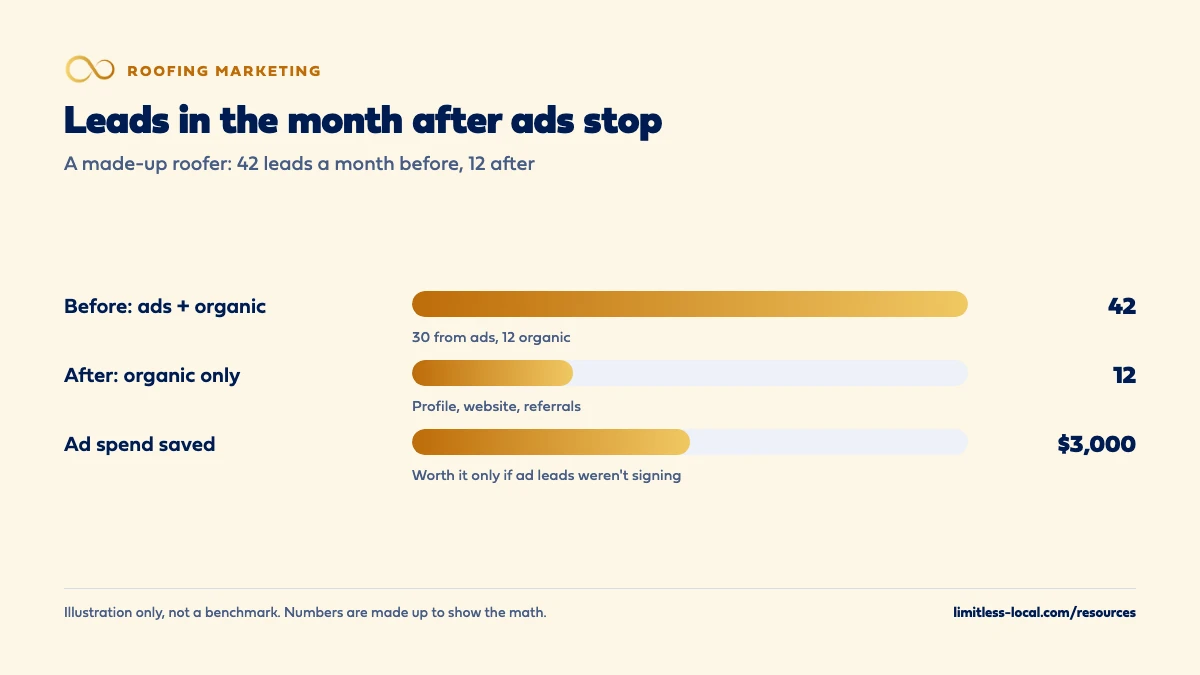
These numbers are made up to show the math, not a benchmark and not a client result. A roofer spends $3,000 a month on Google Ads. In a typical month, the ads produce 30 leads and the Google profile, website and referrals produce 12, for 42 in total.
- Month after stopping: ad leads fall to about zero. Organic leads stay near 12, though the profile’s call count in Business Profile performance looks lower, because it no longer includes ad-driven actions.
- Total leads: from 42 to about 12, a drop of roughly 71%.
- Money saved: $3,000.
Whether that was a good trade depends on how many of the 30 ad leads were signing. If they produced two replacements a month, the $3,000 saved probably cost far more in lost jobs. If they produced none after fixes, stopping was right. The same roofer with 30 organic leads a month would barely feel the cut.
How we’d handle it: we’d look at signed jobs by source before touching spend, then narrow campaigns before stopping them, while local SEO keeps building. Our Essentials package ($3,500 a month) includes Google Ads management up to $2,500 a month in ad spend plus local SEO; ad spend is paid directly to Google. We don’t guarantee lead counts; nobody honestly can.
Frequently asked questions
Will stopping Google Ads hurt my Google Maps ranking?
Google says you can’t pay for a better local ranking, so ads don’t directly set your Maps position. Your profile’s performance numbers can still fall, because they include actions from ads.
Do paused Google Ads campaigns lose their data?
No. Google says pausing preserves all settings and history. Removing a campaign is permanent.
Can I stop ads only on certain days instead of all the time?
Yes. Google’s Local Services help says you can choose the days of the week and times of day your ad runs, and Google Ads campaigns can use ad schedules too. That cuts spend on hours you can’t answer, though it won’t bring leads in during the hours you’ve turned off.
Will my LSA reviews disappear if I stop Local Services Ads?
Reviews on your Google Business Profile belong to the profile, not to the ad campaign. Google says profile details sync from the profile to Google Ads.
Should I stop ads in winter?
It depends on your market and backlog. In our view, narrowing to leak and emergency repair searches usually beats a full stop.
How do I restart roofing ads after a pause?
Enable the campaign, then any ad groups or keywords you paused separately. Expect results to take some time to settle.
Key takeaways
- Paid leads stop within days of stopping ads; organic leads continue at whatever level you’ve built.
- Stopping ads doesn’t directly lower your Maps ranking, but your profile’s call count can fall because it includes ad actions.
- Pause instead of removing campaigns, so settings and history are kept.
- A narrower, smaller campaign often beats a full stop.
- Check signed roofs by source before cutting, and build organic before relying on it.
Not sure what's working right now?
Start with a free visibility audit: rankings, Google profile, reviews and tracking, checked against your service area.
More in this section
- How do I get commercial roofing leads with Google Ads?
- Why are my roofing ads getting clicks but no calls?
- Should roofing ads send people to my homepage or a landing page?
- Do Facebook ads work for getting roofing leads?
- How long should I run roofing Google Ads before judging them?
Sources
- Enable, pause, or remove a campaign — Google Ads Help
- About Smart Bidding learning — Google Ads Help
- How budget changes take effect — Google Ads Help
- Local Services Ads transition to Performance Max campaigns with pay-per-lead goals — Google Ads Help
- Tips to improve your local ranking on Google — Google Business Profile Help
- Understand your Business Profile performance & insights — Google Business Profile Help
- SEO Starter Guide: The Basics — Google Search Central
- About ad scheduling — Local Services Help