
How do I market my HVAC company in a new city where nobody knows us?
- How does an HVAC company break into a new city with no reviews or name recognition there?
- Why is it so hard to get calls in a city where nobody knows my company?
- Do I need an office in the new city, or can I serve it from where I am?
- What should I turn on first to get calls in the new city?
- Should I use Local Services Ads in a new city?
- How do I get my first reviews in the new city?
- Should I build a page on my website for the new city?
- How do I get the new city to know my company's name?
- How long until the new city brings in calls without ads?
- How do I know if the new city is worth it?
- What's different about entering a new city for HVAC companies
- A worked example: what being unknown costs per booked job
- Frequently asked questions
- Key takeaways
- More in this section
- Sources
The short version
- Ads first: they can bring calls within days while the map pack takes months.
- Serve the city from your current base if it's within about 2 hours, or open a real location.
- Earn reviews from your first jobs there; never pay or discount for them.
- Track the new city's booked jobs and cost per job on their own.
For HVAC owners expanding into a city or a set of towns where the company has no reviews, no map presence and no word of mouth yet.
Get a free visibility audit · Book a growth call
How does an HVAC company break into a new city with no reviews or name recognition there?
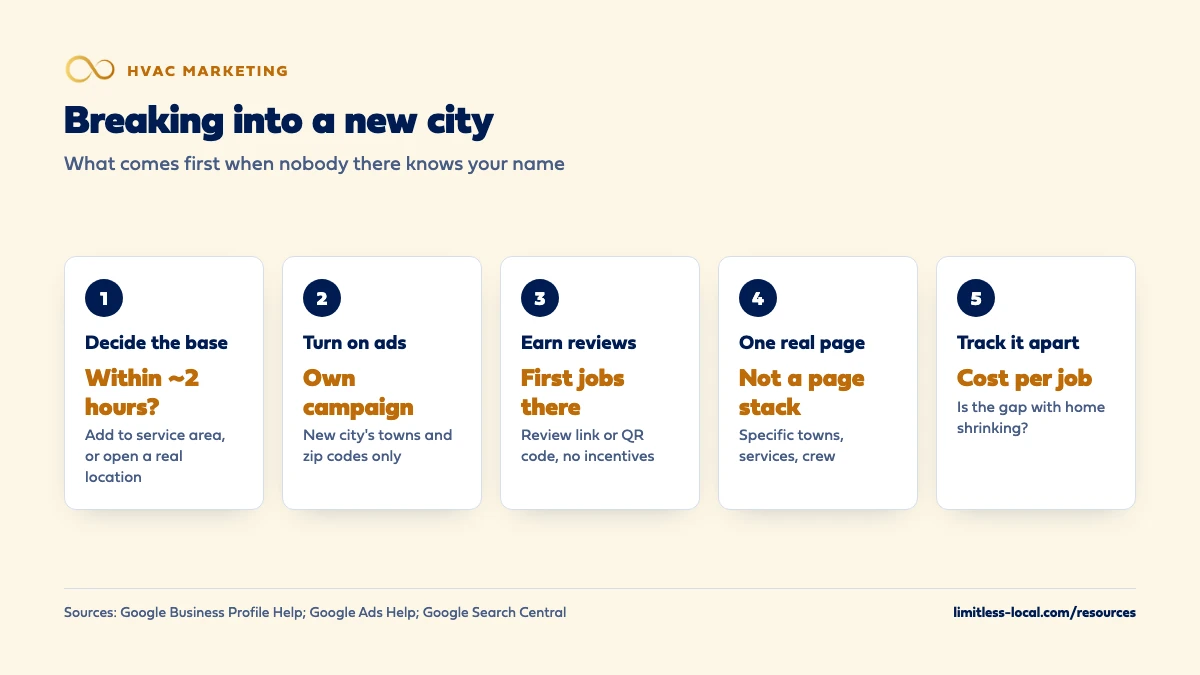
Start with paid ads aimed at the new city’s towns and zip codes, because ads can bring calls within days while map and organic rankings in a market where nobody knows you take months to build. At the same time, set your Google Business Profile up honestly: add the new towns to your service area if they’re within about 2 hours of driving from where you’re based, or open a real staffed location there, since Google doesn’t allow virtual offices. Then earn reviews from your first jobs in that city, build one genuinely useful page about serving it, and track booked jobs from the new area separately so you know when it’s paying off.
Getting a company’s name known in a new set of towns is the kind of work our local SEO service covers: the Google profile, the location and service pages, reviews and listings, run alongside the ads that carry the calls while the rankings build. See how it fits together on our HVAC marketing page. For the wider view of where HVAC calls come from, the HVAC lead generation guide covers every channel, and the rest of the HVAC marketing questions library goes question by question.
Why is it so hard to get calls in a city where nobody knows my company?
Because the free spots on Google lean on things you don’t have there yet. Google’s page on improving your local ranking says local results are mainly based on relevance, distance and popularity. Relevance is how well your profile matches the search. Distance is how far you are from the person searching. Popularity is how well-known the business is, and Google says it’s based partly on how many websites link to you and how many reviews you have.
In your home market you’ve had years to build all three. In the new city you’re farther away, you have no reviews from local customers and no local sites mention you. Google also says there’s no way to request or pay for a better local ranking. So the honest plan is to buy visibility with ads first and build the free kind underneath it.
Do I need an office in the new city, or can I serve it from where I am?
It depends on the drive. Google’s help page on service areas says you can list up to 20 service areas by city, zip code or other area, and that the whole area shouldn’t run more than about 2 hours of driving from where your business is based. If the new city is inside that, add its towns to your existing profile and serve it from your current shop.
If it’s farther, the profile route is a real location: Google’s guidelines allow one profile per location when each has separate staff and a separate service area. What they don’t allow is a shortcut. A rented mailing address you don’t operate out of is a virtual office, and it isn’t eligible, and a co-working desk only counts if it’s signed, staffed and receives customers during business hours. If you’re opening a real branch, marketing a second HVAC location covers the setup.
Either way, be honest with yourself about response times. A city at the edge of your drive is a city where a no-cool call waits longer than it would with a local company.
What should I turn on first to get calls in the new city?
Google Ads aimed at the new city. Ads can start producing leads within days of launch, while organic and map rankings typically take months. Google Ads lets you target ads to geographic locations: whole cities, postal codes or a radius around a point. Two settings matter for a new market:
- Size. Google notes that very small target areas may show your ads only now and then, or not at all. Target the set of towns you want, not one small zip code.
- Presence or interest. Google recommends its broader “Presence or Interest” setting as a best practice on Search. It reaches people in your target area and people elsewhere who’ve shown interest in it, and Google says it can capture more conversions and clicks. Google also says to consider the narrower “Presence” setting when you only want people who are actually in those locations. Our judgement, which departs from Google’s default, is to start a new city on Presence, because every click there is expensive and you can only serve the homes your trucks reach. The trade-off is real: Presence can miss someone searching from outside the area for a job inside it, like an owner booking a repair at a rental or a parent’s house. Once the campaign has a baseline, test the broader setting and keep it if the extra calls turn into jobs you can run.
Run the new city as its own campaign with its own budget. If it shares a campaign with your home market, the established area will soak up the budget and you won’t see what the new one costs.
Should I use Local Services Ads in a new city?
They can work there, with two catches. First, Google’s ad rankings page says Local Services Ads are ranked by your bid and by how likely your ad is to produce a lead, which includes your rating, how many reviews you have, how quickly you respond and the location of the search. Missed calls can hurt your responsiveness, and a market where your trucks are farther away is one where calls are easier to miss.
Second, check the paperwork before you count on them. Google’s screening and verification requirements include a business license and an owner license at the state level, and say additional requirements can depend on the state you operate in. If the new city is across a state line, expect the screening to cover that state too. Google says the process takes 3 to 4 weeks on average after you submit documents, so start early. Whether they’re worth it at all is covered in whether LSAs are worth it for HVAC.
Curious what your marketing is actually booking?
Get a free visibility audit — no obligation, no sales pitch.
How do I get my first reviews in the new city?
One job at a time, from the first week. Every completed job in the new area is a chance at a review that mentions that town. Google’s tips to get more reviews suggest sending customers a Google review link or QR code and replying to the reviews you get. They’re equally clear on the limit: offering anything in exchange for a review, like a discount or a free filter, counts as fake content.
Early reviews in a new city carry more weight with homeowners because there are so few of them, so the first ten jobs deserve extra care: the tech who shows up on time, cleans up and asks politely at the end. Getting techs to ask for reviews covers how to make that routine.
Should I build a page on my website for the new city?
Yes, one good one. A page about serving the new city gives your ads somewhere specific to land and gives Google something relevant to match to searches there. Make it specific: the towns and neighborhoods you cover, the services you offer there, how scheduling works from where you’re based, photos of the crew that runs those calls, and the reviews you’ve earned there as they come in.
What not to do is spin up a stack of near-identical town pages or a separate website for the new city. Google’s spam policies list doorway abuse, including multiple domains or pages aimed at specific regions or cities that funnel visitors to one page, and substantially similar pages built to rank for similar searches. Building city pages that don’t look like spam covers what a useful page looks like.
How do I get the new city to know my company's name?
The same way you did at home, faster if you plan it. Google’s popularity factor includes how many websites link to your business, so local mentions do double duty: they put your name in front of people and give Google a reason to treat you as part of that market. Places to start:
- The supply houses, builders, property managers and real estate agents who work in that city.
- A local sponsorship or two where the sponsor gets a mention on the organization’s site.
- The main directories and your Google profile, with the same name, address and phone number everywhere.
- Trucks parked and working in the area. Wrapped trucks on the new city’s streets are the slowest marketing you’ll buy and some of the most durable.
None of this replaces the ads in the first months. It’s what lets you spend less on them later.
How long until the new city brings in calls without ads?
Expect months, not weeks. SEO typically takes 3 to 6 months to show meaningful organic growth, and in a city where you start with no reviews and no local links, it’s sensible to plan for the longer end of that. Ads carry the calls while that builds. How long HVAC SEO takes explains what moves first and what takes longest.
A practical sign that the new city is starting to stand on its own is when calls from that area that didn’t come through an ad start showing up in your call tracking. That’s the point to test trimming the ad budget, not before.
How do I know if the new city is worth it?
Track it separately from the start: its own ad campaigns, a call tracking number on its page, and the town or zip code on every job in ServiceTitan, Housecall Pro or Jobber. Then look at three things each month:
- Cost per booked job in the new city compared with your home market.
- Average ticket on those jobs, since a longer drive eats into a small service call more than into a system replacement.
- Whether the gap is closing as reviews and organic calls build.
If after six months the new city still costs far more per job and the gap isn’t shrinking, it may be a market to serve opportunistically rather than chase. Deciding which cities and zip codes to target covers how to make that call.
What's different about entering a new city for HVAC companies
Arrive before the season, not during it. Starting ads in a new city during the first heat wave means competing for the most expensive clicks of the year with no reviews. Starting in the shoulder season gives you a few months of cheaper calls and early reviews before demand peaks.
Emergency calls test the distance. No-heat and no-cool calls want someone today. If your trucks are an hour away, say so honestly in how you schedule, and focus your new-city ads on work where a short wait matters less, like maintenance, replacements and estimates, until you have a crew based closer.
Permits and licensing can change at the city or county line. Check what the new area requires for the work you’ll do there before the ads go live, not after the first job.
Not sure which of these is costing you jobs?
A free visibility audit checks the Google profile, reviews, site and tracking, and shows what to fix first.
A worked example: what being unknown costs per booked job
These numbers are made up to show the math, not a benchmark for your market. Say your home market’s Google Ads spend $2,400 a month and book 16 jobs: $150 per booked job. The new city’s campaign spends $1,600 and books 8 jobs: $200 per booked job. The extra $50 per job is roughly the price of being a stranger there, with no reviews and no name recognition yet.
The plan is to watch that number fall as reviews and organic calls build. If the new city’s cost per booked job is still $200 a year later, the market or the drive time is the problem, not the newness.
For the management side: if you’re serving the new city from your current location, our Essentials package covers one location at $3,500 a month, including Google Ads management up to $2,500 a month in ad spend. It doesn’t include Local Services Ads. Growth, at $4,500 a month, adds Local Services Ads management, Google Ads up to $5,000 in monthly spend and SEO for up to 2 locations if you open a branch. Ad spend is paid to Google separately in both.
Frequently asked questions
Will adding a far-away city to my service area get me into its map pack?
Probably not by itself. Google says distance from the searcher is one of the main local ranking factors, and in our view listing a city doesn’t change where your business is based. Ads and real local reviews do more there.
Can I pay Google to rank higher in the new city's Maps results?
No. Google says there’s no way to request or pay for a better local ranking. You can pay for ads, which show separately from the free map results.
How many towns can I list in my Google service area?
Up to 20 service areas, by city, zip code or other area. Google also says the whole area shouldn’t extend more than about 2 hours of driving from where you’re based.
Can I set up a separate website just for the new city?
We wouldn’t. Google’s spam policies list multiple domains aimed at specific regions or cities that funnel visitors to one page as doorway abuse. One site with a useful page for the new city is the safer setup.
Do I need another license to run Local Services Ads in a different state?
Possibly. Google’s screening requirements include state-level business and owner licenses and say requirements can depend on the state you operate in, so check that state’s requirements before you plan around LSAs.
Key takeaways
- In a new city you start with no reviews, no local links and more distance, which is why ads come first.
- Serve the city from your current base if it’s within about 2 hours; otherwise open a real, staffed location.
- Run the new city as its own ad campaign and track its booked jobs separately.
- Earn reviews from your first jobs there and build one genuinely useful city page, not a stack of copies.
- Judge the market on whether its cost per booked job is closing the gap with your home market.
Want a second set of eyes on your setup?
We'll look at how you show up locally and where calls are leaking, then send you a plain-English breakdown.
More in this section
- How do I market a second HVAC location?
- How should a commercial HVAC company market itself?
- What's the simplest marketing setup for a small HVAC company?
- How do I get more repeat customers and referrals for my HVAC company?
- How do I attract fewer price shoppers to my HVAC company?
Sources
- Tips to improve your local ranking on Google — Google Business Profile Help
- Guidelines for representing your business on Google — Google Business Profile Help
- Manage your service areas for service-area & hybrid businesses — Google Business Profile Help
- Tips to get more reviews — Google Business Profile Help
- Target ads to geographic locations — Google Ads Help
- About ad rankings — Google Local Services Help
- Business screening and verification requirements – United States — Google Local Services Help
- Spam Policies for Google Web Search — Google Search Central