
When should a plumbing company raise or cut its marketing budget?

- When should I increase my plumbing marketing budget, and when should I cut it?
- What should decide whether I raise or cut my plumbing marketing budget?
- What are the signs a plumbing company should spend more?
- What are the signs I should cut my marketing budget?
- When should I fix something before changing the budget?
- How much should I raise or cut at a time?
- How long should I wait before judging a budget change?
- Should I cut SEO first when money gets tight?
- Should I raise my budget before a freeze or wait until the phones ring?
- Should I cut marketing when business slows down?
- Should I pause my ads or just lower the budget?
- What changes when an agency runs my marketing?
- What's different about plumbing budgets
- A worked example: one budget, three different answers
- Frequently asked questions
- Key takeaways
- More in this section
- Sources
The short version
- Decide channel by channel, not for the whole budget at once.
- Raise when cost per booked job is under your ceiling and the schedule has room.
- Cut when the schedule is full or a channel stays over your ceiling.
- Fix unanswered calls, bad-fit searches and tracking before touching the budget.
For plumbing company owners who already have a budget and need a rule for when to turn it up, down or leave it alone.
Get a free visibility audit · Book a growth call
When should I increase my plumbing marketing budget, and when should I cut it?
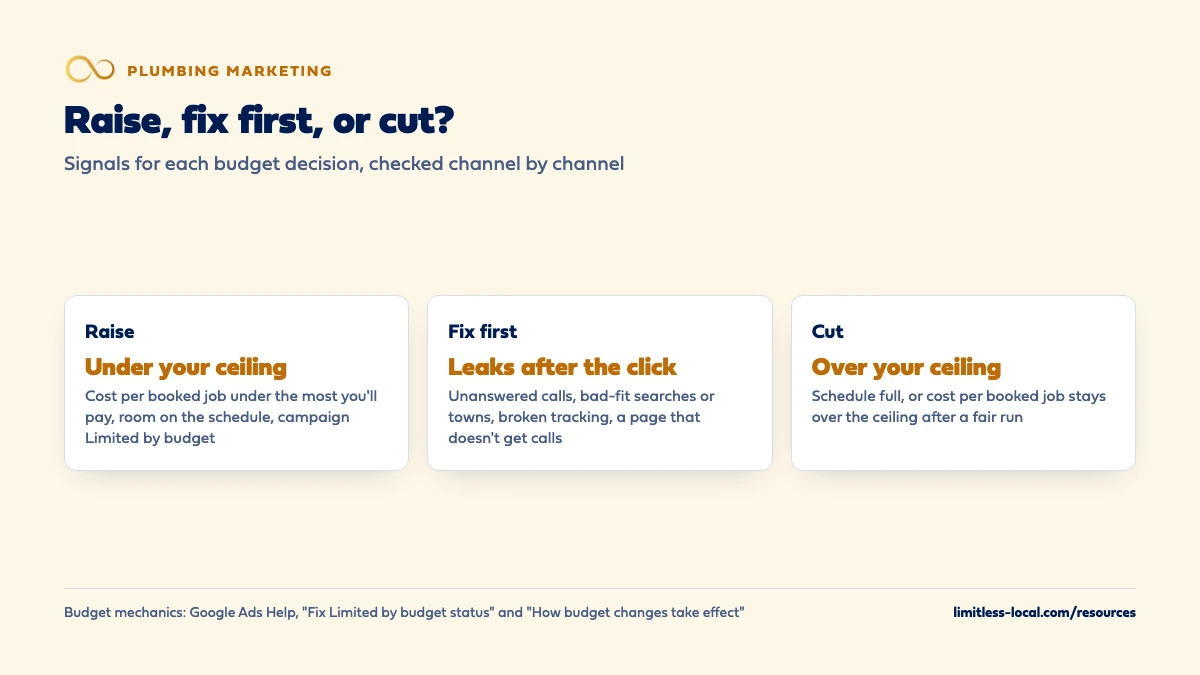
Raise a plumbing marketing budget when a channel’s cost per booked job is under the most you can afford to pay for a job and your schedule has room for more work. Cut it when the schedule is full, or when a channel’s cost per booked job stays over that ceiling after you’ve given it a fair run. If calls go unanswered, tracking is broken or the ads are showing for the wrong searches, fix that first, because changing the budget won’t fix it.
That channel-by-channel view is how we run budgets too: every package includes a monthly report with a cost-per-lead breakdown and call tracking with source tagging, and ad spend is paid to Google separately, so the spend can move without the fee moving. The tiers and what each covers are on our marketing packages page, how it fits a plumbing shop is on our plumbing marketing page, and the rest of the plumbing marketing questions library goes channel by channel.
What should decide whether I raise or cut my plumbing marketing budget?
Three questions, asked about each channel separately, not about the budget as one lump:
- Is the cost per booked job under your ceiling? Your ceiling is the most you’re willing to spend in marketing to win one job, after parts, labor and overhead. How much you can afford to pay for a plumbing lead shows how to set it.
- Is there room on the schedule? More spend only helps if your crews can run the extra jobs this week, not three weeks from now.
- Can you trust the numbers? If calls aren’t tied to booked jobs, or half of them go unanswered, the cost per job you’re looking at is wrong, and so is any budget decision built on it.
When all three are yes, raising that channel is usually the right call. In our judgement, most bad budget decisions come from turning the whole budget up or down at once.
What are the signs a plumbing company should spend more?
In our judgement, you have a case for raising a channel’s budget when most of these are true:
- Its cost per booked job has stayed under your ceiling for at least a few weeks of steady spend.
- The schedule has open slots, or your techs are waiting on calls in the morning.
- The calls it brings are the jobs you want, in the towns you want.
- Google Ads shows the campaign as Limited by budget. Google marks a campaign this way when it’s underperforming because of a limited budget, and it may suggest a recommended average daily budget based on recent performance, your current budget, keywords and targeting (Google Ads Help: Fix “Limited by budget” status).
Treat Google’s recommended budget as one input: it’s built to increase clicks and impressions, and Google won’t show one if your campaign rarely meets its daily budget or has limited data.
What are the signs I should cut my marketing budget?
Cutting makes sense when the money is buying calls you can’t use or can’t afford:
- The schedule is full. If you’re booking jobs out a week or more, extra calls mostly go to whoever can come today. Trim the channels that bring the lowest-value work first.
- The cost per booked job is over your ceiling and stays there after you’ve given the channel enough time and fixed the obvious problems.
- A channel books almost nothing once tracking is trustworthy: lots of calls, few jobs, and the calls that do book are small tickets.
- You’re short on techs. Spending to fill a schedule you can’t staff turns into missed appointments and bad reviews.
Cut the weakest channel first. A blanket cut treats your best money the same as your worst.
When should I fix something before changing the budget?
Whenever the problem is what happens after the click, not how many clicks you buy. More budget poured into a leak just makes a bigger leak. Check these first:
- Unanswered calls. In Local Services Ads, a missed call during your business hours is still a charged lead if the caller stays on the line for more than 20 seconds, and a call that goes to voicemail is treated the same way (Local Services Help: How leads work).
- Bad-fit searches and towns. Ads showing for job seekers, DIY questions or towns you don’t serve.
- Broken tracking. Calls that aren’t tagged by source, or booked jobs nobody marks in your software.
- A landing page that doesn’t turn visitors into calls, especially on a phone.
The marketing traps that waste the most money for plumbers walks through each one. Once they’re fixed, the same budget often books more jobs.
How much should I raise or cut at a time?
In steps you can measure. In our judgement, change one channel at a time by an amount large enough to show up in booked jobs, then hold it long enough to read the result.
Know how Google handles the change. A new average daily budget shows in your account immediately. On the day you change it, your daily spending limit is based on the highest average daily budget you set that day, and for most campaigns you won’t be charged more than 2 times that amount on that day. For the rest of the month, spend won’t go over your new average daily budget times the calendar days left in the month (Google Ads Help: How budget changes take effect).
If you use Smart Bidding, Google says budget updates take effect in the next auction and never trigger the “Learning” status (Google Ads Help: About Smart Bidding learning). The change is quick; the booked jobs that follow from it still take time to show up, which is another reason to wait before judging.
Curious what your marketing is actually booking?
Get a free visibility audit — no obligation, no sales pitch.
How long should I wait before judging a budget change?
Long enough for the change to show up in booked jobs, not just in clicks. In our judgement, a few weeks of steady spend is the minimum for paid search, because a single slow week or one busy weekend can swing a small account’s numbers either way. If your jobs take a while to book, say a water heater replacement that starts as an estimate, give it longer.
Ads and SEO run on different clocks. Ads can generate leads within days of launch, while SEO typically takes 3 to 6 months to show meaningful organic growth. So an SEO budget can’t be judged on the same timetable as an ads budget. Judge SEO on its own month-over-month trend.
Should I cut SEO first when money gets tight?
It’s the easiest line to cut, because it doesn’t stop the phone this week. That’s also why cutting it can cost more than it saves. SEO work builds over months, and in our judgement, stopping partway through means paying for the slow part without getting the part that pays off. When you restart, you start a new ramp.
If cash really is tight, a better order is usually: trim the weakest paid channel, keep the paid channel that books under your ceiling, and keep the free work going yourself (asking every customer for a review, keeping your Google Business Profile current). How long plumbing SEO takes to bring calls covers what the ramp looks like. Cut SEO when it has had a fair run and the trend isn’t moving, not because it’s the line that doesn’t ring.
Should I raise my budget before a freeze or wait until the phones ring?
Plan for it before. When a hard freeze hits, burst-pipe calls come in all at once, and a budget sized for an ordinary week can run out early in the day. Google already flexes a little: it optimizes spend toward days when you’re more likely to get clicks and conversions, so some days you spend under your average daily budget and on others you exceed it, with a monthly limit of 30.4 times your average daily budget for most campaigns (Google Ads Help: About average daily budgets).
If you use Smart Bidding and expect a major jump in conversion rates for a short event, Google offers seasonality adjustments, which it says are ideal for events of 1 to 7 days and may not work as well beyond 14 days at a time. Google also says Smart Bidding already manages seasonal events (Google Ads Help: About seasonality adjustments). The bigger question is crew capacity: raise spend only as far as you can answer and run the calls. Preparing plumbing marketing for a winter freeze covers the rest of the plan.

Should I cut marketing when business slows down?
Not automatically. A 2019 post on the SBA’s blog warns about a chicken-and-egg trap: sales drop, so you cut marketing, and sales decline further. It suggests a slowdown might be the right time to increase marketing, particularly in a slow economy when other businesses are cutting back (SBA: How to Get the Most From Your Marketing Budget). The same post says to focus on the efforts that have gotten the best results in the past and phase out the ones that haven’t.
For a plumbing company, that usually means holding or raising the channels that book under your ceiling, cutting the ones that don’t, and putting time into the cheapest work: past customers, open estimates and maintenance members. A slow stretch with open slots on the schedule is often where an extra dollar does the most, as long as it books. Keeping plumbing calls coming in during slow months has the full plan.
Should I pause my ads or just lower the budget?
Pausing stops the ads completely; Google says pausing or removing a campaign stops its ads from showing. Removing is permanent: you can’t resume a removed campaign, though you can still see its past data. And when you turn a campaign back on, any ad groups or keywords you also paused have to be resumed one by one (Google Ads Help: Enable, pause, or remove a campaign).
In our judgement, emergency campaigns are usually better lowered than paused, because burst pipes and backed-up drains don’t keep a schedule, and a lower budget keeps you showing for the most urgent searches. Planned-work campaigns, like water heater replacements, are easier to pause for a few weeks if the schedule is full. Never remove a campaign you might want again; pause it instead.
What changes when an agency runs my marketing?
Keep two numbers apart: what you pay Google and what you pay the people running it. With us, ad spend isn’t included in any package; it’s paid directly to Google, so you can raise or lower it without touching the management fee. Each package covers ad spend up to a limit: Google Ads management up to $2,500 a month in spend on Essentials ($3,500 a month), and up to $5,000 on Growth ($4,500 a month), which also adds Local Services Ads.
Whoever runs it, ask them to show you cost per booked job by channel before any budget change, and to say plainly when a channel should get less. We work month-to-month. Our standard ask is three months, written into the contract, but we won’t make you stay. How much a plumbing company should spend on marketing covers setting the starting number.
Not sure which of these is costing you jobs?
A free visibility audit checks the Google profile, reviews, site and tracking, and shows what to fix first.
What's different about plumbing budgets
Weather moves demand faster than you can plan for. A hard freeze or a week of heavy rain can bring a wave of urgent calls in a day. Budgets for emergency work need room to flex, and the limit is usually crew capacity, not money.
Two kinds of work, two budgets. Emergency repairs and planned jobs like water heater replacements, repipes and sewer lines book differently and are worth very different amounts. A channel that looks expensive per lead can be your cheapest per dollar of revenue if it brings repipes. Track them separately so you raise and cut the right one.
Answering is part of the budget. Plumbing callers with water on the floor rarely wait. Spending more while calls ring out only raises cost per booked job.
A worked example: one budget, three different answers
These numbers are made up to show the math, not a benchmark for your market. Say your ceiling is $150 in marketing per booked job, and last month looked like this:
- Google search ads: $2,000 spent, 25 booked jobs. That’s $80 per booked job, under the ceiling, and the campaign shows Limited by budget. With open slots on the schedule, this is the one to raise.
- Local Services Ads: $1,500 spent, 6 booked jobs. That’s $250 per booked job, over the ceiling. But the call log shows a lot of rung-out calls in the evening, inside the hours on the Google profile. Fix the answering first, then judge it again.
- A lead-buying site: $600 spent, 2 small jobs. That’s $300 per booked job. This is the one to cut.
Moving the $600 to search ads takes that budget from $2,000 to $2,600, which is about $86 as an average daily budget after dividing by 30.4. Total spend stays at $4,100, but it’s pointed at the channel that books. A free visibility audit is a simple way to run your own channels through the same three questions.
Frequently asked questions
Will Google spend more than my budget on a busy day?
It can. Google says some days you might exceed your average daily budget, and for most campaigns it won’t charge more than 2 times the daily budget in a day or 30.4 times it in a month.
Should I just apply Google's recommended budget?
Treat it as a starting point. Google bases it on recent performance, your current budget, keywords and targeting, and it’s meant to increase clicks and impressions. Check it against your own cost per booked job before you accept it.
Is a percentage of revenue a good way to decide when to raise or cut?
It’s a common rough guide, and the SBA blog post cited above notes many businesses use one. For deciding whether to move money, cost per booked job by channel tells you much more than a percentage does.
Does changing my budget reset Smart Bidding?
Google says budget updates take effect in the next auction and never trigger the “Learning” status. The booked jobs that follow still take time to show up, so wait before judging the change.
How often should I revisit my plumbing marketing budget?
In our judgement, look at cost per booked job by channel monthly, and make a deliberate budget decision each quarter or before your busy season, rather than reacting week to week.
Key takeaways
- Decide channel by channel, using cost per booked job, schedule room and trustworthy tracking.
- Raise a channel that books under your ceiling while the schedule has room.
- Cut the weakest channel first when the schedule is full or costs stay over the ceiling.
- Fix unanswered calls, bad-fit searches and tracking before changing spend.
- Change one thing at a time and give paid search a few weeks; SEO typically takes 3 to 6 months.
- Lower emergency budgets rather than pausing them, and never remove a campaign you may want back.
Want a second set of eyes on your setup?
We'll look at how you show up locally and where calls are leaking, then send you a plain-English breakdown.
More in this section
- How much should a plumbing company spend on marketing each month?
- Should I market harder before or after hiring another plumber?
- How much does a plumbing marketing agency cost per month?
- What makes a good plumbing marketing company?
- Should I hire a plumbing marketing agency or do it myself?
Sources
- Fix “Limited by budget” status — Google Ads Help
- How budget changes take effect — Google Ads Help
- About average daily budgets — Google Ads Help
- About Smart Bidding learning — Google Ads Help
- About seasonality adjustments — Google Ads Help
- Enable, pause, or remove a campaign — Google Ads Help
- How leads work — Google Local Services Help
- How to Get the Most From Your Marketing Budget — U.S. Small Business Administration