
Should an electrician hire a full-service agency or one specialist?

- Is a full-service marketing agency or a Google Ads or SEO specialist better for an electrical contractor?
- What's the real difference between a full-service agency and a specialist?
- When does one specialist make sense for an electrician?
- When does a full-service agency make more sense?
- What goes wrong when specialists don't talk to each other?
- Who owns the tracking when the work is split?
- Which accounts should stay in my name, whoever I hire?
- How do I compare the cost of specialists against one agency?
- What should I ask a specialist before hiring?
- What should I ask a full-service agency before hiring?
- Can I start with a specialist and switch to full-service later?
- What's different about this choice for an electrical contractor
- A worked example: comparing two specialists with one agency
- Frequently asked questions
- Key takeaways
- More in this section
- Sources
The short version
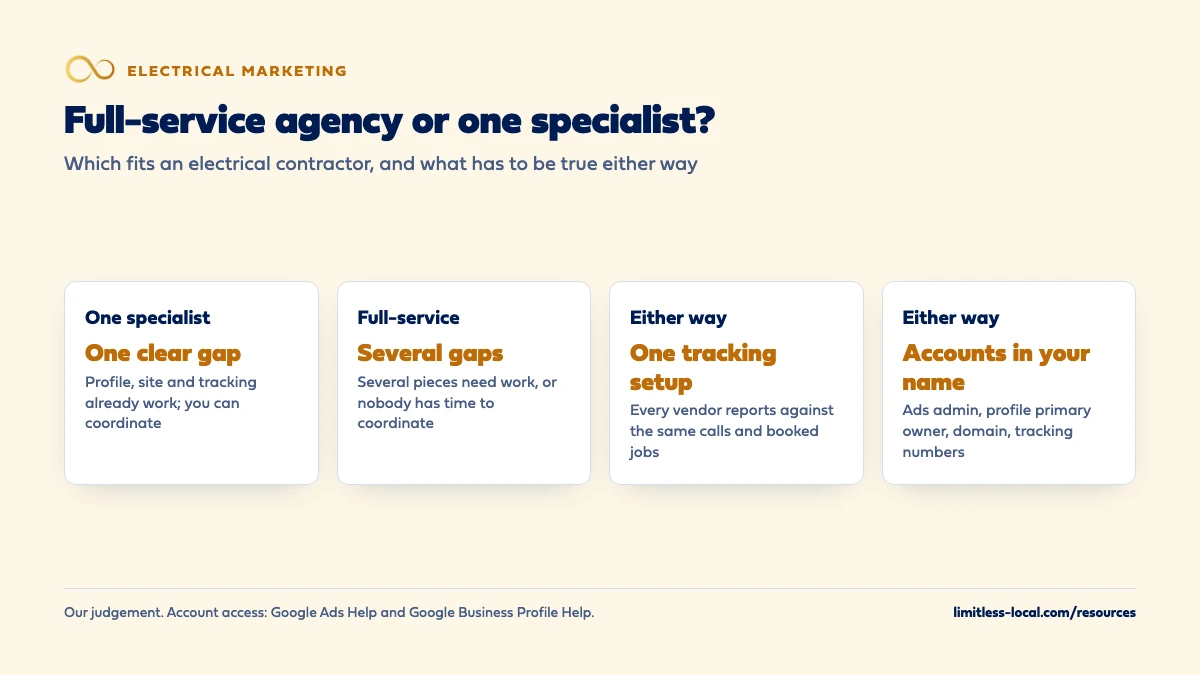
- One specialist fits when one channel is the only gap.
- Full-service fits when several pieces need work or nobody can coordinate vendors.
- With several vendors, someone in your shop must own tracking and the monthly review.
- Keep the Google Ads account, Google profile, domain and tracking numbers in your name.
- Compare total cost, including your coordination time, against booked jobs.
For electrical contractors who’ve decided to pay for help and are choosing between one firm that does everything and a specialist for one channel, such as Google Ads or SEO.
Get a free visibility audit · Book a growth call
Is a full-service marketing agency or a Google Ads or SEO specialist better for an electrical contractor?
Hire one specialist when a single channel is the gap and everything else already works: your Google profile, reviews, website and call tracking are in good shape, and you just need someone to run Google Ads or do SEO. Hire a full-service agency when several pieces need work at once or nobody in your shop has time to coordinate vendors, because ads, SEO, the website and tracking affect each other. Either way, someone has to own the whole picture and the tracking, every account should stay in your name, and each vendor should be judged on cost per booked job.
We’re a full-service option, so weigh this with that in mind: our packages combine local SEO, the Google profile, Google Ads, call tracking and reporting under one monthly fee. If a single specialist fits your gap better, that’s the right call for your business. Our packages page lists what each tier covers, our electrical contractor marketing page explains how we approach the trade, and the rest of the electrical marketing questions library covers hiring help from other angles.
What's the real difference between a full-service agency and a specialist?
A specialist does one thing: a freelancer who runs Google Ads, an SEO consultant, a web designer, a call tracking setup. A full-service agency takes on several channels at once, usually the Google profile, SEO, ads, the website and the tracking and reporting that ties them together.
In our judgement, the bigger difference isn’t the list of services. It’s who coordinates. With specialists, you are the general contractor: you decide what each one does, make sure their work fits together, and compare their reports. With a full-service agency, the agency coordinates, and you hold it to one set of numbers. Google’s page on hiring an SEO makes a related point about any outside help: you are ultimately responsible for the actions of the companies you hire.
When does one specialist make sense for an electrician?
A specialist tends to be the better buy when most of these are true:
- One channel is clearly the gap. Your Google profile, reviews and website are solid, and the problem is, say, a Google Ads account nobody has time to manage.
- Your tracking already works. Calls are tracked by source and booked jobs are marked in your field software, so you can judge the specialist on results.
- Someone in your shop can coordinate. You or an office manager has a few hours a month to brief the specialist and review the numbers.
- The budget is tight. Paying for one channel done well can beat paying for five done thinly.
For example, take an established electrician with steady referrals and a good Google profile who wants more panel upgrade and EV charger calls from search ads. A Google Ads specialist with a clear brief can fit that well.
When does a full-service agency make more sense?
Full-service tends to fit when several pieces need work at the same time, or when nobody can coordinate. The channels depend on each other more than they used to. Google’s page on the move of Local Services Ads into Google Ads says your business name, address and hours sync one way from your Google Business Profile into the ad campaign, and that campaigns with pay-per-lead goals use information from your Business Profile instead of keyword lists. So the profile, the paid campaigns and the reviews behind them are one system, not three separate jobs.
In our judgement, full-service also fits when you’re adding trucks or towns and need the calls to grow in step, or when you’ve tried specialists and ended up with reports that don’t agree. If you’re weighing whether to run both kinds of Google ads, our page on running Google Ads and LSAs at the same time covers how they fit together.
What goes wrong when specialists don't talk to each other?
In our judgement, the same few problems show up again and again:
- Ads send people to a page that doesn’t convert. The ads specialist builds a good campaign, but the website isn’t theirs to fix, so clicks land on a slow page with no clear phone number.
- SEO chases jobs you don’t want. The SEO specialist ranks pages for work you’ve stopped doing or towns you don’t serve.
- Everyone counts leads their own way. One report counts clicks on a phone number, another counts calls over a set length, a third counts form fills, and none of them ties to booked jobs.
- Nobody owns the Google profile. Each vendor assumes someone else is updating hours, services and photos.
None of these is a reason to avoid specialists. Each is something to agree in writing before the work starts.
Curious what your marketing is actually booking?
Get a free visibility audit — no obligation, no sales pitch.
Who owns the tracking when the work is split?
One person, and preferably you or someone on your staff. Tracking is where split work most often breaks, because each vendor naturally measures their own channel. Google’s help on phone call conversion tracking lists several different ways to count calls from ads, from calls placed straight from the ad to clicks on a phone number on your mobile site to calls imported from another system, where you can choose to count only the calls that include sales. Two vendors using different methods will report different numbers for the same month.
Set up one tracking system that covers every channel. Then have every vendor report against the same calls and the same booked jobs in your field software. Our page on tracking which electrical marketing brings in real jobs covers the setup.
Which accounts should stay in my name, whoever I hire?
The more vendors you have, the more this matters, because each one may set up accounts their own way.
- Google Ads. Google’s page on account access levels shows that only admin users can give access, change access levels and unlink manager accounts. Keep admin access yourself and give vendors the level they need. Google’s help on manager account ownership says a client account can have only one owner manager, but that the client account still owns its data and can remove that ownership by unlinking.
- Google Business Profile. Google’s help on owners and managers says a profile can have multiple owners but only one primary owner, and that managers can do most things owners can, except add or remove users or remove the profile. Be the primary owner and add vendors as managers.
- Tracking numbers. CallRail’s porting help says you own the numbers you create in its system and that porting a U.S. tracking number to another provider is free but typically takes 4-6 weeks. Make sure the tracking account is yours, not the vendor’s.
- Your domain and website logins, registered to your company.
Our page on red flags that an electrical marketing agency will waste money covers what to watch for in the contract.
How do I compare the cost of specialists against one agency?
Add up everything on each side, not just the headline fees. For specialists, that means each specialist’s fee, any separate software such as call tracking, and the hours you or your office spend briefing them and reconciling their reports. For an agency, it means the monthly fee and anything it doesn’t include. Ad spend is usually paid to the platform on both sides, so keep it out of the comparison and judge it separately.
Then compare the totals against what each option is expected to produce, and after a few months, against what it actually produced in booked jobs. Our page on what a marketing agency costs an electrician covers how agency fees are usually built.

What should I ask a specialist before hiring?
Google’s page on hiring an SEO suggests questions that work for any specialist, not just SEO. Among them:
- Can you show me examples of your previous work and share some success stories?
- What kind of results do you expect to see, and in what timeframe? How do you measure your success?
- What’s your experience in my industry, and in my city?
- Will you share all the changes you make and explain your recommendations and the reasoning behind them?
Google also says to see whether they’re interested in your business, and to check references from past clients. Add your own questions about how they’ll work with your other vendors and whose tracking they’ll report against. And Google is clear on one thing: no one can guarantee a #1 ranking on Google.
What should I ask a full-service agency before hiring?
Ask the same questions, plus a few that matter more when one firm does everything:
- Which parts do you do in-house, and which do you pass to someone else?
- What’s not included in the fee, such as ad spend, website changes or software?
- Will I get one report that shows calls, booked jobs and cost per booked job by source?
- Whose name are the accounts in, and what happens to them if I leave?
- What are the contract terms and the notice period?
Our page on how to know if your electrical marketing agency is getting results covers what to check once you’ve signed.
Can I start with a specialist and switch to full-service later?
Yes, and the reverse, as long as the accounts are in your name. If you own the Google Ads account, the Google profile, the domain and the tracking numbers, changing who does the work means changing access, not starting over. If a vendor owns them, switching can mean losing history, waiting weeks for numbers to move, or rebuilding from scratch.
If you’re still deciding whether to pay anyone at all, our page on whether to hire an agency or do your own electrical marketing covers which tasks are worth keeping in-house.
Not sure which of these is costing you jobs?
A free visibility audit checks the Google profile, reviews, site and tracking, and shows what to fix first.
What's different about this choice for an electrical contractor
Licensing has to be right in every channel. Your license number, insurance and service areas appear on your website, Google profile and ads. With several vendors, in our judgement, one of them should own keeping those details consistent, or you should.
Service calls and project work need different handling. A specialist running ads for service calls and another doing SEO for panel upgrades and EV chargers can work well, as long as both report booked jobs by job type in the same place.
Your field software is part of the tracking. Whether you use ServiceTitan, Housecall Pro or Jobber, the lead source on each job is what ties marketing to revenue. Any vendor you hire should be able to report against it.
Local Services Ads screening needs you. Google’s screening requirements for the United States list license and insurance requirements for electricians, for select users, and those documents come from the business, so whoever manages those ads will need your help with them.
A worked example: comparing two specialists with one agency
These numbers are made up to show the math, except where they’re our published prices. Say an electrician is comparing:
- Specialists: a Google Ads freelancer at $1,000 a month, an SEO consultant at $1,200 a month, call tracking at $90 a month, and 5 hours a month of the owner’s time coordinating them, valued at $75 an hour, $375. Total: $2,665 a month.
- One agency: our Essentials package at $3,500 a month, which includes Google Business Profile management, SEO content and link building, Google Ads management up to $2,500 a month in ad spend, call, web and form tracking, and a real-time dashboard with a monthly report.
In this example the agency costs $835 a month more. Ad spend is paid to Google separately in both cases. Whether the difference is worth it depends on whether the specialists’ work fits together, whether their reports agree, and above all on cost per booked job after a few months. For some electricians the specialists will be the better deal, and that’s a fine answer.
Frequently asked questions
Is a specialist always cheaper than a full-service agency?
Not always. Two or three specialists plus software plus your coordination time can add up to as much as one agency fee. Compare the full totals, and then compare booked jobs.
Can I use a full-service agency for some channels and a specialist for others?
Yes. You might keep an SEO or web specialist you trust and hand the rest to an agency. Agree in writing who owns tracking and the Google profile so the work doesn’t overlap or fall through the gap.
Should the agency or specialist own my Google Ads account?
In our judgement, no. Keep admin access to your own account and give the vendor the access level it needs. Google says a client account still owns its data and can remove a manager’s ownership by unlinking.
What should my monthly marketing budget include besides the vendor fees?
Ad spend, website upkeep, tracking, review tools and your own time. Our page on what electricians should include in a monthly marketing budget lists each line.
How long should I give a specialist or an agency before judging them?
Long enough for the channel to work: ads can generate leads within days of launch, while SEO typically takes 3-6 months to show meaningful organic growth. Judge both on booked jobs, not activity.
Do full-service agencies do everything in-house?
Not necessarily. Some pass parts of the work to others. Ask which parts are done by whom, and who’s accountable for the results.
Key takeaways
- Hire one specialist when one channel is the only gap and the rest already works.
- Hire full-service when several pieces need work or nobody can coordinate vendors.
- With split work, one person must own the tracking and every vendor reports against it.
- Keep Google Ads admin access, primary ownership of your Google profile, your domain and tracking numbers.
- Compare total cost, including your coordination time, and judge everyone on cost per booked job.
Want a second set of eyes on your setup?
We'll look at how you show up locally and where calls are leaking, then send you a plain-English breakdown.
More in this section
- Should I hire an agency or DIY my electrical marketing?
- How much does a marketing agency cost for an electrician?
- Which channels work best for residential vs commercial electricians?
- What should an electrician's website have to get more calls?
- Should an electrician use an AI receptionist for after-hours calls?
Sources
- Do You Need an SEO? — Google Search Central
- About access levels in your Google Ads account — Google Ads Help
- Manager Accounts (MCC): About ownership of client accounts — Google Ads Help
- Manage your Business Profile owners & managers — Google Business Profile Help
- Port a phone number away from CallRail — CallRail Help Center
- About phone call conversion tracking — Google Ads Help
- Local Services Ads transition to Performance Max campaigns with pay-per-lead goals — Google Ads Help
- Business screening and verification requirements – United States — Google Local Services Help