
How many jobs a month does an electrician need to hit a revenue goal?

- How many new jobs do I need each month to reach my revenue goal?
- What numbers do I need before I start?
- Step 1: How do I turn a yearly goal into a monthly number?
- Step 2: What's my real average job value?
- Step 3: How do I work out the jobs I need?
- Step 4: How much of that work comes in without marketing?
- Step 5: How many estimates do I need?
- Step 6: How many calls and requests does marketing need to bring in?
- Step 7: Can my crew actually do that many jobs?
- Step 8: How do I turn that into a marketing budget?
- Should I set the goal by revenue or by profit?
- How often should I re-run the numbers?
- What's different about the math for electricians
- A worked example: from a revenue goal to calls per month
- Frequently asked questions
- Key takeaways
- More in this section
- Sources
The short version
- Jobs needed = monthly revenue goal divided by average job value.
- Subtract the work you'll get anyway from repeat customers, referrals and builders.
- Divide by your close rate for estimates, then by your booking rate for calls.
- Run service work and project work separately, using your own numbers.
For electrical contractors who have a revenue number in mind and want to turn it into the jobs, estimates and calls they need each month.
Get a free visibility audit · Book a growth call
How many new jobs do I need each month to reach my revenue goal?
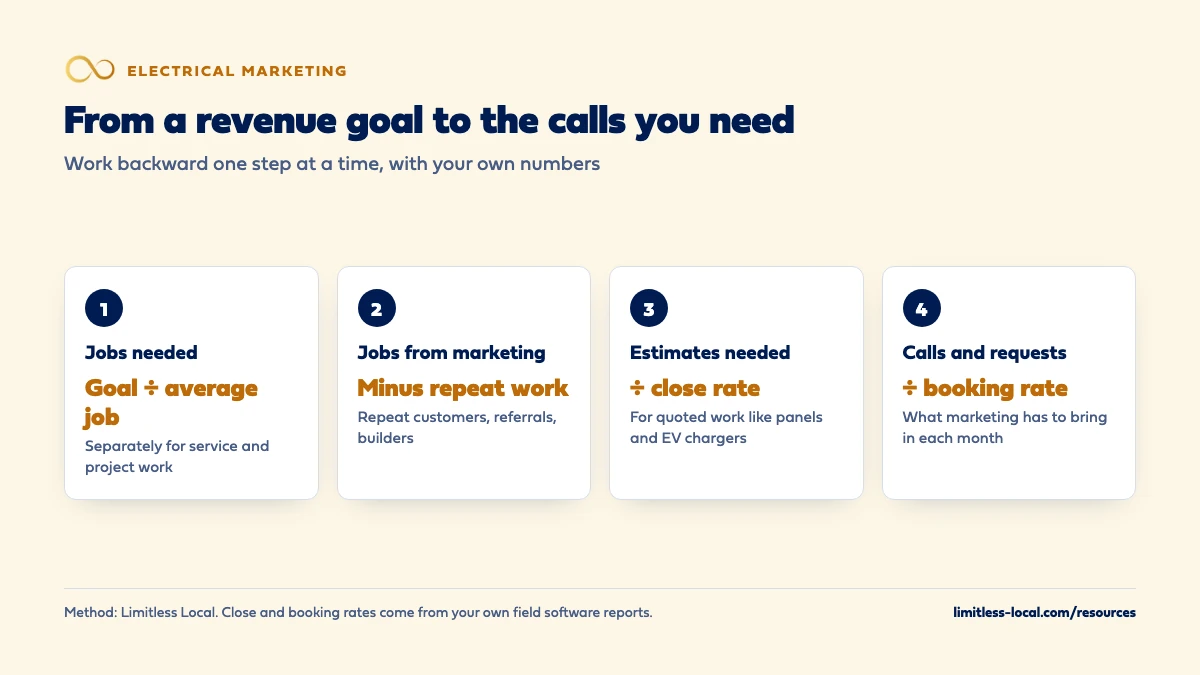
Divide your monthly revenue goal by your average job value, and that’s the number of jobs you need. Then work backward: subtract the work that comes in anyway from repeat customers, referrals and builders, divide the rest by your close rate to get the estimates you need, and divide that by your booking rate to get the calls and requests your marketing has to bring in. Do it separately for service calls and for bigger jobs like panel upgrades, EV chargers and generators, because one average hides how differently they behave.
That last number, the calls and requests marketing has to bring in each month, is where our work starts. We plan around booked jobs, not clicks, and every package includes monthly reports with a cost-per-lead breakdown and call tracking so you can check the math against real results. Our packages page lists what each tier covers and costs, and our electrical contractor marketing page explains how it fits an electrical shop. More answers are in the electrical marketing questions library.
What numbers do I need before I start?
Six numbers, and most of them are already in your field software:
- Your revenue goal for the year or the month.
- Average job value for each kind of work: service calls and repairs, and bigger jobs such as panel upgrades, EV chargers, generators and rewiring.
- Close rate: how many estimates turn into sold jobs.
- Booking rate: how many calls and requests turn into a booked appointment or estimate.
- Work that comes in anyway: repeat customers, referrals, maintenance agreements and builders or general contractors who send you work.
- Crew capacity: how many jobs your electricians can actually get to in a month.
Use your own numbers, not someone else’s. A published average from another market or another trade can send you looking for twice the leads you need, or half.
Step 1: How do I turn a yearly goal into a monthly number?
Divide the yearly goal by twelve, then adjust for your seasons. In our judgement, most electrical shops don’t earn evenly: storm season, summer air-conditioning load and the holiday lighting stretch can all move the calendar, depending on where you work. If last year’s revenue was heavy in some months and light in others, spread this year’s goal the same way so a slow month doesn’t look like a failure and a busy month doesn’t hide a problem.
Next, split the monthly number by kind of work. Decide how much should come from service and repair calls and how much from larger jobs. That split is a business decision, not a marketing one: it depends on which work you’re best at, which pays best, and which your crew can staff.
Step 2: What's my real average job value?
Pull the average invoice for completed, sold jobs over the last year, split by job type. ServiceTitan, for example, reports an Average Ticket as the job average for completed, converted jobs based on invoice subtotals, and lets you set a sold threshold, the minimum invoice subtotal at which a job counts as converted. If you use other field software, look for its job or invoice report.
Leave out warranty callbacks and no-charge visits, because they pull the average down without bringing in revenue. If your average swings a lot from month to month, use the last twelve months, not the last one.
Step 3: How do I work out the jobs I need?
Divide the revenue you want from each kind of work by its average job value:
Jobs needed = revenue goal for that work ÷ average job value for that work
Round up, because you can’t do part of a job. Do it once for service work and once for project work, and you’ll usually find you need many small jobs and a handful of big ones. That difference matters for marketing. In our judgement, small, urgent jobs come from people who call the first electrician they find, while bigger jobs come from people who compare a few estimates first. The worked example below runs the full math with made-up numbers.
Step 4: How much of that work comes in without marketing?
Not every job has to come from new marketing. Subtract what arrives anyway:
- Repeat customers and maintenance agreements.
- Referrals from past customers, neighbors and other trades.
- Builders, general contractors and property managers who send steady work.
Use what actually happened last year, not what you hope will happen. If your field software tags lead sources, it’s a quick count: Jobber’s Lead Source Report, for example, shows the number of leads by source, how many reached a quote, a job and an invoice, and the value of the first invoice from each. What’s left after you subtract is the number of jobs your marketing has to produce.
Curious what your marketing is actually booking?
Get a free visibility audit — no obligation, no sales pitch.
Step 5: How many estimates do I need?
For quoted work, divide the jobs marketing has to produce by your close rate. If you sell about one in every three estimates, you need three estimates for each job you want.
Get the close rate from your software, not from memory. Jobber’s Quotes Report shows a quote conversion rate based on quotes sent and quotes converted in a month. ServiceTitan treats an estimate as closed once it meets your sold threshold. For small service calls, where the tech fixes the problem on the first visit, you can usually skip this step, because a booked call and a sold job are close to the same thing.
Close rate is often the cheapest number to improve. Following up on every open quote, which following up on electrical quotes automatically covers, raises it without a single extra lead.
Step 6: How many calls and requests does marketing need to bring in?
Divide the estimates and service jobs you need by your booking rate, the share of calls and requests that turn into a booked visit. Housecall Pro, for example, reports a lead conversion rate as the share of leads moved to won out of all leads, including won, lost and open ones, and a call conversion report for calls that came through its phone system. ServiceTitan counts a booked call when a call is booked as a job.
This is where missed calls hurt the math. A call that rings out is still a lead your marketing paid for, and every one you miss means you need more to hit the same goal. If your booking rate is low, how fast your office should answer electrical calls is a cheaper fix than buying more leads.
Step 7: Can my crew actually do that many jobs?
Check the jobs you need against the hours your electricians have. A month of service calls and a month of rewiring jobs use very different amounts of crew time, so compare the jobs by type, not just the total. If the goal needs more jobs than your crew can handle, you have three honest options: raise your average job value, hire, or lower the goal.
In our judgement, the expensive mistake is buying more leads than the crew can reach. Those calls go to voicemail or get booked two weeks out, the booking rate falls, and the cost of every job goes up. If you’re short on electricians, whether to pause marketing while you’re hiring walks through the trade-offs.

Step 8: How do I turn that into a marketing budget?
Multiply the jobs marketing needs to bring in by what a booked job costs you in marketing, for each kind of work. If you don’t know that number yet, start with the most you can afford to pay for a job: what’s left of the invoice after labor and materials, and the share of it you’re willing to spend to win the job. What a good cost per booked job looks like for electricians walks through that ceiling.
Then sanity-check the total. The U.S. Small Business Administration says there’s no hard and fast answer to how much a marketing budget should be, and that many businesses use a percentage of revenue as a guide. How much an electrical contractor should spend on marketing compares the percentage method with the job math.
Should I set the goal by revenue or by profit?
Revenue is easier to count, but profit is what pays you. Before you settle on a revenue goal, check that it covers your costs. The Small Business Administration’s break-even calculator uses this formula:
Fixed costs ÷ (price − variable costs) = break-even point in units
The SBA describes fixed costs as costs that don’t change with sales or volume because they’re based on time, worked out monthly in its calculator, and variable costs as costs that change with sales or volume. For an electrician, a unit is a job. Fixed costs are things like the shop, trucks, insurance and office pay; variable costs are the materials and labor on each job. Your break-even job count is the floor, and the revenue goal is everything you want on top of it.
How often should I re-run the numbers?
Once a month, when you look at the books. Compare the jobs you needed with the jobs you got, then find which step fell short: too few calls, too few booked, too few estimates closed, or a lower average job than you planned. Each one has a different fix, and only one of them is more marketing.
This only works if every call and request carries its source into your field software. How to track which electrical marketing brings in real jobs covers that setup, so the monthly check uses real numbers instead of guesses.
Not sure which of these is costing you jobs?
A free visibility audit checks the Google profile, reviews, site and tracking, and shows what to fix first.
What's different about the math for electricians
Two very different kinds of work. An electrical shop often mixes quick, urgent service calls with larger planned jobs. Lumping them into one average job value can make the plan look fine on paper while the schedule fills with the wrong work.
Permits and inspections move the revenue date. A sold panel upgrade or service change may not be invoiced until the permit, the utility and the inspection line up. In our judgement, it’s worth counting project revenue in the month you expect to invoice, not the month you sold it.
Commercial work runs on bids. In our judgement, commercial and builder work usually comes through bids and relationships with lower win rates and longer timelines. Track it as its own line with its own close rate.
Capacity is often the real limit. When licensed electricians are hard to hire, crew hours, not leads, can cap revenue, so check Step 7 before you raise the budget.
A worked example: from a revenue goal to calls per month
These numbers are made up to show the math, not a benchmark for your market. Say your goal is $960,000 for the year, or $80,000 a month, with $32,000 a month from service work and $48,000 from projects like panel upgrades and EV chargers.
- Jobs needed: service averages $320 a job, so $32,000 ÷ $320 = 100 service jobs. Projects average $2,400, so $48,000 ÷ $2,400 = 20 projects.
- Work that comes in anyway: repeat customers and referrals bring 40 service jobs and 5 projects, so marketing needs to produce 60 service jobs and 15 projects.
- Estimates: you sell about one in three project estimates, so 15 × 3 = 45 estimates.
- Calls and requests: your office books 80% of calls and requests, so 60 ÷ 0.8 = 75 service calls and 45 ÷ 0.8, rounded up, is 57 project requests. That’s 132 calls and requests a month from marketing.
- Budget: if a booked service job costs you $150 in marketing and a sold project costs $400, that’s 60 × $150 + 15 × $400 = $15,000 a month.
Now change one input. Raise the booking rate from 80% to 90% and the same jobs need 67 service calls and 50 project requests, fifteen fewer calls and requests a month without spending a dollar more. That’s why the booking and close rates are the first places to look.
Frequently asked questions
What's a typical average ticket for an electrician?
We don’t quote one, because it swings with your market, your mix of service and project work and your pricing. Pull your own from the last twelve months of completed, sold jobs in your field software.
Should I count maintenance agreements toward the goal?
Yes, as their own line. Count agreement revenue and the visits it brings separately, and subtract them before working out what new marketing has to produce.
What if I don't know my close rate?
Start tracking it now. Mark every estimate as sent and every sold one as converted for a couple of months; Jobber, Housecall Pro and ServiceTitan all report a conversion rate once the data is in.
Is it better to raise prices or get more jobs?
It depends on your market and your crew. Raising average job value reaches the same revenue with fewer jobs, which helps when crew hours are the limit; more jobs helps when the crew has room.
Does this math work for commercial electrical work?
Yes, but run it separately. Bids usually have different win rates and longer timelines than residential estimates, so give commercial work its own average job value and close rate.
How many leads does an electrician need a month?
There’s no standard number. It’s the output of this math: the jobs marketing has to produce, divided by your close rate for quoted work and by your booking rate for calls.
Key takeaways
- Jobs needed equals your monthly revenue goal divided by your average job value, worked out separately for service and project work.
- Subtract the work that comes in anyway before deciding what marketing has to produce.
- Work back to estimates with your close rate and to calls with your booking rate, using your own software’s numbers.
- Check the job count against crew capacity before buying more leads.
- Improving booking and close rates lowers the calls you need without raising the budget.
Want a second set of eyes on your setup?
We'll look at how you show up locally and where calls are leaking, then send you a plain-English breakdown.
More in this section
- What should electricians include in their monthly marketing budget?
- How much should an electrician spend on Google Ads each month?
- What is a good cost per booked job for electrical marketing?
- How much should an electrical contractor spend on marketing?
- How do I run an electrical business that gets steady calls?
Sources
- Break-even point calculator — U.S. Small Business Administration
- How to Get the Most From Your Marketing Budget — U.S. Small Business Administration
- Quotes Report — Jobber Help Center
- Lead Source Report — Jobber Help Center
- Conversion Rate Reporting — Housecall Pro Help Center
- Technician Close Rate by Job Type Legacy Report — ServiceTitan Help
- ServiceTitan Glossary (commonly used ServiceTitan terms) — ServiceTitan Help