
How do I run an electrical business that gets steady calls?

- What weekly marketing routine keeps an electrical company's phone ringing all year?
- Why do calls to an electrical business come in waves?
- What does an electrical business with steady calls have in place?
- The daily routine: answer, return and log every call
- The weekly routine: reviews and your Google profile
- The weekly routine: follow up on open quotes
- The monthly routine: check where calls and jobs came from
- The monthly routine: move money toward what booked jobs
- How do I keep calls steady when the schedule is full?
- How do I keep calls steady through slow stretches?
- What should never depend on a single source?
- What's different about steady calls for an electrical business
- A worked example: one month's review for an electrical shop
- Frequently asked questions
- Key takeaways
- More in this section
- Sources
The short version
- Build a base that keeps working: Google profile, reviews, website and SEO.
- Add paid ads as the layer you turn up or down with the schedule.
- Daily: answer or return every call. Weekly: reviews and quote follow-up.
- Monthly: check booked jobs by source and move money toward what works.
- Don't let one source, one customer or one contractor carry the business.
For electrical contractors whose phone swings between too busy and too quiet, and who want a marketing routine that evens it out. This is about marketing and calls, not running the rest of the business.
Get a free visibility audit · Book a growth call
What weekly marketing routine keeps an electrical company's phone ringing all year?
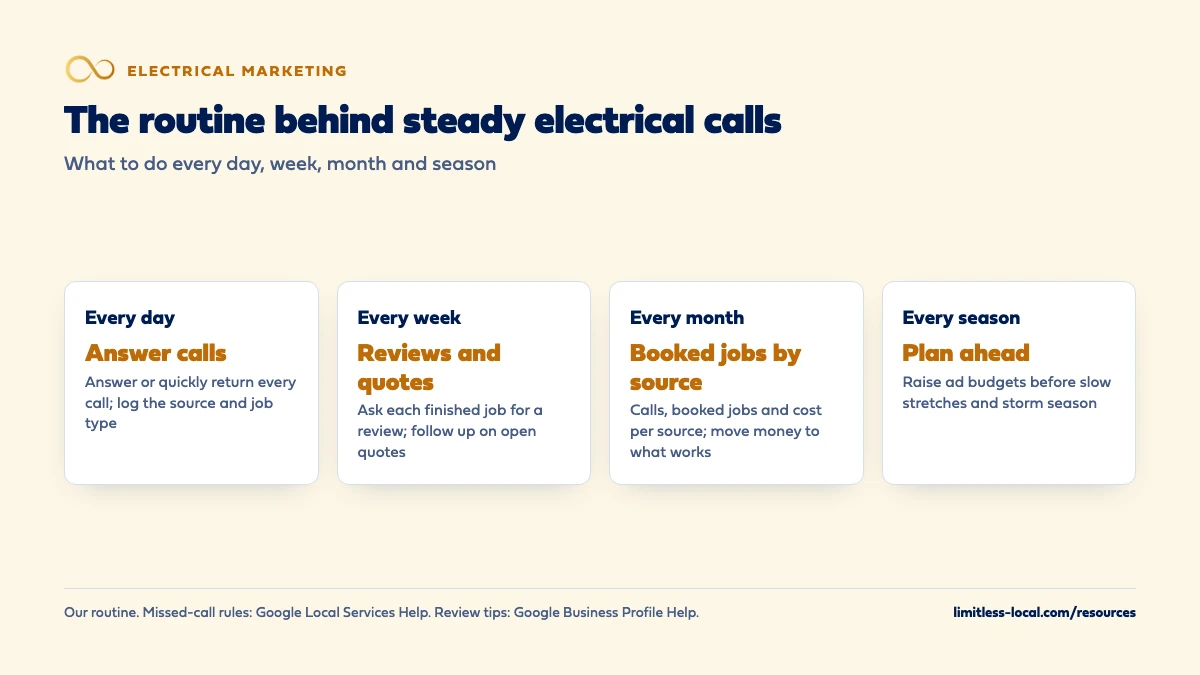
An electrical business gets steady calls from a routine, not from one channel: sources that keep working in the background, like your Google Business Profile, reviews and website, plus paid ads you can turn up or down as the schedule changes. Every day, answer or quickly return every call; every week, ask each finished job for a review and follow up on open quotes; every month, check which sources produced booked jobs and move money toward them. Calls usually swing when one source carries the business, the phone goes unanswered, or marketing stops the moment the schedule fills.
That routine is what our packages are built around: we run the platform side, including the Google profile, ads, review requests and call tracking, and every package includes a monthly report with a cost-per-lead breakdown and a real-time dashboard, while you keep answering the phone and doing the work. Our packages page shows what each tier covers, our electrical contractor marketing page explains how we approach the trade, and the rest of the electrical marketing questions library goes channel by channel.
Why do calls to an electrical business come in waves?
In our judgement, most feast-or-famine phones come down to one of three patterns. The first is a business that runs on one source: referrals from past customers, one general contractor, or one ad campaign. When that source slows, so does everything. The second is a phone that isn’t answered during busy weeks, so the calls are there but the jobs aren’t. The third is the most common: the owner stops marketing when the schedule fills, and restarts when it empties, so the next slow stretch is already on its way.
The fix isn’t a new channel. It’s a set of sources that don’t all depend on the same thing, and a routine that keeps them running at a steady level whether or not this week is busy.
What does an electrical business with steady calls have in place?
Think of it in two layers.
- The base layer keeps working in the background: a complete Google Business Profile, a steady flow of new reviews, a website with a page for each kind of work you want, and SEO that builds over months. You don’t turn it off when you’re busy.
- The flexible layer moves with the schedule: Google search ads and Local Services Ads, which you can raise ahead of a slow stretch and trim when crews are booked out.
Under both sit two things that decide whether the calls turn into jobs: someone answers the phone, and every call is tracked to its source. If you’re still building the base layer, growing a small electrical business with marketing covers the order to add each piece.
The daily routine: answer, return and log every call
Steady calls are worthless if they ring out. Every day, someone should answer calls during business hours, return any missed call quickly, and log the source and job type in your field software, whether that’s Jobber, Housecall Pro or ServiceTitan.
Missed calls also cost you in paid channels. Google’s page on how Local Services Ads leads work says a missed call during your business hours counts as a valid lead when the customer stays on the line for more than 20 seconds, so you can pay for a call nobody answered. Its page on Local Services Ads ranking says missed calls may negatively affect your responsiveness, which is one of the factors in how likely your ad is to produce a lead. Our page on how to stop missing calls lays out the fixes.
The weekly routine: reviews and your Google profile
Once a week, check that every finished job got a review request, and reply to the reviews that came in. Google’s tips to get more reviews suggest reminding customers with a Google link or QR code, replying to reviews, and valuing all of them, since a mix of positive and negative feedback often feels more trustworthy. Google also says offering incentives in exchange for reviews is considered fake and misleading content.
The same weekly slot is a good time to add a photo of recent work or a short update to your profile. Google’s help on Business Profile posts says updates, offers and events show on your profile on Search and Maps, and that posts older than 6 months are archived unless a date range is set. A steady trickle of reviews and updates, in our judgement, matters more than a burst once a year. Our page on getting more Google reviews for an electrical business covers how to ask.
Curious what your marketing is actually booking?
Get a free visibility audit — no obligation, no sales pitch.
The weekly routine: follow up on open quotes
Panel upgrades, EV charger installs, generators and rewiring jobs usually start with a quote, and quotes that nobody follows up on tend to go quiet. Once a week, go through every quote that’s still open: who got it, when, what the next step is, and who’s calling them back.
This is the cheapest way to steady the schedule, because those customers already called you. If the list gets long, it’s worth automating reminders through your field software; our page on following up on electrical quotes automatically shows how.
The monthly routine: check where calls and jobs came from
Once a month, pull three numbers for each source: calls or leads, booked jobs, and what the source cost. Sources include Google Ads, Local Services Ads, the Google profile, the website, referrals, contractors and anything printed on your trucks.
Tracking numbers make the calls countable. CallRail’s source tracking help recommends one source tracking number per campaign to keep reports accurate, and lists sources from paid and organic search to directory listings such as Google My Business (now Google Business Profile) and printed materials such as signs. Google’s Business Profile performance help lists calls, website clicks, direction requests and the searches people used to find you, and notes the performance data includes interactions from both organic results and Google Ads; the searches metric updates at the start of each month and can take up to 5 days to show. Our page on tracking which marketing brings in real jobs covers the setup.
The monthly routine: move money toward what booked jobs
With booked jobs by source in front of you, the monthly decision is simple: put more into the sources that book the work you want at a cost you can live with, and fix or trim the ones that don’t. A 2019 SBA blog post on getting the most from a marketing budget gives similar advice: if you’ve been in business a while, focus on the marketing that has gotten the best results in the past and phase out what isn’t working.
The same post warns about a trap that hits trades businesses hard: sales drop, so you cut marketing, and sales drop further. In our judgement, keep the base layer running through slow stretches and use the flexible layer, your ad budgets, to make the adjustments.

How do I keep calls steady when the schedule is full?
Don’t switch everything off. Google’s help on pausing campaigns says pausing stops your ads from showing and stops further charges, and that you can resume at any time with your settings and history kept. That’s useful for a week when you’re booked out, but the calls stop with it.
In our judgement, a better move when you’re busy is to narrow rather than stop: trim ads to the higher-value jobs and closer towns, keep the review requests and profile updates going, and keep following up on quotes so the next few weeks are already filling. The base layer keeps working while you’re on jobs.
How do I keep calls steady through slow stretches?
Plan for the slow months before they arrive. Look back at last year’s calls by month, if you tracked them, and raise ad budgets a few weeks ahead of the dip rather than in the middle of it. Work the list of past customers and open quotes, and push the planned work, such as panel upgrades, surge protection and lighting, that homeowners can schedule any time.
Our page on getting more electrical leads in the slow season has more ideas for the quiet months.
What should never depend on a single source?
In our judgement, three things are worth spreading out:
- Where calls come from. If more than about half of last month’s booked jobs came from one source, one change at Google or one lost relationship can empty the schedule.
- Who sends you work. One general contractor or one property manager can be a great customer and still a risky share of the business.
- Who holds the accounts. Your Google Business Profile, Google Ads account, website domain and tracking numbers should be in your name, so a change of vendor or employee doesn’t reset everything.
Want to see where your company stands?
A free visibility audit shows where you show up on Google, Maps and AI answers, and what it's costing you in calls.
What's different about steady calls for an electrical business
Service calls and project work move at different speeds. Troubleshooting and repair calls tend to come in fast from Maps and paid search; panel upgrades, EV chargers and generators usually involve a quote and a wait. In our judgement, a steady schedule needs both: service calls to fill this week, quoted work to fill next month.
Storms and seasons move generator and surge work. In our judgement, demand for generators and surge protection often rises around storm season. Raise budgets for those jobs ahead of the season rather than once the phones are already busy.
Contractor work can crowd out residential. A big commercial or new-construction job can tie up crews for weeks. Keep the residential base layer running so calls are still there when it ends.
Safety calls can’t wait for a callback. A caller with a burning smell or a sparking panel should reach a person quickly, so plan who answers those even in the busiest weeks.
A worked example: one month's review for an electrical shop
These numbers are made up to show the math, not a benchmark for your market. Say a two-truck electrical shop pulls its monthly numbers:
- Google search ads: $1,500 spent, 10 booked jobs, so $150 per booked job.
- Local Services Ads: $900 spent, 4 booked jobs, so $225 per booked job.
- Google profile and website: 14 booked jobs, at the cost of time spent on reviews, photos and pages.
- Referrals and contractors: 12 booked jobs.
That’s 40 booked jobs, with 26 of them coming from sources that would keep working even if the ads were paused. The owner might move some Local Services Ads money into search ads for panel upgrades, check how many Local Services Ads calls went unanswered, and keep the review routine going, because the profile is doing a lot of the work. Next month, the same review shows whether the change helped.
Frequently asked questions
How many hours a week does this routine take?
It depends on the size of the shop and what you hand off. The daily call handling belongs to whoever answers the phone; the weekly review and quote check and the monthly numbers can be a short, fixed block on the calendar.
Should I stop advertising when I'm fully booked?
In our judgement, narrow rather than stop. Pausing a Google Ads campaign stops the ads and the charges, but the calls from those ads stop with it.
Is word of mouth enough to keep an electrical business busy?
It can be for a while, but a business that runs on one source is exposed when that source slows. In our judgement, referrals work best alongside a Google profile, reviews and a website that keep working in the background.
What should my monthly marketing budget cover besides ads?
Usually management, the website, tracking and review requests as well as ad spend. Our page on what electricians should include in a monthly marketing budget itemizes the lines.
Which number should I watch every month?
Cost per booked job by source: what the source cost divided by the jobs it booked. Calls and clicks are useful, but they don’t tell you whether the work was booked.
Do Google profile posts help bring in calls?
Google says posts show on your profile on Search and Maps and that posts older than 6 months are archived unless a date range is set. In our judgement, they’re a small, steady part of keeping the profile current, not a channel on their own.
Key takeaways
- Steady calls come from a routine across several sources, not from one channel.
- Keep the base layer running (Google profile, reviews, website, SEO) and adjust the ads layer with the schedule.
- Answer or quickly return every call; a missed call during business hours can still be charged as a Local Services Ads lead if the caller stays on the line more than 20 seconds.
- Every week, ask for reviews and follow up on open quotes; every month, check booked jobs by source.
- Plan budgets ahead of slow stretches and storm season instead of reacting once the phone is quiet.
Not sure what's working right now?
Start with a free visibility audit: rankings, Google profile, reviews and tracking, checked against your service area.
More in this section
- How do I market a new electrical business from day one?
- Where should I advertise my electrical business?
- Do I need call tracking numbers for my electrical business?
- How do I grow a small electrical business with marketing?
- What should an electrician's website have to get more calls?
Sources
- How leads work — Google Local Services Help
- About ad rankings — Google Local Services Help
- Tips to get more reviews — Google Business Profile Help
- Create & manage posts on your Business Profile — Google Business Profile Help
- Understand your Business Profile performance & insights — Google Business Profile Help
- Source tracking basics — CallRail Help Center
- How to Get the Most From Your Marketing Budget — U.S. Small Business Administration
- Enable, pause, or remove a campaign — Google Ads Help