
Should a restoration company budget for content and reviews?
- Do content and review generation deserve their own line in a restoration marketing budget?
- Why do content and reviews need their own budget line?
- What counts as content for a restoration company?
- How much content should a restoration company pay for?
- Should content come before or after ads?
- What does a review program actually cost?
- Why are reviews worth paying for at all?
- What should never be in a review budget?
- Do review replies need a budget too?
- When is it too early to spend on content?
- How do I know content and reviews are paying off?
- What's different for restoration companies
- A worked example: what a review program costs in a month
- Frequently asked questions
- Key takeaways
- More in this section
- Sources
The short version
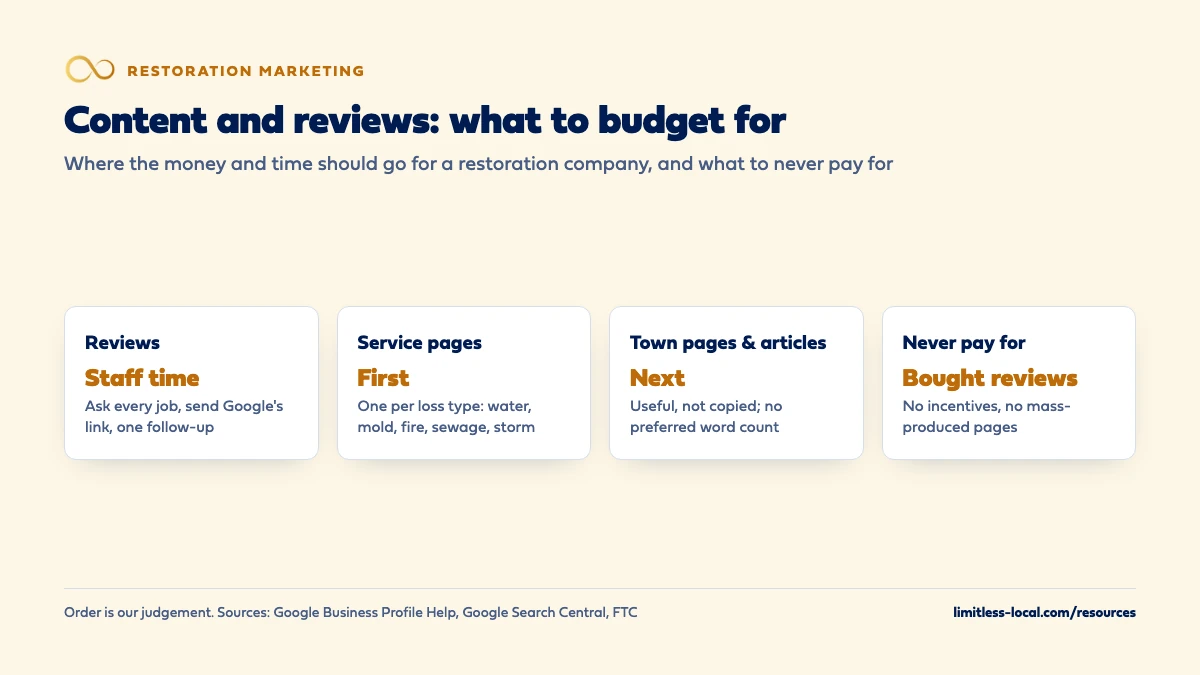
- Reviews: mostly staff time and a consistent ask; never pay or reward customers for them.
- Content: service pages for each loss type first, then town pages and genuinely useful articles.
- Both are slow and easy to skip in busy months, which is why they need their own line.
- Judge them on review pace, service-page impressions, calls and signed jobs.
For restoration owners setting a marketing budget who wonder whether service pages, articles and a review program are worth paying for, or just nice to have.
Get a free visibility audit · Book a growth call
Do content and review generation deserve their own line in a restoration marketing budget?
Yes. Both deserve a small, steady line in a restoration company’s budget, because Google says more reviews and positive ratings can help local ranking, reviews affect where you show in Local Services Ads, and service pages are what let your site show up for water, mold and fire searches. Reviews cost mostly staff time and discipline, not ad money; content costs writing time or a writer, and should go to useful service and town pages before articles. What neither should get is money for buying reviews, which Google’s policies and federal rules prohibit, or for mass-produced pages, which Google’s spam policies treat as abuse.
Content and reviews are part of our packages. Essentials, at $3,500 a month for one location, includes a content sprint of up to 10 pages, 2 blog posts a month, review response and basic review generation, alongside Google Business Profile and Google Ads management. Growth, at $4,500 a month, moves to 4 blog posts a month and advanced review generation, and automated review requests are part of the custom-priced Scale tier. Our restoration marketing page covers how this fits water, fire and mold companies, the restoration marketing guide sets out every channel, and the restoration marketing library answers the rest question by question.
Why do content and reviews need their own budget line?
Because they’re slow, and slow work is the first thing cut when the phones get busy. Ads show results in days and stop when you stop paying. Reviews and service pages build up over months and keep working, but nobody misses them in a single week, so in our judgement they quietly stop unless someone is paid, or at least assigned, to do them.
The SBA’s guide to marketing budgets says there’s no hard and fast answer to how much a small business should spend, recommends a mix of marketing methods rather than putting all your eggs in one basket, and says tracking results is key to getting the best return. A budget that’s all ads is one basket. A line for reviews and a line for content give you a second and third that don’t switch off when the ad budget runs out.
What counts as content for a restoration company?
In order of what usually earns its keep, in our judgement:
- Service pages, one for each kind of work you want: water damage, mold remediation, fire and smoke, sewage cleanup, storm damage. These are the pages that show up for hiring searches.
- Town pages for the main areas you serve, each with something real about working there, not the same page with the town name swapped.
- Google profile posts and job photos: real crews and equipment, never homeowners’ faces or addresses.
- Articles that answer the questions customers actually ask you: what happens on day one of a water job, how drying is checked, what to expect when insurance is involved, kept general and without promising any claim outcome.
A new site with no service pages should spend on those before a single blog post.
How much content should a restoration company pay for?
Less than many content plans suggest, done better. Google’s guidance on helpful content lists warning signs such as producing lots of content on many different topics in hopes some of it performs, using extensive automation to produce content on many topics, and writing to a particular word count. On word count, Google says plainly that it doesn’t have a preferred one.
Google’s spam policies go further. They describe scaled content abuse as many pages generated mainly to manipulate rankings rather than help people, and doorway abuse as including pages targeted at specific regions or cities that funnel users to one page. For a restoration company, that rules out buying fifty near-identical town pages. In our judgement, paying for a smaller number of pages that each show real knowledge of the work, from someone who’s actually run a drying job, is the better use of the same money.
What monthly restoration SEO work should include covers how much content a month is reasonable to expect.
Should content come before or after ads?
Usually alongside, with ads carrying the calls in the early months. Ads can generate leads within days of launch; SEO typically takes 3-6 months to show meaningful organic growth. If you need calls this month, ads come first. If you plan to be in business in two years, content needs to start now, because the months it takes don’t start counting until the pages exist.
One overlap is worth knowing: a good water damage service page is also the best landing page for a water damage ad. Money spent on that page works for both channels. The monthly marketing budget a restoration company needs covers how to set the ad floor first and fit everything else around it.
Curious what your marketing is actually booking?
Get a free visibility audit — no obligation, no sales pitch.
What does a review program actually cost?
Mostly time. Google lets you create a link or QR code for customers to review your Business Profile, at no charge, and suggests putting it on receipts and in thank-you emails. The costs are:
- The ask. A technician or crew lead asking at the end of every job, the same way each time.
- The follow-up. Someone in the office sending the link the same day and one reminder later.
- The tracking. Counting how many finished jobs got an ask, so you know whether it’s happening.
- Optional software to send requests automatically from your job management system. It saves time but doesn’t replace the ask.
In our judgement, the most common failure isn’t the cost; it’s that nobody owns it. Getting more five-star Google reviews for a restoration company sets out who should own the ask and when on a job to make it.
Why are reviews worth paying for at all?
Because Google ties them to where you show up in two places. On Maps, Google’s local ranking page says more reviews and positive ratings can help your business’s local ranking, and lists how many reviews you have among the information that shapes how well-known you are. On Local Services Ads, Google says star ratings and number of reviews affect how your business is ranked, and that providers with higher ratings and more reviews stand out and typically book more jobs.
Reviews also do the selling once you’ve shown up. Google’s review tips say reviews give potential customers helpful information, and that a mix of positive and negative feedback often feels more trustworthy. For a homeowner choosing who to let into a flooded house, that’s often the deciding read.
What should never be in a review budget?
Anything that pays for, rewards or fakes a review. Google says offering incentives, like free or discounted goods or services, in exchange for customers posting, changing or removing reviews is fake and misleading content and is strictly prohibited.
Federal rules point the same way. The FTC’s final rule on fake reviews and testimonials, announced in August 2024, prohibits businesses from buying fake reviews, from providing compensation or incentives conditioned on reviews expressing a particular sentiment, and from using certain insider reviews without clearly disclosing the connection. It also prohibits suppressing negative reviews through groundless legal threats, intimidation or certain false accusations. This isn’t legal advice; if you’re unsure whether a review program is allowed, ask a lawyer.
In practice, that means no gift cards for reviews, no discounts on the next job, no asking staff or family to post as customers, and no service that sells reviews by the batch.

Do review replies need a budget too?
A small one, in time. Google’s review tips ask businesses to reply to reviews, keep replies short, personal and polite, protect the reviewer’s privacy, and respond in a timely manner. For a restoration company, a reply also has to stay away from claim details, insurers, health effects and anything private about the home, which in our judgement makes it a job for someone careful, not whoever has a spare minute.
A few minutes per review is usually enough once there’s a standard way of doing it. How a restoration company should reply to Google reviews has the wording to use and avoid.
When is it too early to spend on content?
In our judgement, hold off on paid content until three things are in place, because content sends people to the site and the profile and the rest has to work when they arrive:
- Someone answers the phone, including at night and on weekends, or there’s a clear plan for those calls.
- Calls and forms are tracked, so you can tell later whether the pages produced anything.
- The basics of the site work on a phone: fast, with a one-tap number on every page.
Reviews are different. Start asking for them from the first job, because there’s no setup that needs to come first and the count only builds from the day you start.
How do I know content and reviews are paying off?
Look at different numbers for each, and give them months, not weeks:
- Reviews: new reviews per month against finished jobs, your rating, and how your count compares with the restoration companies showing in your map pack.
- Content: Search Console impressions and clicks for each service page on hiring searches with your town names, then calls on the website tracking number.
- Both: calls, signed jobs and cost per signed job by source.
Telling whether restoration SEO is working before leads arrive covers the early content signals in detail. If a year in the review count hasn’t moved and the service pages get no impressions, the line items aren’t working and it’s time to find out why.
Want to see where your company stands?
A free visibility audit shows where you show up on Google, Maps and AI answers, and what it's costing you in calls.
What's different for restoration companies
Each loss type is its own search. In our judgement, restoration needs more distinct service pages than many trades, because water, mold, fire, sewage and storm work bring different people with different worries. That makes the content line bigger at the start and smaller once the core pages exist.
Health and insurance claims need care. Content about mold should only say what sources like the EPA or CDC say, and insurance content should stay general, never promising how a claim will turn out. That kind of care takes more time per page, so budget for it.
Reviews come at an awkward time. A water job can run for days while the customer deals with an insurer. Asking once the house is dry and the equipment is out tends to work better than asking on day one.
Storms change the plan. After a regional storm, profile posts and job photos about that kind of damage may matter more that month than the planned article. Leave room in the content line to switch.
A worked example: what a review program costs in a month
These numbers are made up to show the math, not a benchmark for your business. Say a restoration company finishes 40 jobs a month.
- A crew lead asks for a review at the end of each job, which takes about 2 minutes: 80 minutes a month.
- The office sends the link the same day and one reminder to the 25 customers who haven’t left a review yet, about 5 minutes each: 125 minutes.
- That’s 205 minutes, or about 3.4 hours a month.
At a loaded staff cost of $30 an hour, the program costs about $102.50 a month in time. If the average job in this example is worth $4,800, a single extra job won in a year because of the reviews would cover a full year of the program’s time, about $1,230, nearly four times over. The real cost is the discipline of asking every time, which is why it needs an owner and a line in the budget, even if the dollar figure is small.
Frequently asked questions
Can I give customers a small thank-you gift for leaving a review?
Not in exchange for the review. Google says offering incentives, like free or discounted goods or services, for posting a review is prohibited. Thank customers for their business, not for the review.
Should I pay a writer or write the pages myself?
Either can work. Google’s helpful content guidance values first-hand expertise, which owners have in abundance; a writer can save time if you review every page for accuracy before it goes live.
Is AI-written content a waste of money for a restoration site?
Google’s spam policies list using generative AI tools to generate many pages without adding value as an example of scaled content abuse. Pages that add real knowledge of your work, however they’re drafted, are a different matter.
Do I need review software?
No. Google provides a free review link and QR code. Software can send requests automatically, which helps once volume is high, but the ask at the end of the job matters more.
Should content and reviews come out of the same budget as ads?
Same total budget, different lines. Keeping them separate stops a busy ad month from quietly eating the slow work.
Key takeaways
- Content and reviews both deserve a small, steady budget line, because they’re slow and the first thing to slip.
- Google says more reviews and positive ratings can help local ranking, and reviews affect Local Services Ads ranking.
- A review program costs mostly staff time; never pay, reward or fake reviews.
- Spend on service pages for each loss type before town pages and articles, and skip mass-produced pages.
- Judge both on review pace, service-page impressions, calls and signed jobs over months.
Not sure what's working right now?
Start with a free visibility audit: rankings, Google profile, reviews and tracking, checked against your service area.
More in this section
- How does a restoration company recover when its reviews drop?
- What monthly marketing budget does a restoration company need?
- What is a good cost per booked job for a restoration company?
- Should a restoration company hire an in-house marketer vs agency?
- Should a restoration company run Google Ads, LSAs or both?
Sources
- How to Get the Most From Your Marketing Budget — U.S. Small Business Administration
- Creating helpful, reliable, people-first content — Google Search Central
- Spam policies for Google web search — Google Search Central
- Tips to get more reviews — Google Business Profile Help
- Create a Google link or QR code to request reviews — Google Business Profile Help
- Tips to improve your local ranking on Google — Google Business Profile Help
- Reviews and Ratings on Local Services Ads — Google Local Services Help
- Federal Trade Commission Announces Final Rule Banning Fake Reviews and Testimonials — Federal Trade Commission