
Should a restoration company run Google Ads, LSAs or both?
- Is it better for a restoration company to use Local Services Ads or Google search ads in 2026?
- What's the difference between Google Ads and LSAs for a restoration company?
- Do Local Services Ads cover water, fire and mold jobs?
- What changed for restoration Local Services Ads in 2026?
- What will I pay for with Local Services Ads?
- What happens to junk and out-of-area LSA leads?
- What decides where my restoration company shows up in LSAs?
- Why pay for Google Ads if LSAs already show at the top?
- When should a restoration company start with LSAs?
- When should a restoration company start with Google search ads?
- How do I compare LSAs and Google Ads fairly?
- What's different about paid search for restoration companies
- A worked example: what each channel can bill in a month
- Frequently asked questions
- Key takeaways
- More in this section
- Sources
The short version
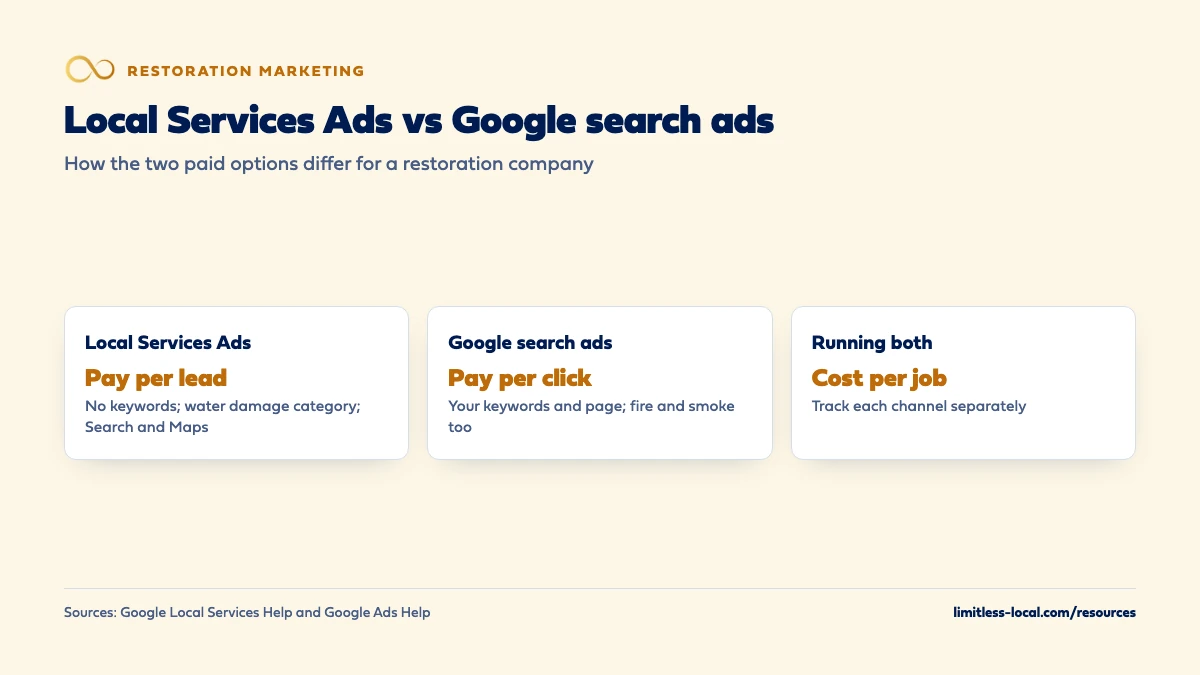
- LSAs: you pay per valid lead, there are no keywords, and the category is "Water damage services".
- Search ads: you pay per click, choose the keywords and the landing page, and can advertise any service you do.
- Restoration isn't named in the first group of LSA accounts moving into Google Ads; Google lists later phases for late 2026 and 2027.
- Compare the two on cost per booked job, tracked separately.
For restoration owners deciding where paid search money goes, now that Google is moving Local Services Ads into Google Ads.
Get a free visibility audit · Book a growth call
Is it better for a restoration company to use Local Services Ads or Google search ads in 2026?
Most restoration companies that can answer the phone around the clock do best running both: Local Services Ads for water damage leads, where you pay per valid lead and rank on responsiveness, reviews and verification, and Google search ads for the jobs and wording LSAs don’t have a category for, such as fire and smoke damage. If you can only fund one, start with LSAs when your phones are covered and your reviews are solid, and start with search ads when you need control over which searches you pay for and where the click lands. Either way, compare them on cost per booked job, not cost per lead or cost per click.
That last point is how we judge paid search for restoration companies: what each booked job cost, channel by channel. Google search ads and Local Services Ads management are both part of our local ads work, with LSAs included from the Growth package up. The restoration marketing guide covers every channel and what restoration marketing costs, and the restoration marketing questions library takes them one question at a time.
What's the difference between Google Ads and LSAs for a restoration company?
They’re both Google, both show on search results, and both cost money when someone acts on them. That’s where the overlap ends.
- Google search ads charge per click. You choose the keywords, write the ad and pick the page the click lands on, and you set or automate the bids. A click costs you whether or not the person calls.
- Local Services Ads charge per valid lead: a call, a message or a booking request. There are no keywords; Google targets them by the service categories and areas you choose, shows them only on Google Search and Maps, and in eligible categories can show a Google Verified badge once you pass its checks.
In our judgement, the trade-off for restoration is control against simplicity. Search ads let you decide exactly which jobs and wordings you pay for; LSAs take less setup and charge only when a homeowner reaches out, but you live with Google’s categories. Sources: Cost-per-click (CPC): Definition and Local Services Ads transition to Performance Max campaigns with pay-per-lead goals.
Do Local Services Ads cover water, fire and mold jobs?
Partly. Google’s list of US Local Services Ads categories includes Water damage services, which Google describes as professionals who clean and inspect water damage issues such as mold, sewage and paint damage. Google notes that professionals in some states may need additional licenses for mold remediation or assessment, and the checks it lists for the category, each marked for select users, include background checks, business registration, general liability insurance, state licenses and IICRC certification.
The same list doesn’t include a separate fire or smoke damage category. So if fire and smoke jobs matter to you, in our judgement search ads are the way to advertise them on Google, with their own keywords and landing page. Google also says Local Services Ads are only available for certain categories and areas, so check eligibility for your market before you plan around them. Sources: Getting started with Local Services Ads (United States) and Business screening and verification requirements (United States).
What changed for restoration Local Services Ads in 2026?
Google is moving Local Services Ads into the main Google Ads platform as Performance Max campaigns with pay-per-lead goals. The first phase began in August 2026 for select home and storefront service advertisers, and Google’s named list (plumbing, HVAC, electrical, appliance repair, house cleaning, lawn care, roofing, pest control, moving) doesn’t mention water damage. Google lists late 2026 for service-area businesses without storefronts and 2027 for remaining categories, so many restoration accounts are still waiting. Your account administrator gets an email 14 days before the move.
What stays the same: pay per lead, Search and Maps placement, keywordless targeting. What changes: weekly budgets become daily average budgets, manual bidding such as a maximum price per lead goes away, and business name, address and hours sync one way from your Google Business Profile. Your old performance reports don’t carry over, so download or screenshot them first. Past leads, messages and call recordings do move across. Source: Local Services Ads transition to Performance Max campaigns with pay-per-lead goals.
What will I pay for with Local Services Ads?
Google charges for valid leads, which it defines as: a call you answer, or a call back where you speak with the customer; a missed call during your business hours where the caller stays on the line more than 20 seconds; a text or email; a voicemail; or a booking request. Message leads are typically priced lower than phone leads, though not always. If the same customer contacts you again within 15 days from the same number or email, you aren’t charged twice.
Here’s the restoration catch. Google defines “business hours” as the hours on your Google Business Profile. If your profile says you’re open around the clock and a 3 a.m. call rings out past 20 seconds while your ads are scheduled to run, that can be a charged lead you never spoke to. In our judgement, either staff the phone for the hours you list or list the hours you can really answer. How fast to answer emergency calls covers the coverage side. Source: How leads work.
Curious what your marketing is actually booking?
Get a free visibility audit — no obligation, no sales pitch.
What happens to junk and out-of-area LSA leads?
Google screens leads at first contact and doesn’t charge for ones it judges invalid or low quality, such as spam or duplicates. Charged leads keep getting reviewed, and credits for low-quality ones are usually applied within thirty days. Each lead shows as Charged, Not charged, In review or Credited.
What Google no longer credits: leads for a job type you don’t service or an area you don’t serve. Google’s advice for unwanted leads is to refine your service areas, categories and service types, and it warns that narrowing them can reduce volume. In our judgement, that trade is worth making: draw the area your crews will actually drive to in an emergency, and switch off job types you don’t want, because the cost of those leads now sits with you. Sources: About Automated Local Services Ads lead credits and How leads work.
What decides where my restoration company shows up in LSAs?
Local Services Ads are ordered by an auction that weighs your bid against how likely your ad is to produce a lead. Google lists what goes into that second part:
- Responsiveness. Missed calls may hurt you. Turning on message and booking leads gives homeowners another way to reach you, especially at night and on weekends.
- Relevance. The job and place searched, and how well your services and business bio match.
- Profile quality. Rating, number of reviews, average response time, good photos and the verification checks you’ve completed.
Google adds that if you have several locations serving the same area, only your highest-ranking ad shows for a search. Since campaigns that have moved to Google Ads are set up from your Business Profile, optimizing your restoration Google Business Profile pays off in both places. Source: About ad rankings.
Why pay for Google Ads if LSAs already show at the top?
It’s a fair question, and sometimes the answer is that you shouldn’t yet. But there are four common reasons restoration companies run search ads alongside LSAs, in our judgement:
- Services without an LSA category, fire and smoke damage most of all.
- Control. You choose the wording, block the searches you don’t want with negative keywords, and send each click to a page about that exact job.
- Staying visible when the LSA budget runs out. Google says that once you reach your monthly maximum, your Local Services ad won’t appear for the rest of the month unless you change the budget.
- Commercial and larger jobs, where the searches and the landing page are different from a homeowner emergency.
Building that keyword list well is its own job; which Google Ads keywords to target walks through it. Source: How leads work.
When should a restoration company start with LSAs?
In our judgement, LSAs make the better first step when most of these are true:
- Someone answers the phone at every hour your Google profile lists, and messages get a reply quickly.
- You have a solid rating and a steady flow of new Google reviews.
- Water damage is most of the work you want.
- You can pass Google’s checks for the category, including licensing and insurance.
- You don’t have a strong landing page yet, since LSA leads contact you straight from the ad.
They’re a weaker first step when calls roll to voicemail, reviews are thin, or the work you want most is fire, smoke or commercial.
When should a restoration company start with Google search ads?
In our judgement, search ads make the better first step when:
- The jobs you want aren’t covered by the water damage category, or you want specific ones like sewage cleanup.
- Local Services Ads aren’t available for your category in your area.
- You have a fast landing page for each job that makes calling easy.
- You want to choose wording and block searches yourself.
- You can track calls from the ads to booked jobs, so you can tell which keywords pay.
They’re a weaker first step when nobody can watch the search terms and negative keywords, because a search campaign left alone keeps paying for clicks that never call. For a one-truck shop, getting emergency calls cheaply covers how to choose with a small budget.
How do I compare LSAs and Google Ads fairly?
Not on cost per lead against cost per click. An LSA lead is a contact; a click is a visit that may or may not call. In our judgement, the fair comparison is cost per booked job, and for restoration it’s worth adding what each job was worth, because one mitigation job can be worth many small ones.
- Give each channel its own tracking, so you know which calls came from which.
- Mark every call: booked job, estimate, wrong service, out of area, spam.
- Divide each channel’s monthly spend by the jobs it booked.
- Look at job value alongside the count before you move money.
Insurance-paid jobs can take a while to close, so judge over a couple of months, not one week. Tracking which marketing books restoration jobs covers the setup.
Not sure which of these is costing you jobs?
A free visibility audit checks the Google profile, reviews, site and tracking, and shows what to fix first.
What's different about paid search for restoration companies
Emergencies at all hours. Both channels reward a phone that’s answered. With LSAs, missed calls during your listed hours can cost you and may hurt your ranking; with search ads, every click that reaches a voicemail is money spent. The hours on your Google profile and the hours someone answers should match.
Category limits. The LSA category is water damage. Fire, smoke and much commercial work need search ads if you want them from Google’s paid results.
Verification matters to homeowners and to Google. The checks Google lists for water damage services (for select users) include insurance, state licensing and IICRC certification. In our judgement, completing them is worth it before you spend: they feed the badge homeowners see and the profile quality that helps ranking.
Slow-paying, high-value jobs. In our judgement, judge the channels on booked jobs and job value over a couple of months, not on the first week’s lead count.
A worked example: what each channel can bill in a month
These numbers are made up to show the math, not a benchmark for any market. Say your Local Services Ads budget is $700 a week. When your account moves into Google Ads, Google divides that by 7 to set a daily average budget of $100, and caps monthly spend at the daily average times 30.4, or $3,040. Daily spend can run higher on busy days without passing that cap.
Next to it, you run a search campaign at an average daily budget of $50. Google’s monthly limit for most campaigns is also 30.4 times the daily average, so $1,520. Between them, the most you can be billed in a month is $4,560.
Now the part that decides it. Say the LSA campaign spends its full cap and books 8 jobs, while the search campaign spends its full limit and books 4, one of them a fire job LSAs had no category for. In this made-up example, each channel cost $380 per booked job, but they didn’t bring the same jobs. That’s why the comparison is cost per booked job and what the jobs were worth.
On our side, Essentials ($3,500 a month) includes Google Ads management up to $2,500 a month in ad spend but not Local Services Ads. Growth ($4,500 a month) adds Local Services Ads management and raises Google Ads to $5,000 a month in spend. Ad spend is paid to Google separately. A free visibility audit is the easiest way to see which channel your market points to first.
Frequently asked questions
Will my LSA account move into Google Ads automatically?
Yes. Google migrates existing campaigns automatically and emails the account administrator 14 days before the move. For now, new pay-per-lead campaigns still have to be created through Local Services, not inside Google Ads.
Does the Google Verified badge carry over?
Yes. Google says a completed verification and the Google Verified badge transfer to Google Ads automatically, and insurance and license reverification are no longer required after the move.
Can I still set a maximum price per lead?
Not after the move. Google says manual bidding, such as a maximum cost per lead, isn’t supported in Google Ads.
Do Local Services Ads show on YouTube or other websites?
No. Google says they show only on Google Search and Google Maps, unlike standard Performance Max campaigns.
Can I pause LSAs when my crews are full?
Yes. In Google Ads you can set the campaign to Paused and switch it back to Enabled when you can take leads again.
Am I charged again if the same homeowner calls back?
Not within 15 days, if the contact comes from the same phone number or email address. After 15 days without activity, a new contact can be a new charged lead.
Key takeaways
- LSAs charge per valid lead and have a water damage category; search ads charge per click and can cover fire, smoke and anything else you do.
- Restoration wasn’t named in the first group moving LSAs into Google Ads; Google lists late 2026 and 2027 for later phases, so save your old reports.
- A missed call during your listed Google profile hours can be a charged lead, so list the hours you can really answer.
- Google no longer credits leads for areas or job types you don’t serve, so set them tightly.
- Compare the two on cost per booked job and job value, tracked separately, over a couple of months.
Want a second set of eyes on your setup?
We'll look at how you show up locally and where calls are leaking, then send you a plain-English breakdown.
More in this section
- How should a restoration company market to commercial properties?
- How do I track which marketing brings in booked restoration jobs?
- Which Google Ads keywords should a water damage company target?
- How should a restoration company handle marketing during storm season?
- How do I optimize my restoration company's Google Business Profile?
Sources
- Local Services Ads transition to Performance Max campaigns with pay-per-lead goals — Google Ads Help
- How leads work — Google Local Services Help
- About Automated Local Services Ads lead credits — Google Local Services Help
- About ad rankings — Google Local Services Help
- Getting started with Local Services Ads (United States) — Google Local Services Help
- Business screening and verification requirements (United States) — Google Local Services Help
- Cost-per-click (CPC): Definition — Google Ads Help
- About campaign total budgets — Google Ads Help