
How should a restoration company market to commercial properties?

- How do restoration companies win work from property managers and commercial building owners?
- How is marketing to commercial properties different from residential?
- What does a property manager's emergency plan need from a restoration company?
- What should I hand a property manager before anything goes wrong?
- Which commercial properties should a restoration company go after first?
- How do I get in front of property and facility managers?
- What should my website show commercial buyers?
- Do search ads and SEO work for commercial restoration?
- Should my restoration company go after government and federal buildings?
- What are commercial customers most worried about when they hire?
- How do I keep a commercial account once I have it?
- How do I tell if commercial marketing is working?
- What's different about commercial restoration work
- A worked example: what one property management account can be worth
- Frequently asked questions
- Key takeaways
- More in this section
- Sources
The short version
- Commercial buyers pick emergency vendors before the loss, so get into their plan early.
- Give property managers an after-hours number, a named contact and a response time you can keep.
- Have license, insurance and certifications ready for their vendor file.
- Keep search and ads running for the emergency calls from buildings you haven't met.
For restoration owners who want steadier commercial work from offices, apartment buildings, retail and other properties, without losing the residential emergencies that pay the bills. General information, not legal advice.
Get a free visibility audit · Book a growth call
How do restoration companies win work from property managers and commercial building owners?
Market to commercial properties as a vendor that belongs in their emergency plan, not as an ad they find after the pipe bursts. Ready.gov’s planning guidance asks businesses how they would reach a contractor late at night and how long it would take to arrive, and tells them to note outside resources’ response times, so a restoration company that wants commercial work should make those answers easy: an after-hours number, a named contact, proof of license and insurance, and a response process a property manager can write into the plan. Search ads and a strong website still catch the emergency call from a building you’ve never met, but steady commercial work usually comes from relationships built before the loss.
We look at commercial work the same way we look at residential: what matters is booked jobs and the revenue behind them, not impressions. Our restoration marketing work covers the search, ads and website side of winning both, and Meta remarketing in our Growth package can keep your name in front of property managers who have already visited your site. The restoration marketing guide covers channels and budgets across the business, and the restoration marketing questions library goes one question at a time.
How is marketing to commercial properties different from residential?
The buyer and the timing change. A homeowner usually picks a restoration company in the first panicked hour after finding water. A property manager, facility manager or building owner is supposed to have picked one already, because emergency planning asks them to.
That shifts where your marketing does its work. Residential marketing is about being found and trusted fast. Commercial marketing is mostly about being known and approved before anything happens, then performing when it does. In our view, the companies that win steady commercial work treat it as a slow, relationship-driven channel and keep their residential lead flow running while it builds.
What does a property manager's emergency plan need from a restoration company?
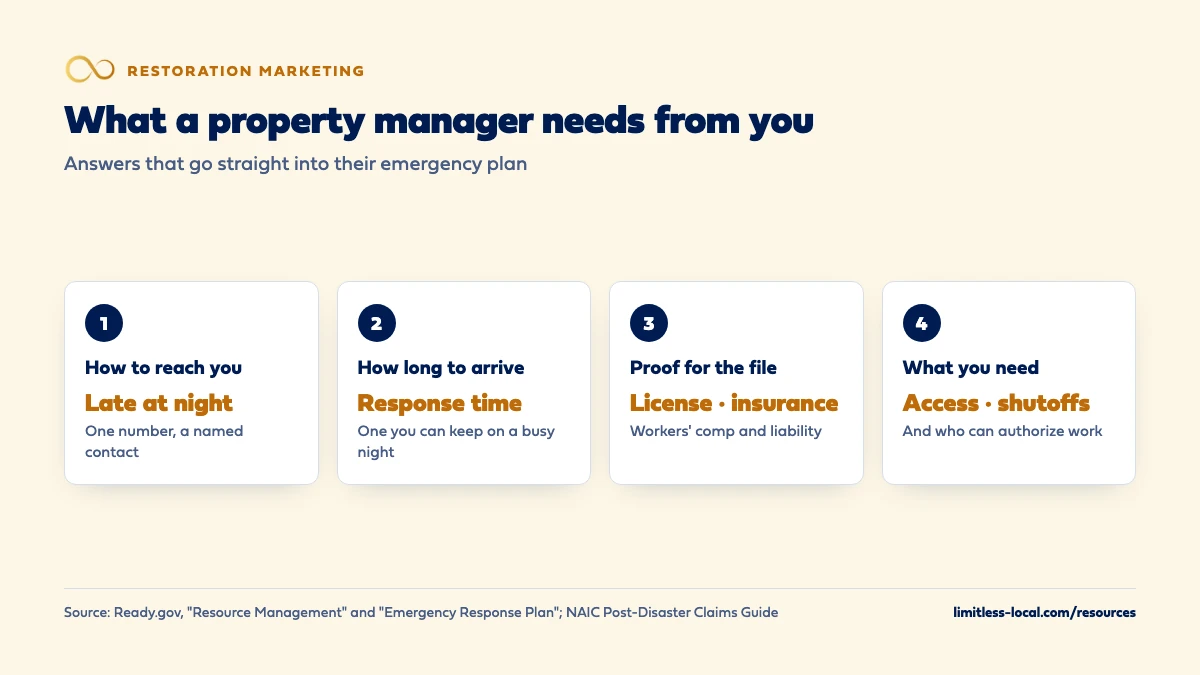
Ready.gov’s emergency response plan guidance lays out 10 steps for businesses. One is to assess the resources available to stabilize an incident, including those from outside the business, and to document whether outside resources have the information they would need to handle an emergency. Its resource management page names contractors as one of those outside resources and asks: “How do you reach a contractor late at night and how long will it take them to arrive?” It also tells businesses to note the estimated response time of outside resources.
Read that as a buyer’s checklist. A restoration company that hands over a clear after-hours number, a named contact, an honest response time and the details it would need about the building (shutoff locations, access, who can authorize work) is filling in a blank on the property manager’s plan for them.
What should I hand a property manager before anything goes wrong?
A short emergency response profile they can drop into their plan or vendor file:
- How to reach you, any hour. One number, answered by a person, plus a named account contact.
- A realistic response time for their address, and what you’ll do on the first visit.
- Proof for their file. The NAIC tells property owners to get a contractor’s business license, proof of workers’ compensation and proof of liability insurance; commercial buyers usually want the same, often as a certificate naming them.
- What you’re trained to. The IICRC S500 water damage standard and the S520 mold remediation standard both cover residential, commercial and institutional buildings. If your technicians are certified, say so.
- What you need from them on the call: building access, who can authorize work, and where the shutoffs are.
Which commercial properties should a restoration company go after first?
Start close to your trucks. A commercial account two hours away is a response-time promise you probably can’t keep. Then favor properties where water problems are frequent and one call can involve several units: apartment and condo buildings, office buildings, medical offices, retail centers, schools and hotels.
In our view, property management companies are often the best first target, because one relationship can cover many buildings. If you already have plumber partners, ask who manages the buildings they service; building a referral network covers how to approach property managers without a hard sell.
How do I get in front of property and facility managers?
- Ask for a vendor meeting, not a sale. Offer to walk a building and leave the emergency profile behind.
- Show up where they meet. Local property management and building owner associations, and continuing-education events for managers.
- Follow up after a loss you didn’t get. A manager who had a slow response from someone else is often ready to add a second vendor.
- Stay visible online. Meta remarketing can show your ads to people who have already visited your website, which keeps you in mind between meetings.
None of this is quick. Expect to meet many managers for each one who adds you as a vendor, and judge the effort over months, not weeks.
Curious what your marketing is actually booking?
Get a free visibility audit — no obligation, no sales pitch.
What should my website show commercial buyers?
A separate commercial page, not a line on your homeowner page. Commercial buyers look for different things: the property types you serve, your after-hours process, crew and equipment capacity, certifications, how you document and communicate during a job, and how to get set up as a vendor before a loss.
Keep every claim on it true and provable. The FTC’s advertising guide for small business says that before a company runs an ad it must have a “reasonable basis” for its claims, meaning objective evidence. A promised response time, a “largest fleet in the region” line or a capacity number all need to hold up. What a restoration website should say about mold and fire covers the service pages commercial buyers will also read.
Do search ads and SEO work for commercial restoration?
They still matter, mostly for the emergency you weren’t pre-approved for: a facility manager whose usual vendor didn’t answer, or a building owner with no plan at all. Those searches look a lot like residential ones, often with a city name and a word like commercial, office or building added.
Search won’t replace the relationship work, but it fills the gap while relationships build and catches the calls they miss. Which search terms to bid on and which to exclude is covered in Google Ads keywords for a water damage company, and how that fits with Local Services Ads is in Google Ads, LSAs or both.
Should my restoration company go after government and federal buildings?
Treat it as its own project. The SBA’s government contracting guide says that to sell to the federal government you’ll need a Unique Entity ID through SAM.gov, a NAICS code that matches your services, and a registration agencies can search. It also warns that winning a first contract can take a long time and a significant amount of money: some businesses spend between $80,000 and $130,000 to earn their first contract, and it could take up to two years to start making a return.
State and local public buildings, such as schools and county facilities, usually have their own purchasing rules. For most owner-operators, private property managers are the faster first step, with public work added once the business can carry a long sales cycle.
What are commercial customers most worried about when they hire?
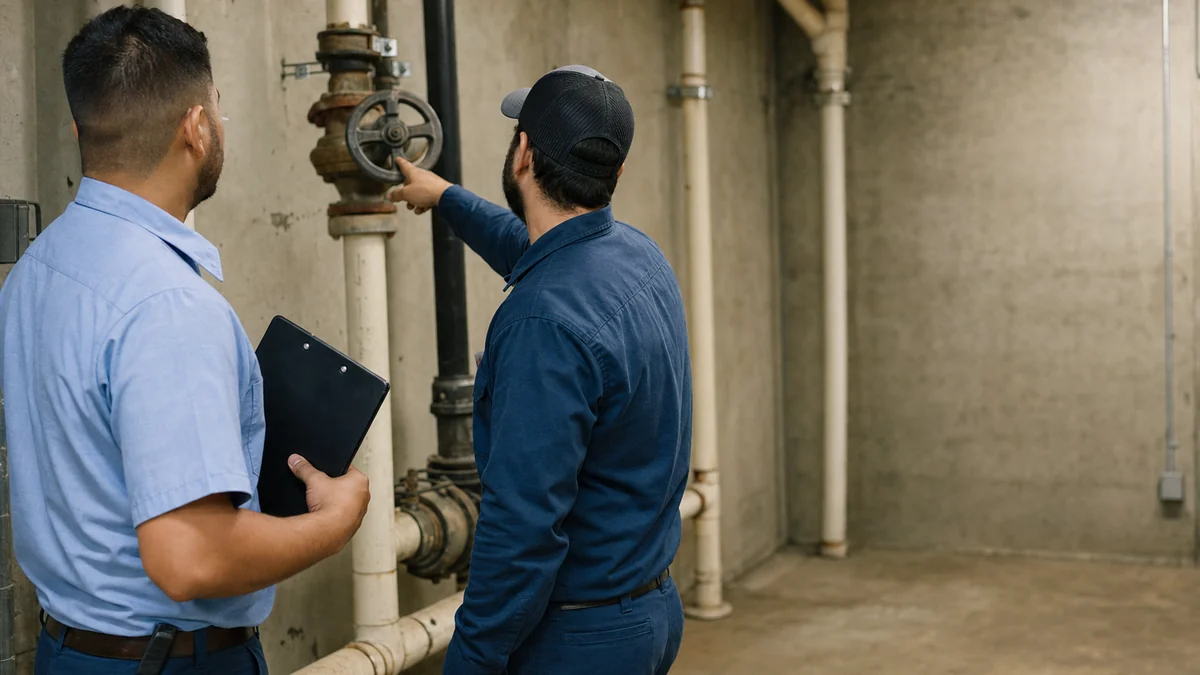
Ready.gov’s list of preparedness goals is a good guide: protect the safety of employees, visitors and contractors; keep serving customers by minimizing disruption to operations; and protect facilities and assets. A restoration pitch that speaks to those (safe work around occupied space, a plan to keep tenants or customers operating, clear communication with the people in charge) lands better than a list of equipment.
They also worry about paperwork. Who authorizes work, how the scope gets documented for the owner or the insurer, and how invoices flow are often deciding factors. Show you’ve thought about them before they ask.
How do I keep a commercial account once I have it?
Act like part of their plan. Ready.gov tells businesses to train their people and practice the plan with exercises, so offer to join a walk-through or a drill, and update your contact details in their plan whenever they change.
After every job, send a short summary of what happened and what you’d change. Between jobs, check in a couple of times a year. When a manager moves to a new company, they often bring their vendors with them, which is one more reason to treat each one well.
How do I tell if commercial marketing is working?
Measure the steps, then the jobs. Early on, count meetings, building walk-throughs and vendor approvals, because jobs may not show up for months. Then track commercial jobs and revenue by source, separate from residential, so a slow commercial ramp doesn’t hide behind a busy storm month.
Tracking which marketing brings booked jobs covers the setup. If someone else runs your marketing, checking whether your agency is producing real jobs covers what to ask for.
Not sure which of these is costing you jobs?
A free visibility audit checks the Google profile, reviews, site and tracking, and shows what to fix first.
What's different about commercial restoration work
One loss, many people. A leak on an upper floor can reach several tenants, a board and an insurer at once. Your communication during the job is part of what the property manager remembers.
Steady, but slower to start. Our own restoration page puts it this way: commercial contracts provide steady work, but residential emergencies pay well. Most restoration companies need both, so don’t pull residential budget to fund a commercial push that may take months.
The standards already cover it. The IICRC water damage and mold standards are written for residential, commercial and institutional buildings, so the training your crews already have is part of your commercial pitch.
A worked example: what one property management account can be worth
These numbers are made up to show the math, not a benchmark. Say a property management company runs 15 buildings near your shop and adds you as their emergency water vendor. In a year, 2 of those buildings have losses you handle, each averaging $8,000. That one relationship is worth $16,000 in a year, before any referrals the manager sends your way, and it can repeat every year you keep the account.
Now the cost side. If winning that account took a few months of meetings plus remarketing to keep your name in front of managers, compare that against what the same revenue would cost through ads. Our Growth package includes Meta remarketing, Local Services Ads management and Google Ads management for up to $5,000 a month in spend, and it is $4,500 a month, with ad spend paid separately. Whether commercial outreach or more emergency ads is the better next dollar comes down to cost per booked job, which is what a free visibility audit is for.
Frequently asked questions
Do I need a separate brand for commercial restoration?
Usually not. A clear commercial page, a separate contact path and commercial case details on the same site are enough for most owner-operators, and they keep your reviews and search strength in one place.
Should I offer commercial clients a pre-loss agreement?
It can make sense, because the paperwork is done before an emergency instead of during one. Have an attorney review the terms, and only commit to response times you can keep.
Is LinkedIn worth it for reaching property managers?
It can help you find and research managers by company and title, and it’s a reasonable place to share the job summaries and certifications they care about. Treat it as support for outreach, not a replacement for meetings.
Do commercial buyers care about IICRC certification?
It’s one of the clearest proofs you can show, because the IICRC water and mold standards are written for commercial and institutional buildings as well as homes. Have your firm and technician certifications ready.
Will commercial work smooth out the slow months?
It can help, because buildings have water problems year-round. Keeping work coming in between storms covers commercial alongside the other steady sources.
How long before commercial marketing brings jobs?
There’s no honest fixed timeline. Ads can bring emergency calls within days of launch, but vendor approvals and the first job from a new account often take months.
Key takeaways
- Commercial buyers choose emergency vendors before the loss, so get into the plan early.
- Ready.gov tells businesses to know how to reach a contractor late at night and how long it takes to arrive.
- Hand managers an after-hours number, a named contact, a response time you can keep, and proof of license and insurance.
- Keep commercial claims on your website provable; the FTC requires a reasonable basis for ad claims.
- Federal work needs SAM.gov registration and patience; private property managers are usually the faster start.
- Track commercial jobs separately so a slow ramp doesn’t hide behind busy residential months.
Want a second set of eyes on your setup?
We'll look at how you show up locally and where calls are leaking, then send you a plain-English breakdown.
More in this section
- How should a restoration company handle marketing during storm season?
- How do restoration companies get insurance-related water damage jobs?
- Should a restoration company run Google Ads, LSAs or both?
- How do I track which marketing brings in booked restoration jobs?
- Is my restoration marketing agency producing real jobs?
Sources
- Emergency Response Plan — Ready.gov
- Resource Management — Ready.gov
- ANSI/IICRC S500 Standard for Professional Water Damage Restoration — IICRC
- ANSI/IICRC S520 Standard for Professional Mold Remediation — IICRC
- Post-Disaster Claims Guide — National Association of Insurance Commissioners
- Get started with contracting — U.S. Small Business Administration
- Get Started with Registration and the Unique Entity ID — SAM.gov
- Advertising FAQ's: A Guide for Small Business — Federal Trade Commission