
What makes homeowners trust a restoration company they find online?
- Which trust signals make homeowners call one restoration company over another online?
- What do homeowners check before they trust a restoration company online?
- Why is trust harder for restoration companies than other trades?
- Do IICRC certifications help homeowners trust my restoration company?
- What should my Google reviews show a homeowner in a hurry?
- Do real crew and equipment photos build more trust than stock photos?
- Should my website show my license and insurance?
- What should my website say about what happens after someone calls?
- How should my site talk about insurance without scaring people off?
- Does the Google Verified badge help homeowners trust me?
- What makes a restoration company look untrustworthy online?
- What's different about earning trust as a restoration company
- A worked example: two restoration profiles side by side
- Frequently asked questions
- Key takeaways
- More in this section
- Sources
The short version
- Show proof a homeowner can check: reviews, certifications, license where required, insurance.
- Use real photos of your crews and equipment, never a customer's damage.
- Explain what happens after they call, in plain steps.
- Drop anything that looks like the scam signs the FTC warns about.
For restoration owners who want the homeowner reading their Google profile or website at 2 a.m. to call them, not the next company on the list.
Get a free visibility audit · Book a growth call
Which trust signals make homeowners call one restoration company over another online?
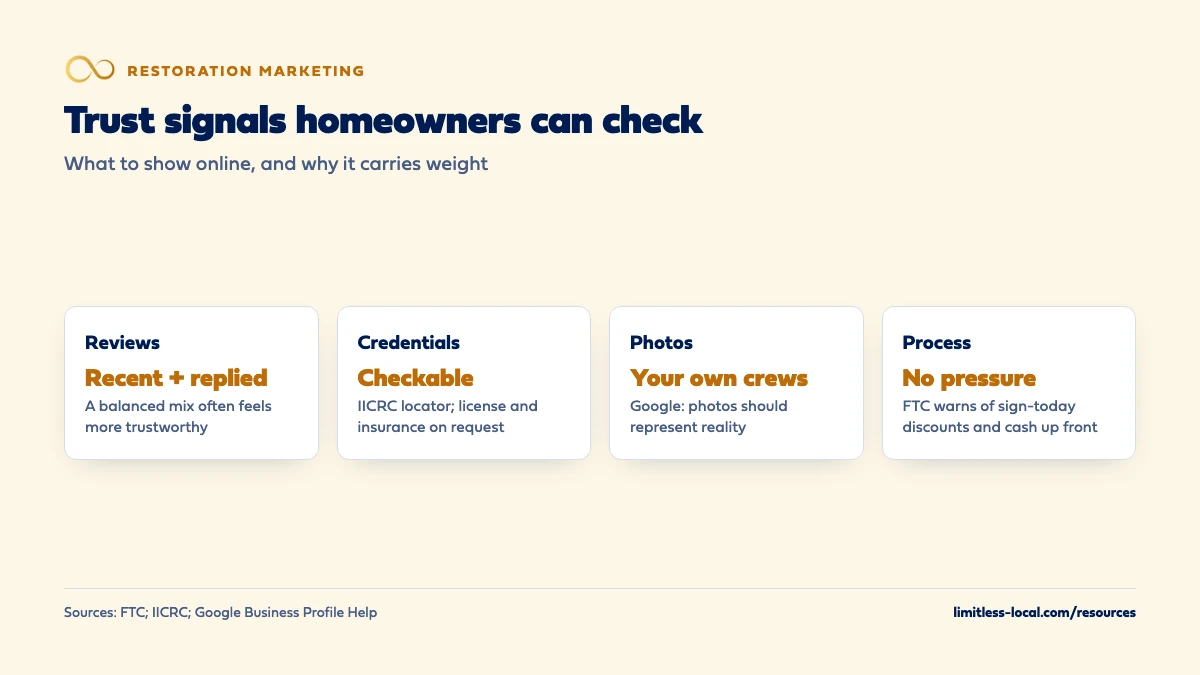
Homeowners trust a restoration company online when they can check the proof themselves: recent Google reviews with real replies, current certifications such as IICRC that they can look up, a stated license where required and proof of insurance, and real photos of your own crews and equipment. A plain explanation of what happens after they call, with no pressure to sign on the spot or hand over an insurance check, matters just as much, because those are the warning signs the FTC tells disaster victims to watch for.
That proof has to be easy to find on your website and your Google profile, and in an emergency, fast. Our website work is built to put it where homeowners look, and our restoration marketing page covers how we help water, fire and mold companies collect and show reviews. For the wider picture of restoration marketing, the restoration marketing guide covers every channel, and the rest of the restoration marketing questions library goes question by question.
What do homeowners check before they trust a restoration company online?
Often, exactly what the government tells them to check. The FTC’s guide to avoiding scams after weather emergencies tells people who need repairs fast to use online review sites they trust, to search a contractor’s name with words like “scam,” “review” or “complaint,” to confirm the contractor’s license and ask for proof of insurance, and to get a written estimate and a written contract.
So a homeowner with water on the floor is likely to look for the same few things, quickly:
- Other people’s experience: reviews, how recent they are, and how you answer the bad ones.
- Proof you’re legitimate: license where your state requires one, insurance, and training or certification they can check.
- Signs you’re real and local: your own crews, vans and equipment, and a service area that includes their town.
- A clear next step: what happens when they call, and how soon someone shows up.
In our judgement, a company that answers all four before the homeowner has to ask gets the call. The rest of this page takes them one at a time.
Why is trust harder for restoration companies than other trades?
Because the customer usually meets you on one of the worst days they’ve had in that house. They need someone fast, they can’t wait to collect three quotes the way they would for a remodel, and they’re letting a crew into a home that may be wet, smoky or unlivable. In our judgement, that combination makes them faster to decide and quicker to rule a company out.
The timing works against you too. The FTC warns that unlicensed contractors and scammers often appear in recovery zones after storms and disasters, and tells people to be skeptical of anyone promising immediate clean-up or repairs. A legitimate restoration company does promise fast response, so your online presence has to show the proof that separates you from the people the FTC is warning about.
Do IICRC certifications help homeowners trust my restoration company?
They help most when a homeowner can check them. The IICRC runs a Global Locator that it says connects homeowners and business owners with certified firms and technicians, and it publishes a list of invalid companies promoting Certified Firm status. That makes the certification a claim a customer can verify, which is what turns a logo into a trust signal.
On your website and Google profile, say plainly which certifications your firm and your technicians hold, and only while they’re current. If you follow a recognized standard, name it in plain words: the IICRC describes its S500 standard as setting out the procedures and precautions for water damage restoration in residential, commercial and institutional buildings. In our judgement, one sentence like “our water crews follow the IICRC S500 standard” says more than a row of badges no one recognizes.
What should my Google reviews show a homeowner in a hurry?
Recent reviews about real jobs, and replies that sound like a person. Google’s review tips say honest and balanced reviews help customers decide, that a mix of positive and negative feedback often feels more trustworthy, and that replying shows customers their feedback matters. For bad reviews, Google suggests apologizing when appropriate and showing you understand how the customer feels.
In restoration, the most useful reviews mention what happened: how fast the crew arrived, whether they explained the drying process, how they treated the house. Getting detailed reviews after a water damage job covers how to ask for those, and replying to restoration reviews covers what to say back, including when a review mentions an insurance claim.
Never buy reviews or pay for positive ones. The FTC’s rule on consumer reviews and testimonials makes it a violation for a business to offer compensation or incentives in exchange for reviews expressing a particular sentiment, positive or negative.
Curious what your marketing is actually booking?
Get a free visibility audit — no obligation, no sales pitch.
Do real crew and equipment photos build more trust than stock photos?
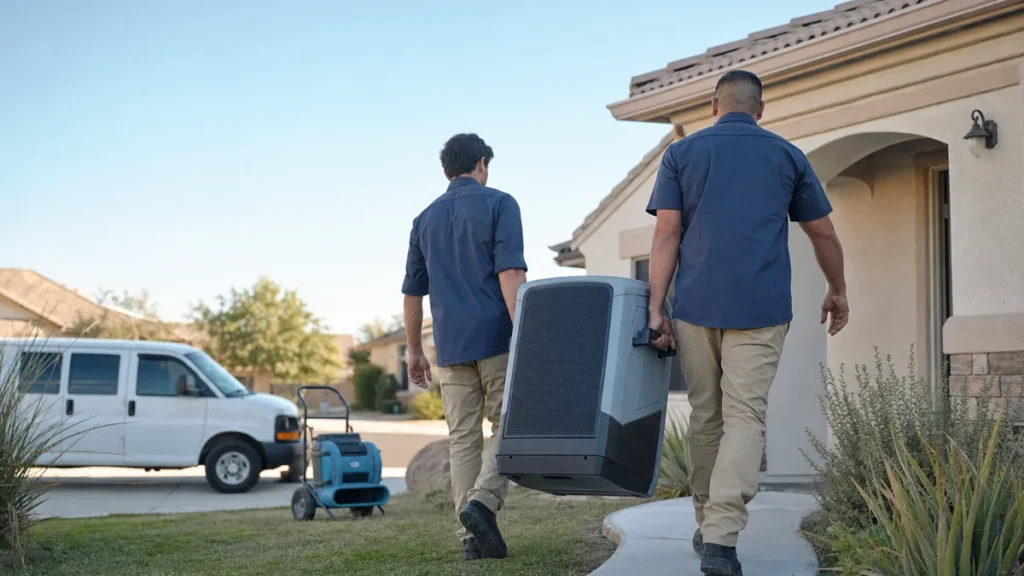
Yes, and Google’s own photo guidance points the same way. Google’s tips for business photos say a photo should be in focus, well lit and free of significant alterations or excessive filters or AI; in its words, the image should represent reality. For photos at work, Google suggests adding at least three that represent the services you offer, and at least three team photos to show a more personal side of the business.
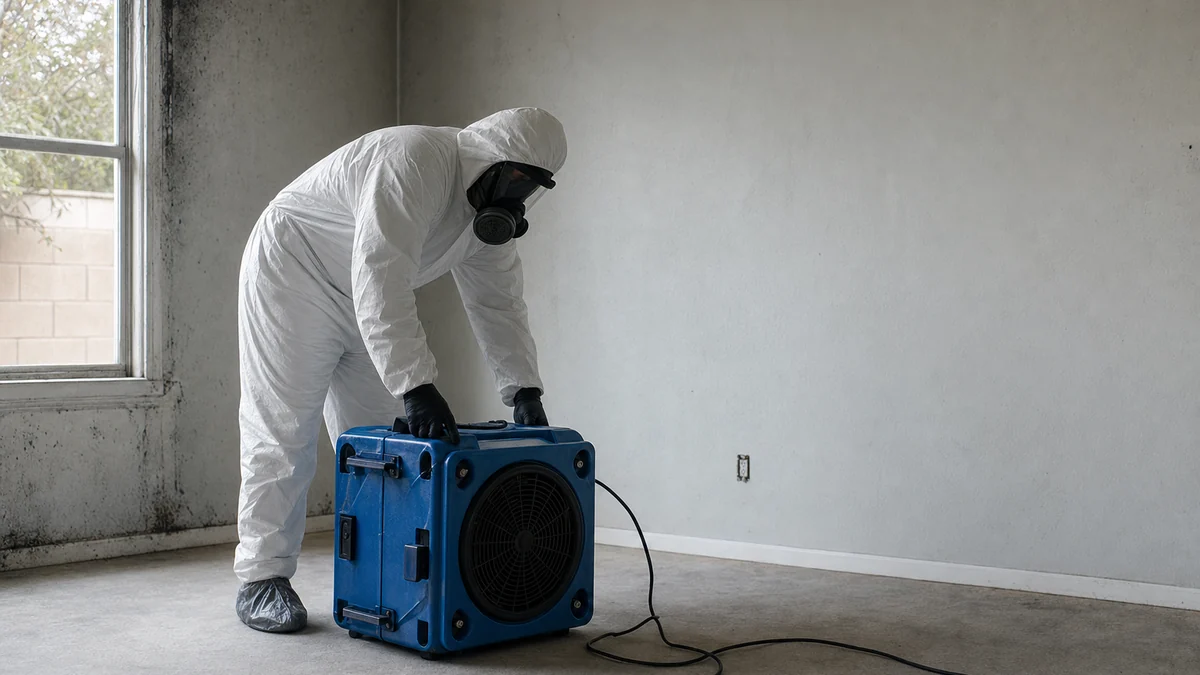
For a restoration company, that means your techs in protective gear, your drying equipment set up in a room, your vans, and your owner and office staff. Leave out anything that could identify a customer’s home or belongings; in our judgement, photos of other people’s damage can read as voyeuristic to the next customer, not reassuring.
Whether job photos help you rank covers the Google profile side of this in more detail.
Should my website show my license and insurance?
Yes. The FTC tells homeowners to confirm a contractor’s license with their state or county, to ask for proof of insurance, and to treat a contractor who won’t provide copies of their license, insurance or a written contract as a red flag. If your customers are being told to ask, answer before they do.
Put it where they look: on the homepage near your phone number, on each service page, and in the footer. State that you carry liability insurance, list any license your state requires for the work you do, and say how a customer can get a certificate of insurance. Requirements differ by state and by type of work, so check with your state licensing board on what has to appear in your ads and on your vans.
In our judgement, “licensed and insured” with nothing behind it reads like a slogan. A license number and an offer to send the certificate read like proof.
What should my website say about what happens after someone calls?
Walk them through it in plain steps, because a homeowner in the middle of a loss wants to know what the next few hours look like. In our judgement, a short “what to expect” section does more for trust than a paragraph of claims about quality:
- The call. Who answers, and that someone answers at night and on weekends if that’s true.
- Arrival. What you aim for, stated honestly, without a promise you can’t keep in a storm week.
- The first visit. What the crew checks, how they find hidden moisture, what equipment they set up.
- The paperwork. What the customer will be asked to sign and why, with a written scope and estimate.
- Drying and follow-up. How progress is checked and when the equipment leaves.
This matches what the FTC tells homeowners to expect from a legitimate contractor: a written estimate describing the work, the price and the contractor’s contact information, and a written contract they can read before signing.
How should my site talk about insurance without scaring people off?
Carefully, and without promises. The FTC tells homeowners not to rely on a contractor to tell them what’s covered and never to sign their insurance check over to a contractor. A website that promises coverage, or pushes customers to hand over the check, reads like the scam the FTC describes, even when the company is legitimate.
What builds trust is explaining your part of the process: that you document the damage, that you can work with the customer’s insurer, and that coverage decisions belong to the policy and the adjuster. This is general marketing guidance, not insurance or legal advice. Whether to explain the insurance claims process covers what a claims page can safely say.
Does the Google Verified badge help homeowners trust me?
It adds a third-party check if you run Local Services Ads. To take part, Google says every business must pass its screening and verification process, which varies by category and location and may include background, business registration, insurance and license checks, plus minimum review requirements. In some categories and locations, background checks cover the business, the owner and the field workers who go into customers’ properties.
Businesses that pass get the Google Verified badge, which Google says shows on the Local Services Ads profile and may appear on other surfaces where it adds value for customers, with the relevant verifications called out on the profile. Check your own dashboard for which checks apply to your category. Whether to run Google Ads, LSAs or both covers whether LSAs make sense for you in the first place.
What makes a restoration company look untrustworthy online?
Mostly the same signs the FTC tells homeowners to watch for after a disaster, showing up in your own marketing by accident:
- Pressure. “Discount if you sign today” language. The FTC lists a discount offered only if you sign right away as a sign of a scam.
- Money up front. Copy that implies full payment before work starts. The FTC tells people to walk away from contractors who want cash up front.
- Insurance-check language. Anything suggesting the customer sign their insurance check over to you.
- No proof. No license, insurance or certification anywhere a customer can check it.
- Stock photos and borrowed testimonials. The FTC rule bars testimonials that misrepresent a reviewer’s experience, and staff testimonials need a clear disclosure when the relationship isn’t otherwise obvious.
- A profile that doesn’t match the website. Different names, numbers or service areas from one place to the next.
Most of these are quick fixes. If your Google profile is where the mismatch starts, optimizing your Google Business Profile covers the name, number and hours.
Want to see where your company stands?
A free visibility audit shows where you show up on Google, Maps and AI answers, and what it's costing you in calls.
What's different about earning trust as a restoration company
Customers decide in minutes, not weeks. A homeowner with standing water or smoke damage won’t read your About page twice. Put proof near the phone number, not three clicks deep.
You’re working in the homeowner’s worst week. Photos, reviews and copy should show calm, competent crews and equipment, never the customer’s loss. In our judgement, dramatic damage photos hurt trust more than they help.
Disasters bring out imitators. After a big storm, out-of-town crews and scammers compete for the same calls, and the FTC tells homeowners to be wary. Verifiable proof is what separates an established local company from them.
Adjusters and property managers check you too. In our judgement, the same reviews, certifications and clear process that reassure a homeowner also matter to the adjusters and property managers who refer work.
A worked example: two restoration profiles side by side
These two profiles are made up to show the comparison a homeowner makes, not a benchmark. Company A has a 4.7 rating from 64 reviews, most from the last year, with replies under nearly every one, including a calm reply to a critical review about a late arrival during a storm. Its photos show its own techs in protective gear, its drying equipment set up in a room and its vans. Its website names its IICRC certifications, states it carries liability insurance, offers a certificate on request and walks through what happens after you call.
Company B has a 5.0 rating from 9 reviews, the newest more than a year old, no replies, stock photos of a smiling technician, “licensed and insured” in the footer with nothing behind it, and a banner offering a discount if you book today.
On stars alone, B wins. In our judgement, most homeowners call A, because almost everything on A’s profile can be checked and adds up, and B’s discount banner matches a warning sign the FTC tells people to watch for. Every gap on B’s profile is fixable, except the reviews, which take steady work to build.
Making a site show this kind of proof clearly is part of what our website work covers. Our themed website is $3,750, or $3,000 with any of our marketing packages; whether it’s worth it comes down to whether it turns more of your calls into signed jobs, which is what a free visibility audit is for.
Frequently asked questions
Do homeowners trust Google reviews more than my website?
There’s no reliable number for that, but the FTC tells people hiring after a disaster to use review sites they trust and to search a company’s name with words like “complaint.” In our judgement, reviews are usually where trust starts and your website is where it gets confirmed.
Should I list every certification my technicians hold?
List the ones a homeowner can verify and that apply to the work, and keep them current. The IICRC keeps a public locator and a list of invalid firms, so an expired claim is easy to catch.
Can I post before-and-after photos from customers' homes?
In our judgement, only with the owner’s permission, and without anything that identifies the home or its contents. Photos of your crews and equipment at work build trust without that risk.
Is it okay to ask employees to leave Google reviews?
In our judgement, no: reviews should come from customers. The FTC rule requires a clear disclosure when an officer or manager writes a review about the business, and restricts managers from asking employees for reviews that get posted without disclosing the relationship.
Should my site promise a response time?
Only one you can keep on your busiest night. A stated target that you miss during a storm turns into the bad review the next homeowner reads.
Does a BBB rating or association membership help?
It can, if it’s real, current and checkable. The FTC suggests homeowners check with a local home builders’ association for complaints, so in our judgement a membership in good standing is worth showing.
Key takeaways
- Homeowners check what the FTC tells them to: reviews, complaints, license, insurance and a written contract.
- Make every credential checkable, such as IICRC certification a customer can look up.
- Use real photos of your crews and equipment; Google says photos should represent reality.
- Explain what happens after someone calls, in plain steps, with no pressure to sign.
- Avoid sign-today discounts, cash-up-front language and anything about signing over insurance checks.
- Never buy reviews or pay for positive ones.
Not sure what's working right now?
Start with a free visibility audit: rankings, Google profile, reviews and tracking, checked against your service area.
More in this section
- What do property managers look for in a restoration vendor?
- Do Angi or HomeAdvisor listings help restoration companies rank?
- How do restoration companies get insurance-related water damage jobs?
- How do restoration companies show up in AI search answers?
- How should a restoration company market to real estate agents?
Sources
- How To Avoid Scams After Weather Emergencies and Natural Disasters — Federal Trade Commission
- IICRC Global Locator — IICRC
- ANSI/IICRC S500 Standard for Professional Water Damage Restoration — IICRC
- Tips to get more reviews — Google Business Profile Help
- Tips for business-specific photos on your Business Profile — Google Business Profile Help
- Understand the screening and verification process — Google Local Services Help
- About Google Verified badge — Google Local Services Help
- 16 CFR Part 465: Rule on the Use of Consumer Reviews and Testimonials — Electronic Code of Federal Regulations