
How should a restoration company market to real estate agents?
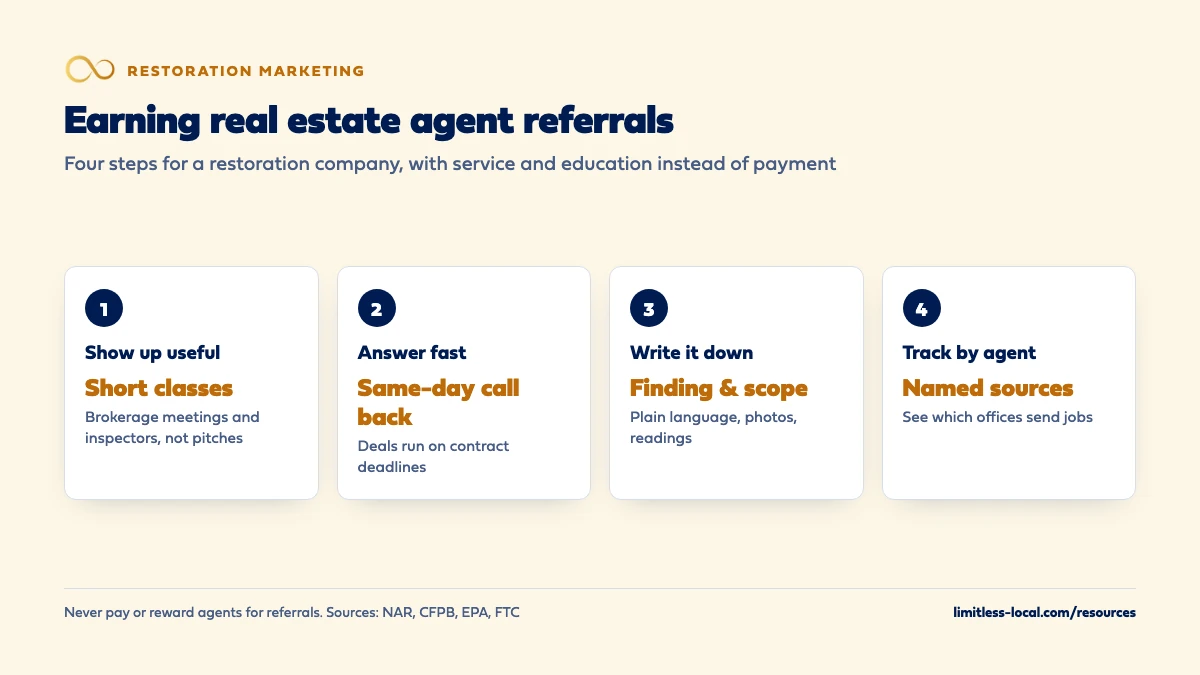
- How does a restoration business earn real estate agent referrals without paying for them?
- Why are real estate agents worth a restoration company's time?
- When in a home sale does an agent need a restoration company?
- What does an agent need from me that a homeowner doesn't?
- How do I get in front of agents without a hard sell?
- What can I teach agents that's actually useful?
- Can I pay agents, or give them gifts, for referrals?
- How do I keep an agent posted without breaking the owner's trust?
- How do I stay in touch with agents without spamming them?
- What will agents check before they recommend me?
- How do I know if agent marketing is producing jobs?
- What's different about agent marketing for restoration companies
- A worked example: two quarters of agent outreach
- Frequently asked questions
- Key takeaways
- More in this section
- Sources
The short version
- Be the fast, calm answer when an inspection finds water damage or mold.
- Hand agents a plain written finding and scope, then keep them updated.
- Teach short, useful classes at office meetings; don't pitch.
- Never pay or reward agents for referrals.
For restoration owners who want agents to call them when an inspection turns up water damage or mold, and want to earn those calls the right way.
Get a free visibility audit · Book a growth call
How does a restoration business earn real estate agent referrals without paying for them?
Market to real estate agents as the restoration company that keeps their deals moving: answer fast when an inspection or a listing walk-through turns up water damage or mold, give a plain written finding and scope they can share, and keep them posted until the work is done. Get in front of them with short, useful education at office meetings and with the home inspectors they already trust, and make it easy to check you online. Earn the referrals with service, never with payment: NAR’s Code of Ethics cases treat undisclosed referral fees and contractor rebates as violations, and federal RESPA rules bar referral fees tied to settlement services on federally related mortgage loans, so don’t offer agents anything of value for sending you work.
Agents almost always check a restoration company online before they pass its name to a client, so the referral is only as strong as your Google profile, your reviews and the water and mold pages on your site. That’s the part our local SEO work covers, alongside the Google Ads and review management on our restoration marketing page. The restoration marketing guide covers channels and budgets; this page stays on agent relationships. The rest of the restoration marketing questions library goes question by question.
Why are real estate agents worth a restoration company's time?
Because agents are standing in houses when water problems come to light. A home inspection finds staining under a sink, a musty crawlspace or a soft subfloor; a listing walk-through turns up an old leak the seller never fixed; a vacant listing sits through a freeze. In each case the agent needs someone who can look, explain and fix it, usually on a deadline.
In our judgement, an agent who has one good experience with you becomes a repeat source in a way most homeowners can’t, because they’ll face the same problem again with the next client. That makes agent relationships a steady, low-cost channel next to your emergency ads and search, not a replacement for them.
When in a home sale does an agent need a restoration company?
Four moments come up again and again:
- The inspection report. The buyer’s inspector notes moisture, staining or possible mold, and both agents need to know what it means and what it costs to fix.
- Listing prep. The seller’s agent finds old water damage before the house goes on the market and wants it dealt with first.
- Vacant listings. A leak or freeze in an empty house can go unnoticed for days.
- Before closing. Something fails between the inspection and the final walk-through.
Each one has a clock on it. Our view: build your agent pitch around these four moments rather than around your services list, because that’s how an agent thinks about the problem.
What does an agent need from me that a homeowner doesn't?
Speed, clarity and a paper trail. Agents work against contract deadlines, so a call back the same day and an assessment within a day or two matter more than anything on your website. After that, they need:
- A plain written finding: what you found, where, what caused it if you know, and what you recommend.
- A scope and price range both sides can negotiate from.
- Photos and moisture readings that support what you wrote.
- A completion record once the work is done, for the owner to keep and share.
Keep the tone factual. An agent will stop calling a company that scares buyers with worst-case language, and will keep calling one that explains the problem in proportion. What the seller must disclose is a question for the agent and the seller’s own advisers, not for you. How fast you need to answer covers the response side.
How do I get in front of agents without a hard sell?
Go where agents already gather and bring something useful:
- Brokerage sales meetings. Ask the managing broker for ten minutes to explain what an inspection finding about water or mold usually means, then leave.
- Local association events where vendors are welcome.
- Home inspectors. They write the reports agents are reacting to. An inspector who knows you’re fast and fair is a natural person for an agent to ask.
- Agents you’ve already worked with. Ask them which colleagues in their office would find a short session useful.
Bring a one-page guide, not a brochure: the four moments above, what you need from them to get started, and your after-hours number. In our judgement, one useful session at a brokerage does more than a stack of mailers to individual agents.
Curious what your marketing is actually booking?
Get a free visibility audit — no obligation, no sales pitch.
What can I teach agents that's actually useful?
Teach what helps them advise a client, and stick to what a reliable source says. The EPA’s brief guide to mold, moisture and your home is a good base because it’s short and neutral:
- The key to mold control is moisture control.
- If mold is a problem, clean it up promptly and fix the water problem.
- Water-damaged areas and items should be dried within 24-48 hours to prevent mold growth.
- If there’s been a lot of water damage, or mold covers more than about 10 square feet, the EPA points to its guide for schools and commercial buildings, and says that guide applies to other building types too.
- If someone hires a contractor for mold cleanup, the EPA says to make sure the contractor has experience cleaning up mold and to check references.
Add what only you can teach: how to read a moisture note in an inspection report, what a reasonable scope looks like, and what questions to ask any restoration company before recommending one. Don’t make health claims beyond what the EPA itself says, and don’t turn the session into a pitch. What your website should say about mold covers the same line on your own pages.
Can I pay agents, or give them gifts, for referrals?
Don’t. Paying for referrals in a real estate transaction runs into rules on both sides of the referral:
- The agent’s rules. NAR’s case interpretations for Article 6 of its Code of Ethics include a REALTOR found in violation for taking rebates from contractors who did work for a client, and another found in violation for collecting a referral fee from “preferred providers” without disclosing it.
- Federal rules. RESPA’s prohibition against kickbacks and unearned fees says no person shall give or accept any fee, kickback or other thing of value under an agreement or understanding to refer business that’s part of, or incident to, a settlement service involving a federally related mortgage loan. It adds that an agreement can be shown by a pattern: a thing of value received repeatedly and connected to the volume or value of business referred is evidence of one.
- State rules. Some states have their own. Florida’s section 489.147, for example, bars contractors from offering or accepting any compensation, inducement or reward for referrals of services paid with property insurance proceeds.
Whether a particular restoration job counts as part of a settlement service is a legal question we can’t answer for you, and this page isn’t legal advice. The safe line for marketing is the one this page follows: earn referrals with fast, honest service and useful education, and ask an attorney before giving anything of value to someone in a position to refer you.
How do I keep an agent posted without breaking the owner's trust?
Agree with the property owner, at the start, what you’ll share with their agent. Then give the agent the updates they need to manage the deal: when you’ll be on site, when drying or remediation is expected to finish, and when the completion record is ready.
Keep insurance and claim details between the owner, the adjuster and the policy unless the owner asks you to share them. In our view, an agent who sees you handle a client’s information carefully trusts you more with the next one, not less.

How do I stay in touch with agents without spamming them?
Send a few genuinely useful emails a year rather than a monthly pitch: a seasonal note before freeze season, a short explainer on a common inspection finding, a reminder of your after-hours number. If those emails promote your business, the FTC’s CAN-SPAM compliance guide applies, and it isn’t limited to bulk email. Among its requirements:
- Header information must be accurate and identify who sent it.
- The message must be clearly identified as an advertisement.
- It must include your valid physical postal address.
- It must explain clearly how to opt out, and you must honor opt-outs within ten business days.
That’s a summary of the FTC’s guide, not legal advice.
A personal follow-up after a job you did together is a different kind of message, and usually the more useful one.
What will agents check before they recommend me?
Their reputation rides on your work, so expect them to look you up. In our judgement, they’ll check:
- Your Google reviews, especially recent ones that mention water or mold work
- Whether your website clearly covers water damage, mold and the after-hours line
- Proof of license and insurance, and any certifications you hold. The IICRC’s Global Locator connects homeowners and business owners with certified firms and technicians, so if you’re certified, make sure your listing there is current.
If any of that is thin, fix it before you start visiting brokerages. What makes people trust a restoration company online covers the same signals from the homeowner’s side.
How do I know if agent marketing is producing jobs?
Give agent referrals their own lead source, and name the agent and brokerage on every job. Then you can see which offices send work, which agents send repeat jobs, and what those jobs are worth once they’re paid. Agent referrals can take months to build, so in our judgement it’s worth judging the channel over two or three quarters rather than week by week. Tracking which marketing books jobs covers the setup, and building a referral network covers plumbers and property managers, the other half of most restoration referral work.
Not sure which of these is costing you jobs?
A free visibility audit checks the Google profile, reviews, site and tracking, and shows what to fix first.
What's different about agent marketing for restoration companies
The deadline belongs to someone else. Home sales run on contract dates, so response time to an agent matters as much as response time to an emergency call.
Mold makes buyers nervous. In our judgement, the restoration company that explains a finding in proportion, using what the EPA actually says, gets called back; the one that alarms people doesn’t.
Paying for referrals is a real risk here. Real estate has its own referral-fee rules, and restoration work paid by insurance can have state rules too. Service and education are the only safe currency.
Vacant homes are a seasonal opening. Freeze season is a natural time to remind listing agents what to watch for in empty houses.
A worked example: two quarters of agent outreach
These numbers are made up to show the math, not a forecast for your market. Say you get onto the agenda at 3 brokerage sales meetings, with about 45 agents in the rooms in total. You spend roughly 9 hours preparing and presenting, and $180 printing one-page guides.
Over the next six months, agents from those offices send you 11 calls about inspection findings, listing prep and vacant-house leaks. You sign 6 of them. Your out-of-pocket cost per signed job is $180 ÷ 6, or $30, plus your time.
The more useful number is who sent them: if 4 of the 6 jobs came from two agents, those two relationships are worth a personal follow-up and a second session at their office. None of this involved paying anyone for a referral, and none of it should.
Frequently asked questions
Should I offer agents a discount for their clients?
A discount tied to referrals can look like a thing of value given for the referral, which is the problem the RESPA rule describes. Price every job the same way whoever referred it, and ask an attorney before offering anything else.
Can agents leave me a Google review?
If they worked with you on a real job, they can share their honest experience like anyone else. Don’t offer anything in exchange for it.
Is it worth sponsoring a brokerage event?
Sponsorships aimed at people who refer you can raise the same referral-fee questions as payments. Ask an attorney before sponsoring anything for a brokerage or association that sends you work.
Should I market to buyer's agents or listing agents?
Both. In our judgement, listing agents bring prep and vacant-house work, while buyer’s agents bring inspection findings, and both need the same fast, plain answers.
Do I need a separate page on my website for agents?
A short page that explains how you handle inspection findings, how fast you respond and how to reach you after hours is useful to link from your emails and one-page guide.
Key takeaways
- Agents need you at four moments: inspection findings, listing prep, vacant listings and before closing.
- Answer fast and hand them a plain written finding, a scope and a completion record.
- Get in front of them with short, neutral education at brokerage meetings and through home inspectors.
- Never pay or reward agents for referrals; NAR, RESPA and some state rules all bear on it.
- Track referrals by agent and brokerage, and judge the channel over quarters, not weeks.
Want a second set of eyes on your setup?
We'll look at how you show up locally and where calls are leaking, then send you a plain-English breakdown.
More in this section
- How should a restoration company market to commercial properties?
- How should a restoration company handle marketing during storm season?
- Is my restoration marketing agency producing real jobs?
- How do restoration companies get insurance-related water damage jobs?
- How should a restoration company run Google Ads for fire damage?
Sources
- Case Interpretations Related to Article 6 — National Association of REALTORS
- § 1024.14 Prohibition against kickbacks and unearned fees — Consumer Financial Protection Bureau
- 489.147 Prohibited property insurance practices; contract requirements — The Florida Legislature (Online Sunshine)
- A Brief Guide to Mold, Moisture and Your Home — US EPA
- CAN-SPAM Act: A Compliance Guide for Business — Federal Trade Commission
- IICRC Global Locator — IICRC