
How should a restoration company run Google Ads for fire damage?
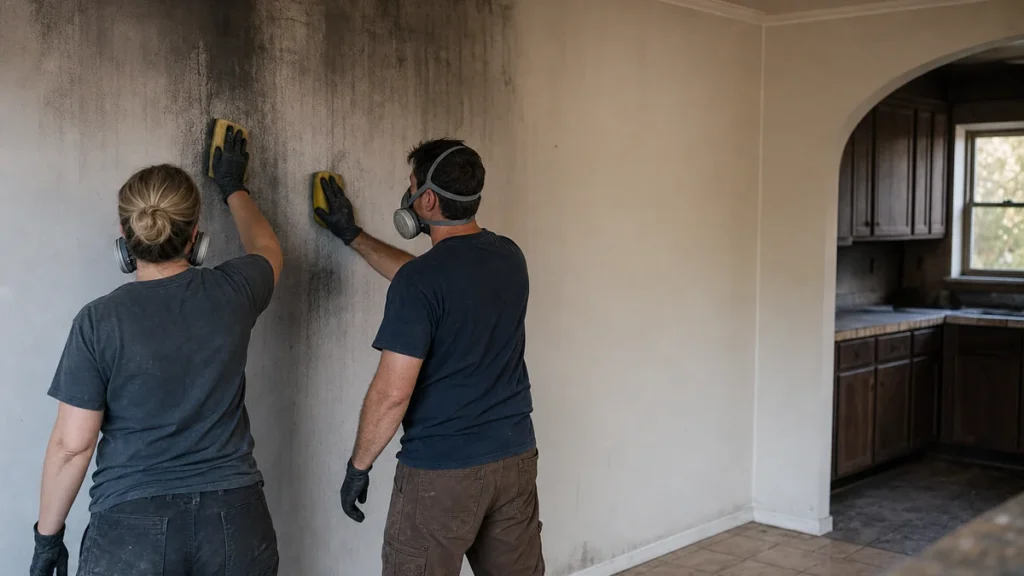
- What's the right way to set up Google Ads for fire and smoke damage jobs?
- Should fire damage have its own Google Ads campaign?
- Who is searching for fire damage help, and when?
- Which fire damage keywords are worth paying for?
- Which searches should a fire damage campaign block?
- Can I advertise when a big fire or wildfire is in the news?
- Which bid strategy suits a low-volume fire campaign?
- Should fire ads reach people who aren't in my service area?
- Where should fire damage ads send people?
- How do I track fire jobs that pay weeks later?
- How long should I run fire ads before judging them?
- What's different about fire damage advertising
- A worked example: judging a fire campaign over a quarter
- Frequently asked questions
- Key takeaways
- More in this section
- Sources
The short version
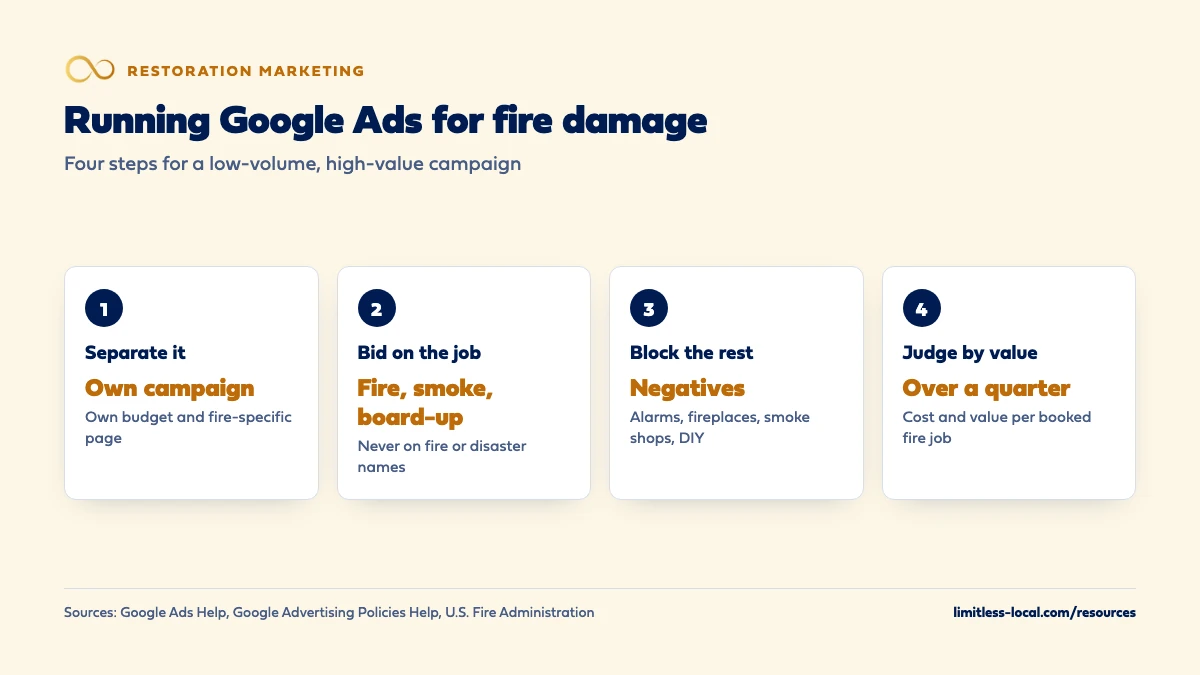
- Give fire and smoke its own campaign, budget and landing page.
- Bid on board-up, fire and smoke cleanup searches; block the many other meanings of "fire" and "smoke".
- Never use the names of fires or disasters in keywords or ads.
- Track each booked fire job and its value, and judge the campaign over a quarter.
For restoration owners who want fire and smoke jobs from Google search ads without wasting a small budget on the wrong searches.
Get a free visibility audit · Book a growth call
What's the right way to set up Google Ads for fire and smoke damage jobs?
Run fire and smoke damage as its own Google search campaign, with its own budget, a tight list of job searches (fire damage restoration, smoke and soot cleanup, emergency board-up) and a long list of negative keywords, sending every click to a fire-specific page. Fire searches are fewer than water searches but the jobs are bigger, so set the budget by what a booked fire job is worth to you, record each job’s value, and judge the campaign over a quarter rather than a month. Never bid on the names of fires or disasters in the news: Google’s Sensitive Events policy prohibits using keywords related to such an event to drive extra traffic. Google’s Local Services Ads have no separate fire category, so search ads are the paid route for this work.
Running low-volume, high-value campaigns like fire and smoke, with call tracking and job values so you can see what each booked job cost, is part of our Google Ads management for restoration companies. The restoration marketing guide covers channels and budgets across the business, and the restoration marketing questions library takes the rest one question at a time.
Should fire damage have its own Google Ads campaign?
In our judgement, yes, for most restoration companies. Fire and smoke work differs from emergency water in almost every setting that lives at campaign level: fewer searches, bigger and longer jobs, a different budget you’ll want to control by itself, and often a wider area you’re willing to cover. Mixed into a water campaign, fire keywords either get starved by burst-pipe traffic or quietly spend water money on a slow week, and you can’t tell which.
There’s a second reason. Google’s list of US Local Services Ads categories includes water damage services but no separate fire or smoke damage category, so if you want fire jobs from Google’s paid results, search ads are where they come from. Whether to run Google Ads, LSAs or both covers that split, and whether mold needs its own campaign walks through the same decision for mold. Source: Getting started with Local Services Ads (United States).
Who is searching for fire damage help, and when?
Often not the person you’d picture, and often not that night. The U.S. Fire Administration’s guide for people after a home fire tells them to contact their insurance company right away and ask what to do first, to ask the insurer for recommendations of companies they can trust for cleaning and restoring their things, and to get a cost estimate in writing. It also says that in some cases they may need to board up windows and doors so no one can get in.
In our judgement, that shapes fire searches in three ways:
- Board-up is the urgent search. It happens in the first hours, often while the family is staying somewhere else.
- Cleanup searches come after the insurance call, sometimes days later, from people comparing who to trust with the house and their belongings.
- The searcher may be a relative, landlord or property manager, not the homeowner.
So fire ads should speak to board-up, smoke and soot cleanup and contents, and the page should make it easy for someone to call on another person’s behalf. Source: After the Fire: Returning to Normal.
Which fire damage keywords are worth paying for?
In our judgement, only searches for fire work your crews actually do, grouped so each group has its own ad and page:
- The job by name: fire damage restoration, fire damage cleanup, fire restoration company.
- Smoke and soot: smoke damage cleanup, soot removal, smoke odor removal.
- Board-up and securing: emergency board up, fire board up service. Only if you can send someone fast.
- Contents: contents cleaning, pack-out after a fire, if you offer them.
- Commercial fire: in its own ad group with its own page, if you want those jobs.
Expect low search volume in a small market. In our judgement, that’s a reason to keep the list tight rather than pad it with loosely related terms, because a handful of good searches is the whole campaign.
Which searches should a fire damage campaign block?
“Fire” and “smoke” mean a lot of things, so the negative list matters as much as the keyword list. In our judgement, block these groups from day one:
- Fire safety products: extinguisher, alarm, smoke detector, sprinkler.
- Other fires: fireplace, fire pit, wildfire maps, fire department, burn ban.
- Other smoke: smoke shop, vape, smoker grill.
- Do-it-yourself: how to clean soot, how to remove smoke smell yourself.
- Vehicles and devices: car fire damage, phone fire damage.
- Job seekers and training: jobs, hiring, certification, course.
- Help you don’t give: lawyer, attorney, FEMA, grant, claim help.
Google’s rules apply here as everywhere: negative keywords don’t match close variants, so add singulars, plurals and synonyms yourself (“detector” and “detectors”), while casing and misspellings are handled for you. Negative keywords for restoration Google Ads covers the full list. Source: About negative keywords.
Curious what your marketing is actually booking?
Get a free visibility audit — no obligation, no sales pitch.
Can I advertise when a big fire or wildfire is in the news?
Carefully, and never by its name. Google’s Sensitive Events policy covers events such as natural disasters and civil emergencies, and among the things it lists as prohibited are using keywords related to a sensitive event to try to drive extra traffic, and price gouging or artificially inflating prices during one. Google says it may take a variety of actions while a sensitive event is going on.
In our judgement, the safe approach during a large fire is to keep bidding on the job itself (smoke damage cleanup, fire damage restoration) in the towns you serve, raise the budget only if you have crews to send, and keep the ad copy calm: no event names, no urgency built on someone else’s disaster, no price changes. The same policy also prohibits claims that victims were responsible for their own tragedy, which is a useful reminder about tone in every fire ad. Source: Sensitive events.
Which bid strategy suits a low-volume fire campaign?
One you can live with at your budget, because with few fire searches each choice shows quickly. Google says Maximize conversions will try to fully spend your average daily budget, and if you’re currently spending much less than the budget, switching to it could increase spend significantly. If you have a clear cost-per-job goal, Google points you to Target CPA instead, which sets bids to achieve the average cost per conversion you set. Both need conversion tracking set up first.
In our judgement, two things matter more for fire than the strategy name:
- What counts as a conversion. If a short wrong-number call counts the same as a booked board-up, the strategy will chase the wrong thing.
- The budget you’d be comfortable spending in full, every month, since that’s what Maximize conversions is built to do.
Start with phrase and exact match on a tight list, and treat broad match as something to test only once conversions reflect real jobs. Source: About Maximize conversions bidding.
Should fire ads reach people who aren't in my service area?
Often, yes. By default, Google Ads location targeting reaches people who are in or regularly in your area and people who’ve shown interest in it. You can narrow it to people in or regularly in your area only.
In our judgement, the default suits fire work better than it suits most trades. After a fire, the family may be staying in a hotel across town or with relatives in another city, and a grown child in another state may be the one finding a company for a parent’s house. Cutting to “presence only” can cut those searches. Watch the calls instead: if out-of-area calls are for properties outside your area, tighten it; if they’re about homes in your towns, leave it. Source: About advanced location options.
Where should fire damage ads send people?
To a page about fire and smoke damage, with a call button at the top, not your water damage page or your homepage. In our judgement, the page should say plainly what you do (board-up, smoke and soot cleanup, odor removal, contents and pack-out if you offer them), the towns you cover, that someone answers, and how you work with the insurance company in general terms, without promising what a policy will cover.
Because so many fire customers ask their insurer who to trust, as the USFA guide tells them to, proof on the page carries more weight than usual: real reviews that mention fire jobs, your own crew photos, and certifications your firm actually holds. What a Google Ads landing page should include covers the paid page, and what your website should say about fire damage covers the service page. Source: After the Fire: Returning to Normal.
How do I track fire jobs that pay weeks later?
By carrying each lead through to the booked job and its value, then telling Google Ads about it. Google says conversion values let you see the total business value your ads produced instead of just a count, and that if your leads differ in value, you should record a different value for each conversion. A board-up and a full structure and contents job shouldn’t count the same.
For work that closes away from the website, Google lets you import offline conversions: you save the Google click ID with the lead, and when the customer converts offline, for example by signing a contract, you send that back to Google Ads. Google now recommends enhanced conversions for leads as the upgraded version of this for advertisers starting out. In our judgement, a fire campaign judged only on calls will undervalue the few big jobs it brings. Tracking which marketing books restoration jobs covers the setup. Sources: About conversion values and About offline conversion imports.
How long should I run fire ads before judging them?
Longer than water. In our judgement, a fire campaign in a small or mid-size market might book a couple of jobs one month and none the next, so a single month says very little. Judge it over a quarter, on two numbers side by side: what each booked fire job cost in ad spend, and what those jobs were worth.
Before you judge, check the basics: were the calls answered, did the search terms report show real fire searches, and did the ads run when people were searching? A fire campaign that loses money because calls went to voicemail has a phone problem, not an ad problem. If the numbers still don’t work after a fair run, it’s reasonable to pause fire ads and put the money into the work that does book. The worked example below shows the math.
Not sure which of these is costing you jobs?
A free visibility audit checks the Google profile, reviews, site and tracking, and shows what to fix first.
What's different about fire damage advertising
Low volume, high stakes. In our judgement, fire searches are far fewer than water searches in most markets, and one job can be worth many water jobs, which is why budget and tracking matter more than keyword volume.
The insurer is often asked first. The USFA tells people after a fire to contact their insurance company and ask it for companies they can trust, so your ads compete with that recommendation. Proof on your page helps.
Board-up is the urgent moment. Cleanup decisions can wait days; securing the house can’t. If you can board up fast, say so.
Tone matters. Google’s Sensitive Events policy bans exploiting disasters, and in our judgement fire ads should read as calm help, never as urgency built on someone’s loss.
A worked example: judging a fire campaign over a quarter
These numbers are made up to show the math, not a benchmark or a forecast for any market. Say you set a fire and smoke campaign at $1,100 a month.
- Month one: the campaign spends its budget and books no fire jobs.
- Month two: it books one, a smoke and soot cleanup worth $8,000.
- Month three: it books one, a fire job with board-up, cleaning and contents worth $14,000.
After month one, the campaign looks like a loss. Over the quarter, it spent $3,300 and booked 2 jobs, or $1,650 in ad spend per booked fire job, against $22,000 of work. Whether that’s good depends on your margins, but you can only see it by tracking each job’s value and waiting long enough to have any jobs to count.
On our side, Google Ads management is part of every package. Essentials ($3,500 a month) covers Google Ads management up to $2,500 a month in ad spend; Growth ($4,500 a month) raises that to $5,000. Ad spend is paid to Google separately, and we don’t promise a number of fire jobs from any budget. A free visibility audit can show what your fire ads are paying for now.
Frequently asked questions
Can I get fire damage leads from Local Services Ads?
Not through a fire category. Google’s US Local Services Ads category list includes water damage services but no separate fire or smoke damage category, so search ads are the paid route for fire work.
Should board-up have its own ad group?
In our judgement, yes, if you offer fast board-up. It’s the most urgent fire search and needs an ad and page that say how quickly you can secure a property.
Can my fire ads mention insurance?
In general terms, if it’s true, such as that you work with insurance companies. Don’t promise that a policy will cover the job or that the work costs the owner nothing.
Should I run fire ads around the clock?
Only if someone answers around the clock. In our judgement, board-up searches justify night hours for companies that can send a crew; cleanup searches can usually wait for business hours.
Do I need separate fire ads for commercial properties?
If you want commercial fire jobs, in our judgement yes: a separate ad group and page, because the searcher, the job size and the decision process differ from a homeowner’s.
Key takeaways
- Run fire and smoke as a separate search campaign with its own budget and page; LSAs have no fire category.
- Bid on board-up, fire and smoke cleanup searches and block the many other meanings of fire and smoke.
- Never use fire or disaster names in keywords; Google’s Sensitive Events policy prohibits it.
- Keep Google’s default location setting unless out-of-area calls are for properties you don’t serve.
- Record each booked fire job’s value and judge the campaign over a quarter, not a month.
Want a second set of eyes on your setup?
We'll look at how you show up locally and where calls are leaking, then send you a plain-English breakdown.
More in this section
- Should a restoration company run Google Ads, LSAs or both?
- Which Google Ads keywords should a water damage company target?
- How should a restoration company market to commercial properties?
- How should a restoration company handle marketing during storm season?
- How should a restoration company reply to Google reviews?
Sources
- After the Fire: Returning to Normal — U.S. Fire Administration
- Sensitive events — Google Advertising Policies Help
- About negative keywords — Google Ads Help
- Getting started with Local Services Ads (United States) — Google Local Services Help
- About Maximize conversions bidding — Google Ads Help
- About conversion values — Google Ads Help
- About offline conversion imports — Google Ads Help
- About advanced location options — Google Ads Help