
Should mold remediation have its own Google Ads campaign?
- Should I split mold remediation and water damage into separate Google Ads campaigns?
- When does mold need its own campaign instead of its own ad group?
- How is a mold search different from an emergency water search?
- What goes wrong when mold and water share one budget?
- Should mold ads run at different hours than water damage ads?
- Should mold ads cover the same towns as water damage ads?
- When is a mold ad group inside the water campaign the better choice?
- How do I stop water and mold ads from fighting over the same search?
- Which keywords belong in a mold campaign?
- What should a mold ad and its landing page say?
- How do I tell whether the mold campaign is paying for itself?
- What's different about mold for a restoration company
- A worked example: splitting a shared budget
- Frequently asked questions
- Key takeaways
- More in this section
- Sources
The short version
- Split mold into its own campaign when it needs a different budget, schedule or area from emergency water work.
- Keep it as an ad group inside the water campaign when mold volume or budget is too small to stand alone.
- Either way, give mold its own keywords, ads and landing page, and decide which campaign gets searches that mention both.
- Judge mold on cost per booked mold job and job value over a longer window than water.
For restoration owners deciding how to set up Google search ads when mold remediation and emergency water damage are both on the menu.
Get a free visibility audit · Book a growth call
Should I split mold remediation and water damage into separate Google Ads campaigns?
Give mold remediation its own campaign when it needs its own budget, hours or service area, which is the line Google itself draws between a new campaign and a new ad group. For most restoration companies mold does: it’s planned work rather than a middle-of-the-night emergency, and in a shared campaign either water emergencies eat the mold budget or mold clicks drain the water money. If mold gets too few searches to fund on its own, keep it as a separate ad group inside your water campaign, since Google also advises pooling conversion data where you can. Either way, mold needs its own ads, its own keywords and its own landing page.
Setting up campaigns around the jobs you want, with the budget and hours each one deserves, is part of our Google Ads management for restoration companies, with call tracking so each campaign is judged on booked jobs. The restoration marketing guide covers channels, budgets and cost across the whole business, and the restoration marketing questions library takes them one question at a time.
When does mold need its own campaign instead of its own ad group?
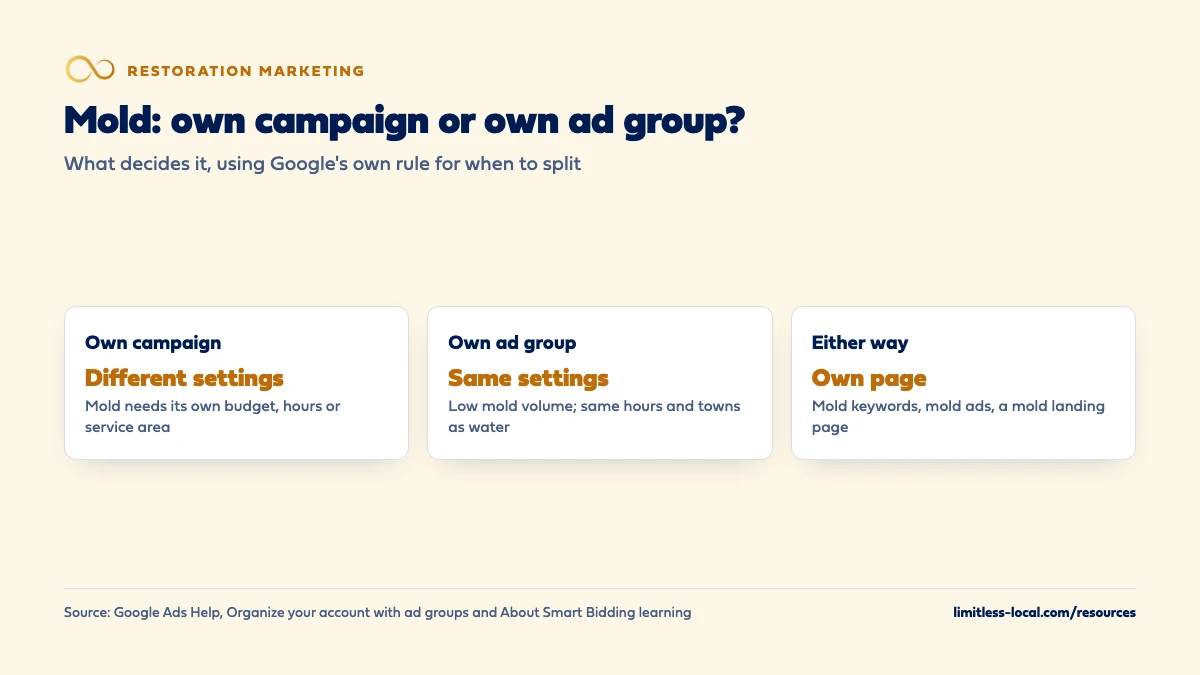
Google draws the line for you. In its advice on organizing an account, it says that when you need a different set of campaign settings, such as budget or location targeting, you should create a separate campaign. If you want everything to share one budget and one set of locations, one campaign is enough, and ad groups handle the different themes inside it.
So the question for a restoration company isn’t really “mold or water”. It’s whether mold needs a different budget, different hours or a different map from your emergency water work. In our judgement, it often does:
- Budget: you want a fixed amount for mold that water emergencies can’t eat, and a ceiling so mold can’t eat the water money.
- Hours: ad schedules are set per campaign, and mold calls rarely need a truck at 2 a.m.
- Area: you may drive further for a planned mold job than for a 3 a.m. extraction.
If none of those differ for you, a mold ad group inside your water damage campaign, with its own ads and its own page, does the job. Source: Organize your account with ad groups.
How is a mold search different from an emergency water search?
Someone searching “water extraction near me” usually has water on the floor right now. Someone searching “mold removal” may have found a patch last week or may want to know whether they can clean it themselves. In our judgement, mold searches are more planned, slower to book and more mixed in intent than emergency water searches.
That last point has a real source behind it. The EPA tells homeowners that if the moldy area is less than about 10 square feet, in most cases they can handle the job themselves, and that bigger growth or a lot of water damage calls for its guide to professional remediation. So a share of the people typing “mold” into Google are deciding whether to call anyone at all. Your negative keywords should filter out the people looking for a spray or a test kit. Source: Mold Cleanup in Your Home.
What goes wrong when mold and water share one budget?
A campaign’s average daily budget is shared by every ad group in it. Google says it will spend more on days it expects more clicks and conversions and less on others; for most campaigns, you won’t pay more than twice your average daily budget on a single day or 30.4 times it in a month. Inside that cap, you don’t decide how much goes to mold and how much to water.
In our judgement, that causes one of two problems for a restoration company:
- Water starves mold. A wet week fills the campaign with burst-pipe searches, the budget runs out by afternoon, and mold ads barely show.
- Mold drains water. If mold searches keep coming while water is quiet, mold clicks can spend the money on a slow morning, and the budget is thin when the evening emergency call would have come in.
Google also notes that when a campaign is limited by budget, a keyword in it won’t always be able to trigger an ad even when it otherwise could. A separate mold campaign gives mold its own budget line, so you can set it, cap it and judge it by itself. Sources: About average daily budgets and About ad group and asset group prioritization.
Should mold ads run at different hours than water damage ads?
Often, yes. Google Ads campaigns show ads “All day” by default, and Google’s own description of ad scheduling includes showing ads only during business hours, when you’re available to handle customer inquiries. You can also raise or lower bids by day and hour. The schedule belongs to the campaign, so mold can only keep different hours from water if it sits in its own campaign.
In our judgement, emergency water is worth paying for around the clock only if someone answers around the clock. Mold usually isn’t an emergency, so many owners run mold ads when the office can book an inspection and leave the night to water. One thing to know: with an ad schedule, Google still paces toward a monthly spend of 30.4 times the average daily budget, so fewer hours mean the money is spent in fewer hours, not that you spend less. Set the budget to what you want mold to cost in a month. Source: About Ad Scheduling.
Curious what your marketing is actually booking?
Get a free visibility audit — no obligation, no sales pitch.
Should mold ads cover the same towns as water damage ads?
Not always. Location targeting is a campaign setting too, and it’s one of the two examples Google gives of a reason to split campaigns. In our judgement, many restoration owners draw a tight map for emergency water, because the first company on site often gets the job, and a wider one for mold, because an inspection is booked a day or two out and the job runs longer.
Google notes that in some states, professionals may need additional licenses to do mold remediation or assessment, so check what applies where you work before you advertise it there. Sources: Organize your account with ad groups and Business screening and verification requirements (United States).
When is a mold ad group inside the water campaign the better choice?
When mold gets too few searches or too little budget to stand on its own. Google’s advice on Smart Bidding pulls the other way from splitting: it suggests consolidating ad groups and campaigns where possible to pool conversion data, and it says very restrictive settings such as low daily budgets or narrow targeting can slow a campaign’s ramp-up. A mold campaign that books one job a month gives an automated bid strategy very little to learn from.
In our judgement, keep mold as an ad group inside the water campaign when:
- The budget you can give mold is small enough that a separate campaign would run out early most days.
- You answer mold and water calls the same hours and serve the same towns.
Even then, give mold its own ad group, ads that say mold and a page about mold. Google recommends a narrow theme per ad group and ads that mention one of its keywords in the headline. Sources: About Smart Bidding learning and Organize your account with ad groups.
How do I stop water and mold ads from fighting over the same search?
Inside one account they don’t bid against each other. Google says that when several of your keywords could match the same search, only one of them can trigger an ad. An exact match keyword identical to the search wins first, then phrase and broad keywords identical to it, then Google picks the most relevant ad group by looking at the search, all the keywords in each ad group and their landing pages.
The catch is the search that mentions both, such as “mold after water damage”. In our judgement, decide where that search should go and enforce it with negative keywords: add mold words as negatives in the water campaign if you want those searches on your mold page, or the reverse. Google also lists exceptions: a keyword in a budget-limited campaign won’t always be able to trigger an ad, and one whose campaign isn’t targeting that location can’t, so a cross-negative can leave nobody showing for a search if the other campaign is off for the night. Negative keywords for restoration Google Ads covers the full list. Sources: About ad group and asset group prioritization and About negative keywords.

Which keywords belong in a mold campaign?
In our judgement, only searches for mold work your crews do and are allowed to do, grouped by job:
- Remediation: mold remediation, mold removal, black mold removal, basement or attic mold removal.
- Inspection or testing: only if you offer it and your state allows you to, in its own ad group with its own page.
And block the searches that won’t book: DIY and how-to, sprays, bleach, kits, test kits if you don’t sell testing, jobs and certification courses, and “mold in car”. Google says negative keywords don’t match close variants, so add plurals and synonyms yourself (“kit” and “kits”). For building out the water side of the account, which water damage keywords to target walks through it. Source: About negative keywords.
What should a mold ad and its landing page say?
The ad should say mold, the page should be about mold, and both should make it easy to book an inspection. Sending a mold click to your emergency water page makes the homeowner hunt for the answer. In our judgement, it should cover what you do, where, how an inspection is booked, and proof you can honestly show.
Be careful with health claims. The EPA’s cleanup page tells homeowners with health concerns to consult a health professional before starting cleanup, and it also says small areas can often be cleaned without a contractor. In our judgement, scare claims a source doesn’t support are a risk to your reputation and your account. What your website should say about mold covers the claims to keep and the ones to drop, and what a Google Ads landing page should include covers the paid-traffic page. Source: Mold Cleanup in Your Home.
How do I tell whether the mold campaign is paying for itself?
On cost per booked mold job, judged next to what those jobs were worth, over a longer window than water. A mold lead often goes inspection, then estimate, then a scheduled job, and an insurance-paid job can take longer again.
Google says Smart Bidding performance can take one to two conversion cycles to settle after a structural change, and suggests judging over two conversion cycles or a two-week window, whichever is longer. Give the mold campaign its own call tracking and mark every call: booked, estimate only, wrong service, DIY question or out of area. Tracking which marketing books restoration jobs covers the setup. Source: About Smart Bidding learning.
Not sure which of these is costing you jobs?
A free visibility audit checks the Google profile, reviews, site and tracking, and shows what to fix first.
What's different about mold for a restoration company
It’s planned work, not an emergency. In our judgement, that changes the hours worth paying for, the size of the map and how long you should wait before judging results.
The rules vary by state. Google notes that some states may require additional licenses for mold remediation or assessment. Advertise only the mold services you’re licensed and set up to do, in the places you’re allowed to do them.
Many searchers are deciding whether to hire anyone. The EPA tells homeowners that small patches can usually be cleaned without a contractor, so expect more DIY and research clicks than on emergency water searches, and plan your negative list around them.
A worked example: splitting a shared budget
These numbers are made up to show the math, not a benchmark for any market. Say you run one water damage campaign at $3,000 a month, with mold as an ad group inside it. At the end of the month you look at spend and booked jobs by ad group:
- Water ad groups spent $2,100 and booked 14 water jobs: $150 per booked job.
- The mold ad group spent $900 and booked 2 mold jobs: $450 per booked job.
That doesn’t make mold a bad buy, since one mold job may be worth several small water jobs. But you never chose to put $900 into mold; the shared budget did.
So you split it. The water campaign gets $2,400 a month, an average daily budget of about $79 (Google divides a monthly amount by 30.4), and runs all day. The mold campaign gets $600 a month, about $20 a day, runs during office hours and covers a slightly wider area. Now each one has its own cost per booked job, its own hours and its own ceiling, and you can change mold’s budget without touching the water money.
On our side, Google Ads management is part of every package. Essentials ($3,500 a month) covers Google Ads management up to $2,500 a month in ad spend; Growth ($4,500 a month) raises that to $5,000 and adds Local Services Ads management. Ad spend is paid to Google separately. A free visibility audit can show how your current campaigns split the money.
Frequently asked questions
Will a new mold campaign start Smart Bidding from scratch?
Not entirely. Google says that if your account has past conversion data, Smart Bidding uses it, along with data from similar campaigns, when a new campaign launches. New campaigns can still swing for a while, and a “Learning” status can show for up to seven days.
Can I advertise mold work if my state requires a mold license?
Only once you hold what your state requires. Google notes that some states may need additional licenses for mold remediation or assessment; check your state’s rules before you run mold ads, because we can’t tell you what they are for your area.
Should mold inspection and mold remediation share an ad group?
In our judgement, no. They’re different searches and different jobs, so give each its own ad group and page, and only advertise inspection or testing if you offer it and are allowed to.
Should fire and smoke damage get the same treatment?
Usually, for the same reason: different searches, budget and timing from emergency water. Running Google Ads for fire damage covers that campaign.
Can Local Services Ads target mold separately?
Not as a separate campaign. Google’s US Local Services category is water damage services, which it describes as covering issues such as mold, sewage and paint damage; you choose job types and service areas inside it, but there are no keywords to split.
Key takeaways
- Google’s rule: create a separate campaign when you need different settings such as budget or location targeting.
- Mold usually qualifies, because it’s planned work that needs its own budget, hours and sometimes a wider area.
- Keep mold as an ad group inside the water campaign when its volume or budget is too small to stand alone.
- Decide which campaign gets searches that mention both mold and water, and use negatives to enforce it.
- Watch health claims and state licensing in mold ads, and judge mold on booked jobs over a longer window.
Want a second set of eyes on your setup?
We'll look at how you show up locally and where calls are leaking, then send you a plain-English breakdown.
More in this section
- How should a restoration company run Google Ads for fire damage?
- Should a restoration company run Google Ads, LSAs or both?
- Which Google Ads keywords should a water damage company target?
- What negative keywords should restoration Google Ads use?
- What should a restoration website say about mold and fire damage?
Sources
- Organize your account with ad groups — Google Ads Help
- About ad group and asset group prioritization within a Google Ads account — Google Ads Help
- About Smart Bidding learning — Google Ads Help
- About average daily budgets — Google Ads Help
- About Ad Scheduling — Google Ads Help
- About negative keywords — Google Ads Help
- Mold Cleanup in Your Home — US EPA
- Business screening and verification requirements (United States) — Google Local Services Help