
How do restoration companies show up in AI search answers?
- How does a water damage company get named in Google AI Overviews and ChatGPT?
- Where do AI answers get the restoration companies they mention?
- Which restoration searches actually get an AI answer?
- Can I pay or sign up to be named in AI answers?
- Step 1: Can Google, Bing and ChatGPT actually read my website?
- Step 2: Are my Google and Bing listings complete and the same?
- Step 3: What should my restoration pages say so AI tools can use them?
- Step 4: Should I write a page for every city and every question?
- Do reviews and mentions on other websites matter for AI answers?
- Does schema markup or an llms.txt file help with AI search?
- Step 5: How do I check whether AI search is showing my restoration company?
- What if an AI answer gets my restoration company wrong?
- What's different about AI search for restoration companies
- A worked example: checking one water damage page against the steps
- Frequently asked questions
- Key takeaways
- More in this section
- Sources
The short version
- AI answers draw on the same search index and business listings as regular results.
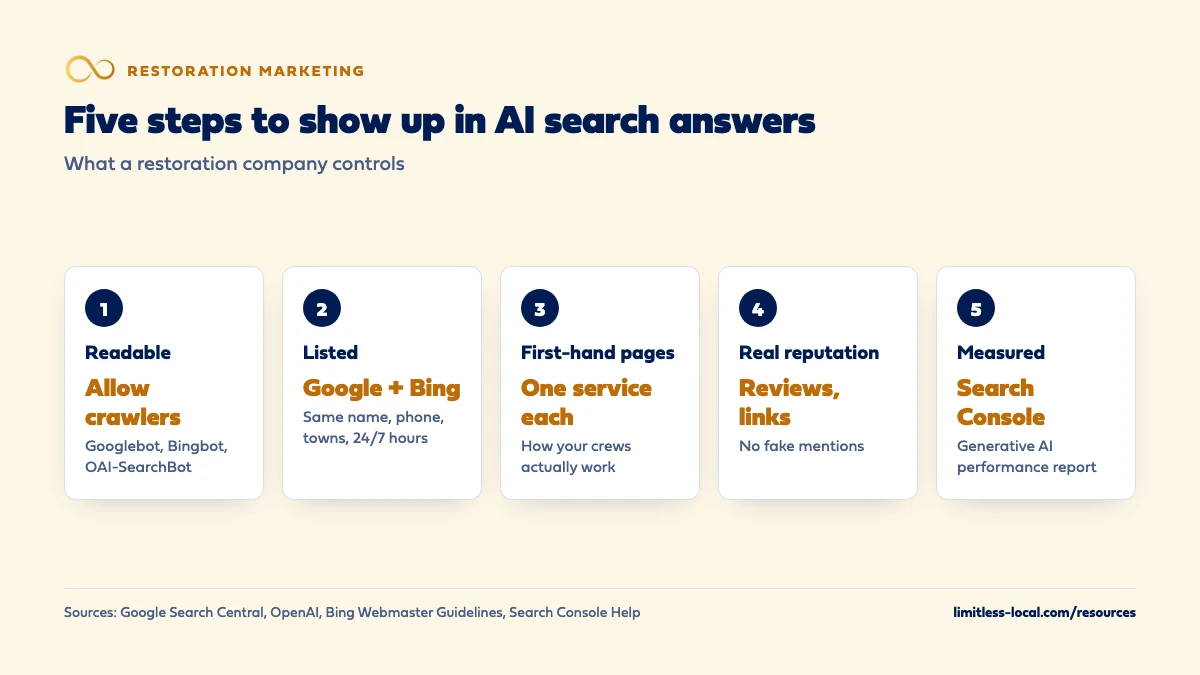
- Let Google, Bing and OpenAI's search crawler read your site.
- Claim and match your Google and Bing listings, including 24/7 hours.
- Write first-hand pages, one service each, about how your crews actually work.
For restoration owners who want their company named when homeowners and property managers ask Google’s AI or ChatGPT for help.
Get a free visibility audit · Book a growth call
How does a water damage company get named in Google AI Overviews and ChatGPT?
Restoration companies show up in AI answers the same way they show up in Google: a website that AI crawlers can read and that is indexed in Google and Bing, complete and matching business listings, and pages that explain the company’s water, fire and mold work in first-hand detail. Google’s AI Overviews and AI Mode draw on its regular search index and Business Profiles, and ChatGPT’s search answers leave out sites that block OpenAI’s search crawler. Google says there’s no way to pay for a better local ranking, and OpenAI doesn’t promise placement.
That’s the work we do for restoration companies too: showing up in AI answers is one of the three places our local SEO covers, next to the regular Google results and the Maps 3-pack. See how it fits a water, fire and mold business on our restoration marketing page. The restoration marketing guide covers every channel and budget, and the rest of the restoration marketing questions go one question at a time.
Where do AI answers get the restoration companies they mention?
Google’s AI Overviews and AI Mode don’t keep a separate list of restoration companies. Google says these features are rooted in its core Search ranking and quality systems: they pull relevant pages from the regular Search index and show links to the pages that support the answer. Google adds that AI responses can include information about local businesses, and that its Business Profiles help businesses show up in AI responses and other search results (Google Search Central).
ChatGPT works differently but lands in a similar place. When it searches the web, it may send rewritten searches to partner search providers, use an approximate location to find local results, and share location with third-party providers for things like nearby business listings (OpenAI Help Center). Microsoft says Bing and Copilot answers rely on the same crawling, indexing and ranking foundation as regular Bing search (Bing Webmaster Guidelines).
So there are three places to be found: your website, your Google Business Profile and Bing.
Which restoration searches actually get an AI answer?
Not every search does. Google says AI Overviews show only when its systems decide they add something beyond the regular results, and that they often don’t trigger. AI Mode is aimed at questions that need more reasoning or comparison.
In our view, that splits restoration searches into two kinds. The panic search, someone typing “water damage restoration near me” with water on the floor, is a phone-and-Maps moment, and the map pack and ads still do most of the work there. The AI answer shows up more around the call: “what do I do after a pipe bursts”, “how long does it take to dry out a basement”, “what does mold remediation involve”, or a property manager asking an AI tool to compare restoration vendors for a set of buildings. Those are the questions where a well-written page from a real restoration company can get cited.
Can I pay or sign up to be named in AI answers?
No. Google says there’s no way to request or pay for a better local ranking (Google Business Profile Help), and OpenAI says placement in ChatGPT search isn’t something it promises. Google also says many of the “AI search optimization” hacks sold online aren’t effective or supported by how its Search works, and it names a few you can ignore: special AI text files, chopping pages into tiny chunks, rewriting content just for AI, and chasing fake mentions.
The real work is the same work that gets a restoration company found on Google, plus a few AI-specific checks.
Step 1: Can Google, Bing and ChatGPT actually read my website?
Start with access, because everything else depends on it. Google lists allowing crawling in robots.txt, and by any CDN or hosting setup, among the basics, and says a page must be indexed and eligible to show with a snippet to be a supporting link in AI Overviews or AI Mode (Google Search Central). Google’s guide adds that a site must be included in the Search generative AI setting in Search Console to be eligible, so check that nobody has excluded it.
For ChatGPT, OpenAI uses a crawler called OAI-SearchBot to show websites in ChatGPT’s search results. Sites that block it won’t be shown in ChatGPT search answers, and OpenAI recommends allowing it in robots.txt and allowing traffic from its published IP addresses. A separate crawler, GPTBot, is for training, and you can block one while allowing the other (OpenAI). Bing says blocking Bingbot or serving pages it can’t render can keep them out of its index and out of Copilot answers.
Ask whoever runs your site to check robots.txt, any security plugin or firewall, and the CDN. In our experience, security tools sometimes block crawlers without anyone noticing.
Step 2: Are my Google and Bing listings complete and the same?
Google says businesses with complete and accurate information are more likely to show up in local results, and asks for your hours, category and other details. Google’s AI features guide adds checking that your Business Profile information is up to date. If your profile still needs work, optimizing your restoration Google profile covers it step by step.
Bing has its own listing, Bing Places. A few details matter for emergency work (Bing Places for Business):
- You can mark the business as open 24/7.
- A service-area business can hide its address and list up to 20 service areas.
- You can pick 1 primary category and up to 9 more, for ten in all.
- If you sync your Google listing, your services import automatically.
Bing also says it only applies changes to your name, address, phone and website when they match trusted outside data, so a listing that disagrees with your Google profile or your website may not publish or may be overwritten. Use one business name, one phone number and the same towns everywhere.
Curious what your marketing is actually booking?
Get a free visibility audit — no obligation, no sales pitch.
Step 3: What should my restoration pages say so AI tools can use them?
Google’s strongest advice is unique, useful content it calls non-commodity: its AI systems look across many sources, so a first-hand point of view stands out more than a summary of what others wrote. Bing asks for pages that state facts plainly, stand on their own and stick to one topic each.
For a restoration company, that means writing what only someone who does the work can write:
- What happens in the first hour. Who answers, how fast a crew rolls, what they do on arrival and what the homeowner should and shouldn’t touch.
- How you document the job. Moisture readings, photos and drying logs, in plain words.
- One service per page. Water mitigation, mold remediation, fire and smoke cleanup and sewage cleanup each get their own page.
- Real photos. Your crew and equipment, with descriptive file names and alt text, which Bing lists as aids to understanding.
Be careful on two topics. Mold health effects should be stated only the way a public health source states them, and insurance questions should be general guidance, never claims advice. What a restoration website should say about mold and fire and how much to explain the insurance claims process cover both.
Step 4: Should I write a page for every city and every question?
No. Google warns that making separate pages for every variation of how people search, mainly to steer rankings or AI answers, breaks its scaled content abuse spam policy, and that its AI systems understand synonyms and general meaning without an exact match. You don’t need fifty near-identical “water damage in [town]” pages to be considered for an AI answer about your area.
A town page with real jobs, local details and the crew that covers it is worth having; one that swaps the town name into the same paragraph isn’t. Building city pages that rank goes into how to do it without looking like spam.
Do reviews and mentions on other websites matter for AI answers?
They matter for local results, and that’s where AI answers about local businesses draw from. Google says local results are mainly based on relevance, distance and popularity, that how well known a business is depends partly on how many websites link to it and how many reviews it has, and that more reviews and positive ratings can help local ranking. Google’s AI guide also says its generative AI features can show what’s being said about a business across the web, including blogs, videos and forums.
The same guide warns that seeking inauthentic mentions isn’t as helpful as it might seem, because spam systems sit underneath the AI features. Real mentions come from real relationships: a plumber who links to you, a property manager’s vendor list, detailed reviews from customers whose basements you dried. In our view, a steady stream of honest, specific reviews is the most useful thing a restoration company can add here, and what makes homeowners trust a company online covers the signals people look for.
Does schema markup or an llms.txt file help with AI search?
Not the way they’re often sold. Google says you don’t need new machine-readable files, AI text files or special markup to appear in its generative AI features, because Google Search doesn’t use them. It also says structured data isn’t required and there’s no special schema for AI, though it’s still worth using for rich results as part of normal SEO. If you do use it, Google says it must match the visible text on the page.
Bing takes a similar line: structured data may support clearer answers but doesn’t guarantee visibility, and markup has to reflect what’s visible on the page.
Step 5: How do I check whether AI search is showing my restoration company?
For Google, use the Generative AI performance report in Search Console, which Google rolled out to all websites on August 31, 2026. It shows how often links to your site appeared in AI Overviews and AI Mode, which pages showed most, and the trend over time. If you don’t see the report, Google says it usually means your site hasn’t had enough impressions in those features yet, or that your site is excluded from them (Search Console Help).
For ChatGPT, there’s no report, so ask it the questions your customers ask, with your town in the question, and note which companies it names and which pages it cites. Keep in mind that OpenAI says search results and citations can be incomplete, outdated or wrong, so one answer on one day isn’t a verdict.
Neither of those tells you whether the phone rang. That part comes from call tracking and asking callers where they found you, which tracking which marketing brings booked jobs walks through.
What if an AI answer gets my restoration company wrong?
Fix the source, not the answer. AI tools repeat what they find, so a wrong phone number or an old service area usually traces back to your website, your Google profile, your Bing listing or an old directory listing. Correct it there first.
Bing gives you a way to speed that up: it recommends IndexNow, a way of telling Bing when pages are added, changed or removed, and says timely updates reduce outdated references in Copilot answers. For Google, updating your Business Profile and the page itself, and keeping both in Search Console, is the route.
Not sure which of these is costing you jobs?
A free visibility audit checks the Google profile, reviews, site and tracking, and shows what to fix first.
What's different about AI search for restoration companies
The emergency call usually isn’t an AI moment. With water on the floor, people call whoever answers. AI answers matter more in the research before and after: what to do while waiting, what drying involves, what mold remediation means, and which vendor a property manager should put on the list.
Hours have to match everywhere. If your website says 24/7 and your Google or Bing listing shows weekday hours, an AI answer may repeat the wrong one. Pick one truth and use it on every listing.
Mold and insurance invite overstatement. AI tools quote what they find. A page that overstates mold health risks or promises insurance outcomes can get repeated with your name attached. State mold health facts only as public health agencies state them, and keep insurance content general.
A worked example: checking one water damage page against the steps
This is a made-up company to show the checks, not a real audit. An owner asks ChatGPT for water damage help in her town, and another company gets named. Going through the steps:
- Access. The site’s security plugin blocks unknown bots, and OAI-SearchBot is among them. Allowing it comes first.
- Listings. The Google profile shows weekday hours while the website says 24/7, and nobody has claimed Bing Places. She sets 24/7 on both and lists the same towns.
- The page. It’s a general paragraph about water damage that could be on any site. She rewrites it around her crew’s first hour on site and how they document drying, with real photos.
- Measurement. She checks the Generative AI performance report monthly and asks ChatGPT the same questions each month.
That doesn’t guarantee she gets named, because nobody controls that; it removes the reasons she couldn’t be. If you’d rather have a team run these checks, our Essentials package is $3,500 a month and includes Google Business Profile management, listing cleanup and a content sprint of up to 10 pages; ad spend, if you run ads, is paid to Google separately. A free visibility audit shows where you stand first.
Frequently asked questions
Does blocking GPTBot keep me out of ChatGPT search?
Not by itself. OpenAI says GPTBot is for training and OAI-SearchBot is for search, and each setting is independent, so you can block GPTBot and still allow OAI-SearchBot.
Will an AI Overview show for "water damage restoration near me"?
Sometimes, but Google says AI Overviews only show when they add something to the regular results and often don’t trigger. Your Google profile and the map pack still matter most for that kind of search, in our view.
Do I need a separate AI strategy from my SEO?
Mostly no. Google and Bing both say the same SEO basics that get you found in regular search also make you eligible for their AI answers, plus a few checks like allowing OpenAI’s search crawler.
How long does it take to show up in AI answers?
Nobody can promise a date. AI answers sit on top of regular search, and SEO work typically takes 3-6 months to show meaningful organic growth, so plan on a ramp rather than a switch.
Is Bing worth bothering with for a restoration company?
Yes. Bing says Copilot answers rely on the same crawling and indexing as Bing search, and ChatGPT sometimes uses partner search providers. Claiming Bing Places and allowing Bingbot is a small job.
Key takeaways
- AI answers draw on regular search indexes and business listings; there’s no separate sign-up or payment.
- Let Googlebot, Bingbot and OpenAI’s OAI-SearchBot read your site, and confirm the Search Console AI setting is on.
- Claim Google and Bing listings and keep name, phone, towns and 24/7 hours identical everywhere.
- Write first-hand pages, one service per page, and skip mass city pages and fake mentions.
- Measure with the Search Console Generative AI performance report and real call tracking.
Want a second set of eyes on your setup?
We'll look at how you show up locally and where calls are leaking, then send you a plain-English breakdown.
More in this section
- Do Angi or HomeAdvisor listings help restoration companies rank?
- How does a restoration company recover when its reviews drop?
- How should a restoration company reply to Google reviews?
- What makes homeowners trust a restoration company they find online?
- Do job photos on Google help a restoration company rank?
Sources
- Optimizing your website for generative AI features on Google Search — Google Search Central
- AI features and your website — Google Search Central
- Generative AI performance report — Search Console Help
- Overview of OpenAI Crawlers — OpenAI
- Searching the web with ChatGPT — OpenAI Help Center
- Bing Webmaster Guidelines — Bing Webmaster Tools
- Bing Places for Business: Manage your listing — Bing Places for Business
- Tips to improve your local ranking on Google — Google Business Profile Help