
Do Angi or HomeAdvisor listings help restoration companies rank?

- Will paying for Angi or HomeAdvisor help my water damage company show up higher on Google?
- Does an Angi or HomeAdvisor listing help my restoration company rank on Google?
- What's the difference between an Angi profile and paying for Angi leads?
- Can a directory listing help my Google Maps ranking indirectly?
- Do links from Angi or HomeAdvisor count for SEO?
- Do reviews on Angi count toward my Google ranking?
- Are Angi or HomeAdvisor leads worth it for a restoration company?
- Which listings matter more than Angi for a restoration company's rankings?
- How do I tell whether Angi is actually bringing in restoration jobs?
- Should I cancel my Angi or HomeAdvisor account if it isn't producing jobs?
- What's different about directory listings for restoration companies
- A worked example: what a marketplace job really costs
- Frequently asked questions
- Key takeaways
- More in this section
- Sources
The short version
- Google doesn't name directories or lead marketplaces as a ranking factor.
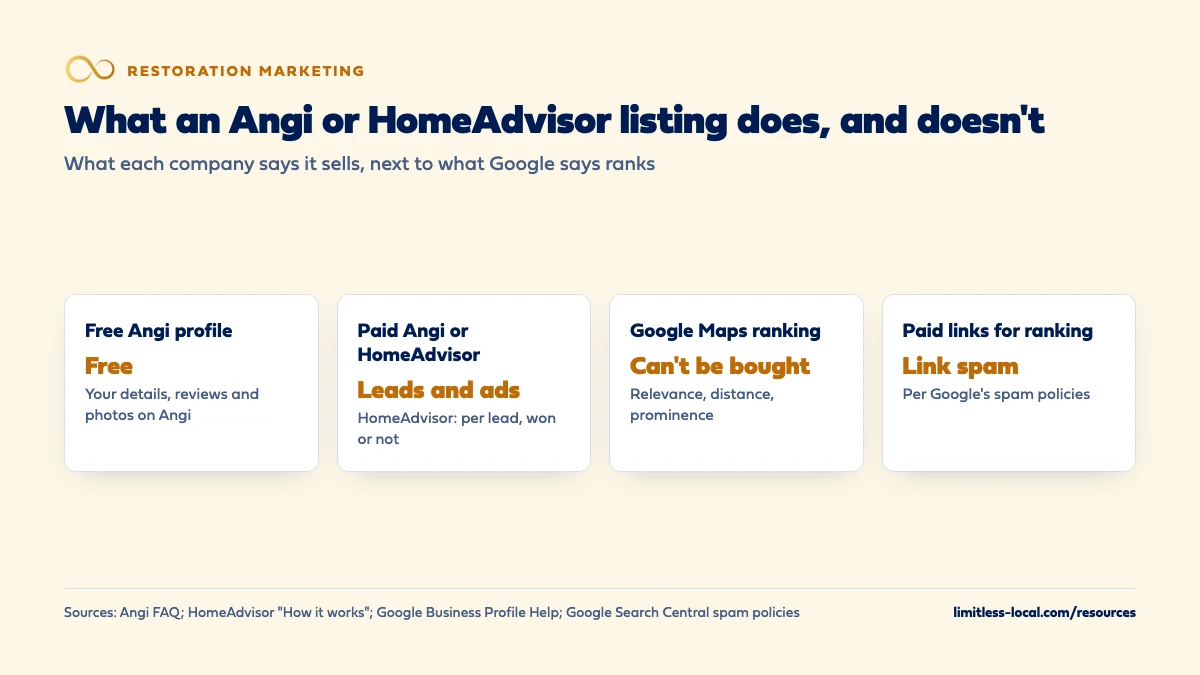
- An Angi profile is free; paying gets you advertising and leads, not a Google position.
- Google treats buying links for ranking as spam and asks sites to mark paid links.
- Judge any paid lead plan by cost per booked job.
For restoration owners deciding whether an Angi or HomeAdvisor account is helping them on Google, or just costing money.
Get a free visibility audit · Book a growth call
Will paying for Angi or HomeAdvisor help my water damage company show up higher on Google?
Not in any way Google documents. Google says local rankings are based mainly on relevance, distance and popularity, that prominence comes partly from links to your website and your reviews, and that there’s no way to pay for a better local ranking. A free Angi profile can be one more place homeowners find you with your correct name, address and phone number, but a paid Angi or HomeAdvisor plan buys advertising and leads, not Google rankings. If ranking in Google Maps is the goal, your time and money go further on your Google Business Profile, your reviews and your own website.
Directory listings are part of the cleanup in our local SEO work: we sync your name, address and phone across 50+ directories so the details match everywhere, but we treat that as housekeeping, not a ranking plan. That work is part of every package of our restoration marketing. Whether buying leads is worth it at all is covered in the water damage leads guide, and the rest of the restoration marketing questions go one question at a time.
Does an Angi or HomeAdvisor listing help my restoration company rank on Google?
Not directly, as far as anything Google publishes says. Google’s description of local ranking names three factors: relevance (how well your Business Profile matches the search), distance (how far you are from the searcher) and prominence (how well-known you are). It says prominence is based partly on how many websites link to your business and how many reviews you have, and that more reviews and positive ratings can help. It doesn’t mention directories, lead marketplaces or paid listings.
Google is also blunt about money: there’s no way to request or pay for a better local ranking. So whatever an Angi or HomeAdvisor plan does for you, it isn’t buying a spot in Google Maps. In our judgement, any ranking effect from a listing on those sites is small at best, and the reasons it might help are the same reasons any accurate listing helps, covered below. Source: Tips to improve your local ranking on Google.
What's the difference between an Angi profile and paying for Angi leads?
They’re two different things, and owners often mix them up:
- A free profile. Angi says businesses can set up a free profile to share information about their business and services, and that professionals with a profile can add reviews, ratings and photos.
- Paid advertising. Angi says its revenue comes partly from service professionals who pay to advertise on Angi. To be Angi Approved and advertise, a pro must keep an average rating of at least 3.5 stars, and the owner must pass a criminal background check, except for pros Angi labels Approved (Corporate).
- HomeAdvisor leads. HomeAdvisor, now powered by Angi and branded Angi Leads on its pro pages, matches you with homeowners based on the services and locations you choose. It says you’re charged for each lead you receive, whether or not you win the job, and that your monthly spend target is an estimate, not a hard cap, so it’s possible to go over it.
None of those, in either company’s own description, is a Google ranking product. You’re paying for exposure on their sites and for leads. Sources: Angi Frequently Asked Questions, How does HomeAdvisor work for contractors? and Lead Credit Guidelines (Angi Leads).
Can a directory listing help my Google Maps ranking indirectly?
Possibly, in a small way, through accuracy. Google says the information in Business Profiles is compiled from several sources, including publicly available web content such as your official website, licensed data from third parties, and users who contribute facts like addresses and phone numbers. Google also asks you to represent your business the way it’s consistently represented in the real world, on your signage, paperwork and other branding.
Our reading: when your name, address and phone match everywhere they appear, including directories, Google has fewer conflicting details to sort out about who you are. That’s a reason to keep any listing you have accurate, not a reason to pay for one. A free, correct Angi profile does that job as well as a paid one. Sources: Understand how Google sources & uses info in Business Profiles and Guidelines for representing your business on Google.
Do links from Angi or HomeAdvisor count for SEO?
You can’t count on it. Google asks websites to label certain outbound links so it knows how to treat them: rel="sponsored" for advertisements and paid placements, rel="ugc" for user-generated content such as comments and forum posts, and rel="nofollow" when a site would rather Google not associate it with the page it links to. A directory decides how to mark the link on your profile, and that can change without notice.
Google’s spam policies also name “buying or selling links for ranking purposes” and “low-quality directory or bookmark site links” as examples of link spam. In our judgement, that settles the practical question: pay for a listing if the leads or exposure are worth it, never for the link. Links worth having come from local businesses, partners and organizations that would mention you anyway. Sources: Qualify outbound links for SEO and Spam policies for Google web search.
Curious what your marketing is actually booking?
Get a free visibility audit — no obligation, no sales pitch.
Do reviews on Angi count toward my Google ranking?
Google’s local ranking guidance talks about reviews in the context of your Business Profile, and Google’s help pages don’t say that reviews on other sites feed your Maps ranking. We’d assume they don’t, and plan around that.
That doesn’t make Angi reviews worthless. A homeowner who finds you on Angi reads the reviews there, and Angi uses your rating to decide whether you can stay Approved. But if you can only ask a customer for one review, ask for it on Google, where it can help both the homeowner deciding and your Maps visibility. Optimizing your restoration Google profile covers how to ask without breaking Google’s rules. Sources: Tips to improve your local ranking on Google and Angi Frequently Asked Questions.
Are Angi or HomeAdvisor leads worth it for a restoration company?
That’s a different question from ranking, and the water damage leads guide answers it in detail: bought versus owned leads, shared versus exclusive, and how to judge a lead source by the jobs it books. Two points from HomeAdvisor’s own terms are worth knowing before you sign up:
- Credits are limited. HomeAdvisor says it may issue credits at its discretion, requested within 30 days of the charge, for situations like duplicate leads, a wrong ZIP code outside your area, a wrong job type you don’t do, or contact details that are all wrong.
- Some bad outcomes aren’t credited. A homeowner who doesn’t call back, already hired someone, changed their mind, was just shopping, or didn’t pick you is accounted for in lead pricing, not credited.
For an emergency trade, that second list matters. A water damage lead that went to several companies at once and went quiet is still a lead you paid for. Source: Lead Credit Guidelines (HomeAdvisor).
Which listings matter more than Angi for a restoration company's rankings?
In rough order of what we’d fix first:
- Your Google Business Profile. It’s the listing Google ranks in Maps. Category, services, service area, hours, photos and reviews all live there.
- Your own website. Google pulls business information from official websites, and its local ranking guidance counts links to your site toward prominence.
- The main map and directory listings homeowners use. Bing, Apple Maps, Yelp and, yes, Angi, kept accurate and identical in name, address and phone.
- Real local links and mentions. Partners, suppliers, local associations and community groups that would link to you anyway.
If you’re running a lean operation, getting emergency calls on a small budget shows where a one-truck shop should put its first dollars.

How do I tell whether Angi is actually bringing in restoration jobs?
Count it the same way you’d count any channel: leads in, jobs booked, money spent, and cost per booked job. Marketplace leads usually arrive through the platform’s own app or email, so they’re easy to count. The harder part is marking which ones became jobs, especially when insurance pays weeks later.
- Tag every marketplace lead as its own source in your job software.
- At the end of each month, total what you paid and how many of those leads booked.
- Ask callers how they found you, because some homeowners see you on Angi and then search your name on Google.
Tracking which marketing books restoration jobs covers the setup. If an agency is telling you directory listings are why your calls went up, checking whether your agency produces real jobs shows what to ask for.
Should I cancel my Angi or HomeAdvisor account if it isn't producing jobs?
Separate the free part from the paid part. Keeping a free profile accurate costs you almost nothing and keeps your details consistent across the web, so in our view there’s little reason to delete it. The paid part should earn its place every month like any other channel.
HomeAdvisor says you can change your spend target at any time and mark when you’re busy to narrow the leads you receive. If your cost per booked job from marketplace leads is higher than from your own channels, turn the spend down and move that money to the channels you own, such as your Google profile, Local Services Ads or search ads. Choosing Google Ads, LSAs or both compares those two. Source: How does HomeAdvisor work for contractors?.
What's different about directory listings for restoration companies
Emergencies go to Google first, in our view. A homeowner with water coming through the ceiling tends to search and call from the map, not fill out a marketplace form and wait for matches. That makes your Google profile the listing that matters most for emergency work.
Marketplace leads lean toward planned work. Rebuilds, mold inspections and remodel-after-loss jobs give a homeowner time to compare, which suits a platform built on matching and quotes. Judge marketplace leads by the kind of jobs they actually book, not just by count.
Speed decides shared leads. When a lead goes to more than one company, the first to call usually has the edge. A crew in the middle of an extraction often can’t be first.
Badges are platform trust, not Google trust. An Angi Approved badge tells homeowners on Angi that the rating meets Angi’s bar and, except for pros labeled Approved (Corporate), that the owner passed a background check. It’s useful there; it isn’t a Google signal.
Want to see where your company stands?
A free visibility audit shows where you show up on Google, Maps and AI answers, and what it's costing you in calls.
A worked example: what a marketplace job really costs
These numbers are made up to show the math, not a benchmark for your market. Say you spend $1,200 on marketplace leads in a month and receive 16 leads. Two were duplicates and got credited. Of the rest, most went quiet or hired someone else, and 2 booked. Your cost per booked job from the marketplace is $1,200 divided by 2, or $600.
Now run the same math on your Google profile calls and any paid search or Local Services Ads you run. If those channels book jobs for less, the marketplace is the expensive channel, even if it sends the most leads. If it books jobs your other channels don’t, like rebuild work, it may still earn a smaller budget. Either way, the decision comes from booked jobs, not from whether the listing might help your rankings, because nothing Google publishes says it does.
Frequently asked questions
Is an Angi profile free?
Yes. Angi says businesses can set up a free profile with information about their services. Advertising on Angi is the paid part.
Does HomeAdvisor only charge for jobs I win?
No. HomeAdvisor says you’re charged for each lead you receive, whether or not you win the job and whether or not the customer hires anyone.
Can I get credit for a bad HomeAdvisor lead?
Sometimes. HomeAdvisor’s guidelines list duplicates, wrong ZIP codes or job types outside your profile and all-wrong contact details as possibly eligible, if you ask within 30 days. A customer who just went quiet isn’t.
Should I add my Angi profile link to my Google Business Profile?
Use your own website as the link on your Google profile. Google’s rules say not to use URLs that redirect or refer users to pages other than your actual business’s.
Will deleting my Angi profile hurt my Google ranking?
Nothing Google publishes suggests it would. We’d still keep a free profile accurate rather than delete it, because homeowners use it and consistent details across the web don’t hurt.
Key takeaways
- Google doesn’t name directories or lead marketplaces as local ranking factors, and says you can’t pay for a better local ranking.
- An Angi profile is free; paid plans sell advertising and leads, and HomeAdvisor charges per lead whether or not you win the job.
- Google treats buying links for ranking as link spam, so never pay for a listing for the link.
- Keep every listing accurate, but put ranking effort into your Google profile, reviews and website.
- Judge any marketplace by cost per booked job against the channels you own.
Not sure what's working right now?
Start with a free visibility audit: rankings, Google profile, reviews and tracking, checked against your service area.
More in this section
- Should a restoration company run Google Ads, LSAs or both?
- How should a restoration company market to commercial properties?
- How do restoration companies get insurance-related water damage jobs?
- How do I track which marketing brings in booked restoration jobs?
- Is my restoration marketing agency producing real jobs?
Sources
- Tips to improve your local ranking on Google — Google Business Profile Help
- Understand how Google sources & uses info in Business Profiles & local search results — Google Business Profile Help
- Guidelines for representing your business on Google — Google Business Profile Help
- Spam policies for Google web search — Google Search Central
- Qualify outbound links for SEO — Google Search Central
- Frequently Asked Questions — Angi
- How does HomeAdvisor work for contractors? — HomeAdvisor
- Lead Credit Guidelines — HomeAdvisor Pro