
How do restoration companies get insurance-related water damage jobs?
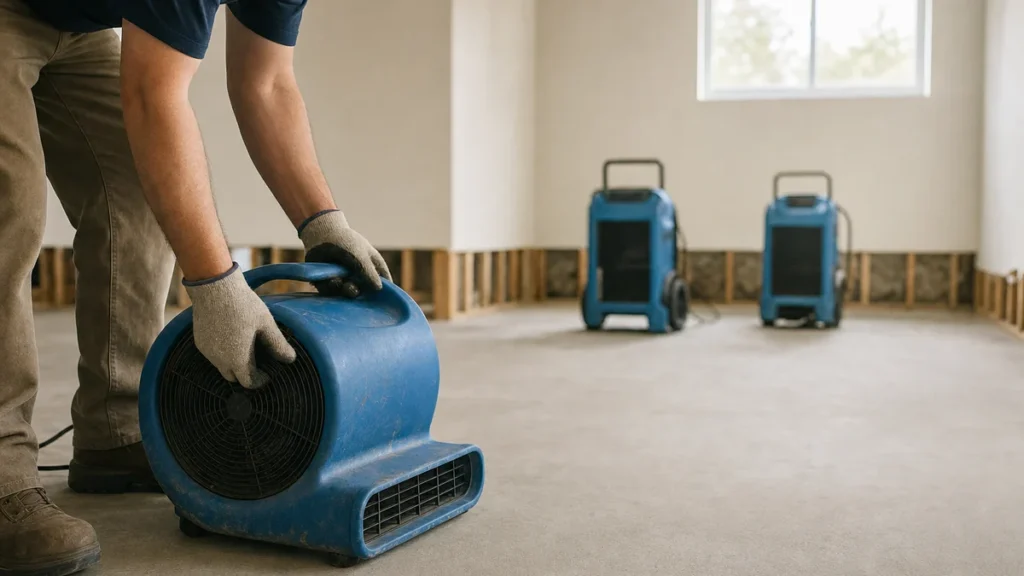
- Where do insurance-paid water damage jobs come from for a restoration company?
- Where do insurance-paid water damage jobs actually come from?
- Can a homeowner hire my company if their insurer recommends someone else?
- How do I get on an insurance company's preferred vendor list?
- What do owners and adjusters check before they trust a restoration company?
- Why does the first hour decide who gets the job?
- Should I advertise that we handle the insurance claim?
- What about deductibles, rebates and free inspections?
- Where do plumbers, agents and property managers fit in?
- Should I ask homeowners to sign an assignment of benefits?
- How do I judge whether insurance-paid jobs are worth chasing?
- What's different about insurance-paid jobs versus cash jobs
- A worked example: cost per booked insurance-paid job
- Frequently asked questions
- Key takeaways
- More in this section
- Sources
The short version
- Many insurance-paid water jobs start with the owner's phone call, not the insurer.
- Owners, partners and adjusters check license, insurance and reviews, so make them easy to find.
- Vendor lists can add work, but each one sets its own terms and none promises volume.
- Don't advertise that you'll handle the claim or cover the deductible; Texas bars both, and other states have their own rules.
For restoration owners who want more insurance-paid water mitigation work without betting the business on one carrier’s vendor list. General information, not legal or insurance advice; rules differ by state, so check yours with an attorney.
Get a free visibility audit · Book a growth call
Where do insurance-paid water damage jobs come from for a restoration company?
Many insurance-paid water damage jobs start with the property owner, who often calls a restoration company after the leak before the insurer is involved. In Washington, for example, the state insurance regulator tells homeowners they have the right to pick their own contractor even when the insurer suggests preferred providers. So restoration companies win these jobs by being the company owners find and trust in the first hour, by earning referrals from plumbers, property managers and agents who see the damage first, and, for some, by qualifying for insurer or program vendor lists, which set their own requirements and promise no volume.
That is how we look at it too: an insurance-paid job is still a booked job that started with someone finding you, calling you and trusting you. Our restoration marketing work covers the parts you can control (showing up in search and Maps, answering fast, tracking which calls turn into jobs), and we don’t promise insurer work, because no marketing firm can. For the channel-by-channel picture, the guide to water damage leads compares buying leads with generating your own, and the restoration marketing questions library goes one question at a time.
Where do insurance-paid water damage jobs actually come from?
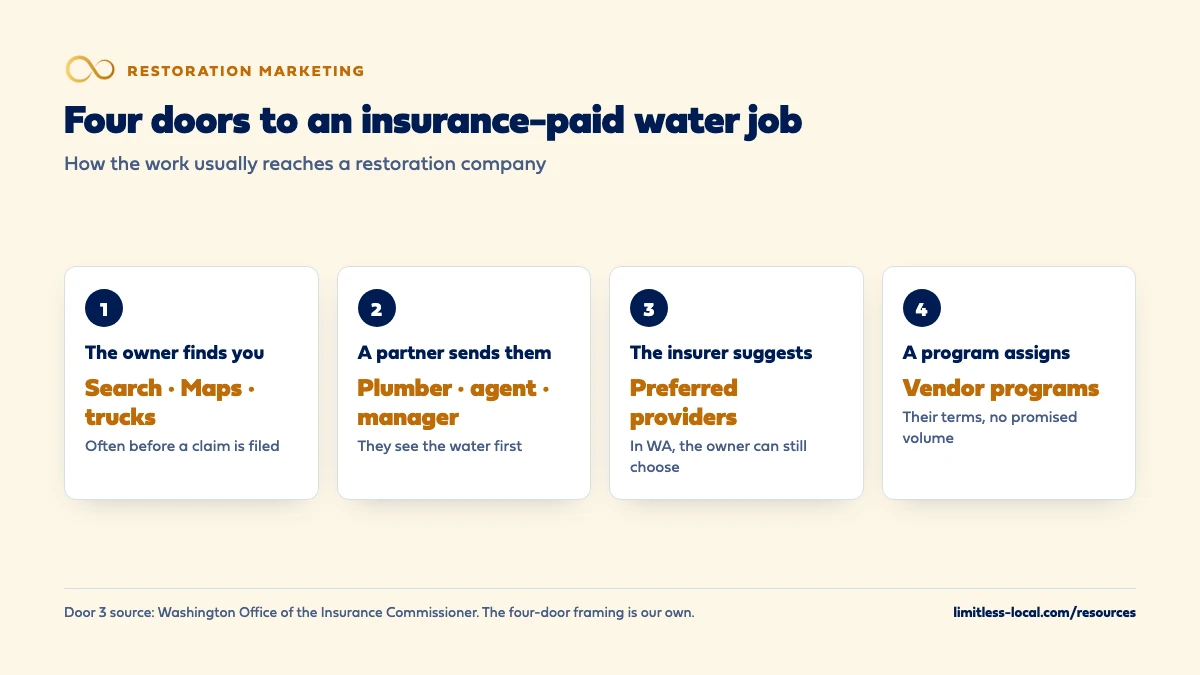
When a supply line bursts or a water heater fails, the job usually reaches a restoration company through one of four doors:
- The owner finds you. They search, check Maps, or call the number on a truck they’ve seen. Many of these jobs become insurance claims after you’re already on site.
- A partner sends them. The plumber who fixed the leak, the property manager, or the insurance agent the owner called first.
- The insurer suggests someone. Washington’s insurance regulator says an insurance company “may suggest a list of contractors or ‘preferred providers’ it’s worked with before.”
- A program or network assigns it. Some carriers route work through vendor programs with their own rules.
In our judgement, most owner-operators should build the first two doors before chasing the last two, because those are the ones you control. The rest of this page goes through each.
Can a homeowner hire my company if their insurer recommends someone else?
In Washington, yes. The state’s Office of the Insurance Commissioner tells policyholders, “you do have the right to select your own contractor to complete the work on your home,” and adds that the insurer “is not required to provide you with a list of contractors.” The same page notes the insurer has 30 days from the date the claim was filed to inspect the damage, and that in Washington insurers have five business days to approve a mitigation scope when the policy requires the owner to protect the property from further damage.
Every state writes its own rules, so don’t print another state’s rights on your website as if they were universal. What holds everywhere is the practical point: a homeowner who already trusts you is in a strong position to ask for you by name. That trust is built before the claim, in search results, reviews and referrals.
How do I get on an insurance company's preferred vendor list?
There’s no single public application. Each carrier or third-party program sets its own requirements, pricing terms and audit rules, and we haven’t found a regulator page that describes how those lists are built. So treat anyone selling you a shortcut onto them with caution.
What you can do is be the kind of company a program can approve quickly. That usually means current licensing, proof of workers’ compensation and liability insurance, certified technicians, and job files that hold up when someone else reads them. The IICRC S500 standard for water damage restoration covers “administrative procedures, project documentation, and risk management” alongside the drying work itself, and it applies to residential, commercial and institutional buildings. Ask the local claims offices you already see on jobs who manages their vendor program, and read any program agreement closely before you sign it, because the terms are theirs.
One more caution: a vendor list can be a large share of your work one year and a much smaller share the next. Build it as one door, not the only one.
What do owners and adjusters check before they trust a restoration company?
Regulators tell homeowners exactly what to look for, which makes it a useful checklist for your website and Google profile. The NAIC Post-Disaster Claims Guide says to get a copy of the contractor’s business license, proof of workers’ compensation insurance and proof of liability insurance, and to call the insurer to verify that coverage. It also tells owners to ask for references, check online for information about the contractor, and ask the Better Business Bureau and state Attorney General’s office about complaints.
So put the answers where people look: license numbers, proof of insurance on request, certifications, a real local address if you have one, and recent reviews that mention the water jobs you actually do. Optimizing your Google Business Profile covers the profile side, which is often the first thing an owner sees before they call.
Curious what your marketing is actually booking?
Get a free visibility audit — no obligation, no sales pitch.
Why does the first hour decide who gets the job?
Because the owner is told to act fast. California’s Residential Property Claims Guide says one of the most important things to do after a loss is to make temporary repairs to prevent further damage, that policies may not cover ensuing damage if the owner didn’t take reasonable steps, and that insurers reimburse reasonable protection costs when the owner keeps receipts. Washington’s page on leaks and water damage adds that home insurance often covers sudden, accidental water damage like a burst supply line, while gradual leaks usually aren’t covered, and that owners should report quickly.
Put those together and the first company that answers, shows up and starts protecting the property has a real head start, whether or not the claim is filed yet. That’s why how fast you answer emergency calls matters as much as any vendor relationship.
Should I advertise that we handle the insurance claim?
Be careful with that line. The Texas Department of Insurance says Texas doesn’t allow a contractor to act as a public insurance adjuster on a claim if they’re also doing the work, and that contractors can’t advertise that they will. It lists improper language such as offering to negotiate claim settlements or file a claim for the policyholder, and telling others, including insurance companies, that you represent the policyholder. Texas counts a website as an advertisement.
In Florida, section 489.147 of the contracting statutes says a contractor may not interpret policy provisions, advise an insured about coverages or duties under the policy, or adjust a claim on the insured’s behalf unless the contractor holds a public adjuster license. The section is written for contractors; if your company does mitigation only, confirm with a Florida attorney whether and how it applies to you. What you can say is what you actually do: document the damage, write itemized estimates, and meet with the owner and adjuster when the owner asks. Explaining the claims process on your website covers where that line sits. This is general information, not legal or insurance advice; rules differ by state, so have an attorney who knows yours review your wording.
What about deductibles, rebates and free inspections?
Don’t use them as a hook. In Texas, the Department of Insurance says it’s illegal for a contractor to offer to waive, rebate or absorb a policyholder’s deductible, and that state law requires contracts of $1,000 or more that involve an insurance settlement to include a notice that the policyholder must pay the deductible. In Florida, section 489.147 prohibits contractors from offering a residential property owner gifts, cash or a deductible waiver in exchange for a roof inspection or a roof claim, and allows fines of up to $10,000 per violation.
The same Florida section also bars contractors from “offering, delivering, receiving, or accepting any compensation, inducement, or reward, for the referral of any services for which property insurance proceeds are payable.” As above, ask a Florida attorney how it applies to a mitigation-only company, and check your own state’s rules. The rule also matters for how you build partner relationships, which building a referral network walks through without the payment shortcuts.
Where do plumbers, agents and property managers fit in?
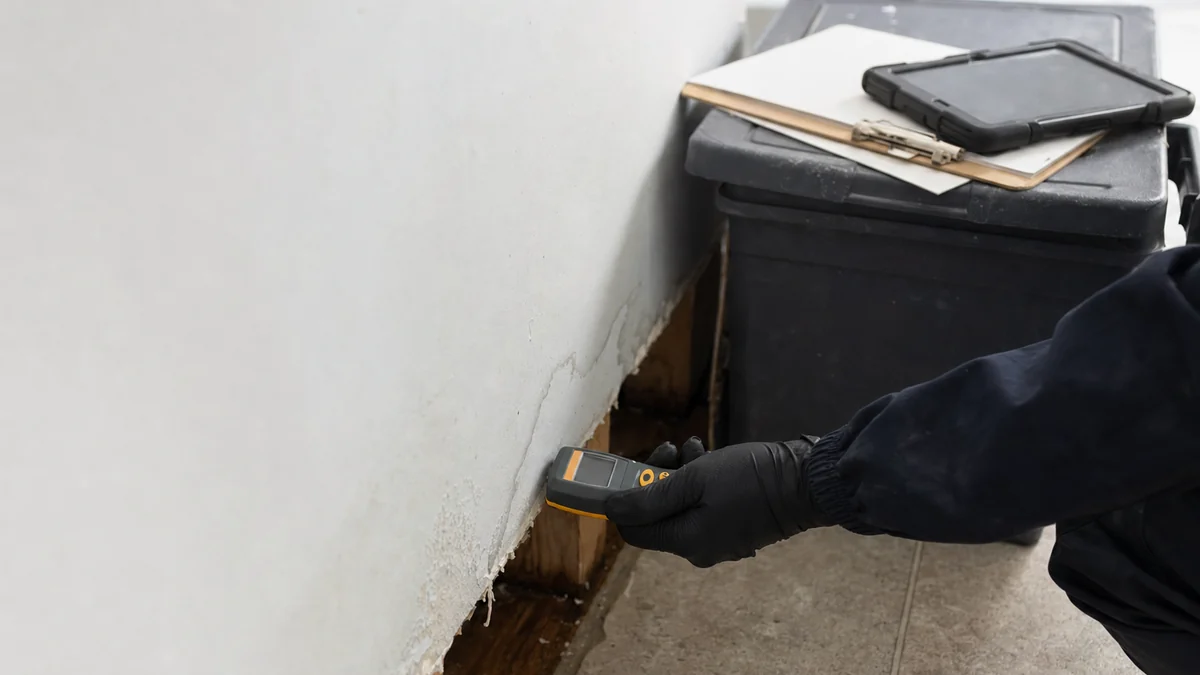
They’re often the first call. The NAIC tells homeowners to contact their insurer or agent to start a claim, and the S500 standard treats fixing the source of the water as the property owner’s responsibility, which in practice usually means a plumber is there before you are. Property managers run the buildings where one leak can reach several units.
Each of those people is effectively choosing who the owner calls next. In our view, a short list of partners who have seen you show up fast and finish clean will send more insurance-paid work, more steadily, than a vendor list you don’t control. For larger buildings, marketing to commercial properties covers how property and facility managers pick emergency vendors before anything goes wrong.
Should I ask homeowners to sign an assignment of benefits?
That’s a legal question for your attorney, not a marketing one, and the rules vary by state. From a marketing point of view, know how owners are being coached. Washington tells homeowners an assignment of benefits “could allow the contractor to negotiate, make decisions and settle the claim directly with the insurance company – without your approval,” and the NAIC says to “be cautious if you’re asked to sign an AOB.”
So whatever paperwork you use, don’t make it the headline of your ads or your intake script. To an owner who has read that guidance, leading with it can look like the red flag regulators described.
How do I judge whether insurance-paid jobs are worth chasing?
By booked and collected jobs per source, not by calls. Insurance-paid work can take longer to collect: California’s guide notes the first insurance check is often an advance, and that when a home is mortgaged the repair check is usually made out to the owner and the lender, who may hold the money in escrow and release it as work is completed.
That gap means a channel can look great in calls and still strain your cash flow. Track each job from first call to collected payment, tagged with where it came from: search, Maps, a partner, a carrier program. Tracking which marketing brings booked jobs shows how to set that up.
Not sure which of these is costing you jobs?
A free visibility audit checks the Google profile, reviews, site and tracking, and shows what to fix first.
What's different about insurance-paid jobs versus cash jobs
Someone else reads your file. On a cash job, the owner judges your work. On an insurance-paid job, an adjuster reviews your scope, photos and estimate too, so documentation is part of how you get paid, not just paperwork.
The scope can be shaped by the policy. Washington notes that if a contractor suggests an upgrade beyond restoring the property to its previous condition, the owner may have to pay the difference. Be clear with owners about what’s repair and what’s an upgrade.
Payment can run through more people. Mortgage lenders, escrow releases and advance payments are normal on these claims, so cash flow planning matters more than on a quick cash job.
A worked example: cost per booked insurance-paid job
These numbers are made up to show the math, not a benchmark for your market. Say you spend $6,000 in a month on ads and marketing. That month brings 50 calls; 20 are real water jobs in your service area, and 10 of those book. Your cost per booked job is $6,000 divided by 10, or $600. If most of those are insurance-paid mitigation jobs that comfortably cover $600 plus the cost of the work, the channel is paying its way, as long as you can carry the wait to get paid.
For comparison, our Essentials package is $3,500 a month and includes Google Ads management for up to $2,500 a month in ad spend, which is paid to Google separately. It doesn’t include Local Services Ads; Growth, at $4,500 a month, adds them. Whichever way you go, the test is the same: what each booked, collected job cost you.
Frequently asked questions
Do insurance companies have to give homeowners a list of contractors?
Not in Washington: the state’s insurance regulator says the insurer “is not required to provide you with a list of contractors.” Rules differ by state, so check yours.
Can my restoration company talk to the adjuster?
Yes, about your own work. The NAIC’s claims guide notes the adjuster may contact the contractor about estimates. Negotiating the claim on the owner’s behalf is different: Texas and Florida, for example, restrict it for contractors. Check your own state’s rules.
Does homeowners insurance cover every water damage job?
No. Washington’s regulator says policies often cover sudden, accidental water damage but usually not gradual leaks, and that flooding from a nearby waterway goes to a flood insurer. Owners should check coverage with their insurer or agent, not with you.
Is IICRC certification required to get insurance work?
We haven’t found a regulator rule that says so. The IICRC S500 is the published standard for professional water damage restoration, and in our view training and certifying to it is one of the clearest signals you can show an owner or a program.
Should I quote prices based on what insurance will pay?
Quote the work, itemized. In Florida, section 489.147 says a contractor may not give an insured an agreement authorizing repairs under a property insurance claim without a good faith, itemized estimate. Other states set their own rules.
Will Google Ads bring insurance-paid jobs?
They can bring emergency water calls, and many of those turn into claims. Whether ads, Local Services Ads or both fit your shop is covered in Google Ads, LSAs or both.
Key takeaways
- Many insurance-paid water jobs start with the owner’s call, often before the claim is filed.
- In Washington, owners can choose their own contractor even when the insurer suggests preferred providers.
- Make license, insurance, certifications and reviews easy to find; regulators tell owners to check them.
- Vendor programs set their own terms; build them as one door, not the only one.
- Don’t advertise that you’ll negotiate claims or cover deductibles; Texas bars both, Florida restricts similar practices, and other states have their own rules.
- Judge every channel on booked, collected jobs, because insurance money can take longer to arrive.
Want a second set of eyes on your setup?
We'll look at how you show up locally and where calls are leaking, then send you a plain-English breakdown.
More in this section
- How should a restoration company market to commercial properties?
- How should a restoration company handle marketing during storm season?
- Should my restoration website explain the insurance claims process?
- How fast does a restoration company need to answer emergency calls?
- How do I keep restoration work coming in between storms?
Sources
- Filing a homeowner insurance claim — Washington State Office of the Insurance Commissioner
- Leaks, water damage, and mold — Washington State Office of the Insurance Commissioner
- Residential Property Claims Guide — California Department of Insurance
- Roofing and insurance: Know the law — Texas Department of Insurance
- 489.147 Prohibited property insurance practices; contract requirements — The Florida Legislature (Online Sunshine)
- Post-Disaster Claims Guide — National Association of Insurance Commissioners
- ANSI/IICRC S500 Standard for Professional Water Damage Restoration — IICRC