
What contract length is normal for a restoration marketing agency?

- What contract commitment should a restoration company accept from a marketing agency?
- What contract terms do restoration marketing agencies usually ask for?
- Is month-to-month realistic for restoration marketing?
- How long should the first commitment be?
- Why would an agency want a year-long contract?
- What should the cancellation clause say?
- What clauses make a short contract act like a long one?
- Does the contract cover my ad spend too?
- How do storm seasons and slow months fit into a contract?
- Are call tracking and software on the same contract?
- What should I ask an agency before I sign?
- When does a longer commitment make sense?
- What's different about agency contracts for restoration companies
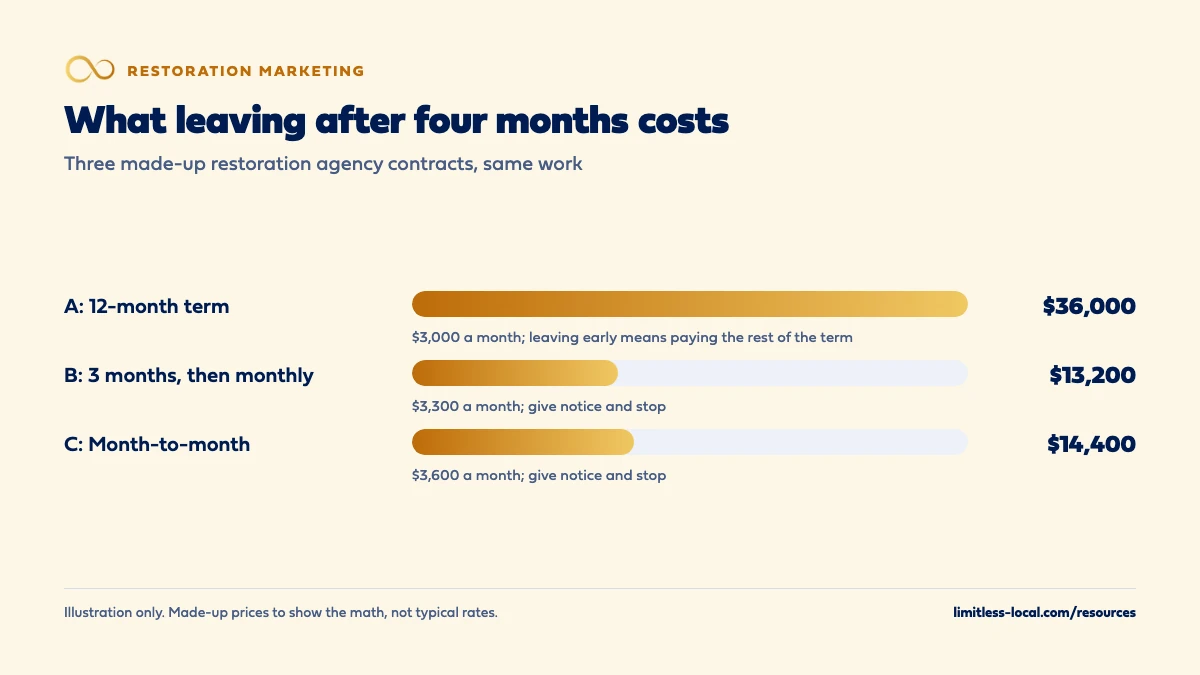
- A worked example: what leaving early costs under three contracts
- Frequently asked questions
- Key takeaways
- More in this section
- Sources
The short version
- There's no industry standard; quotes run from month-to-month to a year or more.
- Match any starting commitment to the slowest channel: weeks for ads, months for SEO.
- Read the early termination fee, auto-renewal and notice clauses before comparing prices.
- Whatever the length, your accounts and tracking numbers should leave with you.
For restoration owners comparing agency proposals who want to know which terms are reasonable and which ones make leaving expensive.
Get a free visibility audit · Book a growth call
What contract commitment should a restoration company accept from a marketing agency?
There’s no industry-standard contract length for restoration marketing; agencies offer anything from month-to-month to fixed terms of a year or more. A reasonable starting commitment is no longer than it takes the slowest channel you’re paying for to show results: weeks for ads, while SEO typically takes three to six months to show meaningful organic growth. What matters as much as the length is what leaving early costs, whether the term renews on its own, and whether your accounts and phone numbers stay with you when you go.
That’s the standard we hold ourselves to: we work without long-term contracts, month to month, so we earn the business every month, and the standard ask is three months written into the contract, but we won’t make you stay. You can see what each tier includes on our packages page, and how we work with water, fire and mold companies on our restoration marketing page. If you’re still deciding whether to hire an agency at all, the restoration marketing guide covers DIY versus hiring, and the rest of the restoration marketing questions library goes question by question.
What contract terms do restoration marketing agencies usually ask for?
There’s no published industry standard, so “normal” is whatever you’re quoted. In our judgement, most agreements fall into three shapes:
- Month-to-month. You give notice and stop. The agency earns the next month by producing this one.
- A short starting term, then monthly. A few months committed up front while tracking, your Google profile and campaigns get built, then month-to-month after that.
- A fixed term of a year or longer. Often with an early termination fee and sometimes an automatic renewal.
The length on its own tells you less than three other things: what leaving early costs, what happens to your accounts when you leave, and whether the term renews on its own. A short contract that keeps your phone numbers is worse than a longer one that hands everything back cleanly.
Is month-to-month realistic for restoration marketing?
Yes, for most of the work. Ads can generate leads within days of launch, so there’s little reason to lock in a long term for ads alone. Month-to-month also keeps the agency honest in a trade where one storm can make any month look good: if the work isn’t producing signed jobs in normal weeks, you can leave.
An agency asking for a short starting commitment isn’t necessarily a red flag, though. The first weeks go into setup that pays off later: call tracking, cleaning up your Google Business Profile and listings, building service and city pages, and getting ad campaigns through their first learning. A few months committed while that happens is a fair trade, as long as nobody is held against their will after it.
What matters more than the label is whether you could judge the agency by the time the commitment ends. Whether your agency is producing real jobs covers how to tell.
How long should the first commitment be?
No longer than it takes the slowest thing you’re paying for to show whether it works. That’s the threshold we’d use. Each channel has its own clock:
- Google Ads. Google says a new campaign’s Smart Bidding learning status lasts no more than 7 days, and that new campaigns without historical data may see performance swing until conversion data matures over your conversion cycle. For water damage calls that’s usually a matter of weeks, not months.
- Local Services Ads. Once verified, leads can start quickly; the setup, not the term, is the slow part.
- SEO. It typically takes 3-6 months to show meaningful organic growth, and nobody can honestly promise a date.
So for an ads-only engagement, a starting term much longer than a couple of months is hard to justify. For SEO and Google profile work, a starting term of a few months is reasonable. In our view, a fixed commitment well past six months is asking you to carry the agency’s risk, not share it.
Why would an agency want a year-long contract?
Usually to cover setup costs it would otherwise lose if you left early, and sometimes because SEO takes a while to pay off. Both are real costs. The question is whether a long term is the right way to cover them.
In our judgement, there are cleaner options. A separate, stated setup fee covers the up-front work without tying you to a year. A website build can have its own price and payment schedule. If an agency offers a lower monthly fee in exchange for a longer term, that can be a fair trade too, as long as you can still leave if it stops producing jobs.
Ask what the longer term buys you. If the answer is only “it takes time,” the agency is asking for patience it hasn’t earned yet.
What should the cancellation clause say?
It should tell you exactly how to leave:
- Notice. How much, delivered how (email is easiest), and counted from when.
- Final bill. What you owe for the last period, and that there’s no charge to get your own accounts back.
- Handover. Admin access to the ad account, primary ownership of your Google profile, website files and logins, the domain, tracking numbers, call recordings and reports, by a set date.
- Access removal. The agency removes its own users once you confirm everything works without them.
The handover list matters because platforms don’t read contracts. Google says a client Google Ads account still owns its data and can remove a manager by unlinking it, and that only profile owners can add or remove people on a Google Business Profile. If those are already set up in your name, the clause is a formality. Who owns your accounts when you fire an agency walks through each one.
Curious what your marketing is actually booking?
Get a free visibility audit — no obligation, no sales pitch.
What clauses make a short contract act like a long one?
- Early termination fees equal to the rest of the term. That turns a bad month into a bad year.
- Automatic renewal into another full term. If it renews, it should roll to month-to-month.
- Long notice windows. A notice period that has to land months before the end date is easy to miss.
- Exit fees for your own accounts, or a website you can only keep by paying a buyout that isn’t written down.
- Price increases mid-term without your written OK.
Any one of these can make a “three-month” agreement as hard to leave as a year-long one. Read them before you compare monthly prices.
Does the contract cover my ad spend too?
It shouldn’t lock it in. Ad spend is money you pay Google; the contract covers the agency’s fee. The cleanest setup is ads running in your own Google Ads account, billed to your card, so the fee and the spend are separate lines and you control the spend.
That also gives you flexibility a contract can’t take away. Google’s page on pausing a campaign says pausing is temporary, stops further charges, and keeps all settings and history, so you can resume later. A slow month can mean less ad spend even if the management fee stays the same.
Ask how the fee works when spend changes. Some agencies charge a flat fee, some a share of spend, and some a minimum. Each is fine if it’s written down; problems start when it isn’t.
How do storm seasons and slow months fit into a contract?
Look at where the dates fall. A term that starts in a quiet month and needs notice in the middle of a busy freeze or storm stretch makes switching agencies almost impossible when it matters most. In our judgement, a contract should let you give notice at any time, and a switch should be planned for a quieter stretch.
Also think about what you’ll judge the agency on. A storm month can flood the phones whatever the agency did, and a dry month can quiet them. If the starting term ends right after a storm, it may look like a success; if it ends in a dry spell, it may look like a failure. Compare like months with like months before you decide. Marketing during storm season covers how to plan spend around the weather.

Are call tracking and software on the same contract?
Often not, and they’re worth checking separately. Call tracking, review tools and scheduling software may sit in the agency’s own accounts, on the agency’s terms, even when your agreement with the agency is month-to-month.
CallRail, a widely used call tracking tool, is an example of why it matters. Its account closing page says it doesn’t require long-term contracts and any administrator on the account can close it at any time, and that if the numbers are deactivated on closing they’re released and can’t be recovered. If that administrator is the agency, the agency controls what happens to the numbers on your vans and Google profile.
So ask, for each tool: whose account is it, what does it cost, and what happens to it when you leave. If you want to see what each tool should be producing, tracking which marketing brings in booked jobs lays out the setup.
What should I ask an agency before I sign?
Google’s advice on hiring an SEO suggests asking what results to expect and in what timeframe, how success is measured, and checking references by asking past clients whether the company was useful and easy to work with. It also says no one can guarantee a #1 ranking on Google, and to be careful with any company that won’t clearly explain what it intends to do. For a restoration company, add:
- What will I have to show for the starting term, in signed jobs and in finished work?
- What exactly does leaving cost, and what notice do you need?
- Does the term renew, and into what?
- Whose name will the ad account, Google profile, domain and tracking numbers be in?
- If the results aren’t there at the end of the starting term, what will you tell me?
A good agency answers these in writing without hesitation. This is general guidance for owners, not legal advice; on a long or large agreement, a business attorney’s review is worth the cost.
When does a longer commitment make sense?
When it buys you something specific and you keep a way out. In our judgement, a longer term can be reasonable if it comes with a clearly lower monthly price, an included website build you’d otherwise pay for separately, or work you’ve already seen this agency do well. Even then, the contract should let you leave for non-performance with reasonable notice, and every account should already be in your name.
It rarely makes sense when you haven’t worked with the agency before, when the work is mostly ads, or when the main argument for the term is that results take time. Time is a reason for patience, not for a penalty.
Not sure which of these is costing you jobs?
A free visibility audit checks the Google profile, reviews, site and tracking, and shows what to fix first.
What's different about agency contracts for restoration companies
Weather can flatter or hide results. A contract that ends right after a storm or a freeze will look like a success almost regardless of the agency. Judge the work on normal weeks and on signed jobs, not on the busiest month.
Your emergency line can’t go quiet. If a contract dispute ends with tracking numbers switched off, water damage callers hear a dead line. Make sure no clause lets numbers be released while the contract is being wound down.
Insurance-paid jobs pay late. If you judge the agency on money collected during a short starting term, slow insurance payments can make good work look weak. Judge the starting term on signed jobs, and on collected value once those jobs have paid.
Relationship work isn’t the agency’s. Referral, program and repeat accounts shouldn’t count toward the results that decide whether you renew.
A worked example: what leaving early costs under three contracts
These numbers are made up to show the math, not typical prices. Three agencies quote a restoration company for the same work, and four months in, the signed jobs aren’t there and the owner wants out.
- Contract A: $3,000 a month on a 12-month term, and leaving early means paying the rest of the term. Paid so far: 4 × $3,000, or $12,000. Leaving adds the remaining eight months, another $24,000. Total: $36,000.
- Contract B: $3,300 a month, three months committed, then month-to-month. Paid so far: 4 × $3,300. The owner gives notice and stops. Total: $13,200.
- Contract C: $3,600 a month, month-to-month from day one. Total: $14,400.
The cheapest monthly price was by far the most expensive way to find out the work wasn’t working, which is why the exit terms belong in the price comparison. Between B and C, the difference is small; what should decide it is what each agency does with your accounts on the way out.
For reference, our Essentials package is $3,500 a month, with ad spend paid to Google separately; whether it’s worth it comes down to cost per signed job, which is what a free visibility audit is for.
Frequently asked questions
Is a three-month minimum normal for a restoration marketing agency?
It’s one of the shapes you’ll see quoted, and in our view a fair one when the first weeks go into setup. What matters is what happens after it: the agreement should move to month-to-month rather than renew into another fixed term.
What's a reasonable notice period?
Short enough that you can give it any time and be out within about a month, in our judgement. Be wary of notice windows that have to land well before an end date, because they’re easy to miss.
Does month-to-month cost more per month?
Sometimes. An agency may price a longer term lower. Compare the total cost of leaving after a few months under each option, not just the monthly fee.
Can an agency keep my accounts until I pay an early termination fee?
It depends on whose name the accounts are in and what you signed. Google says a client Google Ads account owns its data and an admin can unlink a manager. Accounts already in your name are much harder to hold back. For a dispute, ask a business attorney; this page isn’t legal advice.
Should the contract promise a number of leads or rankings?
No. Google’s hiring advice says no one can guarantee a #1 ranking on Google. A contract can promise what the agency will do and report, not what Google or customers will do.
Can I pause marketing in a slow month without breaking the contract?
You can usually lower or pause ad spend in your own Google Ads account, since Google says pausing keeps your settings and history. Whether the management fee pauses too depends on the contract, so ask before you sign.
Key takeaways
- There’s no industry-standard term; quotes run from month-to-month to a year or more.
- Keep any starting commitment no longer than the slowest channel needs: weeks for ads, three to six months for SEO.
- Early termination fees, auto-renewals and long notice windows can make a short contract act like a long one.
- Keep ad spend in your own Google Ads account, separate from the agency’s fee.
- Compare what leaving early would cost under each proposal, not just the monthly price.
- Whatever the length, the ad account, Google profile, domain and tracking numbers should stay yours.
Want a second set of eyes on your setup?
We'll look at how you show up locally and where calls are leaking, then send you a plain-English breakdown.
More in this section
- Is my restoration marketing agency producing real jobs?
- How should a restoration company market to real estate agents?
- How should a restoration company market to commercial properties?
- How should a restoration company handle marketing during storm season?
- How do I keep marketing steady while hiring restoration techs?
Sources
- Do you need an SEO? — Google Search Central
- About Smart Bidding learning — Google Ads Help
- Enable, pause, or remove a campaign — Google Ads Help
- Manager Accounts (MCC): About ownership of client accounts — Google Ads Help
- Manage your Business Profile owners & managers — Google Business Profile Help
- Close my account — CallRail Help Center