
How should an HVAC company reply to Google reviews?

- What should an HVAC company say when replying to good, bad and unfair Google reviews?
- Should an HVAC company reply to every Google review?
- What happens after I post a reply?
- How should I reply to a five-star review?
- Should I mention the service or the town in my replies?
- How should I reply to a fair negative review?
- How should I reply to a negative review that isn't fair?
- What if the review is from someone who was never a customer?
- What should never go in a reply to a review?
- Can I ask a customer to update their review after I fix the problem?
- Who should write the replies, and how fast?
- Do review replies help my HVAC company show up on Google?
- What's different for HVAC companies
- A worked example: one week of HVAC review replies
- Frequently asked questions
- Key takeaways
- More in this section
- Sources
The short version
- Keep replies short, polite and specific to the job.
- For complaints: apologize where it's fair, explain what you can't control, and take the details offline.
- Never share a customer's private information or offer anything to change a review.
- Report only reviews that break Google's policies, not ones you simply disagree with.
For HVAC owners and office managers who answer the reviews themselves and want wording that works for five-star thanks, fair complaints and reviews from people who were never customers.
Get a free visibility audit · Book a growth call
What should an HVAC company say when replying to good, bad and unfair Google reviews?
Reply to Google reviews briefly, politely and specifically: thank happy customers with a detail from their job, and answer complaints by owning what went wrong, explaining what you couldn’t control and inviting the customer to call or email so you can sort it out privately. Google’s own tips say to keep replies short, skip promotions, never share a reviewer’s private information and respond promptly. Report a review only if it breaks Google’s content policies, and never offer a discount or anything else to get a review changed or removed.
Replies are one half of a review habit; the other half is asking every customer. Review response and review generation are part of our local SEO work for HVAC companies, alongside the rest of your Google profile. The HVAC marketing guide shows where reviews fit with ads and your website, and the HVAC marketing questions library covers the rest one question at a time.
Should an HVAC company reply to every Google review?
Reply to every negative or mixed review, and to as many positive ones as you can say something real about. Google’s review tips call replying to reviews and sharing your perspective a best practice, and say replies show customers that their feedback matters.
Google also warns against one thing many companies do: sending the same “thank you” to everyone. It suggests focusing on reviews where you can share a helpful update or answer a question, because that shows you’re listening. In our judgement, a five-star review that just says “great service” can get a one-line reply, but it should still be written for that customer, not pasted.
What happens after I post a reply?
A few things owners don’t always know:
- You have to verify your Business Profile before you can reply at all.
- Google checks each reply against its content policies. Replies usually take up to 10 minutes to review, but sometimes it can take up to 30 days, and if a reply isn’t approved you’ll be asked to edit it.
- Approved replies post publicly under the review as your business. Your personal name isn’t shown.
- The customer gets a notification, and can still change their review after reading your reply.
- You can edit or delete your reply later from the same Read reviews screen.
That last point about notifications matters most. Every reply is read by the reviewer first and by future customers second, so write it for both.
How should I reply to a five-star review?
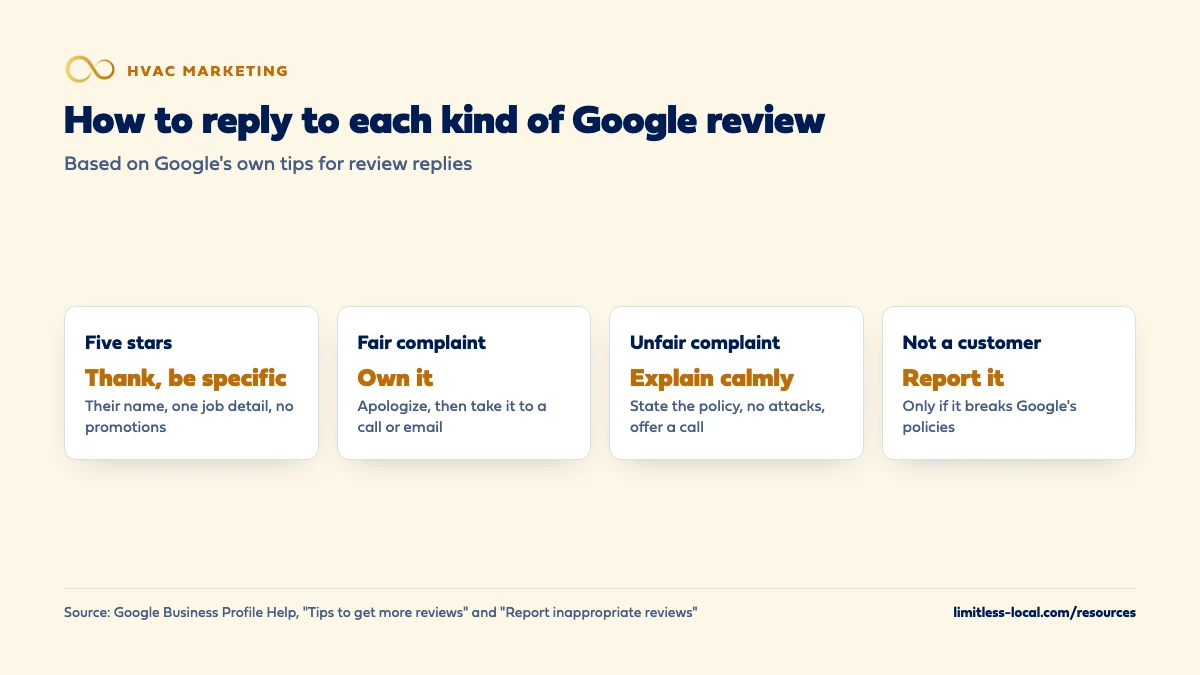
Short, warm and specific. Google’s tips say to be conversational, not promotional: your reviewers are already customers, so skip the deals and share a detail that reinforces their experience. Its tips for negative reviews also suggest addressing the reviewer by name and signing off with your name or initials, and in our judgement that works just as well for a thank-you.
Example wording, with made-up names:
Thanks, Dana. Glad Luis could get the AC running again the same afternoon, especially in that heat. We’ll see you for the spring tune-up. Mike, owner
In our judgement, three things make a positive reply work: the customer’s name, one true detail from the job, and a sign-off from a real person. Leave out the phone number, the coupon and the line about being the best HVAC company in town.
Should I mention the service or the town in my replies?
Mention the job when it’s natural, and don’t force it. Google says customers reviewing a service business may be asked to pick which job you did, from your service list, your website or a standard list for your type of business, and that selection shows in the review. So the review may already say “AC repair” or “furnace installation” next to the stars.
Google doesn’t say that adding service or town names to replies helps your ranking. In our judgement, a reply like “thanks for trusting us with the heat pump install” reads fine, but a reply packed with “best AC repair in town” reads like an ad, and Google’s tips say to keep replies conversational, not promotional. If you’re working on showing up in more towns, how an HVAC company shows up in near-me searches covers what actually drives that.
How should I reply to a fair negative review?
When the customer has a point, say so. Google’s tips for negative reviews are to apologize when appropriate, acknowledge mistakes, address the reviewer by name, respond promptly, and for anything complicated, ask them to contact you by phone or email so you can resolve it privately.
Example wording, with made-up names:
Jim, you’re right that we missed the window we gave you on Tuesday, and I’m sorry. That’s on us, and you shouldn’t have had to call twice to find out. I’d like to make it right. Please call or email the office and ask for me directly. Mike, owner
Google notes that constructive replies and following up on concerns can show you care and may even encourage the customer to update their review. In our judgement, the reply is for future customers as much as for Jim: one owned mistake, handled well, reads better than a wall of five-star reviews with no replies.
Curious what your marketing is actually booking?
Get a free visibility audit — no obligation, no sales pitch.
How should I reply to a negative review that isn't fair?
Stay factual and calm, and don’t argue. Google’s tips say to be honest and explain limitations: acknowledge any mistakes, but don’t take responsibility for things outside your control, and explain what you can and can’t do. They also say never to engage in personal attacks.
Example wording for a common HVAC complaint, with made-up names:
Thanks for the feedback, Carla. Our diagnostic fee covers the tech’s time to find the problem, and we quote it on the phone before booking so there are no surprises. I’m sorry it felt high, and I’m happy to go over the visit with you. Please call the office and ask for me. Mike, owner
In our judgement, the test for any reply to an unfair review is whether a stranger reading it would side with you. Explaining a policy passes. Correcting the customer point by point, or hinting they’re lying, doesn’t, even when you’re right.
What if the review is from someone who was never a customer?
Check your job software first: search the name, phone number and address you have. If there’s no match and the review looks like spam, a competitor or an attack, you can report it. Google says you can report any review, but only those that break its policies are eligible for removal, and you shouldn’t report a review just because you disagree with it. Evaluation typically takes several days, and if Google finds no violation, you can submit a one-time appeal.
In our judgement, also post a short, calm reply while you wait, such as: “We can’t find a record of working with you under this name. If we did, please call the office so we can look into it.” If someone is demanding money to stop posting bad reviews, or several land at once, recovering after a run of bad reviews covers Google’s extortion report and the rest of the cleanup.
What should never go in a reply to a review?
- The customer’s private information. Google’s tips say never to share a reviewer’s private information. In our judgement, for an HVAC company that includes the address, what you saw in the house, the equipment details and what they paid.
- Personal attacks or sarcasm, which Google’s tips also rule out.
- Offers or deals. Google’s tips say to avoid using replies for promotions.
- Anything in exchange for changing the review. Google says offering incentives, like free or discounted services, for customers to post, change or remove reviews is strictly prohibited.
- A long argument. Google’s tips say people may stop reading a long reply before they reach the main point.
Can I ask a customer to update their review after I fix the problem?
You can ask, as long as nothing is offered in return. Google says customers can change their review after reading your reply, and that following up on concerns may encourage them to update it. What it prohibits is an incentive, such as a free or discounted service, to change or remove a negative review.
In our judgement, fix the problem first, then send one plain message: you’re glad it’s sorted, and if they feel differently about the visit now, they’re welcome to update the review. Then leave it. A customer who feels pressured tends to write a second review, not a better one. The same no-incentive rule applies when your techs ask for new reviews, which getting your HVAC techs to ask for Google reviews covers.
Who should write the replies, and how fast?
Google’s tips say a prompt response shows you value your customers’ feedback, but they don’t set a deadline. In our judgement, aim for within a business day or two, and give the job to one person: the owner, or an office manager who knows the jobs and can make a call to fix one. Techs shouldn’t reply from their phones in the driveway.
Local Services Ads use the same reviews. Google says reviews for Local Services Ads are managed in your Business Profile, not the ads account, and that star ratings and number of reviews affect how your business ranks within Local Services Ads. One person working one queue covers both.
Do review replies help my HVAC company show up on Google?
Google doesn’t say replies raise your ranking. In its local ranking tips, it says replying to reviews shows you value customers’ feedback, and that positive reviews and helpful replies can help your business stand out. The ranking input it names is the reviews themselves: more reviews and positive ratings can help your local ranking.
So think of replies as working on the homeowner deciding whether to call, not on Google’s ranking. How much Google reviews affect calls to your HVAC company looks at that side in more detail.
Not sure which of these is costing you jobs?
A free visibility audit checks the Google profile, reviews, site and tracking, and shows what to fix first.
What's different for HVAC companies
Price complaints are usually about fees and replacements. In our judgement, the negative reviews HVAC companies see most are about diagnostic or trip fees and replacement quotes. Explain the policy once, calmly, and offer a call. Don’t put the customer’s quote or invoice amount in the reply.
Peak-season waits are outside your control, partly. A customer who waited three days in July has a real complaint even if every company was booked out. Google’s tips suggest acknowledging mistakes without taking responsibility for things outside your control; say what you did about it, like keeping a waitlist or calling ahead.
Parts delays. When a repair stalls on a back-ordered part, the reply can explain the delay plainly without blaming the customer or naming the supplier.
Techs mentioned by name. When a customer praises a tech, thanking that tech by first name is natural. Leave out last names and anything else personal.
A worked example: one week of HVAC review replies
These numbers are made up to show the routine, not a benchmark. Say your company gets nine new reviews in a busy July week:
- Six five-star reviews. Each gets a one- or two-line reply with the customer’s name and one detail from the job.
- One four-star review that mentions a late arrival. It gets a thank-you and a short apology for the wait.
- One two-star review about the diagnostic fee. It gets the calm, factual reply from the section above, and the office calls the customer the same day.
- One one-star review from a name that isn’t in your job software. It gets reported for policy review and a short “we can’t find a record” reply.
Done by one person who knows the jobs, that’s about 20 minutes for the week. If you’d rather hand it off, review response and basic review generation are included in our Essentials package at $3,500 a month, along with Google Business Profile management for one location.
Frequently asked questions
Can I delete a bad Google review?
No. You can report it, but Google removes only reviews that break its content policies, and it says it doesn’t get involved in disagreements between businesses and customers.
Can I edit a reply after I post it?
Yes. Google lets you edit or delete your reply from the Read reviews screen in your Business Profile.
Will the customer see my reply?
Yes. Google notifies the reviewer when you reply, and the reply is public under their review.
Should I use templates for review replies?
A loose structure is fine, but Google’s tips warn against sending the same “thank you” to everyone. In our judgement, keep a few openings handy and add one detail from each job.
Should I reply to reviews that only have stars and no text?
Google doesn’t set a rule. In our judgement, a one-line thank-you is enough, and your time is better spent on reviews where you can add something.
Can I put my phone number in a reply?
Google’s business guidelines allow your own business contact information in replies to reviews. In our judgement, ask the customer to call the office instead of pasting the number into every reply, which reads like an ad.
Key takeaways
- Reply to every negative or mixed review and to positive ones you can say something specific about.
- Keep replies short, polite and free of offers, and sign them with a real name.
- For fair complaints, own the mistake and move the fix to a call or email.
- Never share a customer’s private details or offer anything to change a review.
- Report only reviews that break Google’s policies; disagreeing with one isn’t enough.
Want a second set of eyes on your setup?
We'll look at how you show up locally and where calls are leaking, then send you a plain-English breakdown.
More in this section
- How do I get my HVAC techs to ask customers for Google reviews?
- How many Google reviews does my HVAC company need?
- How much do Google reviews affect calls to my HVAC company?
- What can I do myself to improve my HVAC company's Google ranking?
- How do I recover after a run of bad reviews on my HVAC company?
Sources
- Manage customer reviews — Google Business Profile Help
- Tips to get more reviews — Google Business Profile Help
- Report inappropriate reviews on your Business Profile — Google Business Profile Help
- About reviews for service businesses — Google Business Profile Help
- Tips to improve your local ranking on Google — Google Business Profile Help
- Reviews and Ratings on Local Services Ads — Local Services Help
- Guidelines for representing your business on Google — Google Business Profile Help