
What should an electrician check weekly to see if SEO is working?

- What should I track each week to know if SEO and my Google profile are working?
- Is it worth checking SEO every week?
- Did the phone ring from search and your Google profile?
- How many of those calls turned into booked jobs?
- What does your Google Business Profile performance show?
- What does Search Console say about your website?
- Did anything break this week?
- Did new reviews come in, and did you reply?
- Why shouldn't I judge SEO by searching Google myself?
- What should I look at monthly instead of weekly?
- Which weekly numbers mean SEO is working, and which don't?
- What should I do if the numbers drop for a week?
- What's different about tracking SEO for an electrician
- A worked example: a month of weekly checks
- Frequently asked questions
- Key takeaways
- More in this section
- Sources
The short version
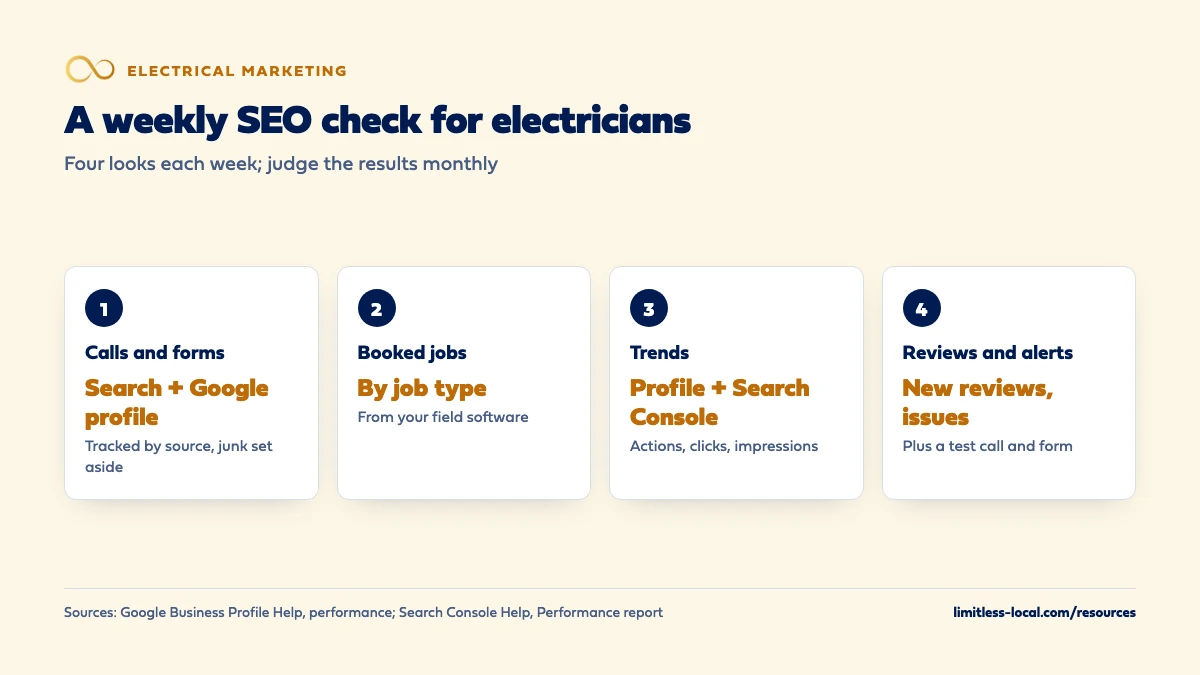
- Weekly: calls and forms from organic search and your Google profile, with junk set aside.
- Weekly: how many of those turned into booked jobs, by job type.
- Weekly: direction in Business Profile actions and Search Console clicks and impressions.
- Monthly, not weekly: cost per booked job, and whether SEO is paying off.
For electrical contractors paying for SEO, or doing it themselves, who want a short weekly check that shows whether it’s heading the right way before the monthly numbers come in.
Get a free visibility audit · Book a growth call
What should I track each week to know if SEO and my Google profile are working?
Each week, an electrician should check four things: tracked calls and form requests from organic search and the Google Business Profile, how many of those became booked jobs, the trend in Business Profile actions and Search Console clicks and impressions, and new reviews and any Search Console alerts. Those show direction and catch broken tracking early, but a single week is too noisy to judge SEO by. Judge it monthly on booked jobs and cost per booked job, and give it months, not weeks, because Google says some changes can take several months to show.
That’s how we report to owners: every package includes call tracking with recording and transcription, form and chat lead tracking, source tagging, a real-time dashboard you can check any week, and monthly reports with a cost-per-lead breakdown. We’re also straight about the ramp: SEO typically takes 3-6 months to show meaningful organic growth. Our local SEO page explains the work behind those numbers, our electrical contractor marketing page shows how it fits with ads for electricians, and the rest of the electrical marketing questions library goes question by question.
Is it worth checking SEO every week?
Yes, as long as you know what a weekly check is for. It isn’t for deciding whether SEO works. Google’s SEO starter guide says some changes might take effect in a few hours and others could take several months, and that you likely want to wait a few weeks to assess whether a change helped. A week of numbers is too short for that.
A weekly check is for two other jobs: catching problems early, like a tracking number that stopped forwarding or a contact form that broke, and seeing which way things are heading. The verdict comes monthly, on booked jobs. If you want the reasons SEO is slower than ads, why SEO takes longer than Google Ads for electricians covers them.
Did the phone ring from search and your Google profile?
Start with calls and forms, because that’s where SEO turns into work. To count them by source, you need a separate tracking number for each place a customer can find you. CallRail describes source tracking as using a unique tracking number for each campaign you want to track, all forwarding to your main business number, and lists organic search from Google and Bing among the sources it can track.
Your Google Business Profile deserves its own number, because in our judgement, for many electricians it brings in more calls than the website does. CallRail’s help page on using it with your Business Profile says you can show a tracking number as the main number on your listing while keeping your main business number on the profile as an additional number. Each week, write down two counts: real calls and forms from organic search, and real calls and messages from the Business Profile. Leave out spam, sales calls and existing customers. If you don’t have separate numbers yet, whether an electrical business needs call tracking numbers covers the setup.
How many of those calls turned into booked jobs?
This is the number that matters, and it lives in your field software, not in Google. Mark each call or form from organic search or your profile as booked or not, and note the job type: service call, panel upgrade, EV charger, generator or commercial. A week with fewer calls but two more panel upgrades booked can be a better week.
Expect the counts to be small and jumpy for a single week. In our judgement, the useful habit is writing them down every week so the monthly total is accurate, not reacting to each one. Tracking which electrical marketing brings in real jobs shows how to set up lead sources and job types so this takes minutes.
What does your Google Business Profile performance show?
Open the Performance view on your Business Profile and set the date range to the last week. Google says it shows how many people viewed your profile on Search and Maps and the actions they took, including calls (taps on your call button), website clicks, direction requests and messages. Compare each number with the week before and the same week a month ago.
Three details keep you from misreading it:
- It includes your ads. Google says performance data includes views, searches and actions from both organic results and Google Ads, so if you run ads, a jump in calls here isn’t all SEO.
- Views are unique people. A person is counted once a day, however many times they look, so views can read lower than you expect.
- The searches list is monthly. The search terms people used to find you update at the start of each month and can take up to 5 days to show, so check them monthly, not weekly.
What does Search Console say about your website?
Google Search Console is free, and its performance report shows clicks, impressions, click-through rate and average position for your site in Google Search. You can switch the chart to a weekly view, which Google says smooths out daily ups and downs, like weekends or holidays, so you can focus on overall growth or decline. The newest data can be preliminary and may change over the next few hours, so don’t read too much into the last day.
Each week, look at three things: total clicks, total impressions, and the Queries tab. In the queries, look for the job types and towns you want, such as panel upgrade, EV charger installation or generator installation plus your town names. In our judgement, impressions growing for the right job types and towns is one of the earliest signs SEO is moving, often weeks before the extra calls show up.
Curious what your marketing is actually booking?
Get a free visibility audit — no obligation, no sales pitch.
Did anything break this week?
A weekly check catches the problems that quietly cost calls. Search Console sends alerts when Google finds indexing, spam or other issues on your site, so read anything it flags. Then do two quick tests yourself:
- Call the tracking number on your Business Profile and the one on your website and make sure each rings through to whoever answers.
- Submit your website’s contact form and check that the request lands where it should, in your inbox or your field software.
In our judgement, these tests take a few minutes and catch the most expensive kind of SEO problem: one where the rankings are fine but the calls never reach you.
Did new reviews come in, and did you reply?
Count new Google reviews each week and reply to them. Google lists relevance, distance and popularity as the main factors in local results and says more reviews and positive ratings can help your local ranking. A steady weekly trickle is the goal, because a profile whose newest review is months old looks quiet to customers comparing electricians.
If reviews only come in when someone remembers to ask, fix that first; automating Google review requests after each job covers how to do it within Google’s rules.
Why shouldn't I judge SEO by searching Google myself?
Because what you see isn’t what your customers see. Google’s Search Console help says search results are specific to the time, place, device and recent history of the person searching. For Maps, distance is one of the three main factors, so the electrician who shows up first from your shop may not be first from the town you most want work in.
Use Search Console’s average position and impressions for your website, and check Maps from the towns you actually serve. If a competitor keeps appearing above you, why a competitor electrician ranks above you on Google Maps walks through how to tell what they’re winning on.
What should I look at monthly instead of weekly?
The decisions. Once a month, add up the weekly counts and work out:
- Booked jobs from organic search and the Business Profile, by job type.
- Cost per booked job from SEO: what you paid for SEO that month divided by those booked jobs.
- The search terms list from your Business Profile, which only updates monthly.
- Month-over-month and year-over-year trends in Search Console, which matter more for seasonal work than week-to-week swings.
If someone else does your SEO, their monthly report should match your own counts. How to know if your electrical marketing agency is getting results lists what that report should show.
Which weekly numbers mean SEO is working, and which don't?
Think of the numbers as a chain that moves in order. In our judgement, it usually goes impressions first, then clicks, then calls and forms, then booked jobs. Early on, rising impressions for the right job types and towns are a good sign even if calls haven’t moved yet. Later, calls and booked jobs are the only numbers that count.
Some numbers look good and mean little: impressions for searches you don’t want, such as electrician jobs or DIY wiring questions; profile views with no calls; or an average position that improved because you started showing for a few easy, low-value searches. Average position is an average across every search you appeared for, so it can move without anything changing for the searches that bring work.
What should I do if the numbers drop for a week?
Check, don’t react. Run the break tests first: tracking numbers, forms and Search Console alerts. Then look for an ordinary explanation, such as a holiday, a stretch of mild weather, or a week your ads spent more and took some of the clicks. One down week with everything working is noise.
Act when the drop lasts several weeks, or when it shows up in booked jobs, not just impressions. Then the questions are bigger: did a competitor overtake you in your main towns, did your Business Profile change, or did something on your website change? Those are monthly conversations, with whoever does your SEO if it isn’t you.
Want to see where your company stands?
A free visibility audit shows where you show up on Google, Maps and AI answers, and what it's costing you in calls.
What's different about tracking SEO for an electrician
Urgent calls and planned jobs show up in different places. In our judgement, someone with no power tends to tap call on your Business Profile, while someone planning a panel upgrade or a generator is more likely to read your website and fill in a form. Watch both, or you’ll undercount one kind of work.
Job types matter more than totals. A week of small service calls and a week with two EV charger installs can have the same call count and very different revenue. Track the job type on every booked job.
Seasons move the baseline. Generator searches may rise before storm season and EV charger work may follow local car sales. Compare with the same weeks last year when you have the data, not just last week.
Commercial work rarely comes through search. Builder and property-manager work usually comes from relationships, so don’t count its absence against SEO.
A worked example: a month of weekly checks
These numbers are made up to show the math, not a benchmark for your market. Say your weekly checks count calls and forms from organic search and your Business Profile of 9, 11, 8 and 14 over four weeks, or 42 in the month. After setting aside spam, sales calls and existing customers, 30 are real leads, and 12 of those turn into booked jobs.
If you paid $1,500 that month for SEO (a made-up figure, not a quote), your cost per booked job from SEO is $1,500 divided by 12, or $125. On its own, that number tells you little. Next month you’ll compare it with the month before, with what a booked job is worth to you, and with what the same booked job costs from ads. That comparison, made month after month, is how you know whether SEO is working.
Frequently asked questions
How long should I wait before deciding SEO isn't working?
Months, not weeks. Google says some changes can take several months to show, and we tell owners SEO typically takes 3-6 months to show meaningful organic growth. Weekly checks are for spotting direction and problems in the meantime.
Do the calls in my Google Business Profile include calls from ads?
They can. Google says Business Profile performance data includes views, searches and actions from both organic results and Google Ads, so separate tracking numbers are the way to tell them apart.
Will a tracking number on my Google profile hurt my ranking?
CallRail says a tracking number on your Business Profile gives you lead data with no risk to your search position, and you can keep your main number on the profile as an additional number.
Should my SEO company send me a report every week?
A monthly report is normal for decisions. In our judgement, it’s more useful to have a live dashboard you can glance at any week, plus a monthly report on calls, booked jobs and cost per lead.
Why does Search Console show my site at a position I never see?
Average position is an average across every search your site appeared for, and Google says results vary by time, place, device and the searcher’s history. Your own search is just one of those.
Key takeaways
- Weekly checks are for direction and catching broken tracking; monthly numbers are for decisions.
- Count calls and forms from organic search and your Google profile separately, with junk set aside.
- Business Profile performance includes Google Ads activity, so don’t credit all of it to SEO.
- Impressions for the right job types and towns usually move before calls do.
- Judge SEO on booked jobs and cost per booked job, over months.
Not sure what's working right now?
Start with a free visibility audit: rankings, Google profile, reviews and tracking, checked against your service area.
More in this section
- What should I fix on my electrical website before investing in SEO?
- What happens to electrician calls if I stop paying for SEO?
- Why does SEO take longer than Google Ads for electricians?
- What should an electrician's website have to get more calls?
- How do I know if my electrical marketing agency is getting results?
Sources
- Understand your Business Profile performance & insights — Google Business Profile Help
- Performance report (Search results): Overview and basic setup — Search Console Help
- About Search Console — Search Console Help
- SEO Starter Guide — Google Search Central
- Tips to improve your local ranking on Google — Google Business Profile Help
- Source tracking basics — CallRail Help Center
- Using CallRail with Google My Business — CallRail Help Center