
How much should an HVAC company spend on Local Services Ads?

- What's a sensible monthly Local Services Ads budget for an HVAC company?
- How does a Local Services Ads budget work for HVAC now?
- What am I paying for with each lead?
- How do I work out a starting LSA budget?
- Where do I find what an LSA lead costs in my area?
- Is there a minimum Local Services Ads budget?
- How does my profile affect what I pay per lead?
- How should my capacity cap the budget?
- Should repair, maintenance and replacement leads get separate budgets?
- How should my LSA budget change with the seasons?
- How does LSA spend fit with my Google Ads budget?
- What's different for HVAC companies
- A worked example: setting an HVAC LSA budget
- Frequently asked questions
- Key takeaways
- More in this section
- Sources
The short version
- Work the budget backward from booked jobs, not from a round number.
- Lead prices vary by location, job type, lead type and bidding.
- Google's bidding help recommends at least 10 leads a week for Maximize leads.
- After the move to Google Ads, monthly spend is capped at daily budget times 30.4.
For HVAC owners setting or resetting a Local Services Ads budget, now that the ads are moving into Google Ads with daily budgets instead of weekly ones.
Get a free visibility audit · Book a growth call
What's a sensible monthly Local Services Ads budget for an HVAC company?
An HVAC company should spend on Local Services Ads what it takes to get the booked jobs it can actually run, at a cost per booked job its margins can carry: booked jobs wanted, divided by how many leads book, times what a lead costs in your market. Google’s Local Services bidding help recommends a budget of at least 10 leads per week for its Maximize leads setting, and its help on leads says prices vary by location, job type, lead type and bidding, so there’s no honest national figure. Once your account moves into Google Ads, the budget is daily, and a month’s spend is capped at your daily average budget times 30.4.
That booked-job math is how we set Local Services Ads budgets for HVAC companies, too. Local Services Ads management is part of our local ads work from the Growth tier up, and the ad spend itself is paid to Google directly, separate from our fee. The HVAC lead generation guide compares every channel that brings in calls, and the rest of the HVAC marketing questions library goes one question at a time.
How does a Local Services Ads budget work for HVAC now?
In the original Local Services Ads dashboard, you set an average weekly budget. Some weeks you’d spend less and some more, but never more than a monthly max of your weekly budget times 30.4, divided by 7. Once you hit it, your ad stops showing for the rest of the month unless you raise the budget.
That’s changing. Google is moving Local Services Ads into Google Ads as Performance Max campaigns with pay-per-lead goals, and HVAC is named in the first phase, which began in August 2026 for select advertisers. On transition day, your weekly budget is divided by 7 to set a daily average budget, and Google says your monthly spend is capped at that daily budget times 30.4, the average number of days in a month. Daily spend may run higher on busy days, but the month won’t pass the cap. You still pay per valid lead, not per click. Whether Google Local Services Ads are worth it for HVAC covers the rest of the change.
What am I paying for with each lead?
Google charges for valid leads: a call you answer or return and speak on, a call you miss during business hours where the caller stays on the line for more than 20 seconds, a text or email, a voicemail, or a booking request. Leads it judges invalid or low quality when they first come in aren’t charged, and it keeps assessing charged leads over a 30-day period, crediting ones it finds poor quality, duplicate or invalid.
Google says lead prices may vary depending on your location, the job type, the type of lead and your bidding mode, and that message leads are typically priced lower than phone leads, though not always. Every lead you receive counts toward the budget. That’s why the budget question is really two questions: how many leads you want, and what they cost where you work.
How do I work out a starting LSA budget?
Work backward from the schedule, not forward from a round number:
- Booked jobs wanted per month from Local Services Ads, given the techs and hours you have.
- Divide by your booking rate: the share of leads that turn into a booked job. If you don’t know it, your call records or job software are the place to find it.
- Multiply by your cost per lead to get a monthly budget.
- Divide by 30.4 for the daily average budget Google Ads asks for.
Then check the answer against what each booked job earns. In our judgement, if the cost per booked job that falls out of the math is more than a typical job can carry, the fix is the booking rate or the job mix, not a bigger budget. What cost per booked call an HVAC company should aim for walks through setting that ceiling.
Where do I find what an LSA lead costs in my area?
From your own account, after the ads have run. There’s no reliable national HVAC lead price, because Google sets prices by market, job, lead type and bidding. Once your campaign is in Google Ads, the Cost / conv. column shows your average cost per lead, because conversions there are the leads you were charged for.
Give it time before you trust the number. Google’s Local Services bidding help says it takes about 2 weeks to see accurate results as the bidding model adjusts and learns about your business, and its migration notes say to allow up to two weeks after migration for performance to settle. In our judgement, set a test budget for the first month, read cost per lead and booking rate at the end, then set the real budget from those numbers.
Curious what your marketing is actually booking?
Get a free visibility audit — no obligation, no sales pitch.
Is there a minimum Local Services Ads budget?
Google doesn’t publish a hard minimum, but its Local Services bidding help says it’s recommended to set a minimum budget of 10 leads per week for optimal results with Maximize leads, its recommended automated bidding mode. That guidance was written for the original Local Services Ads dashboard, so check the recommendation in your Google Ads account once you’ve moved.
In our judgement, the practical floor is the budget that buys enough leads to judge. If a budget buys only a handful of leads a month, a single good or bad week swings your cost per booked job so much that you can’t tell whether the channel works.
How does my profile affect what I pay per lead?
More than most owners expect. Google says Local Services Ads are ranked by an auction that weighs your bid against how likely your ad is to produce a lead, and that likelihood depends on your responsiveness, how relevant your services are to the search, and profile quality: rating, number of reviews, response time, good photos and completed verification checks. Google adds that higher-quality profiles may rank higher and may also pay lower costs per lead.
So the same budget can buy different results for two HVAC companies in the same town. Missed calls may hurt your responsiveness, and message and booking leads can raise the chance of getting a lead at night and on weekends. Before raising the budget, in our judgement, check the profile.
How should my capacity cap the budget?
Spend only for leads you can answer and run. A lead nobody picks up still costs you once the caller has waited more than 20 seconds during business hours, and it may hurt your ranking. In the original dashboard, you could set the ad to run all day, only during business hours, or on custom hours; Google suggests running it when you can respond to calls in a timely manner. In Google Ads, ad schedules are in the campaign settings.
In our judgement, when the schedule is full for the next few days, lower the budget or pause rather than letting leads go cold. Google lets you pause a campaign at any time and set it back to Enabled when you want leads again.

Should repair, maintenance and replacement leads get separate budgets?
In our judgement, it’s worth thinking about, because a replacement lead and a tune-up lead are worth very different amounts. Google’s migration notes say Google Ads doesn’t support separate target costs per category inside one campaign: if you had different targets for different verticals, one campaign-level target is calculated and applied to all of them. To keep separate bidding rules, Google says to set up separate campaigns for each vertical.
For most single-location HVAC companies, the simpler move is to set job types carefully, track which kind of job each lead turned into, and judge the budget on the mix. Separate campaigns make sense when one line of work, such as commercial, needs its own budget.
How should my LSA budget change with the seasons?
Google lets you change the budget any time, as often as you like. In the original dashboard, a mid-month change resets what you can spend for the rest of the month based on the new weekly budget, regardless of what you’ve already spent. In Google Ads, the monthly cap follows the daily average budget.
In our judgement, the HVAC pattern is to raise the budget a few days before the first heat wave or cold snap, hold it while the schedule has room, and trim it in the shoulder months. How an HVAC company should scale up ads for peak season covers timing, and when to raise, lower or pause HVAC ad spend covers the signals to watch.
How does LSA spend fit with my Google Ads budget?
Treat them as two lines in one paid budget, each judged on cost per booked job. Local Services Ads charge per valid lead and show only on Google Search and Maps. Regular search ads work differently: in our judgement, the difference that matters is that you choose the searches and the landing page and typically pay by the click. Many HVAC companies, in our judgement, do well running both: LSAs for general repair calls and search ads for specific jobs like system replacements.
When you have more to spend, put the next dollar where the cost per booked job is lowest and the schedule still has room. How much an HVAC company should spend on Google Ads works through the search side, and whether to raise HVAC ad spend or fix conversion first covers what to check before a big step up.
Talk it through with someone who runs this every day
A 15-minute growth call: your market, your numbers, and what a realistic budget looks like. No pressure.
What's different for HVAC companies
Weather drives demand. In our judgement, the first hot week and the first cold week bring the most urgent searches of the year, and a daily budget set for April will cap you out early in July. Now that budgets are daily, raise them before the forecast turns.
After-hours calls. No-heat and no-cool calls come in at night. If nobody answers then, message leads give those customers a way to reach you, and Google says offering them can increase the chance of getting a lead on nights and weekends. Count those leads in the budget too.
Ticket size swings. A maintenance visit and a full system replacement can come through the same ad. In our judgement, a budget that looks expensive per lead can be fine if a steady share of leads turn into replacements, which is why tracking the job each lead became matters more for HVAC than for many trades.
A worked example: setting an HVAC LSA budget
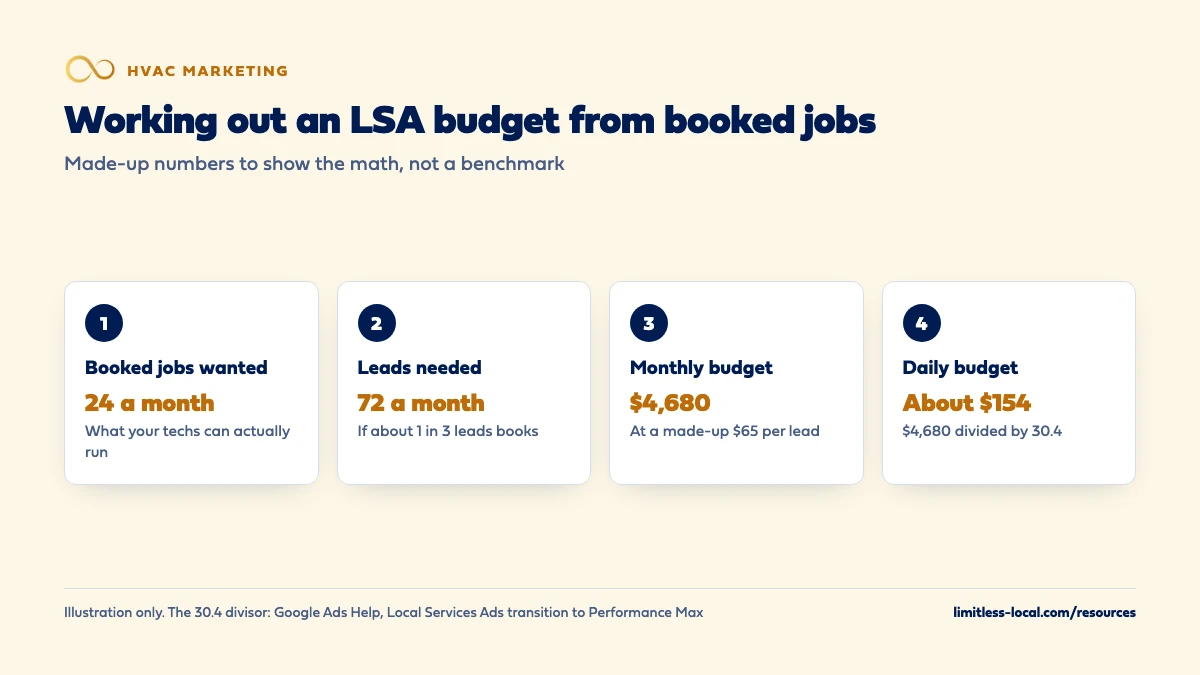
These numbers are made up to show the math, not a benchmark for your market. Say you want 24 more booked repair jobs a month from Local Services Ads, and about 1 in 3 of your leads books.
- Leads needed: 24 booked jobs times 3 is 72 leads a month, about 17 a week.
- Monthly budget: at a made-up $65 per lead, 72 leads cost $4,680.
- Daily budget: $4,680 divided by 30.4 is about $154 a day.
- Cost per booked job: $4,680 divided by 24 booked jobs is $195.
If your average repair ticket comfortably covers $195 plus the cost of doing the job, the budget works. If it doesn’t, raising the booking rate does more than spending more: at 1 in 2 instead of 1 in 3, you’d need 48 leads instead of 72. And about 17 leads a week is above the 10-a-week minimum Google’s bidding help recommends for Maximize leads.
For comparison, our Growth package, which includes Local Services Ads management and Google Ads management up to $5,000 a month in spend, is $4,500 a month, with ad spend paid to Google separately.
Frequently asked questions
Can I set a maximum price per lead?
Not after your account moves to Google Ads. Google says manual bidding, such as setting a maximum cost per lead, is no longer supported there; you can still adjust a target cost per lead for the campaign.
What happens when I hit my monthly LSA budget?
In the original dashboard, Google says your ad won’t appear for the rest of the month unless you adjust the budget. In Google Ads, monthly billing won’t pass the daily average budget times 30.4.
Do I pay for leads that turn out to be spam?
Google says leads it judges invalid or low quality when they first come in aren’t charged, and that it credits charged leads it later finds poor quality, duplicate or invalid, assessing them over a 30-day period.
Does a bigger budget get me ranked higher?
Your bid is one factor in the auction, alongside how likely your ad is to produce a lead, which depends on responsiveness, relevance and profile quality. A bigger budget alone doesn’t fix a weak profile or missed calls.
Is LSA ad spend included in an agency's monthly fee?
Not in our packages: ad spend is paid directly to Google, separate from the management fee. In our judgement, whoever you hire, the ad spend should show up on your own Google Ads billing.
Will my budget carry over when my account moves to Google Ads?
Google says your budget limits transfer automatically, with the weekly budget divided by 7 to set the daily average budget, and that this doesn’t affect your monthly spend.
Key takeaways
- Set the LSA budget from booked jobs wanted, booking rate and your own cost per lead.
- Lead prices vary by location, job type, lead type and bidding, so read your own Cost / conv. after a fair test.
- Google’s bidding help recommends at least 10 leads a week for Maximize leads.
- A stronger profile and faster answering can lower what you pay per lead.
- In Google Ads, monthly spend is capped at the daily average budget times 30.4.
Ready to compare options?
Book a short growth call and we'll walk through the math for your service area, including when we're not the right fit.
More in this section
- How much should an HVAC company spend on Google Ads?
- Are Google Local Services Ads worth it for an HVAC company?
- Should I pay an HVAC agency fee or spend more on ads?
- Should my HVAC company start with LSAs, Google Ads or SEO?
- Can a small HVAC company afford TV advertising?
Sources
- Local Services Ads transition to Performance Max campaigns with pay-per-lead goals — Google Ads Help
- How to edit your budget — Local Services Help
- How bidding works for Local Services Ads — Local Services Help
- How leads work — Local Services Help
- About ad rankings — Local Services Help
- About ad scheduling — Local Services Help