
How should a restoration company split ad spend and agency fees?

- How should a restoration company divide a fixed budget between ads and agency fees?
- What does a restoration marketing budget have to pay for?
- Is there a standard split between ad spend and agency fees?
- Which lines should a restoration company fund first?
- How much ad spend is enough to be worth managing?
- How do I compare a flat fee with a percentage-of-spend fee?
- Where does SEO fit in the split?
- How should a website fit into a monthly budget?
- What does a real package split between fee and ad spend look like?
- How should the split change as the budget grows?
- Who should own the ad accounts and pay Google?
- What's different about splitting a restoration budget
- A worked example: splitting $6,250 a month
- Frequently asked questions
- Key takeaways
- More in this section
- Sources
The short version
- Ad spend is paid to Google; management, SEO, website and tracking are separate lines.
- Fixed lines come first; ad spend is what's left, and it has to last all day.
- Compare fees by what they include, not by their ratio to ad spend.
- Judge the whole split on all-in cost per signed job.
For restoration owners with a set monthly number who need to know how much goes to Google, how much to whoever runs it, and what else has to fit.
Get a free visibility audit · Book a growth call
How should a restoration company divide a fixed budget between ads and agency fees?
Cover the fixed lines first (tracking, a website that turns visits into calls, and the management or SEO fee), then put what’s left into ad spend, and check that it’s enough to keep ads running all day in the towns you serve. There’s no standard percentage split between ad spend and agency fees, because a fee often covers SEO, the Google profile and reporting as well as ad management. Judge the split by the all-in cost per signed job, and if the ad spend left over is too thin to run all day, narrow the services or towns, or do more of the work yourself, rather than shaving every line.
We publish our split so you can do this math before talking to anyone. Essentials is $3,500 a month and manages Google Ads up to $2,500 in monthly spend for one location, along with local SEO, Google Business Profile management, content, review response and call, web and form tracking. Growth is $4,500 a month and adds Local Services Ads management, Google Ads up to $5,000 in spend and SEO for up to 2 locations. Ad spend isn’t included in any package; it’s paid to Google directly, and we recommend a budget after a quick audit. The packages page lists every line, and our restoration marketing page covers how we work with water, fire and mold companies. For the full channel picture, read the restoration marketing guide or browse the restoration marketing questions library.
What does a restoration marketing budget have to pay for?
Five lines, whether one company handles all of them or you handle some yourself:
- Ad spend (media). What you pay Google for clicks on search ads and for leads from Local Services Ads. It goes to Google, not to whoever runs the ads.
- Management. Building and running the campaigns: keywords, negative keywords, ads, bids, budgets and reporting.
- SEO and the Google profile. Service pages, the Business Profile, reviews, citations and content. Monthly work that doesn’t scale with clicks.
- Website. Usually a one-time build, plus hosting and updates. Often spread over a payment plan.
- Tracking. Call tracking numbers, form tracking and the lead source field in your job software.
A quote that shows one monthly number without saying which of these it covers isn’t comparable with anything. Before deciding on a split, write each line down separately, including the ones you’re doing yourself.
Is there a standard split between ad spend and agency fees?
No. The Small Business Administration’s guide to marketing budgets says there’s no hard and fast answer to how much a marketing budget should be and that the percentages businesses use vary widely; it suggests checking with your industry trade association or trade publications for benchmarks. There’s even less of a standard for how that budget divides between media and the people running it.
The bigger reason is that agency fees cover different things. One fee may pay only for running ads. Another may cover ads, SEO, the Google profile, content, review requests and tracking. Comparing the two by their ratio to ad spend makes the second one look expensive when it may be the cheaper way to get all five lines done.
In our judgement, the fair comparison is what each signed job costs once every line is counted. A split is right if it keeps leads coming every day and the all-in cost per signed job is one your margins can carry.
Which lines should a restoration company fund first?
In our judgement, fund them in this order, because each one makes the next one pay:
- Phone coverage and tracking. Emergency calls come at night. If they go unanswered or uncredited, every other line is partly wasted. Tracking is usually the smallest line; what call tracking costs a restoration company prices it.
- A website that turns visits into calls. A page for water damage, one for mold, one for fire, with your number at the top.
- Management and SEO. Done by you, an employee or an agency, but counted either way.
- Ad spend. What’s left. If it’s too small to run all day, change the plan, not the earlier lines.
Owners often do this in reverse: maximum ad spend, then whatever’s left for everything else. That’s how a company ends up buying clicks that land on a weak page and calls nobody can trace.
How much ad spend is enough to be worth managing?
Enough to keep ads running through the day and evening in the towns you serve. Google Ads budgets are daily: Google’s page on average daily budgets says to divide a monthly amount by 30.4 to get the daily budget, and that for most campaigns you won’t be charged more than two times the average daily budget in a day or 30.4 times it in a month.
Too little spend also slows Google’s automated bidding. Its Smart Bidding page lists low daily budgets among the very restrictive settings that can slow down campaign ramp-up. For Local Services Ads, Google’s bidding page recommends a minimum budget of 10 leads per week when you use Maximize leads.
If the ad spend left after fixed lines can’t cover a day of water damage searches in your core towns, in our judgement a management fee is hard to justify yet. Working out a restoration company’s monthly budget floor shows how to size that minimum from the jobs you need.
Curious what your marketing is actually booking?
Get a free visibility audit — no obligation, no sales pitch.
How do I compare a flat fee with a percentage-of-spend fee?
Convert both into dollars at the ad spend you’ll actually run, then list what each includes. Some agencies charge a flat monthly fee; some charge a percentage of ad spend; some combine the two.
In our judgement, each model has a trade-off worth knowing:
- Percentage of spend grows as you spend more, which can reward raising the budget whether or not the extra money signs jobs.
- Flat fees stay put when spend rises, which is cheaper at higher spend but can feel expensive at low spend.
Neither is wrong. What matters is whether the fee is tied to the work you need and whether the reporting shows signed jobs, not just clicks. Ask for the fee at your real spend level, what happens to it during storm weeks when you raise the budget, and which of the five lines it covers.
Where does SEO fit in the split?
As a steady monthly line that doesn’t rise and fall with the ad budget. Ads can generate leads within days of launch, while SEO typically takes 3-6 months to show meaningful organic growth. Google’s local ranking help says there’s no way to request or pay for a better local ranking, so what you’re paying for is the work itself: pages, profile, reviews and links.
Google’s guidance on hiring an SEO also says that if you run a small local business, you can probably do much of the work yourself. In our judgement, that’s a real option when the budget is tight: do the profile and review work in-house, and spend the money on ads and on someone to run them.
The mistake is cutting SEO first every time cash is short. The ramp only moves while the work continues.
How should a website fit into a monthly budget?
Treat it as a one-time cost you can spread. If your current site already has real service pages and loads fast on a phone, it may need updates rather than a rebuild, and that money can go to ads.
If it does need replacing, our pricing is published: a themed website is $3,750, or $3,000 with any of our marketing packages, up to 25 pages; a custom website starts at $5,000; and there are 6- or 12-month payment plans. As a simple illustration, $3,000 spread evenly over 12 months is $250 a month in the budget.
In our judgement, if ads are going to send people to the site, the site comes before more ad spend. A click that lands on a page with no clear number and nothing about water damage costs the same as one that books.

What does a real package split between fee and ad spend look like?
Ours is published, so you can see one example of fee versus spend:
- Essentials: $3,500 a month, which manages Google Ads up to $2,500 in monthly spend for one location, plus local SEO, Google Business Profile management, content, review response and tracking. At the full $2,500 in spend, the total is $6,000 a month.
- Growth: $4,500 a month, which adds Local Services Ads management, Google Ads up to $5,000 in spend and SEO for up to 2 locations. At the full $5,000 in spend, the total is $9,500.
At Essentials the fee is larger than the ad spend, which looks odd if you think of the fee as “ad management.” It isn’t only that: it covers the SEO, profile, content and reporting lines too. That’s why we’d rather you compare on cost per signed job than on the ratio. If the ads-only portion is all you need, doing it in-house may be cheaper; an in-house marketer versus an agency works through that.
How should the split change as the budget grows?
Most of the extra money should go to ad spend. Tracking, the website and SEO for one location are largely fixed, so in our judgement a bigger budget mostly means more media, in more towns or for more services, as long as the cost per signed job holds.
The fixed lines step up when the business does: a second staffed location usually needs its own Google profile and local SEO; fire and mold campaigns need their own pages. How a restoration budget changes for one city versus several covers where those steps fall.
Raise ad spend in steps and give each step a few weeks. Google’s Smart Bidding page says budget changes take effect immediately and don’t trigger a learning status, which makes stepping up, and back down after a storm, straightforward.
Who should own the ad accounts and pay Google?
You should, whatever the split. Ad spend going to Google directly, on your card or invoice, means you can see exactly what was spent and the account stays with you if you change who manages it.
Google’s page on access levels describes the options: Admin access has every permission in Google’s table, including adding or removing product links; Standard can edit campaigns and billing; Read-only can view campaigns and reports. In our judgement, the business should hold Admin access and give the agency the level it needs to do the work. The same goes for your Google Business Profile, website and tracking numbers.
If a quote bundles ad spend into one fee and you can’t see what went to Google, ask for it separately.
Talk it through with someone who runs this every day
A 15-minute growth call: your market, your numbers, and what a realistic budget looks like. No pressure.
What's different about splitting a restoration budget
Ad spend has to last all night. Water damage doesn’t keep office hours, so in our judgement a restoration company needs more of its budget in media than a trade that only books daytime estimates, and a split that leaves ads running out by mid-afternoon is the wrong split.
Storm weeks need a reserve. Freezes and storms bring surges. Keeping a separate reserve for raising ad spend for a few days is often better than inflating the everyday budget, and it’s worth asking how any percentage-of-spend fee treats those weeks.
Several services, several campaigns. Water, mold and fire each need their own pages and, in time, their own campaigns, which adds to the fixed lines.
Cash comes later. Ad spend and fees are due monthly, while insurance-paid jobs may pay weeks after the work. Size the split to what cash flow can carry for a few months, not just one month’s math.
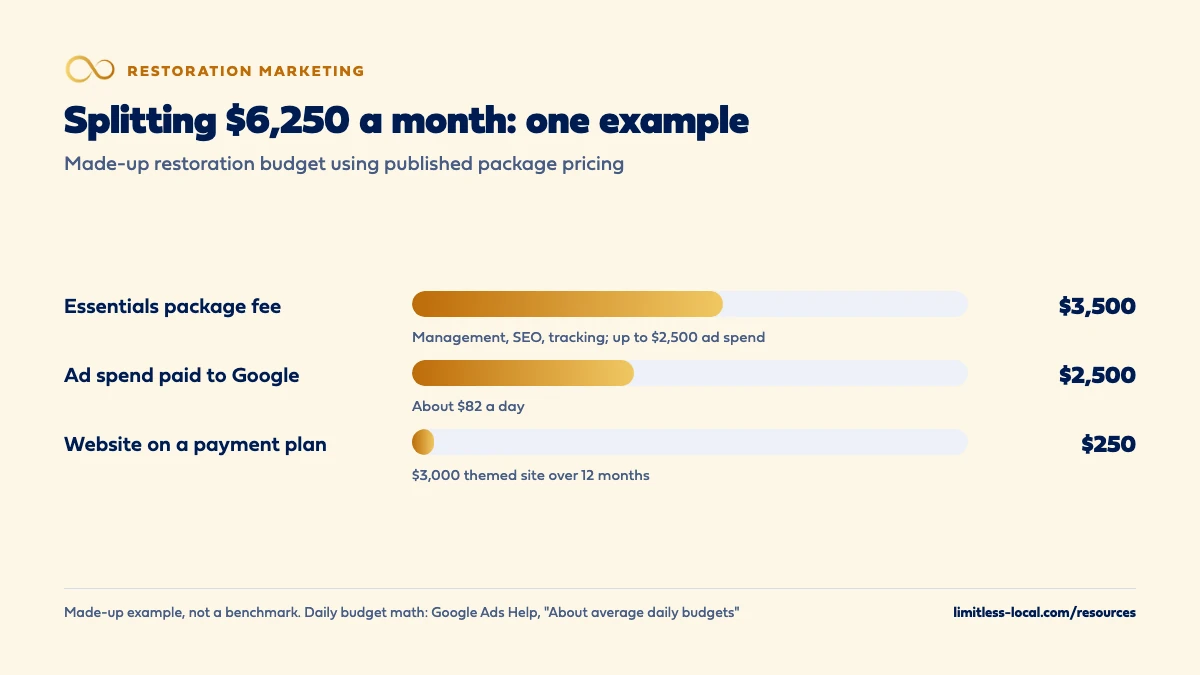
A worked example: splitting $6,250 a month
These numbers are made up to show the math, not a benchmark for your market. A restoration company has $6,250 a month for marketing and needs a new website.
- Website: a themed site at $3,000 with a package, spread evenly over 12 months, is $250 a month.
- Management, SEO, profile and tracking: our Essentials package, $3,500 a month.
- Ad spend: what’s left, $6,250 minus $3,500 minus $250, is $2,500, which is the most Essentials manages.
That’s about 56% to the package, 40% to Google and 4% to the website. Divided by 30.4, the ad spend is about $82 a day. The owner checks whether $82 keeps water damage ads running into the evening in the core towns; if not, the campaign narrows to fewer towns rather than taking money from the website or tracking.
If those ads produce 7 signed jobs a month, the all-in cost is $6,250 divided by 7, about $893 per signed job. If a typical signed job comfortably carries that, the split works. If it doesn’t, the choices are to do more of the work in-house or to wait until the job count grows, not to shave $500 off ads and hope.
Frequently asked questions
Should my agency fee be less than my ad spend?
Not necessarily. If the fee also covers SEO, the Google profile, content and tracking, it can be larger than the ad spend and still be the cheaper way to get all of that done. Compare on all-in cost per signed job.
Is ad spend included in agency packages?
Usually not, and in ours it isn’t: ad spend is paid to Google directly. Ask any agency to show ad spend and its fee as separate lines.
What's a reasonable share of the budget for SEO?
There’s no standard share. In our judgement, it should be a steady amount you can keep up for at least 3-6 months, since that’s how long SEO typically takes to show meaningful growth.
Should I pay for Local Services Ads management separately?
It depends on the setup. In our packages, Local Services Ads management starts at the Growth tier. If you run LSAs yourself, count your own hours as part of the management line.
How often should I revisit the split?
In our judgement, monthly at first, then quarterly once cost per signed job is steady. Revisit sooner after a storm season, a new service or a new location.
Key takeaways
- Write down five lines (ad spend, management, SEO, website, tracking), including the ones you do yourself.
- Fund tracking, the website and management first; ad spend is what’s left, and it has to last all day.
- There’s no standard ratio; compare fees by what they cover, converted to dollars at your real spend.
- Keep ad spend paid to Google directly, with Admin access to the account in the company’s name.
- Judge the split by all-in cost per signed job, and narrow the plan before thinning every line.
Ready to compare options?
Book a short growth call and we'll walk through the math for your service area, including when we're not the right fit.
More in this section
- Should a restoration company hire an in-house marketer vs agency?
- How should a restoration company run Google Ads for fire damage?
- Should a restoration company run Google Ads, LSAs or both?
- How do I vet a restoration marketing agency before signing?
- Restoration leads: shared, exclusive or pay-per-call?
Sources
- How to Get the Most From Your Marketing Budget — U.S. Small Business Administration
- About average daily budgets — Google Ads Help
- About Smart Bidding learning — Google Ads Help
- How bidding works for Local Services Ads — Google Local Services Help
- Tips to improve your local ranking on Google — Google Business Profile Help
- Do you need an SEO? — Google Search Central
- About access levels in your Google Ads account — Google Ads Help