
Which HVAC services should I advertise first?
- Which HVAC service should get my first ad dollars: repair, replacement or maintenance?
- How do I decide which HVAC service to advertise first?
- Why do many HVAC companies start with repair ads?
- Should I advertise AC or furnace replacement first?
- Is it worth advertising HVAC tune-ups and maintenance plans?
- How do I check demand for each HVAC service in my area?
- How do I compare what clicks cost for each HVAC service?
- Should each HVAC service have its own campaign?
- Which services should I keep out of my HVAC ads?
- When should I add the next HVAC service to my ads?
- Does the season change which HVAC service to advertise first?
- What's different about choosing services to advertise for HVAC
- A worked example: scoring repair, replacement and tune-up ads
- Frequently asked questions
- Key takeaways
- More in this section
- Sources
The short version
- Rank each service on four things: profit per booked job, capacity, seasonal demand and click cost.
- Seasonal repair is often first because it books the same day and gives you data fast.
- Replacements can leave the most profit per job but take longer to sell and to judge.
- Give each service its own campaign and page, and add the next one only when the first is paying.
For HVAC owners deciding where the first ad dollars go, and what to add next, without spreading a small budget across every service at once.
Get a free visibility audit · Book a growth call
Which HVAC service should get my first ad dollars: repair, replacement or maintenance?
Advertise first the HVAC service that leaves the most profit after its cost per booked job, that your crews can run right now, and that people in your area are searching for this season. In practice that’s often seasonal repair (AC repair in summer, heating repair in winter), because it books fast and shows within weeks whether the math works, with replacements added when you have someone to run estimates and patience for a longer sales cycle. Google’s Keyword Planner shows monthly searches and top-of-page bid ranges for each service in your area, which gives you the demand and cost side of that comparison.
Google Ads management is part of our local ads work in every one of our HVAC marketing packages, with ad spend paid to Google separately. For the full marketing budget behind those ads, see what an HVAC company should spend on marketing, and the rest of the HVAC marketing questions library goes question by question.
How do I decide which HVAC service to advertise first?
Score each service you’re considering on four tests, using your own numbers:
- What a booked job is worth. Gross profit on the job, not the ticket. A tune-up that becomes a maintenance-plan member may be worth more than its first invoice, so note that too.
- Whether you can run it now. Techs with the right skills, an installer with open days, someone to run estimates.
- Whether people are searching for it this season, in your area. Cooling searches and heating searches peak at different times.
- What it costs to win a booked job. Click prices, how often clicks turn into calls, and how often calls book.
The service to start with is the one that passes all four best: the most profit left after the ad cost of booking it, with capacity to run it and demand right now. A service that wins on profit but fails on capacity, like replacements when your only installer is booked a month out, goes second, not first.
Why do many HVAC companies start with repair ads?
In our judgement, because seasonal repair gives the fastest answer. A no-cool or no-heat call is urgent, the customer often books the same day, and you can tell within a couple of weeks what each booked repair cost you in ad spend.
That speed matters to Google’s bidding as well. Google says Smart Bidding performance usually settles within one to two conversion cycles, and lists conversion volume and the length of the conversion cycle among the main factors in how fast it gets there; very restrictive settings, such as low daily budgets or narrow targeting, slow it down (About Smart Bidding learning). A service with a short path from click to booked job, and enough of them, gives the system more to learn from.
Repair isn’t automatically first, though. If your repair tickets are thin and the clicks in your market are expensive, the math in the worked example below can come out the other way.
Should I advertise AC or furnace replacement first?
Only if you have the capacity to sell them. A replacement can leave far more profit per job than a repair, but it takes a home visit, an estimate, often financing and a decision before it’s booked, and then an install slot. That means fewer conversions per dollar and a longer wait before you can judge the campaign.
In our judgement, replacements make a good first service when you have a comfort advisor or owner who runs estimates quickly, install crews with open days, and enough budget to wait out a longer sales cycle. Otherwise, start with repair and add replacement as a separate campaign once repair is paying. How the message and offer should differ is covered in marketing replacements differently from repairs.
Is it worth advertising HVAC tune-ups and maintenance plans?
In our judgement, rarely as the first service and often as a later one. Tune-ups are low urgency and low ticket, so a booked tune-up can cost more in ads than its first visit brings in. The case for them is what comes after: a maintenance-plan member who calls you for the next repair, or a tired system you spot and quote for replacement.
In our judgement, tune-up ads fit the shoulder months, when crews have open days and repair searches are quiet, and they work best when you track what each tune-up customer is worth over the following year, not just on the first ticket. Keeping calls coming in during slow months covers that part of the calendar.
Curious what your marketing is actually booking?
Get a free visibility audit — no obligation, no sales pitch.
How do I check demand for each HVAC service in my area?
Use Keyword Planner in your Google Ads account. Enter words that describe the service, such as AC repair or furnace replacement, and add your website so Google can try to leave out keyword ideas that aren’t related to what you offer (Use Keyword Planner). Set the location to your service area.
The average monthly searches column is averaged over the month range and location you choose, and Google notes you can use it to see how popular a keyword is at different times of year (About Keyword Planner forecasts). Compare summer and winter months for cooling and heating terms. Two cautions from Google: keywords with very low search volumes aren’t shown (Use Keyword Planner), and you shouldn’t put a city name in your keywords if you’re going to use location targeting for your ads (Best practices for finding new keywords).
It also helps to start from the words homeowners actually use, not trade terms. What homeowners type into Google when their AC breaks covers that side.
How do I compare what clicks cost for each HVAC service?
In the same tool. For each keyword, Keyword Planner shows a top-of-page bid low range and high range, which Google describes as roughly the 20th and 80th percentile of what advertisers have historically paid to show at the top of the page in the locations you chose. Its forecasts estimate clicks and cost for a daily budget you set, and Google says a new account’s forecasts are based on averages across all advertisers until it has data of its own (About Keyword Planner forecasts).
Click price alone doesn’t rank a service. A replacement keyword can cost several times what a repair keyword does and still win, if the job is worth enough. Run each service’s click price, call rate and booking rate through the same backward math; how much to spend on Google Ads shows the formula.
Should each HVAC service have its own campaign?
Each service you want to budget separately, yes. Google’s advice is to create a separate campaign whenever you need different settings, such as a different budget or location targeting, and to build each ad group around a narrow theme with keywords related to it. Google also suggests your website’s structure is a good starting point, with each ad group matching a page or category on your site, and recommends at least 3 ads in each ad group (Organize your account with ad groups).
For an HVAC company, that usually means a repair campaign and a replacement campaign, with ad groups such as AC repair and furnace repair inside the first, and each one sending people to the matching service page. Google warns that reorganizing an account after you’ve built several campaigns wipes out the data you’ve accumulated, so set the structure up before launch, even if you only switch on one campaign at first.
Which services should I keep out of my HVAC ads?
Anything you don’t do, or don’t want more of. Negative keywords let you exclude search terms so your ads don’t show for them. Google’s own example is an optometrist who sells eyeglasses adding “wine glasses” and “drinking glasses” as negatives (About negative keywords). For an HVAC company, typical candidates are commercial or refrigeration work you don’t take, job seekers (jobs, salary, training), do-it-yourselfers (how to, parts) and equipment brands you don’t install.
Google notes two things to watch. Negative keywords don’t match close variants, so you need to add singular and plural forms and synonyms yourself. And using too many negatives can mean your ads reach fewer customers.
When should I add the next HVAC service to my ads?
When the first one is booking jobs at or under the cost per booked job you set, over a fair window, and you have capacity for the next service. Until then, splitting a small budget across more services gives each one less data and makes all of them harder to judge.
Your search terms report helps decide what’s next. Google says it shows the actual searches that triggered your ads and how they performed, and that it can help you find new ideas for ads and landing pages (About the search terms report). If your repair campaign keeps showing for heat pump searches that book well, that’s a sign of where to go next. For the rules on moving budget once a campaign is running, see when to raise, lower or pause ad spend.
Does the season change which HVAC service to advertise first?
Yes, and the answer can flip twice a year. In our judgement, cooling repair leads in summer and heating repair leads in winter, while the shoulder months suit tune-ups, maintenance plans and replacement estimates, when crews have room and homeowners aren’t in a rush. Set up the campaigns for both peaks ahead of time and move budget between them as the season turns. Scaling up ads for peak season covers how to ramp the leading service.
Not sure which of these is costing you jobs?
A free visibility audit checks the Google profile, reviews, site and tracking, and shows what to fix first.
What's different about choosing services to advertise for HVAC
Your crew decides the menu. Ductless installs, commercial rooftop units and indoor air quality work each take different skills and equipment. Advertise what your current techs are ready to run well, not what you’d like to offer next year.
Emergency and planned work behave differently. An emergency repair call books on the phone; a planned replacement books after an estimate. Keep them in separate campaigns so each one is judged on its own clock.
Maintenance members change the math. If you sell service plans, a customer’s value includes future visits and the replacement you may quote later. Count that when you score tune-ups, or they’ll always look like a loss.
A worked example: scoring repair, replacement and tune-up ads
These numbers are made up to show the math, not a benchmark for your market. Say Keyword Planner and your own records give you these inputs for three services:
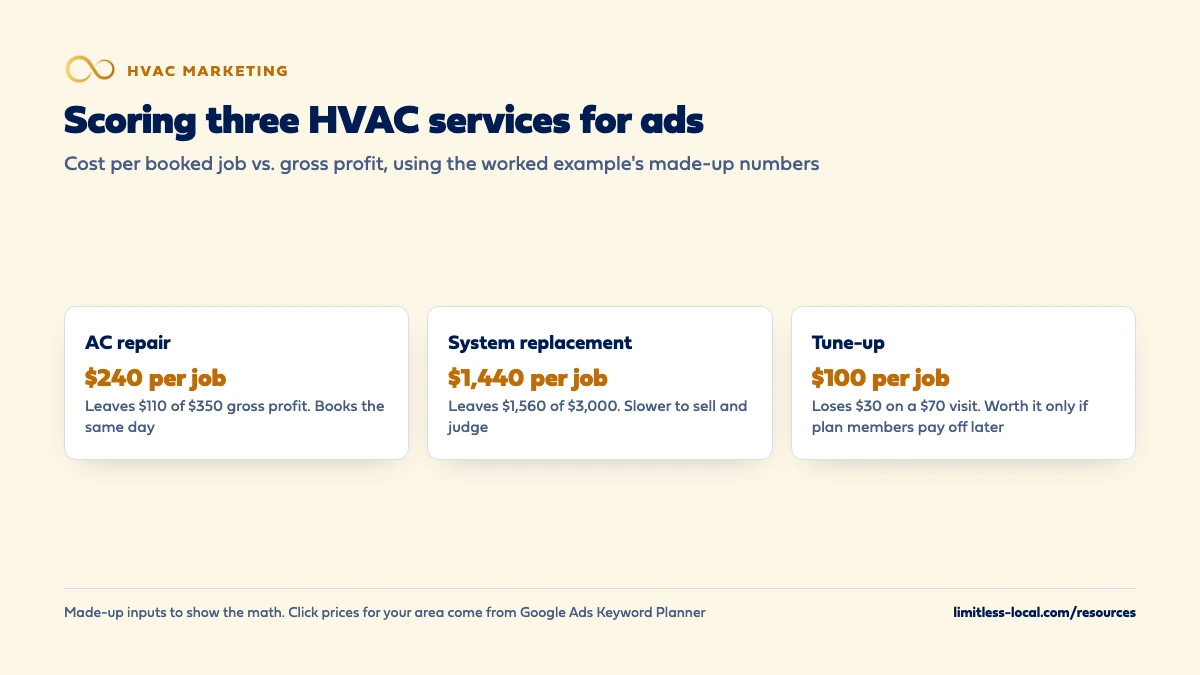
- AC repair. Clicks around $20, 1 in 6 clicks calls, 1 in 2 calls books. Cost per booked job: $20 times 6 times 2, or $240. Gross profit on an average repair: $350, which leaves $110 after the ad cost.
- System replacement. Clicks around $45, 1 in 8 clicks calls, 1 in 4 calls becomes a sold job. Cost per sold job: $45 times 8 times 4, or $1,440. Gross profit on an average replacement: $3,000, which leaves $1,560.
- Tune-up. Clicks around $10, 1 in 5 clicks calls, 1 in 2 calls books. Cost per booked tune-up: $100. Gross profit on the visit: $70, so each one loses $30 on the first ticket.
On profit per job, replacement wins easily. But it needs an estimator and an install slot, sells slowly, and needs a longer window before you know whether it’s working. Repair leaves less per job but books the same day, so it’s the one you can check fastest. In this example, a sensible order is repair first, replacement as soon as someone can run estimates, and tune-ups only in slow months and only if plan members are worth the first-visit loss. Running your own three services through this math is what a free visibility audit is for.
Frequently asked questions
Should I advertise every HVAC service at once to see what works?
Not on a small budget. Spreading the same money across every service gives each one less data, so it takes longer to tell which is paying. Start with one or two and add the next when the first is booking at a cost you can live with.
Can I advertise heat pumps if I mostly do furnaces and AC?
Only if your techs install and service them well today. Ads for work you’re not ready to run can lead to bad jobs and bad reviews; add the service once the crew is.
Do I need a separate web page for each service I advertise?
It helps. Google suggests organizing ad groups the way your website is organized, with each ad group matching a page, so someone who searched for furnace repair lands on your furnace repair page.
Should I put my city name in my HVAC keywords?
Not if you’re using location targeting. Google’s keyword guidance says to include a location in keywords only when customers aren’t in the same place as your service (Best practices for finding new keywords).
How do I stop my ads showing for HVAC jobs I don't do?
Add negative keywords for those services, including plural forms and synonyms, and check the search terms report regularly for new ones to exclude.
Key takeaways
- Score each service on profit per booked job, capacity, seasonal demand and click cost.
- Seasonal repair is often first because it books fast and shows quickly whether the math works.
- Replacements can leave the most profit per job but need estimate capacity and a longer test window.
- Give each service its own campaign and matching page, and set the structure up before launch.
- Add the next service only when the first is booking at a cost you can live with.
Want a second set of eyes on your setup?
We'll look at how you show up locally and where calls are leaking, then send you a plain-English breakdown.
More in this section
- How should a commercial HVAC company market itself?
- Should I market more before or after hiring another HVAC tech?
- How do I market a second HVAC location?
- How do I get HVAC calls without paying for ads?
- Should my HVAC company start with LSAs, Google Ads or SEO?
Sources
- Use Keyword Planner — Google Ads Help
- About Keyword Planner forecasts — Google Ads Help
- Best practices for finding new keywords — Google Ads Help
- Organize your account with ad groups — Google Ads Help
- About negative keywords — Google Ads Help
- About the search terms report — Google Ads Help
- About Smart Bidding learning — Google Ads Help