
Is a 30% close rate good for an electrical company?

- How do I tell whether my electrical company's 30% close rate is good or bad?
- What is my 30% close rate actually measuring?
- How do I split a close rate into calls, estimates and booked jobs?
- Is a 30% close rate good for electrical service calls?
- Is a 30% close rate good on panel upgrades, EV chargers and generators?
- Is a 20% close rate bad, and is 50% realistic?
- Which calls and jobs should I leave out of the math?
- How does my close rate change what each job costs me?
- How many estimates do I need before 30% means anything?
- How do I see my close rate by lead source?
- Is a very high close rate always a good sign?
- What should I fix first if one stage looks weak?
- What's different about close rates for electricians
- A worked example: one month, four different close rates
- Frequently asked questions
- Key takeaways
- More in this section
- Sources
The short version
- First find out what the 30% divides: all calls, booked visits or estimates.
- Split it into four stages and check service calls and estimate jobs separately.
- Judge each stage against your break-even and your own trend, not someone else's number.
- A small sample swings hard: one extra sale moves 3 of 10 to 40%.
For electrical contractors looking at a close-rate number in a report and wondering whether it’s a problem, before changing the ads, the prices or the office.
Get a free visibility audit · Book a growth call
How do I tell whether my electrical company's 30% close rate is good or bad?
A 30% close rate can be good or bad for an electrical company, because it means something different depending on what you count: 30% of every call, 30% of booked visits, or 30% of estimates sold. Split it into stages (real leads, booked visits, estimates given, jobs sold) and work it out separately for service calls and for estimate jobs like panel upgrades, EV chargers and generators. Then judge each stage against your own break-even and your own past months, not against another company’s figure, which almost certainly counts something different.
Splitting the close rate into stages is only possible when every call and form is tied to a lead source, which is why every package we offer includes call tracking with recording, form tracking and monthly reports with a cost-per-lead breakdown. See how we run Google Ads and Local Services Ads management, and what we do for electricians on the electrical contractor marketing page. The rest of the electrical marketing questions library goes question by question.
What is my 30% close rate actually measuring?
Before deciding whether 30% is good, find out what it divides. Owners use “close rate” for several different numbers, and your field software may calculate yet another.
- Calls that turned into work. Housecall Pro’s conversion rate reporting describes a call conversion rate as the percentage of calls that have turned into estimates or jobs, counted from opportunity calls (customer calls, not vendors or spam).
- Estimates that were approved. The same page defines estimate conversion rate as approved estimates out of all estimates: won, lost and still open.
- Estimates a salesperson sold. ServiceTitan’s article on close and conversion rates treats close rate as exclusive to sales and estimates, and keeps conversion rate as a separate measure tied to invoices.
- Quotes converted in a month. Jobber’s quotes report compares quotes with a sent date in a calendar month against quotes with a conversion date in that month.
All four can show 30% and mean very different things.
How do I split a close rate into calls, estimates and booked jobs?
In our judgement, the clearest way is to follow one month of leads through four stages and work out the rate between each one:
- Calls and forms in: everything that came through your ads, website, Google profile and referrals.
- Real leads: people asking for work you do, in places you serve. Wrong numbers, job seekers, sales calls and spam come out here.
- Booked visits: real leads that agreed to a service call or an estimate appointment. Real leads to booked visits is your booking rate, and it mostly belongs to whoever answers the phone.
- Sold work: service calls that were completed and paid, plus estimates that were signed. Estimates given to estimates sold is your estimate close rate, and it mostly belongs to whoever writes the estimates.
Each stage points at a different fix. A weak booking rate is usually a phone, price-question or scheduling problem. A weak estimate close rate is usually a follow-up, pricing or lead-quality problem. A single blended number can’t tell you which one you have.
Is a 30% close rate good for electrical service calls?
For service and repair work, the booking is often the sale: the customer has a dead circuit or a breaker that keeps tripping, the tech goes out, finds it and fixes it on the same visit. So the stage that matters is real callers to booked visits.
If only 30% of real service callers book, in our judgement that usually points at the phone rather than at the ads: calls going to voicemail, a slow callback, or a caller who asked about price and didn’t get a clear answer about the trip or diagnostic fee. Our page on how fast the office should answer electrical calls covers the first two. Listening to a handful of the calls that didn’t book usually shows which one it is.
If 30% is the share of all calls, including spam and wrong numbers, it can hide a healthy booking rate underneath. Strip out the calls that were never real before drawing a conclusion.
Is a 30% close rate good on panel upgrades, EV chargers and generators?
Here the stage that matters is estimates given to estimates sold. A panel upgrade, an EV charger install or a standby generator is a planned purchase: the homeowner often gets more than one price, may need to talk to a spouse, and may be waiting on the utility, a permit or a delivery date.
Whether 30% of those estimates closing is good depends on two numbers you can work out yourself: what each lead for that job costs you, and the most you can afford to spend in marketing to win one. Our page on what close rate is too low to scale ads walks through that break-even. To use made-up numbers: if your break-even close rate on panel upgrades is 20%, then 30% leaves room. If it’s 35%, 30% is losing money on every panel lead you buy, however respectable it sounds.
Is a 20% close rate bad, and is 50% realistic?
Neither number says much on its own. A 20% close rate on estimates can be healthy if those jobs carry a big margin and the leads are cheap. A 50% rate can be poor if it comes from quoting only the easiest work, or from counting only the estimates someone remembered to enter.
We don’t know of a reliable published close-rate benchmark for electricians, and in our judgement another company’s figure is risky to borrow: it may divide calls or estimates, include or exclude spam, and treat open estimates differently. The useful comparison is with yourself. Is your close rate on panel upgrades higher or lower than last quarter? Do calls from a new campaign book less often than calls from your Google profile? Those questions lead to a decision; an industry average usually doesn’t.
Curious what your marketing is actually booking?
Get a free visibility audit — no obligation, no sales pitch.
Which calls and jobs should I leave out of the math?
Most close-rate confusion comes from counting things that were never a chance to sell. Your software already separates some of them, if it’s set up right.
- Calls that weren’t customers. Housecall Pro counts opportunity calls as customer calls, not vendors or spam, using call reasons such as lead created, estimate created, job created, pricing inquiry and follow up.
- Jobs that were never a sale. ServiceTitan says to select its No Charge/Unconvertible setting when a job isn’t an opportunity to bring in revenue, and treats recall and warranty jobs as non-opportunities.
- Diagnostic-fee-only visits. ServiceTitan’s sold threshold is the minimum amount for a job to count as sold. It recommends setting it $1 above your typical dispatch or diagnostic fee, and warns that leaving it at $0 marks every job as converted, which makes both rates wrong.
In our judgement, also count out-of-area callers and requests for work you don’t do separately. They aren’t sales failures; they’re a targeting problem.
How does my close rate change what each job costs me?
Directly. What you pay for each sold job is what you pay for each lead divided by the share of leads that become sold work. If a lead costs you $60 and 30% of leads buy, each sold job costs $200 in marketing. At 20%, the same $60 lead makes each sold job cost $300. Those are made-up numbers to show the math, not a benchmark.
That’s why the close rate and the cost per lead have to be read together. A campaign with cheap leads and a low close rate can cost the same per sold job as one with pricey leads and a high close rate. Our page on a good cost per booked job covers how to set the ceiling for each kind of electrical work, which is the number your close rate is ultimately measured against.
How many estimates do I need before 30% means anything?
More than most owners look at. If you gave 10 estimates and sold 3, you’re at 30%; one more sale puts you at 40%, one fewer at 20%. If you gave 50 and sold 15, one extra sale moves you only to 32%.
In our judgement, don’t make a decision on a job type’s close rate until you have at least a few dozen estimates for it, and expect to wait longer for low-volume work such as generators or commercial bids. Lumping a quarter together is fine, as long as you don’t mix service calls with estimate jobs. The same small-numbers problem applies to ad results, the subject of our page on how much ad spend you need to judge Google Ads.
How do I see my close rate by lead source?
Your field software can probably do it, as long as every lead is tagged with where it came from.
- Jobber’s lead source report shows, for each source, the number of leads and how many have a request, a quote, a job and an invoice, plus the value of the first invoice tied to the lead. Those columns are the stages above, side by side.
- Housecall Pro’s lead reports, available to its Pipeline users, include lead conversion by lead source, and its estimate reports can be filtered by estimate lead source and job type.
- For Google Ads, Google’s page on offline conversion imports explains that when an ad starts a path that ends in a sale over the phone or in person, you can import those conversions to measure what happens after the click or call. Google recommends that advertisers who haven’t adopted offline conversion import start with enhanced conversions for leads instead.
Once you can see close rate per source, the question becomes which source is dragging it down, which is far easier to act on.
Is a very high close rate always a good sign?
Not always. In our judgement, a close rate that looks too good is worth a second look:
- Prices may be too low. If nearly every panel or EV charger estimate gets signed, you may be leaving margin on the table.
- Lost estimates may not be recorded. If only won jobs make it into the software, the rate is inflated. Jobber notes that quotes converted without being sent, or marked as sent, aren’t included in the sent part of its conversion calculation, so its quote conversion rate can even go above 100%.
- You may be quoting only easy work. Turning down anything unfamiliar raises the rate and slows growth.
A high close rate on few leads often means the limit is lead volume, not sales.
What should I fix first if one stage looks weak?
Match the fix to the stage, in our judgement roughly in this order:
- Too many calls aren’t real leads: tighten the ads, keywords and service area that are bringing them in.
- Real leads don’t book: answer live during the hours you advertise, call back fast, and have a clear answer ready for the price question.
- Booked estimates attract shoppers: screen before the visit. Our page on stopping price shoppers wasting your estimates covers qualifying questions and trip fees.
- Estimates sit undecided: follow up on a schedule. See following up on electrical quotes automatically.
- Estimates are declined outright: look at price, options and how quickly the estimate reached the customer.
The first two are usually the cheapest to fix, because they raise the return on leads you’re already paying for.
Not sure which of these is costing you jobs?
A free visibility audit checks the Google profile, reviews, site and tracking, and shows what to fix first.
What's different about close rates for electricians
Two kinds of sale under one roof. Many electrical companies run a fast service business and a slower estimate business side by side. Service calls are urgent and often sold on the first visit; panel upgrades, EV chargers, generators and rewiring are compared, financed and scheduled. One close rate across both says almost nothing.
Open estimates drag the rate down for a while. Housecall Pro counts open estimates in the total it divides by. A service upgrade waiting on the utility, or an EV charger quote waiting on the customer’s car delivery, lowers this month’s rate even if it signs next month. In our judgement, give estimate jobs a longer window before calling them lost.
Commercial bids run on their own clock. Keep tenant buildouts and property-manager bids separate from residential close rates.
A worked example: one month, four different close rates
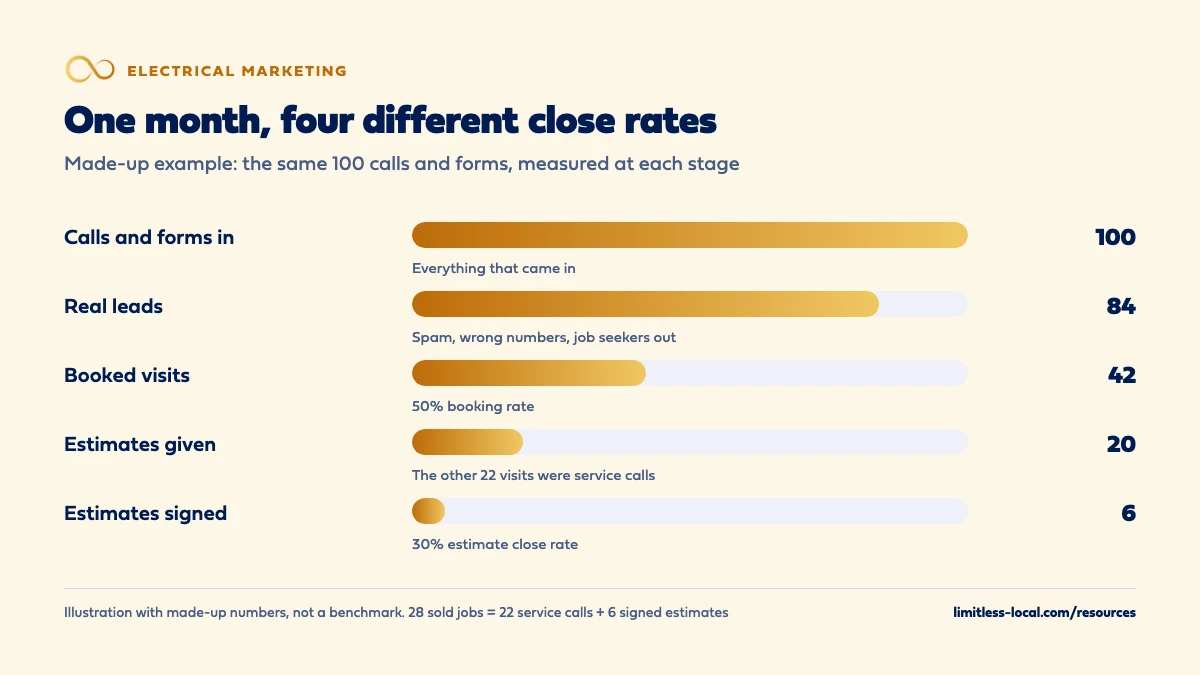
These numbers are made up to show the math, not a benchmark for your market. Say your ads, website and Google profile bring in 100 calls and forms in a month, on $4,000 of ad spend.
- 16 aren’t real leads: spam, wrong numbers, job seekers and a couple of calls from outside your area. That leaves 84 real leads.
- 42 of those 84 book a visit, a booking rate of 50%.
- Of the 42 visits, 22 are service calls fixed and paid on the spot. The other 20 end with an estimate for bigger work.
- 6 of the 20 estimates are signed, an estimate close rate of 30%.
So the month produced 28 sold jobs. Measured against all 100 calls, that’s 28%. Measured against the 84 real leads, it’s about 33%. Same month, same jobs, and the “close rate” is 28%, 30%, 33% or 50% depending on what you divide.
The spend reads the same way: $4,000 divided by 28 sold jobs is about $143 in ad spend per sold job. Whether that’s good depends on what those jobs earned against your own ceiling.
If you’d rather have someone else run the ads and the tracking behind those numbers, our Essentials package is $3,500 a month and includes Google Ads management for up to $2,500 a month in spend, with call, web and form tracking. A $4,000 monthly spend like the one above would fall under Growth, at $4,500 a month, which covers Google Ads spend up to $5,000. Ad spend is paid to Google directly and isn’t part of any package.
Frequently asked questions
Does charging a diagnostic fee change my close rate?
It can, depending on how your software counts it. ServiceTitan recommends setting the sold threshold $1 above your typical dispatch or diagnostic fee, so a visit where only the fee was collected doesn’t count as a sale.
Should the office and the techs have separate close rates?
In our judgement, yes. The office owns the booking rate on calls, and whoever writes estimates owns the estimate close rate. Measured together, one can hide the other.
Do open estimates count against my close rate?
In Housecall Pro’s estimate conversion rate, they do: it divides approved estimates by all estimates, including ones still open. Jobber’s quote conversion rate compares quotes sent in a month with quotes converted in that month.
Will better ads raise my close rate?
They can raise it by bringing fewer wrong-fit leads, but ads can’t fix a phone that goes to voicemail or estimates that never get a follow-up. Check which stage is weak before changing the ads.
Should referral leads count in the same close rate as ad leads?
Track them separately. In our judgement, referrals and repeat customers usually arrive already leaning toward you, so mixing them in can make paid leads look better than they are.
Key takeaways
- A 30% close rate means different things depending on whether it divides calls, booked visits or estimates.
- Split the funnel into real leads, booked visits, estimates given and sold work, and check each stage.
- Keep service calls, estimate jobs and commercial bids apart; they close very differently.
- Judge a close rate against your own break-even and your own past months, not another company’s figure.
- Small samples swing hard, so wait for a few dozen estimates per job type before deciding anything.
- Tag every lead with its source so you can see which channel is pulling the rate down.
Want a second set of eyes on your setup?
We'll look at how you show up locally and where calls are leaking, then send you a plain-English breakdown.
More in this section
- What close rate is too low to scale ads for an electrical company?
- What is a good cost per booked job for electrical marketing?
- How do I run an electrical business that gets steady calls?
- How do I know if my electrical marketing agency is getting results?
- How many jobs a month does an electrician need to hit a revenue goal?
Sources
- Technician's Close or Conversion Rate does not look correct — ServiceTitan Help
- Conversion Rate Reporting — Housecall Pro Help Center
- Quotes Report — Jobber Help Center
- Lead Source Report — Jobber Help Center
- About offline conversion imports — Google Ads Help