
Does SEO or website design matter more for HVAC leads?
- Should an HVAC company spend on SEO or a better website first?
- What's the difference between SEO and website design for getting leads?
- Which one matters more for an HVAC company?
- How do I tell whether SEO or my website is the problem?
- What are the signs SEO is the bottleneck?
- What are the signs my website is the bottleneck?
- Does website design affect SEO?
- Does a better-looking website get more HVAC calls?
- Should I fix SEO or my website first?
- Do I need a brand-new HVAC website to get SEO leads?
- How long does each one take to bring in more calls?
- What's different about SEO and websites for HVAC companies
- A worked example: two HVAC sites, two different problems
- Frequently asked questions
- Key takeaways
- More in this section
- Sources
The short version
- SEO brings visitors; the website turns them into calls.
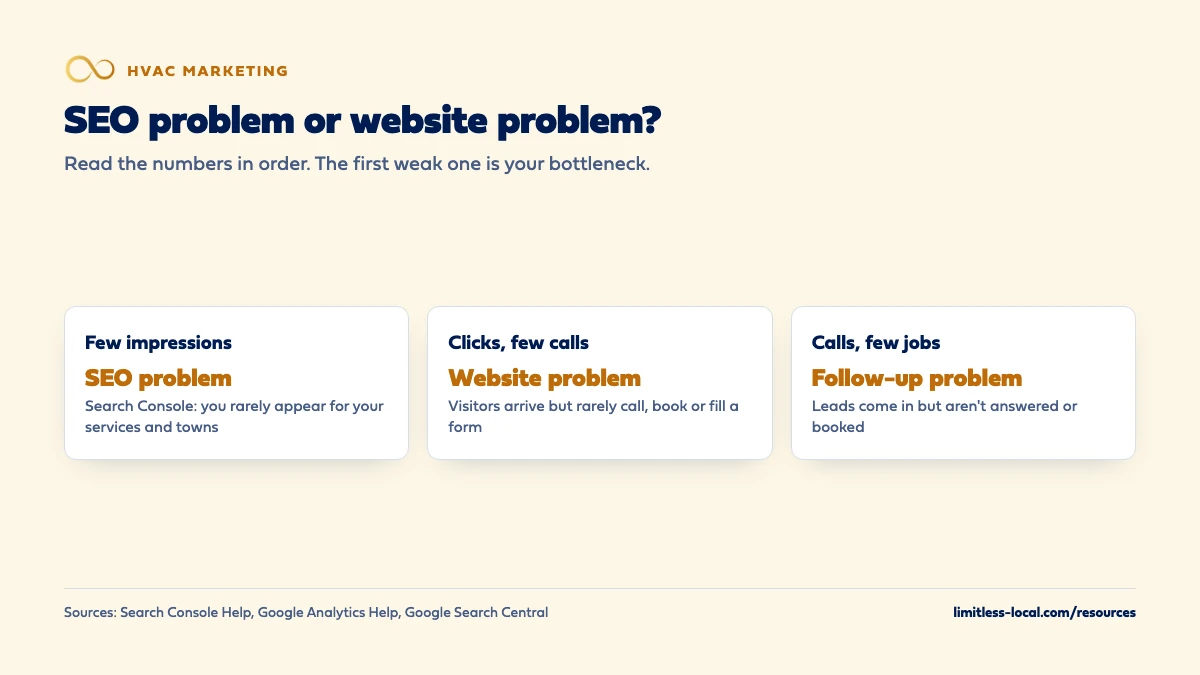
- Few impressions in Search Console: work on SEO.
- Steady visitors but few calls or forms: fix the website.
- Page speed matters to ranking, but relevant content matters more.
For HVAC owners trying to decide whether their lead problem is that nobody finds the site, or that people find it and don’t call.
Get a free visibility audit · Book a growth call
Should an HVAC company spend on SEO or a better website first?
Neither matters more on its own: SEO decides how many homeowners find your HVAC website, and the website decides how many of them call, so your leads are roughly visitors times the share who call. Fix whichever is weaker. If Google Search Console shows few impressions for your services and towns, SEO is the bottleneck; if visitors arrive but rarely call or book, the website is. Website fixes work on the traffic you already have, while SEO typically takes 3-6 months to show meaningful organic growth.
We treat both sides as one job: local SEO to get your services and towns found, and pages built to turn those visitors into booked calls, with tracking to show which one is holding you back. Local SEO and Google Business Profile management are part of every one of our HVAC marketing packages. For the site itself, our website builds are $3,750 for a themed site, or $3,000 with any Limitless Engine package, and custom sites start at $5,000. For how the website fits with reviews, Maps and ads, see the HVAC marketing guide and the rest of the HVAC marketing questions library.
What's the difference between SEO and website design for getting leads?
They do two different jobs. SEO decides whether homeowners find you: whether your pages show up when someone searches “furnace repair” or “AC installation” in your town, and how high. Website design, in the sense that matters for leads, decides what happens after they arrive: whether they can see right away that you do the job they need, where they live, and how to call you.
So the honest comparison isn’t one against the other. Your website leads are roughly the number of visitors times the share who call or book. SEO grows the first number. Design and page content grow the second. If either one is close to zero, the other can’t save you: a beautiful site nobody finds books nothing, and a page that ranks well but buries the phone number wastes the traffic it earns.
One more thing to keep in mind for HVAC: many calls never touch your website at all. Google Business Profile performance data counts calls from the call button on your profile and website clicks separately, so a homeowner can find you in Maps and call straight from there.
Which one matters more for an HVAC company?
Whichever one is weaker right now. That’s not a dodge; it’s the math. If 1,000 people a month already reach your site and almost none call, improving the page will add more calls this month than any amount of SEO. If almost nobody reaches the site, the best-designed page on the internet has nobody to convert.
In our judgement, most small HVAC sites have problems on both sides, but one is usually the bottleneck. A shop with a decent site but only a home page and a contact page usually has an SEO problem, because there’s no page for Google to match to “heat pump repair”. A shop that runs Google Ads or already ranks, yet gets few calls from the site, usually has a website problem. The next section shows how to tell which one you have, using free tools you probably already have access to.
How do I tell whether SEO or my website is the problem?
Look at three numbers, in order:
- Impressions in Google Search Console: how many times your site appeared in Search results. Its Performance report also shows which queries bring traffic and which pages have the highest and lowest click-through rate.
- Clicks and average position, also in Search Console. Low impressions, or appearing only far down the results for your main services, point to SEO.
- Calls and form submissions from the site. In Google Analytics, you can mark an important action, such as a click on your phone number or a completed form, as a key event, then see key events by landing page.
If impressions are low, it’s an SEO problem. If visitors are steady but key events are rare, it’s the website. If both look fine and the schedule is still thin, the problem may be after the call, in how leads are answered and followed up. How to tell if your HVAC ads, website or follow-up is the problem runs the full check stage by stage.
What are the signs SEO is the bottleneck?
- Search Console shows few impressions for searches that name your services and towns.
- You don’t have a separate page for each main service, so there’s nothing specific for Google to show.
- Your pages don’t appear in Google at all; the URL Inspection tool in Search Console can show how Google sees a page.
- Competitors show up in the map pack and the regular results for your best jobs, and you don’t.
Fixing these is mostly about content and organization: pages that use the words homeowners search, descriptive titles, and links between related pages. Google says that if you run a small local business, you can probably do much of this work yourself, and its SEO starter guide describes much of what an SEO professional would do for you. Whether paying for it makes sense at your size is covered in whether SEO is worth it for a small HVAC company.
Curious what your marketing is actually booking?
Get a free visibility audit — no obligation, no sales pitch.
What are the signs my website is the bottleneck?
- Search Console or Google Ads shows a steady flow of clicks, but calls and forms from the site are rare.
- On a phone, the number isn’t a tap-to-call button, or you have to scroll to find it.
- A visitor can’t tell in a few seconds that you do this job in their town.
- The page is slow, cluttered or covered by a pop-up the moment it opens.
- There are no reviews, real photos, license details or other reasons to trust you on the page.
Google’s own advice on mobile landing pages lines up with this list: free of clutter, easy to read, quick to load, simple to navigate and free from full-size pop-ups. It also notes that prospects will wait only seconds for a mobile page to load before going elsewhere. The full checklist, from the call button to the form, is in what an HVAC website should include to turn visitors into calls.
Does website design affect SEO?
Partly. Google says its core ranking systems look to reward content that provides a good page experience, and that Core Web Vitals are used by its ranking systems. Those are three measurements of loading speed, responsiveness and visual stability; web.dev sets the “good” marks at a Largest Contentful Paint within 2.5 seconds, an Interaction to Next Paint of 200 milliseconds or less, and a Cumulative Layout Shift of 0.1 or less.
But Google is also clear about the limits. It says Search always seeks to show the most relevant content, even if the page experience is sub-par, and that beyond Core Web Vitals, other page experience aspects don’t directly help a site rank higher. Good scores don’t guarantee top rankings either. In other words, a fast, clean site helps, but it won’t outrank a competitor whose page actually answers the search better. Design supports SEO; it doesn’t replace pages with real content about your services and towns.
Does a better-looking website get more HVAC calls?
Only when “better-looking” means clearer. In our judgement, homeowners with a broken AC aren’t grading your design; they’re scanning for three things: do you fix this, do you come to my area, and how do I reach you. A plain page that answers those in the first screen often beats an attractive one that opens with a slideshow and a slogan.
Where design does earn its keep is trust. Real photos of your trucks and techs, a visible review rating, and an easy-to-read layout on a phone can be the difference between a call and the back button, especially for a replacement where the homeowner is comparing several companies. Google’s mobile landing page advice also suggests that images can help people learn about a business without reading lots of copy. Spend on the parts the homeowner uses to decide, not on animation.

Should I fix SEO or my website first?
A simple rule of thumb, in our judgement:
- Fix the website first if you already get visitors, from SEO, your Google profile or paid ads. Each visitor you’re already getting is a chance at a call, and paid visitors cost money whether they call or not.
- Start SEO first if almost nobody reaches the site. There’s little to convert yet, and SEO typically takes 3-6 months to show meaningful organic growth, so the clock should start now.
- If both are weak, do the quick conversion fixes (tap-to-call, service area, reviews on the page) in the first week or two, then put steady effort into SEO.
If you’re about to run ads, the site has to come first, since you’ll be paying for every click. Whether to fix your HVAC website and reviews before paying for ads covers the minimum an ad needs.
Do I need a brand-new HVAC website to get SEO leads?
Not always. A site can usually be improved where it stands if you can add and edit pages yourself, it loads quickly on a phone, Google can find and index its pages, and you own the domain and the site. Adding a page for each main service and fixing the call buttons on an existing site is often faster and cheaper than starting over.
A rebuild starts to make sense when the site can’t be edited without a developer, is slow on phones no matter what you change, or is locked inside a platform you don’t control. Before you replace it, check what the new platform lets you do; the best website platform for an HVAC company walks through the options. Either way, keep the pages and web addresses that already bring in traffic, so a new site doesn’t throw away what the old one earned.
How long does each one take to bring in more calls?
Website fixes work on the traffic you already have, so they can show up in your call count as soon as the changes are live and enough visitors have seen them. A tap-to-call button added on Monday can produce calls that week.
SEO is slower. It typically takes 3-6 months to show meaningful organic growth, and new service pages need time to be found, indexed and tested by Google against competitors’ pages. Nobody can honestly promise a ranking or a date. That difference in speed is one more reason to fix the conversion side early: it makes every visitor that SEO eventually sends worth more. For the longer view on the SEO ramp, see how long HVAC SEO takes to bring in calls.
Not sure which of these is costing you jobs?
A free visibility audit checks the Google profile, reviews, site and tracking, and shows what to fix first.
What's different about SEO and websites for HVAC companies
Emergency visitors decide fast. Someone with no cooling in July is usually on a phone and ready to call the first company that looks right. For those pages, in our judgement, conversion basics (the call button, the service area, a reason to trust you) matter more than anything else on the page.
Replacement visitors compare. A homeowner pricing a new system may visit several sites over days. Those pages need more depth: what’s included, financing, warranties, reviews from installs. That depth also gives Google more to match to replacement searches, so this is where SEO and page content overlap most.
The busy season tests the site. Traffic jumps in the first heat wave and cold snap. If the site converts poorly, the busiest weeks of the year waste the most visitors, which is why we’d fix conversion problems before peak season rather than during it.
A worked example: two HVAC sites, two different problems
These numbers are made up to show the math, not a benchmark for your market. Two HVAC companies each pull a month of data from Search Console and Google Analytics.
- Shop A appears 3,000 times in search and gets 90 clicks, a 3% click-through rate. Nine of those visitors call: 10% of visitors. The site converts well; too few people see it. Shop A has an SEO problem.
- Shop B appears 20,000 times and gets 800 clicks, 4%. Only 8 visitors call: 1%. Plenty of people find the site; almost none call. Shop B has a website problem.
If Shop B’s site went from 1% to 2% of visitors calling, the same 800 visitors would produce 16 calls, double the calls without a single extra visitor. Shop A, by contrast, could double its call rate and still get only 18 calls, because it has so few visitors. A free visibility audit runs this same check on your own numbers and tells you which side to fix first.
Frequently asked questions
Can a good website rank without SEO?
A well-built site with a page for each service is already doing much of what SEO means. Without those pages, descriptive titles and links between them, even a good-looking site gives Google little to match to service searches.
Is page speed an SEO issue or a design issue?
Both. Google says Core Web Vitals are used by its ranking systems, and slow mobile pages also lose visitors who won’t wait.
Do website design awards help SEO?
Not in themselves, in our judgement. Google says Search always seeks to show the most relevant content, so what ranks is what the pages say and how they work. Awards can say something about the designer, but judge any site by whether it gets found and gets calls.
How do I see how many calls my website gets?
Track clicks on your phone number as a key event in Google Analytics, and use call tracking if you want to count the calls themselves and tie them to booked jobs.
Does my Google Business Profile count as SEO?
It’s local SEO for the map results. Google says local results are mainly based on relevance, distance and popularity, and calls from the profile’s call button don’t need a website visit at all.
Should I redesign my site before peak season?
Only if you can finish well before it. A rebuild mid-season risks breaking pages that bring in calls; quick conversion fixes on the current site are safer in the busy months.
Key takeaways
- SEO grows the number of visitors; the website grows the share who call.
- Low Search Console impressions point to SEO; steady visitors with few calls point to the website.
- Core Web Vitals are used in ranking, but Google still shows the most relevant content even with a sub-par page experience.
- If you already get traffic or run ads, fix the website first; if nobody finds you, start SEO now.
- Website fixes can work within days; SEO typically takes 3-6 months.
Want a second set of eyes on your setup?
We'll look at how you show up locally and where calls are leaking, then send you a plain-English breakdown.
More in this section
- Is SEO worth it for a small HVAC company?
- How long does HVAC SEO take to bring in calls?
- Should my HVAC company start with LSAs, Google Ads or SEO?
- How can an HVAC company get more leads?
- Should an HVAC company run emergency ads while SEO builds?
Sources
- Do you need an SEO? — Google Search Central
- SEO Starter Guide: The Basics — Google Search Central
- Understanding page experience in Google Search results — Google Search Central
- Web Vitals — web.dev
- Performance report (Search results): Overview and basic setup — Search Console Help
- About key events — Google Analytics Help
- Understand your Business Profile performance & insights — Google Business Profile Help
- 5 things to consider when optimizing your mobile landing page — Google Ads