
What can a roofer do this month to get more leads without waste?

- Which low-cost fixes can a roofing company finish this month to get more leads?
- Why start with fixes instead of new roofing marketing?
- Step 1: How do I find out if my phones are losing roofing leads?
- Step 2: Which leads can I win back without spending anything?
- Step 3: What should I fix on my Google Business Profile this month?
- Step 4: How many reviews can I ask for this month?
- Step 5: How do I stop paying for roofing searches I don't want?
- Step 6: Are my roofing ads showing outside the towns I serve?
- Step 7: What should I check on my roofing website this month?
- Step 8: How do I know which of this month's leads came from where?
- What should a roofer not spend on this month?
- How do I know if this month's roofing fixes worked?
- What's different about this month's list for a roofing company
- A worked example: one month of fixes for a slow roofing company
- Frequently asked questions
- Key takeaways
- More in this section
- Sources
The short version
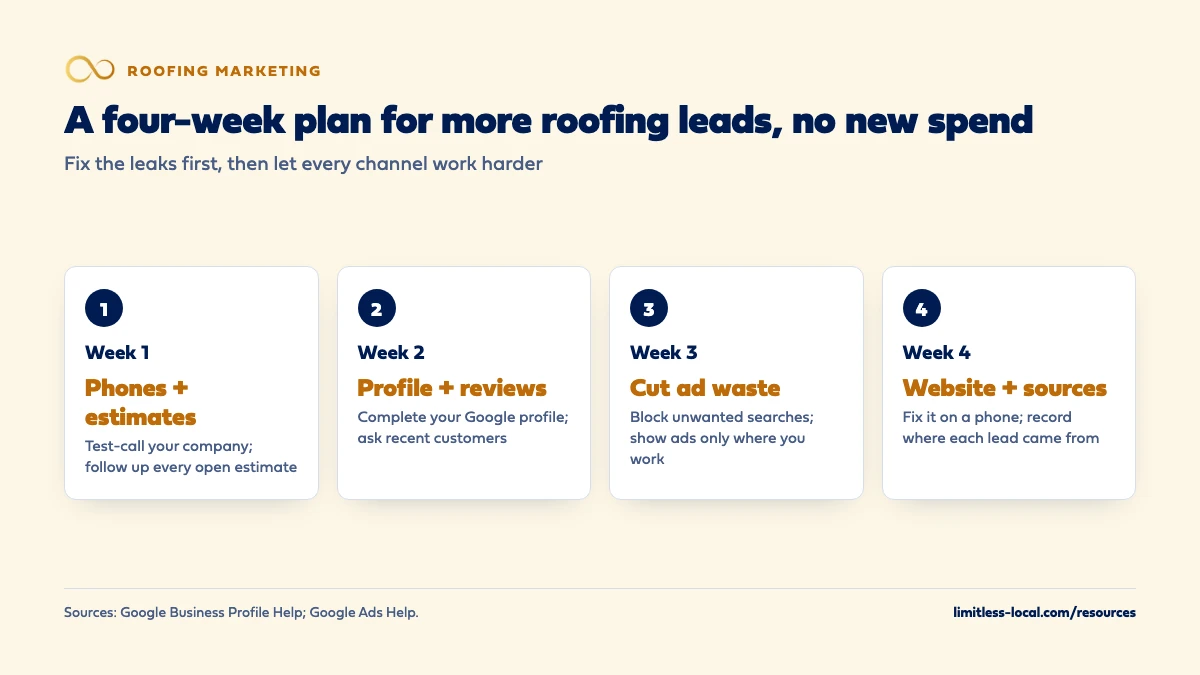
- Week 1: test your phones and work every open estimate.
- Week 2: tighten your Google Business Profile and ask recent customers for reviews.
- Week 3: cut ad spend on searches and areas you don't want.
- Week 4: fix your website on a phone and put a source on every lead.
- Hold off on new channels, redesigns and long contracts until these are done.
For roofing owners who want more calls in the next few weeks without starting a new channel or raising the ad budget.
Get a free visibility audit · Book a growth call
Which low-cost fixes can a roofing company finish this month to get more leads?
Fix the leaks before you buy more leads. This month, test how your phones get answered, follow up on every open estimate, tighten your Google Business Profile, ask every recent customer for a review, cut the searches and areas your ads pay for but don’t want, and check your website on a phone. None of these needs a bigger budget, and together they get more jobs out of the calls and clicks you’re already paying for.
This is the same order our work starts in: build the foundation first (tracking, follow-up and a clean online presence), then turn on lead flow with local SEO and ads, then improve month by month. See how that fits a roofing company on our roofing marketing page. For every channel in more depth, the guide to getting roofing leads lays them out, and the roofing marketing questions library takes the follow-ups one at a time.
Why start with fixes instead of new roofing marketing?
Because the cheapest leads you’ll get this month are the ones already slipping away. A missed call, an estimate nobody followed up on, an ad click from a town you don’t serve: each one cost you money or effort to create, and each one is fixable in an afternoon.
New channels take weeks to set up and months to judge. Fixes pay off this month, and they make every channel you add later work better. So this plan is four weeks, roughly two jobs a week, and none of it needs a bigger budget.
Step 1: How do I find out if my phones are losing roofing leads?
Call your own company. Do it four ways this week:
- During business hours, from a number your office doesn’t know
- After hours and on a weekend
- From the call button on your Google Business Profile
- From your website, on a phone
Write down how many rings it took, whether a person answered, what the voicemail said and whether anyone called back. If a call went to a full mailbox or nobody called back by the next morning, you’ve found your most expensive leak. Homeowners with a leak in the ceiling call the next roofer on the list. How fast a roofing company should call back a new lead sets the standard to aim for.
Step 2: Which leads can I win back without spending anything?
Your open estimates. Pull every estimate from the last 90 days that hasn’t signed or been marked lost, and give each one a real follow-up this week: a call first, then a text with something useful, like a photo from the inspection or an answer to a question they asked.
These homeowners already let you on the roof. They’re the warmest leads you have, and many of them simply haven’t decided yet. Mark each one signed, still open with a next date, or lost with a reason. How to follow up on unsigned roofing estimates has a schedule and what to say at each touch.
Step 3: What should I fix on my Google Business Profile this month?
Spend an hour on it. Google says businesses with complete and accurate info are more likely to show up in local search results, and that local results are mainly based on relevance, distance, and popularity (Google Business Profile Help). For a roofer, that means checking:
- Your primary category and the extra categories for the work you want
- Your services list: replacement, repair, storm damage, gutters if you do them
- Your service area, matching the towns your crews actually drive to
- Hours, including how you handle after-hours calls
- Photos of your own crews, trucks and finished roofs
- Replies to recent reviews
There’s no way to pay Google for a better local ranking, so this is work, not spend. Consistency across the web matters too: a roofing client of ours got 3x map pack visibility in its target towns; better presence and consistent info across the web increased inbound calls.
Step 4: How many reviews can I ask for this month?
One from every customer whose job finished in the last three months. Send each one a direct link to your review form by text, with a short personal note from whoever ran the job. Google lets you create a review link or QR code from your profile, which makes it one tap for the homeowner (Tips to get more reviews).
Keep it clean. Google treats offering incentives, like a discount or a gift, in exchange for reviews as fake and misleading content, so ask everyone and offer nothing. Then make the ask a habit at the end of every job so you’re not doing a catch-up push again next quarter. Getting more Google reviews after a roof replacement covers timing and wording.
Curious what your marketing is actually booking?
Get a free visibility audit — no obligation, no sales pitch.
Step 5: How do I stop paying for roofing searches I don't want?
If you run Google Ads, open the search terms report for the last 30 days. It shows the actual searches that triggered your ads and how each performed. Sort by cost and look for searches that will never become a roof:
- Job hunters: “roofing jobs”, “roofer hiring”
- Do-it-yourselfers: “how to patch a roof”, “roof shingles for sale”
- Work you don’t do: “flat roof” if you don’t do commercial, “metal roof” if you don’t install it
- Towns you don’t serve
Add each as a negative keyword so you stop paying for it. It’s usually the fastest money you’ll save all month. Which negative keywords a roofer should add has a starter list.
Step 6: Are my roofing ads showing outside the towns I serve?
Check your location setting. By default, Google Ads location targeting includes both people physically in your area and people who’ve shown interest in it (About advanced location options). For an online store that’s fine. For a roofer, a click from someone three states away who once looked up your town is wasted money.
Switching to the “Presence” option limits your ads to people in, or regularly in, the areas you target. While you’re there, check the map itself: draw the area around the towns your crews will drive to, not a big radius that pulls in places you’d turn down.
Step 7: What should I check on my roofing website this month?
Open it on your own phone, the way most homeowners will, and go through it like a stranger. Google’s advice for mobile landing pages: pages should be free of clutter, easy to read and quick to load, full-size pop-ups get in the way, and forms are inconvenient on a phone and can make visitors leave (Google Ads). For a roofer, check that:
- Your phone number is at the top and calls with one tap
- The estimate form asks for only name, phone, address and what’s going on
- Each main service, like replacement, repair and storm damage, has its own page
- Reviews and real photos of your roofs show up without scrolling far
- Nothing pops up and covers the screen
Then fill out your own form and make sure the request actually reaches someone. How to tell if your roofing website works well on phones goes deeper.
Step 8: How do I know which of this month's leads came from where?
Start asking. From today, every new lead gets one question on the first call, “How did you find us?”, and the answer goes in your CRM, job software or a simple spreadsheet. Separate tracking numbers for your ads and your Google profile make it automatic, but the question alone gets you most of the way this month.
Without it, next month you’ll have more leads and no idea which fix produced them, so you can’t tell what to keep doing.
What should a roofer not spend on this month?
- A new channel. Starting Facebook ads, a new lead platform and direct mail at once makes it impossible to tell what worked, and they all leak through the same phones.
- A bigger ad budget before steps 5 and 6. More budget on a leaky campaign buys more of the same waste.
- A full website redesign. Fix the phone number, the form and the service pages first. A redesign takes months.
- A long contract with anyone, signed in a hurry because the phone is slow.
- Shared leads you haven’t tested. If you try them, start small and track every one to a signed roof.
How do I know if this month's roofing fixes worked?
Check five numbers at the end of the month and write them down so you can compare next month:
- How many test calls got a live answer or a same-day callback
- How many open estimates you followed up on, and how many signed
- New Google reviews this month
- Ad spend on searches you’ve now blocked, compared with last month
- How many new leads have a source recorded
Some of these pay off right away, like revived estimates and wasted ad spend you stop paying for. Others, like reviews and profile fixes, build over the next few months. That’s fine; the point is that nothing you did this month cost more than your time.
Not sure which of these is costing you jobs?
A free visibility audit checks the Google profile, reviews, site and tracking, and shows what to fix first.
What's different about this month's list for a roofing company
Weather sets the calendar. If a storm just hit your area, swap the order: phones and follow-up first, then reviews, then everything else. If it’s the slow season, it’s the best time to do the profile, website and review work while crews have room.
Open estimates are worth more for roofers. A single signed replacement can be worth more than a month of ad spend, so the follow-up step usually pays off faster than any other step.
Trust matters more after storms. Homeowners worry about storm chasers. Real photos, a clear service area and recent reviews on your profile help you look like the local company you are.
Insurance jobs stay open longer. Estimates waiting on an adjuster need a follow-up date, not a guess. Put the next date in your software so they don’t drift.
A worked example: one month of fixes for a slow roofing company
These numbers are made up to show the math, not a forecast. A roofer finds 20 open estimates from the last 90 days, averaging $14,000 each. The office follows up on all of them in week one, and 2 sign. That’s $28,000 in contracts from a few hours of calls.
In week three, the search terms report shows $450 of last month’s ad spend went to job hunters, do-it-yourselfers and a town the crews don’t serve. Blocking those searches and switching to the Presence location option doesn’t cost anything, and that $450 a month goes back into searches that can actually become roofs.
Meanwhile, the owner texts review links to 25 customers from the last three months and gets 9 new reviews. Nobody can promise what those do for rankings, but every homeowner who checks the profile next month sees a busier, more recent page. Total new spend for the month: zero.
Frequently asked questions
How much time will this month's list take?
A few hours a week for the owner or office manager. The estimate follow-up and review asks take the most time, and they’re also the steps most likely to pay off quickly.
Should I lower my prices to get more leads this month?
Not as a first move. A price cut lowers the value of every job you already have coming in. Fixing slow callbacks and stale estimates usually wins more jobs without touching your margin.
Is it worth sending postcards or flyers this month?
Around jobs you’re already doing, it can be, since neighbors can see your crew at work. As a broad mailing, wait until your phones, follow-up and tracking are fixed, so you can tell whether it worked.
What if I don't run Google Ads?
Skip steps 5 and 6 and spend that week on the Google profile and reviews instead. They’re free and keep working whether or not you ever run ads.
What should I do next month?
Keep the habits from this month, then add one thing at a time. What marketing a roofing company should add first covers the order.
How do I see which searches bring leads once this is done?
Once your leads have sources, your free Google reports can show more. How a roofer sees which searches and pages bring leads walks through them.
Key takeaways
- The cheapest leads this month are the ones already leaking: missed calls, open estimates and wasted clicks.
- Test your own phones and follow up every open estimate from the last 90 days.
- Complete your Google Business Profile and ask every recent customer for a review, with no incentives.
- Block searches you don’t want and limit ads to people in the towns you serve.
- Hold off on new channels and redesigns until the leaks are fixed.
Want a second set of eyes on your setup?
We'll look at how you show up locally and where calls are leaking, then send you a plain-English breakdown.
More in this section
- What is the fastest way for a roofer to get leads online?
- How does a roofer see which searches and pages bring leads?
- How many roofing leads a month do I need to hit my job goal?
- What does a roofing marketer actually do each month?
- What should a roofer expect in the first 90 days of marketing?
Sources
- Tips to improve your local ranking on Google — Google Business Profile Help
- Tips to get more reviews — Google Business Profile Help
- About the search terms report — Google Ads Help
- About advanced location options — Google Ads Help
- 5 things to consider when optimizing your mobile landing page — Google Ads