
What marketing should a roofing company add first to grow?
- Which one marketing channel should a growing roofing company add next?
- Why does the order you add roofing marketing matter?
- What should a roofing company fix before adding any new marketing?
- Is the Google Business Profile the first real channel to add?
- When should a roofer start asking for reviews?
- Does a roofing company need a website before running ads?
- Should a roofer add Google Ads or SEO first?
- Where do Local Services Ads fit in the order?
- When does social media, direct mail or door knocking make sense?
- How much budget should each new channel get before you judge it?
- How do you know it's time to add the next channel?
- What's different about growing a roofing company's marketing
- A worked example: picking the next channel for a referral-only roofer
- Frequently asked questions
- Key takeaways
- More in this section
- Sources
The short version
- First, make sure every call is answered or called back fast and tracked to a source.
- Next, complete your Google Business Profile and ask every finished job for a review.
- Then get a simple website that turns visitors into inspection requests.
- Add Google search ads when you want calls soon; add SEO when you can wait months for it to ramp.
- One channel at a time, with a budget and a review date, beats five channels at once.
For roofing owners who already get some work from referrals or one channel and want to know which single thing to add next, in what order.
Get a free visibility audit · Book a growth call
Which one marketing channel should a growing roofing company add next?
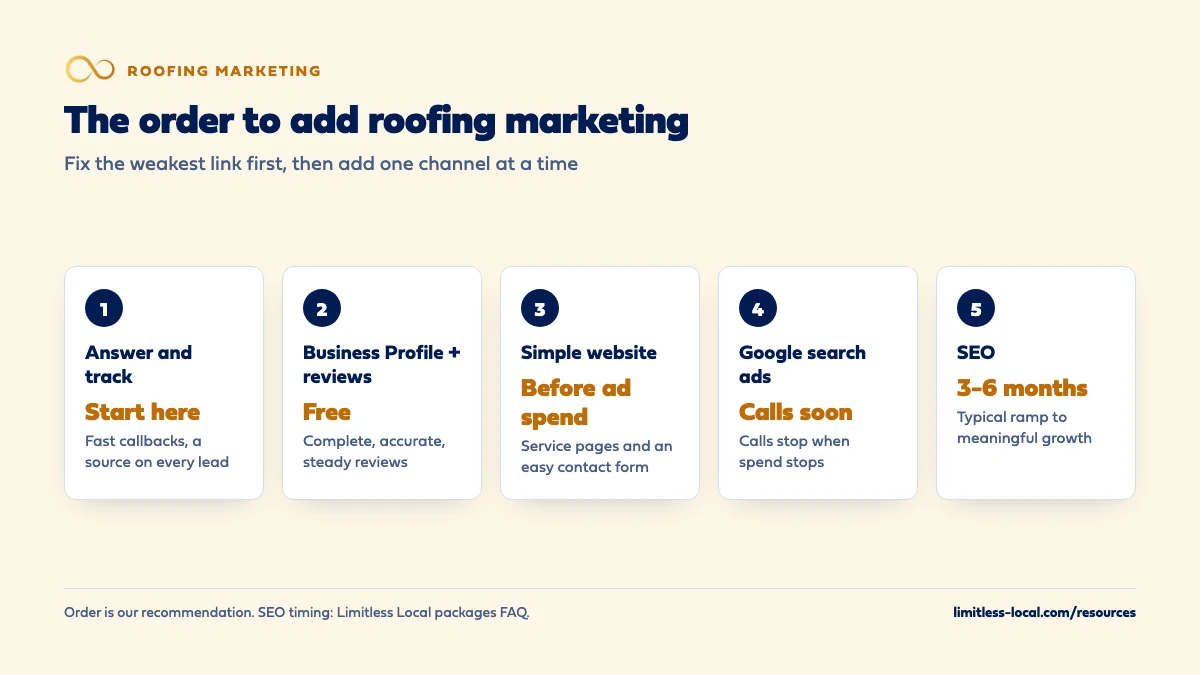
Add marketing in the order that fixes your weakest link first: tracking and fast follow-up, then a complete Google Business Profile with steady reviews, then a simple website, then Google search ads for calls you can switch on quickly, then SEO for the long ramp. Most roofers who are stuck don’t need a new channel; they need to stop losing the leads they already get. Add one channel at a time and give it enough budget and months to judge before adding the next.
Our packages follow the same order: build the foundation (tracking, follow-up, a clean online presence), turn on lead flow with local SEO and ads, then improve month by month. See how that works on our marketing packages page and on roofing marketing. For every channel side by side, the roofing marketing guide lays them out, and the roofing marketing questions library answers the follow-ups one at a time.
Why does the order you add roofing marketing matter?
Because each piece feeds the next. Ads send people to your Business Profile and website. Your profile and website decide whether they call. Your phone and follow-up decide whether the call turns into an inspection. Add ads on top of a weak profile and a phone nobody answers, and you pay to send homeowners to a leak in your own process.
Order also protects your cash. A roofing company that adds Google Ads, Local Services Ads, SEO, social media and direct mail in the same month can’t tell which one worked, so it can’t tell which one to keep. Adding one thing at a time, with a budget and a review date, gives you an answer. That’s our judgement, and it’s the same logic the SBA gives small businesses: track where each new customer came from, even if it’s as simple as asking them, so you can put money behind what works (SBA).
What should a roofing company fix before adding any new marketing?
Two things, and neither is a channel:
- Answering and follow-up. Someone needs to answer calls live or call back within minutes, and every web form needs a reply the same way. Roofing crews are on roofs all day, so this usually means an office person, an answering service, or both. How fast to call back a new lead sets the standard.
- Tracking. Use a separate tracking number per channel, log every lead with its source, and mark which ones became inspections and signed jobs. Google Ads can count calls from your ads and from your website as conversions (Google Ads Help), but you still need your own log for referrals, yard signs and door knocking. Tracking which leads turn into signed jobs covers the setup.
If you skip these, every channel you add later will look worse than it is, and you’ll cut things that were working.
Is the Google Business Profile the first real channel to add?
For most roofers, yes. It’s free, it’s what homeowners see in the map results when they search for a roofer nearby, and it keeps working whether or not you’re paying for ads.
Google says local results are mainly based on relevance, distance, and popularity, and that businesses with complete and accurate info are more likely to show up in local search results (Google Business Profile Help). That gives you a short to-do list: the right primary category, your real service area, your services, hours, photos of your own crews and roofs, and replies to reviews. Google also notes that positive reviews and helpful replies can help a business stand out.
Getting the details consistent pays off. From our own work: “A roofing client got 3x map pack visibility in its target towns; better presence and consistent info across the web increased inbound calls.” That’s one client’s past result, not a forecast. Why a roofer isn’t showing on Google Maps covers the common blockers.
When should a roofer start asking for reviews?
Now, alongside the profile. Reviews are slow to build and they help every other channel: a homeowner who clicks your ad or finds your website usually checks your rating before calling. Make the ask part of the job: at the final walk-through or when the invoice is paid, with a direct link sent by text.
Keep the ask clean: ask every customer, not just the happy ones, and don’t attach a discount or gift to it.
Curious what your marketing is actually booking?
Get a free visibility audit — no obligation, no sales pitch.
Does a roofing company need a website before running ads?
For Google search ads, yes in practice: the ad needs somewhere to send people, and a page that loads fast on a phone, shows your service area and makes calling easy will turn more clicks into calls. It doesn’t need to be big. A home page, a page for each main service (replacement, repair, storm damage) and a contact page with a short form is enough to start.
If you only have a Facebook page today, a Facebook page instead of a website explains why that caps you. The website should come before you spend real money on ads, not after. That’s our judgement based on how ads and landing pages work together, not a Google rule.
Should a roofer add Google Ads or SEO first?
It depends on how soon you need calls and how much cash you can tie up waiting.
- Google search ads can bring calls within days of launch. You set an average daily budget and you pay when someone clicks (Google Ads Help). The tradeoff: the calls stop when the spend stops.
- SEO typically takes three to six months to show meaningful organic growth. The tradeoff: it keeps working after the work is done, and it lowers what you need to spend on ads over time.
Our usual answer for a roofer with no paid lead flow: add Google search ads first for near-term calls, start SEO at the same time or soon after if the budget allows, and let ads carry you while SEO ramps. If cash is tight, do the free Business Profile and review work first and add ads when you can afford to run them for a few months straight. Whether $1,000 a month is enough covers small budgets.
Where do Local Services Ads fit in the order?
After the Business Profile and reviews are in shape, because Google Ads pre-fills these campaigns from your Business Profile details, and in our judgement a thin profile undercuts any lead they bring. Local Services Ads charge per lead rather than per click, and they’re in the middle of a change: Google is moving them into the Google Ads platform as Performance Max campaigns with pay-per-lead goals, and roofing is named in the first phase starting August 2026 (Google Ads Help).
For a roofer, they’re a reasonable second paid channel once search ads are running and tracked, or a first one if you’d rather pay per lead than per click. Whether LSAs are worth it for roofers covers the tradeoffs.
When does social media, direct mail or door knocking make sense?
Later, and as support rather than the main engine, in our judgement. Homeowners rarely go looking for a roofer on social media until they need one, so Facebook works best as remarketing to people who already visited your site, and as proof that you’re active. Direct mail and yard signs work best around jobs you’re already doing in a neighborhood.
Door knocking can produce inspections quickly after a storm, but it depends on people, not systems, and it stops the day the crew stops knocking.
How much budget should each new channel get before you judge it?
Enough to produce a real sample, for long enough to see it. A channel that gets a few hundred dollars for a few weeks hasn’t been tested; it’s been sampled. For Google search ads, plan on at least a few months before judging cost per booked job, because roofing sales take time to close. For SEO, judge leading signals (map visibility, impressions, calls from the profile) for the first few months, and leads after that.
Write down the review date and the number that decides it before you start. Cost per signed job is the best one, because it accounts for both lead cost and how well leads close.
How do you know it's time to add the next channel?
Add the next one when the current one is stable, not when it’s struggling. Three signs it’s time:
- The channel produces signed jobs at a cost you’re happy with, month after month.
- Spending more on it stops producing proportionally more leads.
- Your crews and estimators have room for more work.
If a channel is losing money, fix it or cut it before adding another. Adding a second channel to cover a broken first one usually doubles the problem. That’s judgement, but it’s the pattern behind most “we tried everything and nothing worked” stories.
Not sure which of these is costing you jobs?
A free visibility audit checks the Google profile, reviews, site and tracking, and shows what to fix first.
What's different about growing a roofing company's marketing
High ticket, slower close. A roof replacement is a big decision with an inspection, an estimate and often a second visit before anyone signs. Judge channels on signed jobs over months, not calls in a week.
Storms change everything for a few weeks. Hail and wind bring demand you don’t have to create. The foundation work (answering, tracking, reviews) is what lets you capture it; a new channel added mid-storm is hard to judge.
Repairs and replacements are different buyers. Repair calls are urgent and small; replacements are researched and large. Decide which one you’re growing before choosing a channel, because ads and pages for each read differently.
Trust carries extra weight. Homeowners worry about storm chasers and scams, so reviews, a real address or service area, and photos of your own work matter more for roofers than for many trades. That’s our judgement, not a sourced rule.
A worked example: picking the next channel for a referral-only roofer
These numbers are made up to show the reasoning, not a benchmark. A roofer gets most of its work from referrals and signs about 6 replacements a month. The owner wants 10. The office misses calls when the one office person is out, there’s no tracking, the Business Profile has 18 reviews and no photos, and there’s a five-page website.
- Month one: fix answering (an answering service for gaps), add call tracking, finish the profile, start asking every job for a review.
- Month two: tighten the website’s service pages and contact form.
- Month three onward: launch Google search ads on replacement and repair keywords in the core towns, with a set budget and a review date three months out.
- After that: if ads produce signed jobs at an acceptable cost, start SEO for the long term; if they don’t, fix the ads or the follow-up before adding anything.
The point of the example is the order, not the numbers: the free fixes come first because they make every paid dollar after them work harder.
Frequently asked questions
Can I skip the website and go straight to ads?
You can, but you’ll usually pay for clicks that don’t turn into calls. A simple site with service pages and a clear contact form is a better first step before real ad spend.
Is SEO a waste of money for a small roofing company?
No, but it’s slow. It typically takes three to six months to show meaningful organic growth, so it suits owners who can wait while something else brings calls in.
Should I hire a marketing person before adding channels?
Usually not first. Most small roofers get more from fixing answering and tracking first, and from someone who can run the channels they already have.
How many channels should a roofing company run at once?
As many as you can track and manage well. For most small roofers that’s the Business Profile plus one or two paid channels, in our judgement.
Does a better Business Profile replace paid ads?
Not fully. It can bring steady calls from map results, but ads let you add calls on demand. Most growing roofers use both.
What if I'm already busy from referrals?
Then build the foundation first so you’re ready when referrals slow, and add paid channels only when crews have room.
Key takeaways
- Fix answering and tracking before adding any channel.
- A complete Google Business Profile and steady reviews come next because they’re free and help every channel after.
- Get a simple website in place before spending real money on ads.
- Google search ads bring calls soon; SEO ramps over months. Many roofers run ads while SEO builds.
- Add one channel at a time with a budget, a review date and a cost per signed job that decides it.
Want a second set of eyes on your setup?
We'll look at how you show up locally and where calls are leaking, then send you a plain-English breakdown.
More in this section
- How should a roofing company market commercial roofing?
- Is door knocking or online marketing better for a roofing company?
- How should roofing marketing change when adding more crews?
- How do I market a roofing company in the slow season?
- How should a roofing company market metal roof installs?
Sources
- Tips to improve your local ranking on Google — Google Business Profile Help
- Using Google Ads for online marketing — Google Ads Help
- About phone call conversion tracking — Google Ads Help
- Local Services Ads transition to Performance Max campaigns with pay-per-lead goals — Google Ads Help
- How to Get the Most From Your Marketing Budget — U.S. Small Business Administration