
Is door knocking or online marketing better for a roofing company?
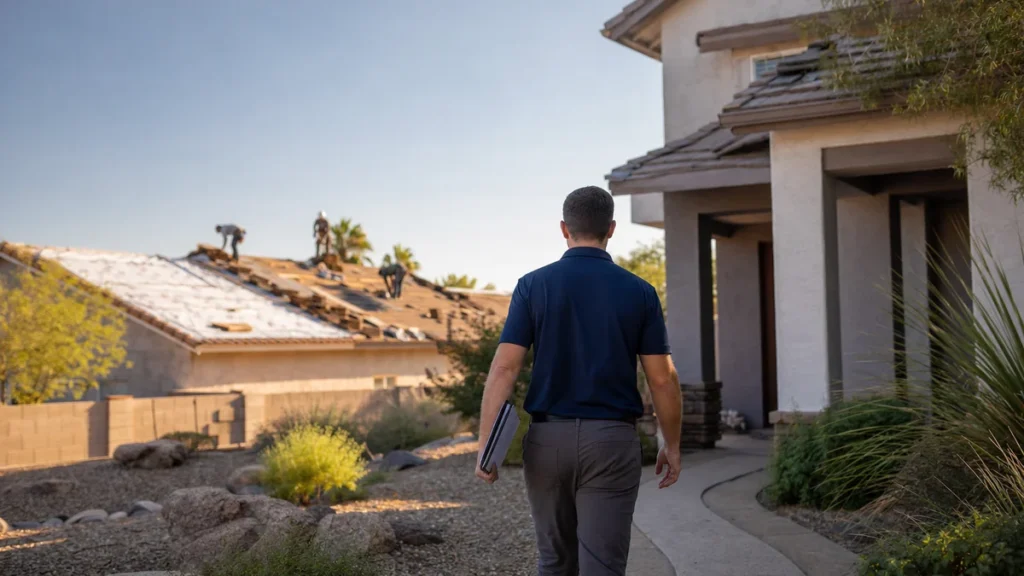
- Should a roofing company put its effort into canvassing or into Google?
- What does door knocking do well for a roofing company?
- What does online marketing do that door knocking can't?
- Why are homeowners wary of roofers who knock on their door?
- What rules apply to roofers who sell door to door?
- Which brings in cheaper signed jobs, canvassing or online?
- When does door knocking make the most sense?
- When should a roofer put the effort online instead?
- How do door knocking and online marketing work together?
- How should I track canvassing next to online leads?
- What's different about this choice for roofing companies
- A worked example: comparing the cost per signed job
- Frequently asked questions
- Key takeaways
- More in this section
- Sources
The short version
- Door knocking works best around an active job or right after a storm in towns you already serve.
- Online marketing reaches homeowners who are already searching, every day, and keeps working when your reps go home.
- Homeowners are warned about door-to-door roofers, and some states restrict soliciting roof and insurance work.
- Compare both by cost per signed job, with every lead tagged by where it came from.
For roofing owners deciding where the next dollar and the next hour go: a canvassing team, or a Google profile, website and ads that work year-round.
Get a free visibility audit · Book a growth call
Should a roofing company put its effort into canvassing or into Google?
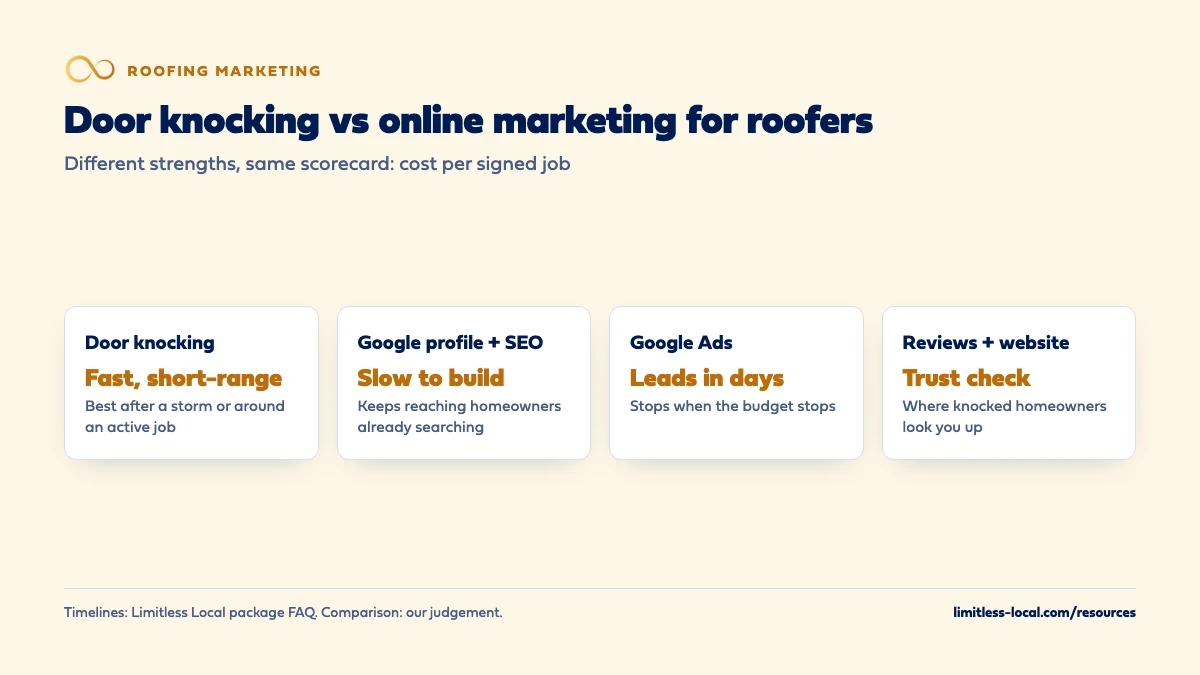
For most roofing companies, online marketing is the better year-round foundation and door knocking is a short-range tool: canvassing can turn one job or one storm into a cluster of nearby inspections, but it stops the day your reps stop walking, while a Google profile, reviews, a clear website and ads keep reaching homeowners who are already looking for a roofer. Door knocking also carries more risk, because consumer agencies warn homeowners about door-to-door contractors and some states restrict how roofers solicit, especially around insurance claims. Many roofers do best with both, judged by the same number: what each signed job cost.
Cost per signed job is how we’d settle the question for any roofer, and it’s why every one of our marketing packages includes call and form tracking: so canvassing, Google and everything else can be compared on the same line. Our roofing marketing work covers the online side. For the storm-week playbook, including neighbor loops, the storm-season roofing marketing guide goes step by step, and the roofing marketing questions library takes the rest one question at a time.
What does door knocking do well for a roofing company?
In our judgement, canvassing has three real strengths:
- It’s fast and you control the volume. Send two reps into a neighborhood this afternoon and you’ll have conversations by evening. No waiting on rankings or ad approvals.
- It reaches people who aren’t looking yet. Plenty of homeowners don’t know a storm damaged their roof until someone points it out. Search only reaches people who already have a reason to search.
- It clusters work. When you’re already on one roof, the houses on either side often went through the same weather. A few knocks can turn one job into several on the same street, which also cuts drive time for your crews.
Its weaknesses are just as plain: it stops when the reps stop, it depends on hiring and keeping good canvassers, and the homeowner at the door didn’t ask for you to be there.
What does online marketing do that door knocking can't?
It catches the homeowner at the moment they decide they need a roofer: the leak over the kitchen, the shingles in the yard, the replacement they’ve been putting off. Those people search, and they choose from whoever shows up and looks trustworthy.
Google says local results are mainly based on relevance, distance and prominence, and that more reviews and positive ratings can help a business’s local ranking (Google Business Profile Help). That work keeps paying after it’s done, unlike a canvassing shift. The honest catch is timing: ads can bring in leads within days of launch, while SEO typically takes 3-6 months to show meaningful growth. Ads also stop producing when the budget stops; the profile, review and website work is slow to build but keeps working. If your Google profile isn’t showing up at all, why a roofing company isn’t on Google Maps is the first thing to fix.
Why are homeowners wary of roofers who knock on their door?
Because they’re told to be. The Texas Department of Insurance tells homeowners to use a local company, verify the contractor’s local address and phone number, and be wary of contractors who go door to door looking for business (Texas Department of Insurance). The FTC’s advice after weather emergencies warns that unlicensed contractors and scammers often show up in recovery areas, and tells homeowners to walk away from anyone who wants cash up front, and calls it a red flag if a contractor won’t give them copies of a license, insurance or a written contract (FTC Consumer Advice).
A legitimate local roofer’s reps carry that baggage whether they deserve it or not. In our judgement, the answer is to make your canvassers easy to check: a company shirt and ID, a printed leave-behind with your local address and license number, no pressure to sign on the spot, and an online presence that holds up when the homeowner looks you up after you leave.
What rules apply to roofers who sell door to door?
This is general information, not legal advice, and rules vary by state and city, so have your contracts and canvassing script checked where you work. A few examples of what’s out there:
- The FTC’s Cooling-Off Rule. It gives buyers three days to cancel certain sales made at their home, lasting until midnight of the third business day, and the seller has to tell the buyer about that right at the time of the sale and provide cancellation forms. It doesn’t cover sales under $25 made at home, or sales needed to meet an emergency (FTC Consumer Advice).
- Florida. State law bars contractors from offering homeowners a rebate, gift, cash, a deductible waiver or anything else of value in exchange for letting them inspect the roof or for making a roof insurance claim. It also bars soliciting homeowners, including in person or by delivery, with materials such as door hangers, business cards and flyers that encourage a roof insurance claim unless they state, in a required type size, that the homeowner pays the deductible and that waiving deductibles or filing false claims is insurance fraud. It treats the acts of anyone paid to solicit for a contractor as the contractor’s own acts, and gives homeowners a 10-day cancellation right on roof contracts signed within 180 days of events behind a governor’s state-of-emergency declaration in the declared area (Florida Statutes).
- Texas. In Texas, contractors can’t act as a public adjuster on a job they’re doing, or advertise that they will, and it’s illegal to offer to waive, rebate or absorb a deductible (Texas Department of Insurance).
Many cities and counties also have their own rules on door-to-door selling, so check locally before a crew of reps hits the street.
Curious what your marketing is actually booking?
Get a free visibility audit — no obligation, no sales pitch.
Which brings in cheaper signed jobs, canvassing or online?
There’s no honest national answer, and anyone quoting one is guessing about your market. It depends on your reps, your towns, the weather and how good your online presence already is. What you can do is measure both the same way.
For canvassing, count everything it costs: rep pay or commission, training, the owner’s or sales manager’s time, leave-behinds and yard signs, and the inspections that go nowhere. For online, count ad spend, management, the website and the review work. Divide each by the jobs it signed, not the doors knocked or the clicks bought. The worked example below shows the math with made-up numbers.
In our judgement, one difference is easy to miss: commission-heavy canvassing costs rise and fall with sales, while online costs are steadier but keep producing in months when nobody is out walking.
When does door knocking make the most sense?
- Right after a storm in towns you already serve and can get back to, not three counties away.
- Around an active job, where the crew, the truck and the yard sign are your introduction.
- In neighborhoods full of roofs the same age, where one replacement often means more coming.
- When you have reps you trust to be polite, honest and easy to verify.
In our judgement, it works best when the online side is already solid, because homeowners you knock on will look you up before they call back. The FTC tells homeowners to check reviews and search a contractor’s name with words like “scam” or “complaint.” If they find a thin Google profile and no website, the knock is wasted.
When should a roofer put the effort online instead?
- Repairs and leaks. The homeowner already knows they need help and is searching right now.
- Replacement shoppers. People planning a replacement compare roofers over weeks, mostly online, and read reviews and websites before they let anyone up a ladder.
- The slow season. Nobody wants a knock in January. Marketing a roofing company in the slow season covers what to do instead.
- Commercial work. The person who signs isn’t at the door. How to market commercial roofing covers that buyer.
- No canvassing team. If the owner is the canvasser, the hours are usually better spent on estimates and on the jobs themselves.
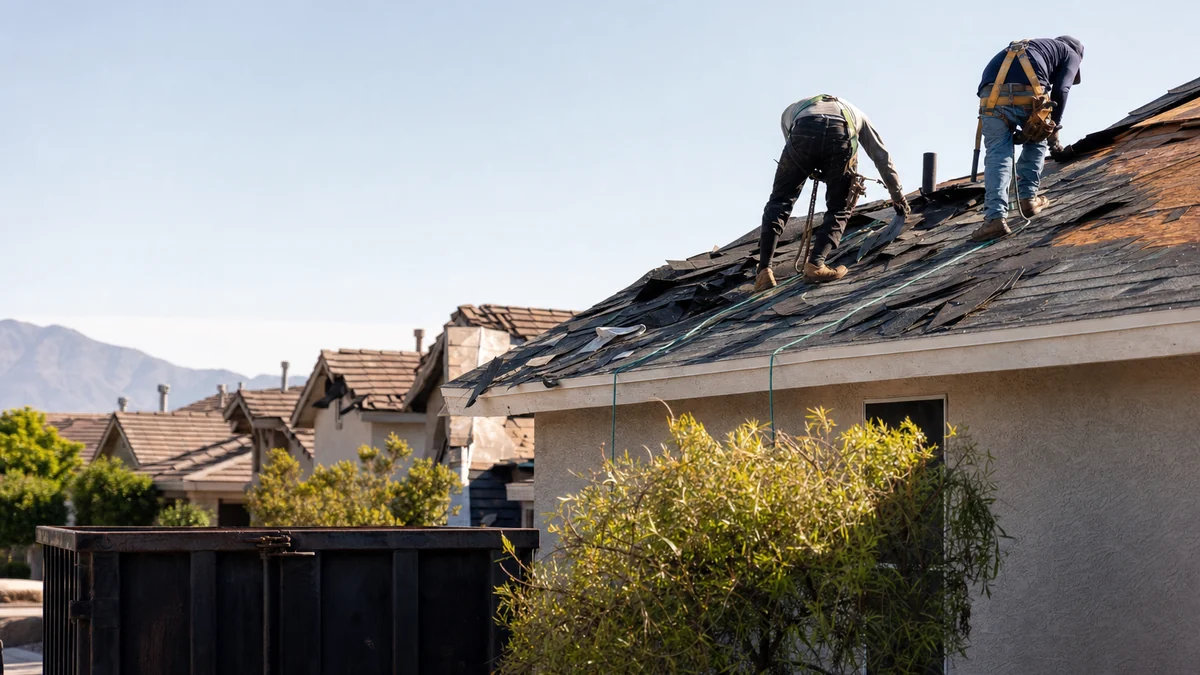
How do door knocking and online marketing work together?
Better than either alone, in our view. A few ways they feed each other:
- The leave-behind points online. A card or door hanger with a QR code to your storm page or reviews gives the homeowner a way to check you without calling. If it mentions insurance claims, check your state’s rules on what it has to say; Florida’s are above.
- Every finished roof becomes a review. Neighbors who were knocked on will read reviews from their own street. Getting more reviews after a roof replacement covers the ask.
- Yard signs and trucks send people to search. Someone who sees your sign may search your name later, and should find a profile and site that match the sign.
- Fast call backs close both. A homeowner who calls back after a knock or fills out a form at night expects to hear from you quickly.
How should I track canvassing next to online leads?
Give every lead a source the moment it comes in, and make canvassing its own source, ideally one per rep or per neighborhood. Field service software handles this: Housecall Pro, for example, has a lead source field that tracks where customers found you on customers, jobs and estimates, so you can see which sources bring in good jobs (Housecall Pro Help Center).
The mistake to avoid: a homeowner who was knocked on, then searched your name and filled out your website form, gets tagged as a website lead, and canvassing looks worse than it is. Ask “how did you first hear about us?” on every call. Tracking which roofing leads turn into signed jobs covers the rest of the setup.
What's different about this choice for roofing companies
Storms change the math for a few weeks. Right after hail, every roofer in the area is knocking and bidding on ads at the same time. In our judgement, the roofer who already has reviews, a storm page and a fast call back gets more out of both channels than the one starting from scratch that week.
Insurance makes canvassing riskier than in other trades. Much of the storm-door pitch involves claims, and that’s exactly where states like Florida and Texas draw lines on inducements, deductibles and acting like an adjuster. Train reps to offer an inspection and leave insurance questions to the homeowner’s agent and adjuster.
Roofs are high-ticket and, leaks aside, rarely a same-day emergency. That gives homeowners time to check you out. Whatever brought them to you, the decision usually gets made after they’ve looked you up.
Want to see where your company stands?
A free visibility audit shows where you show up on Google, Maps and AI answers, and what it's costing you in calls.
A worked example: comparing the cost per signed job
These numbers are made up to show the math, not a benchmark for your market. Say you compare one month of each.
Canvassing: two reps at $4,000 each in pay and commission is $8,000, plus $400 in leave-behinds and signs, for $8,400. They knock about 600 doors, book a stack of inspections, and 6 become signed jobs. That’s $8,400 / 6 = $1,400 per signed job.
Online: our Essentials package at $3,500 a month plus $2,000 in Google Ads spend (paid to Google separately) is $5,500. Say the calls and forms it brings in lead to 5 signed jobs. That’s $5,500 / 5 = $1,100 per signed job.
In this made-up month, online wins, but flip a few inputs (a big storm, a great rep, a brand-new Google profile that hasn’t ramped yet) and canvassing wins. That’s the point: run the same math on your own numbers every month instead of trusting anyone’s rule of thumb, ours included. If you’d like help setting up the tracking to do it, that’s what a free visibility audit starts with.
Frequently asked questions
Do I need a permit for my roofing reps to knock on doors?
It depends on where you work. Many cities and counties have their own rules on door-to-door selling, so check with each one before sending reps out.
Can my canvassers tell homeowners we'll handle their insurance claim?
Be very careful, and treat this as general information, not legal advice. Texas bars contractors from acting as a public adjuster on their own jobs or advertising that they will, and Florida restricts inducements tied to inspections and claims. Train reps to offer an inspection and leave coverage questions to the homeowner’s insurer.
Should I pay my canvassers per signed job or per hour?
That’s a staffing call more than a marketing one. Whatever you choose, track signed jobs per rep, because doors knocked and inspections booked can look good while signed work stays flat.
Does door knocking hurt my online reputation?
It can if reps are pushy, because the homeowner may leave a review or complain. Polite, easy-to-verify reps who leave a card and walk away tend to avoid that, in our judgement.
Can I door knock for commercial roofing?
Rarely with much success, in our view, because the person who signs usually isn’t in the building. Commercial buyers respond better to direct outreach, vendor lists and relationships.
How fast does online marketing start bringing roofing leads?
Ads can bring in leads within days of launch. SEO typically takes 3-6 months to show meaningful growth, so start it before you need it.
Key takeaways
- Door knocking is fast and short-range; online marketing keeps working when your reps go home.
- Canvass right after storms and around active jobs, in towns you actually serve.
- Homeowners are told to be wary of door-to-door contractors, so make your reps and your company easy to check online.
- Know the rules where you work: the FTC’s Cooling-Off Rule, plus state limits like Florida’s and Texas’s on claim-related soliciting.
- Tag every lead by source and compare channels by cost per signed job.
Not sure what's working right now?
Start with a free visibility audit: rankings, Google profile, reviews and tracking, checked against your service area.
More in this section
- How should a roofing company market commercial roofing?
- How do I market a roofing company in the slow season?
- Should my roofing marketing go after repairs or replacements?
- How do I know if my roofing marketing agency is getting results?
- Are Google Local Services Ads worth it for a roofing company?
Sources
- Is it OK for a contractor to waive my deductible? — Texas Department of Insurance
- Roofing and insurance: Know the law — Texas Department of Insurance
- How To Avoid Scams After Weather Emergencies and Natural Disasters — FTC Consumer Advice
- Buyer's Remorse: The FTC's Cooling-Off Rule May Help — FTC Consumer Advice
- Florida Statutes 489.147: Prohibited property insurance practices; contract requirements — The Florida Senate
- Tips to improve your local ranking on Google — Google Business Profile Help
- How to Use Lead Sources — Housecall Pro Help Center