
How do I know if my roofing marketing agency is getting results?
- How can a roofing company tell if its marketing agency is worth the money?
- What should a roofing marketing report show every month?
- Why is one month of roofing numbers misleading?
- Does Google Ads count a roof that signs weeks after the click?
- How do I match the agency's leads to signed jobs in my own software?
- How do I check that the leads are real roofing leads?
- How do I keep door knocking, referrals and storm work out of the agency's numbers?
- How long should I give a roofing marketing agency before judging it?
- What should I ask my roofing marketing agency at the next review?
- Do I own my Google Ads account, Google profile and website?
- What are the red flags that a roofing agency isn't getting results?
- Is it the agency, or is it my sales process?
- What's different when you judge roofing marketing
- A worked example: why one month can make a good agency look bad
- Frequently asked questions
- Key takeaways
- More in this section
- Sources
The short version
- Judge the agency on signed contracts and cost per signed job, with its fee and your ad spend both counted.
- Roofs sign weeks after the first call, so look at a rolling three months, not one month.
- Keep door knocking, referrals and storm work separate from the leads the agency brought in.
- Check the agency's lead count against your own software and listen to the recorded calls.
For roofing company owners who already pay an agency and want to know whether it’s producing signed jobs, not just reports.
Get a free visibility audit · Book a growth call
How can a roofing company tell if its marketing agency is worth the money?
Your roofing marketing agency is getting results if it can show which leads turned into inspections, estimates and signed contracts, and what each signed job cost you once its fee and your ad spend are added together. Because a roof replacement often signs weeks after the first call, judge those numbers over a rolling three months instead of a single month. Keep storm work, door knocking and referrals in their own columns so the agency is judged only on the work it brought in. Clicks, impressions and rankings only count when they end in signed jobs.
We’re an agency too, so this is the standard we hold ourselves to. Every one of our roofing marketing packages includes call tracking with recording and transcription, form and chat lead tracking, a real-time dashboard and a monthly report with a cost-per-lead breakdown, all laid out on our packages page. If you’re still comparing agencies rather than judging the one you have, how to choose a roofing SEO company has the checklist. The rest of the roofing marketing questions library goes question by question.
What should a roofing marketing report show every month?
A useful report follows a lead all the way to a signature. For a roofing company that means these lines, broken out by channel (Google Ads, Local Services Ads, Maps and organic search, Meta):
- Leads: calls, forms and messages, with spam, sales pitches and existing customers taken out or at least marked.
- Inspections booked and run. A lead that never gets a ladder on the roof hasn’t been tested yet.
- Estimates sent.
- Contracts signed, split into repairs and replacements, and retail and insurance work if you do both.
- Total cost: the agency’s fee plus your ad spend.
- Cost per signed job: total cost divided by signed contracts.
The middle steps matter more in roofing than in most trades, because the gap between a call and a signature is long. If the report stops at leads, you can’t tell whether the agency brought in bad leads or your team lost good ones. Setting up the tracking behind those lines is covered in tracking which roofing leads sign.
Why is one month of roofing numbers misleading?
Two reasons. First, the lag. A homeowner calls, you inspect, you send an estimate, they compare bids, and on insurance work they may wait on an adjuster. By the time the contract is signed, the lead that started it sits in last month’s report, so a month that looks dead can be the month that filled your pipeline.
Second, the size of the jobs. When a single replacement is worth more than a stack of repair calls, one contract more or less swings the whole month. In our judgement, a rolling three months is the shortest window that tells you much, and comparing against the same season last year beats comparing against last month.
That isn’t an excuse for no progress: leads, inspections and estimates should still be moving in a month when few contracts sign.
Does Google Ads count a roof that signs weeks after the click?
Only if the account is set up for it. Google Ads records a conversion only inside a conversion window, the period after an ad click during which a conversion counts. For Search campaigns the default window is 30 days, and Google says a custom window suits businesses whose buying cycle doesn’t fit that default. You can set it anywhere from 1 to 90 days depending on the conversion source, and a conversion that happens after the window closes isn’t recorded (Google Ads Help).
The second piece is getting the signed contract back into Google Ads at all. Google’s offline conversion import exists for exactly this: you keep the click ID with the lead, and when that person converts offline, by signing a contract for example, you send it back so Google Ads records it with your other conversions. For accounts that haven’t set this up yet, Google recommends starting with enhanced conversions for leads, an upgraded version of the same idea (Google Ads Help).
Ask your agency two things: what conversion window your lead and sale conversions use, and whether signed contracts are being imported. In our judgement, if neither is set up, the ad account is learning from phone calls and form fills, not from roofs.
How do I match the agency's leads to signed jobs in my own software?
Your job management software is the scoreboard, not the agency’s dashboard. Two ways to make the numbers line up:
- Record the source on every lead. In Jobber, the Lead Source Report shows, for each source, how many leads came in and how many went on to a quote, a job and an invoice, along with the value of the first invoice tied to each lead (Jobber Help Center). That’s close to the funnel a roofer needs.
- Capture callers who aren’t ready to book. In ServiceTitan’s roofing help, a caller who isn’t ready to book a job can be saved as a lead so your team can follow up and convert it to a job later, which requires call reasons classified as leads (ServiceTitan Help). Without a step like that, many of the calls that turn into roofs later never show up as leads at all.
Then compare your signed jobs by channel with what the agency reports. If the two are far apart, ask why; the cause is often fixable, such as duplicate leads or a tracking number missing from a listing.
How do I check that the leads are real roofing leads?
Listen to them. Call tracking can record calls by source, and Google Ads can count calls from your ads and website as conversions, with a minimum call length you set, to show which campaigns bring in the most valuable calls (Google Ads Help). Pull a handful of recordings each month and ask four questions:
- Was it a homeowner or property manager, or a vendor selling you something?
- Is the address inside the area you actually serve?
- Was it work you want: a replacement, a repair, gutters, or something you don’t do at all?
- Did your team get an inspection on the calendar?
If most of the calls are small repairs and you sell replacements, the leads are real but the targeting is off, which is worth a conversation about going after repairs or replacements. If the calls are fine and inspections still don’t get booked, the problem is closer to home.
Curious what your marketing is actually booking?
Get a free visibility audit — no obligation, no sales pitch.
How do I keep door knocking, referrals and storm work out of the agency's numbers?
Give every source its own label and keep it that way. Roofers often run several lead sources at once: canvassers after a hailstorm, yard signs, referrals and whatever the agency runs online. If it all lands in one pile, the agency can get credit for jobs your canvassers knocked, or blame for a month your crew was too busy to knock.
Storms skew the numbers most, so ask for storm-area leads to be reported separately. How the offline and online channels compare is covered in door knocking versus online marketing.
How long should I give a roofing marketing agency before judging it?
It depends on the channel. Ads can bring in leads within days of launching. SEO is a ramp, typically 3 to 6 months before it shows meaningful growth in organic search, because Google has to find, trust and rank your pages and profile. Nobody can honestly promise a date for either.
Roofing adds the sales cycle on top: the first signed contracts trail the first calls by however long your inspections and estimates take. So judge ads first on leads and inspections, then on signed jobs. Judge SEO first on early signs, such as pages published and your Google Business Profile cleaned up, and later on calls and contracts.
What should I ask my roofing marketing agency at the next review?
Google’s own advice for hiring an SEO includes asking what results to expect and in what timeframe, how success is measured, and whether the company will explain all the changes it makes (Google Search Central). Those work just as well for an agency you already pay. For a roofing company, add these:
- How many signed contracts came from your work over the last three months, and what did each one cost me, fee and ad spend included?
- How many inspections and estimates came from your leads, and how many are still open?
- Which channel brings in replacements, and which brings in mostly small repairs?
- Are door-knocking, referral and storm leads kept out of your numbers?
- What conversion window does the ad account use, and are signed contracts imported?
- What would you stop spending on if this were your money?
If the answers keep coming back as more charts, that tells you something.
Do I own my Google Ads account, Google profile and website?
You should, and you can check today.
- Google Ads. Google lists five access levels: Email-only, Billing, Read-only, Standard and Admin. Only Admin users can give account access, change access levels and unlink manager accounts (Google Ads Help). You want at least one Admin login that belongs to the business, not to the agency.
- Google Business Profile. A profile can have several owners but only one primary owner, and owners can add or remove users and even delete the profile. Managers can edit info, respond to reviews and manage posts, but can’t add or remove users or remove the profile (Google Business Profile Help). You should be the primary owner and the agency a manager.
- Website and domain. The domain should be registered to your company, with your own logins to the hosting and the site’s admin.
In our judgement, that’s easier to sort out while the relationship is good.
What are the red flags that a roofing agency isn't getting results?
- Reports that stop at leads, with nothing on inspections, estimates or signed contracts.
- Booked inspections presented as wins. An inspection is a step, not a sale.
- Your door-knocking or referral jobs showing up as the agency’s results.
- No call recordings, or a lead count you can’t check against your own software.
- Promised rankings or lead counts. Google’s hiring advice says no one can guarantee a #1 ranking on Google (Google Search Central).
- Clicks with no calls, month after month, with no plan to fix it. Roofing ads that get clicks but no calls walks through the usual causes.
One red flag is a question to raise. Three or four together usually mean it’s time to plan a change.
Is it the agency, or is it my sales process?
Sometimes the leads are fine and the jobs are lost after the phone rings. Roofing has more places to lose a deal than most trades: the call that isn’t returned until the next day, the inspection that gets pushed back, the estimate that goes out and is never followed up while the homeowner weighs other bids.
The quickest way to find out is to look at each step on its own. How many leads came in, how many got a call back, how many got an inspection, how many got an estimate, and how many signed. If the drop happens between estimate and signature, a new agency won’t fix it. Start with how fast to call back and following up on unsigned estimates.
Not sure which of these is costing you jobs?
A free visibility audit checks the Google profile, reviews, site and tracking, and shows what to fix first.
What's different when you judge roofing marketing
Few jobs, big tickets. An HVAC or plumbing shop can judge a month on a long list of booked calls. A roofer selling replacements may sign a handful of contracts in the same month, so a single job more or less changes the picture. Look at signed revenue alongside the contract count, and use longer windows.
Retail and insurance work move at different speeds. A retail replacement can sign at the kitchen table. Insurance work can wait on the homeowner’s claim and the adjuster. Report the two separately so a slow stretch of insurance approvals doesn’t look like the marketing stopped working.
Storms make everyone look good. Demand after a storm comes from the weather, not the agency. The real test is the weeks between storms, when the agency has to find homeowners who weren’t already looking for a roofer.
A worked example: why one month can make a good agency look bad
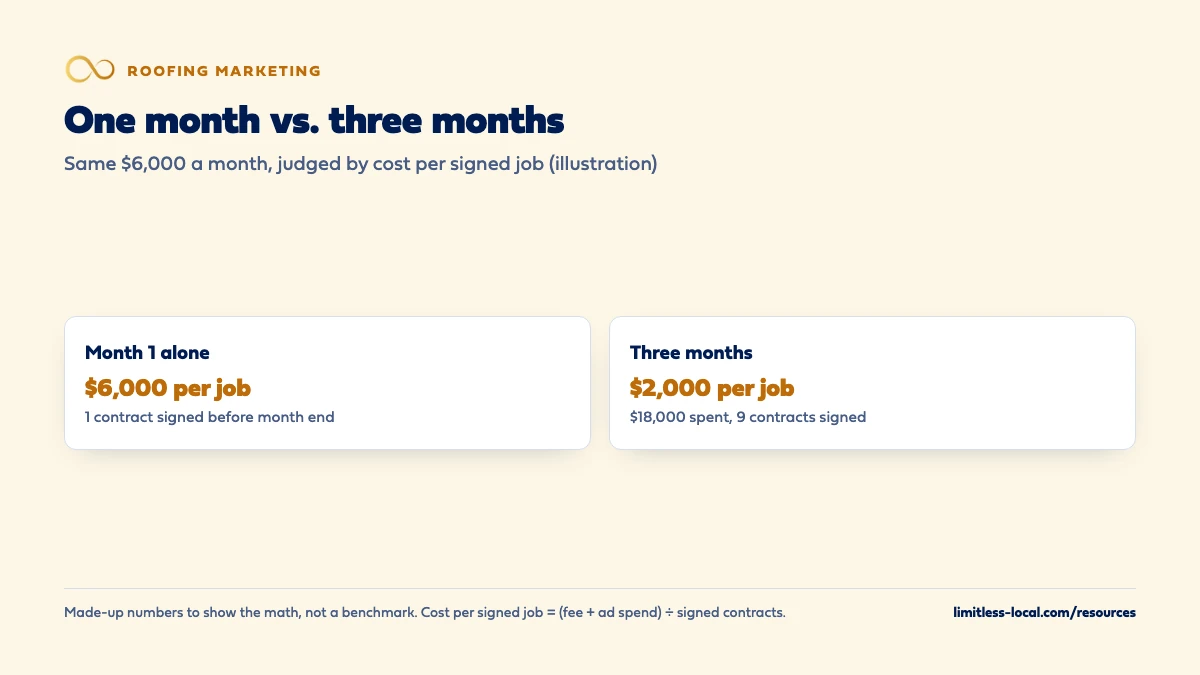
These numbers are made up to show the math, not a benchmark for your market. Say you spend $6,000 a month on the agency’s fee and ad spend combined.
- Month 1: the agency’s work brings in 40 leads. Most get inspected and quoted, but only 1 contract signs before the month ends. Judged on that month alone, the cost per signed job is $6,000.
- Months 2 and 3: many of those estimates close, along with new ones, and 4 contracts sign in each month.
- Three months together: $18,000 spent and 9 signed contracts, or $2,000 per signed job.
Same agency, same work. One view says fire them; the other says the work is paying off. Whether $2,000 per signed job is good depends on your average contract and margin, which only you know.
For reference, our Essentials package is $3,500 a month and includes Google Ads management for up to $2,500 a month in ad spend, call, web and form tracking, a real-time dashboard and a monthly report. Ad spend is paid to Google separately. Whether that’s worth it comes down to this same cost-per-signed-job math, which is what a free visibility audit is for.
Frequently asked questions
Should my agency count booked inspections as results?
Count them as progress, not results. Inspections are a good early sign that the leads are real, but ask for inspections and signed contracts as separate lines so one can’t stand in for the other.
What conversion window should a roofing company use in Google Ads?
For Search campaigns, Google lets you set a click-through conversion window of up to 90 days, depending on the conversion source, and the default is 30. Google suggests checking the time lag report in your attribution reports to see how long your conversions actually take before you choose.
Can I look at my Google Ads account without being able to change anything?
Yes. The Read-only access level can view campaigns and billing information and run performance reports, but can’t edit campaigns, which suits an owner or bookkeeper who just wants to check the numbers.
Is it a bad sign if my agency won't guarantee leads?
No, it’s the honest answer. Google’s own hiring advice says no one can guarantee a #1 ranking, and roofing leads depend on things no agency controls, like the weather and how fast your team calls back.
Should leads from door knocking show up in my agency's report?
Only if the agency ran the canvassing. Otherwise keep them in their own column, so you can judge the agency on the work it brought in and judge your canvassing on its own.
Key takeaways
- Judge the agency on signed contracts and cost per signed job, with its fee and your ad spend both counted.
- Roofs sign weeks after the first call, so read a rolling three months and compare against the same season last year.
- Check the Google Ads conversion window and whether signed contracts are imported, or the account learns from calls, not roofs.
- Keep door knocking, referrals and storm-area leads in their own columns.
- Own your Google Ads account, Google Business Profile, website and domain, and check where leads drop off before blaming the agency.
Want a second set of eyes on your setup?
We'll look at how you show up locally and where calls are leaking, then send you a plain-English breakdown.
More in this section
- Why are my roofing ads getting clicks but no calls?
- How should a roofing company market commercial roofing?
- Is door knocking or online marketing better for a roofing company?
- How do I track which roofing leads turn into signed jobs?
- Should my roofing marketing go after repairs or replacements?
Sources
- Do you need an SEO? — Google Search Central
- About conversion windows — Google Ads Help
- About offline conversion imports — Google Ads Help
- About phone call conversion tracking — Google Ads Help
- About access levels in your Google Ads account — Google Ads Help
- Manage your Business Profile owners & managers — Google Business Profile Help
- Lead Source Report — Jobber Help Center
- Capture a lead from an incoming call — ServiceTitan Help