
Should my roofing marketing go after repairs or replacements?
- Should a roofing company advertise roof repairs or roof replacements?
- What's the real difference between a repair lead and a replacement lead?
- Which job type should a roofing company advertise first?
- Why do repairs matter if replacements make the money?
- Should repairs and replacements be in separate campaigns or ad groups?
- What should repair ads and replacement ads say differently?
- How does storm and insurance work change the decision?
- How do Local Services Ads handle repairs versus replacements?
- How do I see what homeowners in my area actually search for?
- How should I split the budget between repairs and replacements?
- How do I track which job type each lead turned into?
- What's different about this decision for roofers
- A worked example: cost per signed job versus profit per job
- Frequently asked questions
- Key takeaways
- More in this section
- Sources
The short version
- Replacements make the money; repairs keep crews busy, earn reviews and open doors.
- Market them separately: their own ad groups or campaigns, their own pages, their own follow-up.
- Tilt the budget toward the job you can sell, staff and profit from right now.
- Judge each by cost per signed job and profit, not by how many leads it brings.
For roofing company owners deciding which jobs their ads, Google profile and website should chase, and how to split the budget between them.
Get a free visibility audit · Book a growth call
Should a roofing company advertise roof repairs or roof replacements?
Most roofing companies should go after both, but market them separately and tilt the budget toward the job you can profit from and staff best. Replacements carry the big tickets and most of the profit, but the homeowner compares bids and takes longer to decide; repairs are smaller, faster jobs that keep crews busy, earn reviews and can turn into a replacement later. Give each its own ad group or campaign and its own landing page, and judge each by cost per signed job and the profit behind it, not by lead count.
Which jobs to chase is worth settling before spending a dollar on ads, because it changes the keywords, the pages and the follow-up. We build ads around the towns and jobs you want, which is why it comes up early in our Google Ads and Local Services Ads work for roofing companies. For how ads fit with search, reviews and follow-up, our roofing marketing guide covers the full system, and the roofing marketing questions library takes each piece on its own.
What's the real difference between a repair lead and a replacement lead?
They’re different buyers, and in our judgement treating them as one is the most common reason a roofing campaign underperforms.
- Urgency. A repair call often starts with a drip in the kitchen ceiling. The homeowner wants someone out soon, and the first roofer who answers and can come has the edge. A replacement buyer usually has weeks or months.
- Ticket and profit. A repair is a small invoice; a replacement is one of the biggest checks a homeowner writes for the house.
- How they decide. Repairs are often decided on the phone. Replacements involve an inspection, an estimate, several bids, sometimes an insurance claim and often a spouse.
- What they need to see. A repair caller needs to know you’ll show up. A replacement buyer wants proof you’ll do a big job right: reviews, photos, warranty details, and how long you’ve been local.
Everything else on this page follows from those four differences.
Which job type should a roofing company advertise first?
There’s no single right answer, so here are the questions we’d ask an owner before deciding:
- Who sells the replacements? Replacement leads need someone to run inspections, write estimates and follow up for weeks. If that’s the owner on top of everything else, a flood of replacement leads will go cold.
- What do the crews need? If crews have gaps between big jobs, repair work fills them and keeps good people busy.
- How strong is your proof? With few reviews and no project photos, replacement buyers comparing bids have little reason to pick you. Repairs are a faster way to build that proof.
- What’s the season? Storm season pulls demand toward replacements; quiet months tend to be repair and maintenance work.
- What’s your cash position? Replacement ads can take longer to turn into paid jobs because of the longer decision, while repair ads tend to pay back sooner.
For many smaller roofing companies that adds up to starting with repairs, then adding replacement campaigns once there’s someone to work the estimates. For companies with a sales team and strong reviews, replacements usually deserve most of the budget.
Why do repairs matter if replacements make the money?
Three reasons, all our judgement rather than a sourced rule.
They fill the schedule. Replacement work comes in uneven waves. Repairs keep crews working in the gaps, which keeps the crews you’ve trained.
They build proof. More completed jobs means more homeowners to ask for a review, and reviews are exactly what replacement buyers read when they compare bids. Getting more Google reviews after a job covers the ask.
They open the door honestly. When you’re up on a roof for a repair, you see its real condition. If it’s near the end of its life, telling the homeowner plainly, with photos, makes you the roofer they already trust when the time comes. If it isn’t, saying so earns even more trust. Using repair calls to push replacements a roof doesn’t need is the fastest way to get the kind of review no marketing can fix.
Should repairs and replacements be in separate campaigns or ad groups?
At the very least, separate ad groups. Google’s own advice on organizing ad groups is to give each ad group a narrow theme, with keywords and ads related to that theme, and to mention a keyword in the headline so the ad looks relevant to the search. Roof leak repair and full roof replacement are two different themes.
Google also says to create a separate campaign when you need different campaign settings, such as a different budget or different location targeting. That’s often the case in roofing. You may want to cap repair spend so it doesn’t eat the replacement budget, or run replacement ads across a wider area than you’d send a crew for a small repair. Separate campaigns let you set each one deliberately.
Google also warns that reorganizing an account after the fact wipes out the data you’ve built up, so it’s worth setting this up properly from the start. If your current campaign mixes both and isn’t producing calls, why roofing ads get clicks but no calls covers the other places to look first.
Curious what your marketing is actually booking?
Get a free visibility audit — no obligation, no sales pitch.
What should repair ads and replacement ads say differently?
Write to the situation each homeowner is in. This is our recommendation:
- Repair ads and pages: lead with getting someone out to stop the leak, the area you cover, and a phone number that’s easy to tap. Keep the page short; the job of the page is to get the call.
- Replacement ads and pages: lead with proof. Photos of roofs you’ve replaced nearby, your reviews, the materials and warranties you offer, how inspections and estimates work, and whether you offer financing. A short estimate request form belongs next to the phone number, because many replacement buyers would rather request than call.
Send each ad to its own page. A replacement buyer who lands on a page about emergency leak calls has to go looking for what they wanted, and a repair caller who lands on a long replacement page may not find the phone number fast enough.
How does storm and insurance work change the decision?
After a hailstorm or high winds, demand jumps for both repairs and full replacements, and many of those jobs involve a homeowner’s insurance claim. Your ads should be ready before the storm, but what they say matters more than when they run.
The FTC’s advice to homeowners after weather emergencies is worth reading as a roofer, because it’s what careful homeowners are being told. It warns against contractors who say you’ll get a discount only if you sign right away, who ask for everything up front, or who tell you to sign over your insurance check. It tells homeowners to check reviews, confirm a contractor’s license and insurance, and get more than one estimate.
In our judgement, storm ads and pages should answer those checks up front: your license and insurance, your local address, your reviews and a written estimate. Leave the “sign today” pressure out. And keep to roofing; don’t give homeowners advice on what their policy covers.
How do Local Services Ads handle repairs versus replacements?
Local Services Ads don’t use keywords, so you choose the work you want through settings. Google’s help page on industries, service areas and job types has you toggle on the job types your business offers, and it describes a broad search setting that is on by default. Broad search lets your ad show for general searches, the help page’s examples being searches like plumber near me, without a specific service named. Google says turning it off may mean fewer leads, but can make sense if you only want leads from people searching for specific services.
Get this right, because Google no longer gives credits for leads about a job type you don’t service. If you don’t want small repair calls through LSAs, don’t leave those job types on. Whether Local Services Ads are worth it for a roofing company covers the rest of the LSA decision.
How do I see what homeowners in my area actually search for?
Two places. Before you spend, Keyword Planner in Google Ads shows estimates of how many searches a keyword gets each month and the average cost to show an ad for it. Put in repair-type searches (roof leak repair, shingle repair, emergency roof tarp) and replacement-type searches (roof replacement, new roof cost, metal roof installation) for your area, and compare both the volume and the cost.
Once ads are running, the search terms report shows the actual searches people typed before clicking. That tells you which side of the business your money is really going to, which is often not the side you intended. Keep in mind Keyword Planner numbers are estimates, so treat them as a rough guide to where demand is, not a forecast of calls.
How should I split the budget between repairs and replacements?
Start from profit and capacity, not from a percentage rule. For each job type, you need three numbers: what a signed job is worth to you after materials and labor, what it costs in marketing to sign one, and how many of those jobs your crews and sales people can actually handle in a month.
Then put the money where profit after marketing is highest, up to the point where you can’t handle more of that work. If replacements win on profit but you can only run so many estimates a week, spend up to that limit on replacements and put the rest on repairs.
Google Ads can help weigh the two if you tell it they’re worth different amounts. Google says conversion values let you measure the business value of your conversions rather than just the count, and suggests using different values when you offer services at different price points. A replacement estimate request and a repair call shouldn’t count the same.
How do I track which job type each lead turned into?
Tag every lead with the job type when it comes in, and record the outcome when it closes: signed or lost, and for how much. Your job software can hold this as long as whoever answers the phone fills it in.
To feed that back into Google Ads, Google’s offline conversion imports let you measure what happened after an ad led to a click or a call, such as a sale closed over the phone or at the kitchen table. Google now recommends starting with enhanced conversions for leads, its upgraded version. Either way, the campaign can learn which clicks became signed roofs, not just which became phone calls.
For the full setup, tracking which roofing leads turn into signed jobs walks through it step by step.
Not sure which of these is costing you jobs?
A free visibility audit checks the Google profile, reviews, site and tracking, and shows what to fix first.
What's different about this decision for roofers
The gap between the two tickets is unusually wide. In many home-service trades the biggest job is a few times the smallest. In roofing, a full replacement can be worth many small repairs, which is why the replacement side usually wins on profit when you can sell it.
Replacements need a sales process, not just a phone. Inspections, estimates and weeks of follow-up are part of the job. Following up on estimates that didn’t sign is where replacement marketing either pays off or leaks.
Weather moves the mix for you. A storm can turn a repair-heavy month into a replacement rush overnight. Have both campaigns built and ready, and shift budget between them rather than starting from scratch.
Commercial is a third category. Flat roofs, maintenance contracts and property managers follow their own sales cycle again. Marketing commercial roofing covers that side.
A worked example: cost per signed job versus profit per job
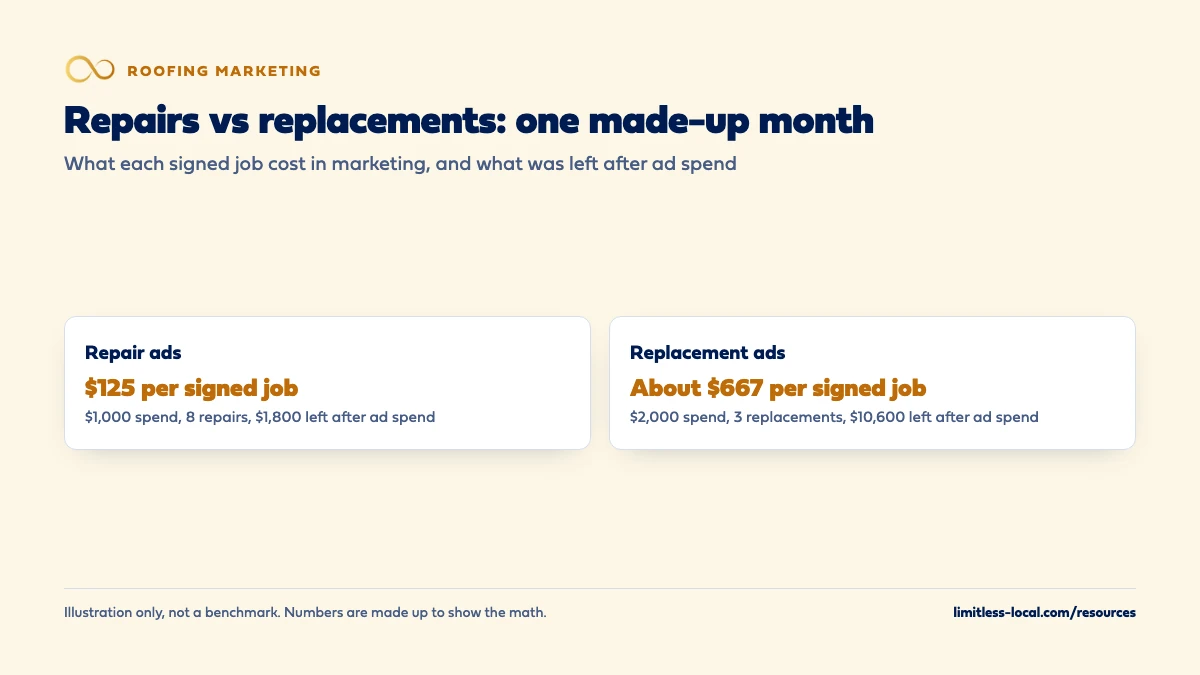
These numbers are made up to show the math, not a benchmark for your market. Say last month you spent $1,000 on repair ads and $2,000 on replacement ads.
- Repairs: 8 signed jobs, so $125 in marketing per signed repair. If each repair leaves you $350 after materials and labor, that’s $2,800, or $1,800 after the ad spend.
- Replacements: 3 signed jobs, so about $667 in marketing per signed replacement. If each leaves you $4,200 after materials and labor, that’s $12,600, or $10,600 after the ad spend.
A signed replacement cost more than five times as much to win, and still left far more money on the table. That’s the case for tilting toward replacements, as long as someone can run the estimates and follow-up. The repair side still earned its keep and filled the crews’ schedule, and it doesn’t count the replacements some of those repair customers may sign later.
Ad spend is paid to Google separately from any management fee. Run the same math on your own numbers before you decide the split.
Frequently asked questions
Is it cheaper to get roof repair leads than replacement leads?
Often per lead, but that’s the wrong comparison. What matters is the marketing cost per signed job against the profit on that job, and a more expensive replacement lead can still be the better buy.
Should I turn off repair work in my ads entirely?
Only if you truly don’t want it. Repairs fill gaps in the schedule and produce reviews, so many roofing companies keep a smaller, capped repair campaign alongside the replacement one.
Can one landing page work for both repairs and replacements?
It can work, but in our judgement it works worse. A repair caller wants a phone number and a promise you’ll come; a replacement buyer wants proof, materials and warranty details. Separate pages let each one get to the point.
Should I add repair and replacement to my Google Business Profile services?
Yes. Google’s services editor lets service businesses list what they offer, and Google says a service may be highlighted on your profile when a local customer searches for it. List the work you actually want.
Do roof inspections count as repair or replacement marketing?
Treat a free or paid inspection offer as the front door to replacement work, because that’s usually what it leads to. Track inspections booked and how many turned into signed replacements, not just how many people asked for one.
How often should I revisit the split?
Look at cost per signed job and profit by job type every month, and shift budget when the season changes or after a storm. Change one thing at a time so you can tell what made the difference.
Key takeaways
- Repairs and replacements are different buyers: urgency and a fast answer versus proof and a longer decision.
- Most roofing companies should market both, separately, with their own ad groups or campaigns and their own pages.
- Tilt the budget toward the job with the best profit after marketing that your team can actually sell and staff.
- In Local Services Ads, turn on only the job types you want, since Google no longer credits leads for job types you don’t service.
- Give replacement and repair conversions different values, and import signed jobs so the campaign learns what pays.
Want a second set of eyes on your setup?
We'll look at how you show up locally and where calls are leaking, then send you a plain-English breakdown.
More in this section
- How should a roofing company market commercial roofing?
- Is door knocking or online marketing better for a roofing company?
- How do I know if my roofing marketing agency is getting results?
- How do I market a roofing company in the slow season?
- How should a roofing company follow up on unsigned estimates?
Sources
- Organize your account with ad groups — Google Ads Help
- About conversion values — Google Ads Help
- About offline conversion imports — Google Ads Help
- Use Keyword Planner — Google Ads Help
- Edit your industries, service areas, and job types — Google Local Services Help
- About Automated Local Services Ads lead credits — Google Local Services Help
- Manage your services on your Business Profile — Google Business Profile Help
- How To Avoid Scams After Weather Emergencies and Natural Disasters — Federal Trade Commission Consumer Advice