
How should a roofing company market commercial roofing?
- What's the best way for a roofing company to win commercial roofing work?
- How is marketing commercial roofing different from residential?
- Who actually hires a commercial roofer?
- What should the commercial side of a roofing website show?
- Does Google still matter for commercial roofing?
- Are Google Ads worth it for commercial roofing?
- How do I get in the door with a property manager?
- How do I sell roof maintenance programs to building owners?
- Should a roofing company do direct outreach to commercial buyers?
- Is government roofing work worth going after?
- How do I measure commercial roofing marketing?
- What's different for roofers who do both residential and commercial
- A worked example: what one commercial account can be worth
- Frequently asked questions
- Key takeaways
- More in this section
- Sources
The short version
- Commercial buyers are property managers, facility managers, building owners and general contractors, not homeowners.
- The usual way in is a small job or an inspection, then a maintenance program, then the replacement.
- Give commercial work its own pages and make it obvious on your Google profile.
- Measure accounts, bids won and maintenance renewals, not cost per lead.
For roofing owners who want more commercial work, or want to add it next to residential, and need to know where those buyers actually come from.
Get a free visibility audit · Book a growth call
What's the best way for a roofing company to win commercial roofing work?
A roofing company should market commercial roofing to the people who control the roof budget, mostly property managers, facility managers, building owners and general contractors, and win them through a first small job, a written inspection report and a maintenance program that leads to repair and replacement work. Online, that means separate commercial pages and a Google profile that clearly shows commercial work, so leak calls and new building owners can find you. Expect a longer sales cycle than residential, and judge the results by accounts and contract value, not cost per lead.
That last point is how we look at it too: one commercial account can be worth more than a month of residential leads, so the number that matters is what each signed contract cost. The getting-found side, a website and Google profile that show commercial work, is our local SEO work, and it’s part of our roofing marketing packages. For every lead channel side by side, the roofing lead generation guide covers residential and commercial, and the roofing marketing questions library goes one question at a time.
How is marketing commercial roofing different from residential?
In our judgement, almost everything changes except the need to answer the phone:
- The buyer usually isn’t the person under the leak. A tenant or store manager reports the drip; a property manager, facility manager or owner decides who fixes it.
- The roof is an asset on a budget. Replacements get planned, approved and bid, often a year or more ahead.
- Several bids are normal. Owners and general contractors compare roofers on price, schedule, paperwork and track record.
- Door-to-door tactics don’t carry over. The person who signs sits in an office, sometimes in another city.
- Paperwork sells. Certificates of insurance, a safety program, written inspection reports and clear warranty terms carry more weight than a clever ad.
What doesn’t change: the roofer who answers fast, shows up when promised and sends a clear report gets called again.
Who actually hires a commercial roofer?
Map the buyers in your area before you spend a dollar. The usual list:
- Property managers for office, retail, industrial and apartment buildings. Many manage a portfolio, so one good relationship can mean many roofs.
- Facility managers at schools, churches, clinics, warehouses and plants.
- Owners of smaller buildings who manage their own property. These are the buyers most likely to search Google.
- General contractors who need a roofing subcontractor on new construction and renovations.
- Roofing consultants and architects who write the specs a job gets bid against.
- HOA and condo boards, which buy like commercial customers even when the roofs look residential.
- Public buyers: cities, counties, school districts and federal agencies, which buy through formal bids.
Each of these finds a roofer differently, which is why commercial marketing is a list of buyers and a plan for each, not one campaign.
What should the commercial side of a roofing website show?
Enough that a facility manager can shortlist you without calling. In our judgement that means:
- Separate commercial pages, not a line on the residential homepage: commercial repair and leak response, maintenance and inspection programs, and replacement or re-roofing.
- The roof systems you actually install and service, named the way specs name them, such as TPO, EPDM, modified bitumen, metal or coatings. List only what your crews do.
- Building types and past projects: warehouses, retail centers, schools, churches, apartment complexes, each with photos and a sentence on what the job was.
- The paperwork buyers ask for: a line saying you can send certificates of insurance, license numbers and safety documentation on request, plus any manufacturer certifications you actually hold.
- A first step that isn’t a full bid. “Request a roof inspection” or “Report a leak” fits a facility manager better than “Get a free quote.”
- A separate form or phone line for commercial, so a property manager’s request doesn’t sit in the same pile as residential estimate requests.
The residential side has its own checklist, covered in what a roofing website needs for more estimate requests.
Does Google still matter for commercial roofing?
Yes, for the work that doesn’t come through a relationship: a leak at a restaurant on a Saturday, a new owner who just bought a building and has no roofer yet, a church committee searching for commercial roofing and the name of their town. Those buyers use the same Google Maps and search results homeowners do.
Google says local results are mainly based on relevance, distance and prominence, and that businesses with complete and accurate information are more likely to show up in local results (Google Business Profile Help). For commercial work, relevance is the part you control most. Google also says the categories you pick affect your local ranking, that you should choose the most specific primary category that fits, and that you should add a few additional categories rather than one for every service (Google Business Profile Help). If a commercial roofing category describes what you do, it belongs on the profile, and your photos, services and description should show commercial roofs too.
If you’re not showing up on Maps at all, start with why a roofing company isn’t on Google Maps before adding anything commercial.
Curious what your marketing is actually booking?
Get a free visibility audit — no obligation, no sales pitch.
Are Google Ads worth it for commercial roofing?
They can be, if the campaign stays narrow. In our judgement, commercial searches are a small slice of roofing searches in most markets, and a broad roofing campaign will mostly buy homeowner clicks. A commercial campaign should stick to clearly commercial terms, such as commercial roof repair, flat roof leak repair or TPO roof replacement, in the area your commercial crews cover, and send clicks to the commercial page, not the homepage.
Negative keywords do the other half of the work. Google describes them as a way to exclude search terms so your campaign focuses on the keywords that matter, and notes that negative keywords don’t match close variants, so you need to add synonyms and singular and plural versions yourself (Google Ads Help). For a commercial campaign, that list usually includes residential and DIY words: shingles, house, home, DIY and jobs.
If a commercial campaign is getting clicks but the phone isn’t ringing, why roofing ads get clicks but no calls walks through what to check.
How do I get in the door with a property manager?
Usually with something small. In our judgement, a property manager rarely hands a new roofer a replacement. The first job is more often a leak call, a one-off repair or an inspection, and that job is the audition: did you show up when you said, did you send photos, was the invoice clean.
Have a vendor packet ready before you reach out: your W-9, certificate of insurance, license numbers, safety program, a short list of commercial references, the roof systems you handle, your service area and how fast you respond to an active leak. Property management companies often have their own vendor approval steps, and a roofer who can send everything the same day is easier to say yes to.
Then follow up like it matters. A commercial request that sits for two days tells the buyer how you’ll treat their tenants, so how fast to call back a new lead applies to commercial requests too.
How do I sell roof maintenance programs to building owners?
Start with the inspection report. Professional Roofing, the magazine of the National Roofing Contractors Association, published a contractor’s guide to maintenance programs in 2010 that lays out the case (Professional Roofing):
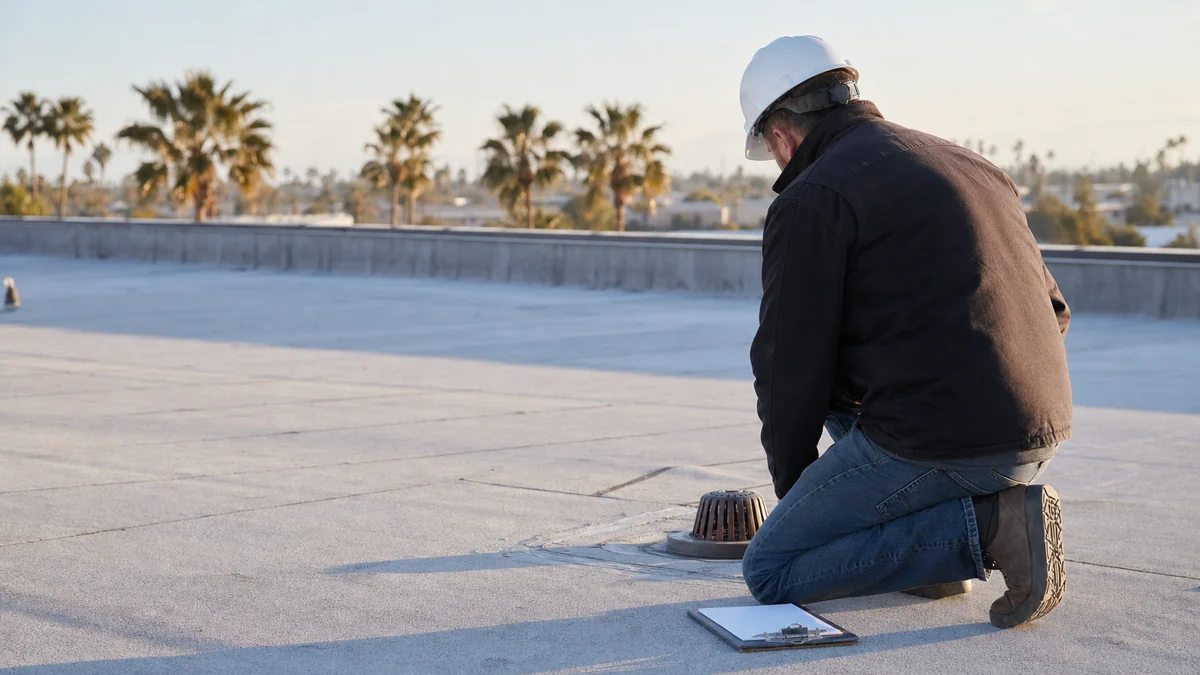
- The most common recommendation is maintenance inspections twice a year, in the fall and spring, plus inspections after major weather events.
- Reporting and documentation are at least as important as the roofing work, because one of the main benefits of maintenance is being able to predict future work.
- Almost all manufacturer warranties could be voided if an owner fails to use reasonable care in maintaining the roof, and the maintenance requirement is often on the warranty’s first page.
- Reports can be turned into a roof rating, which helps owners of several buildings rank their roofs and plan replacement budgets.
- Because maintenance is booked in advance, it can fill gaps in your service schedule, though the article warns that as it grows it can make responding to emergency calls harder.
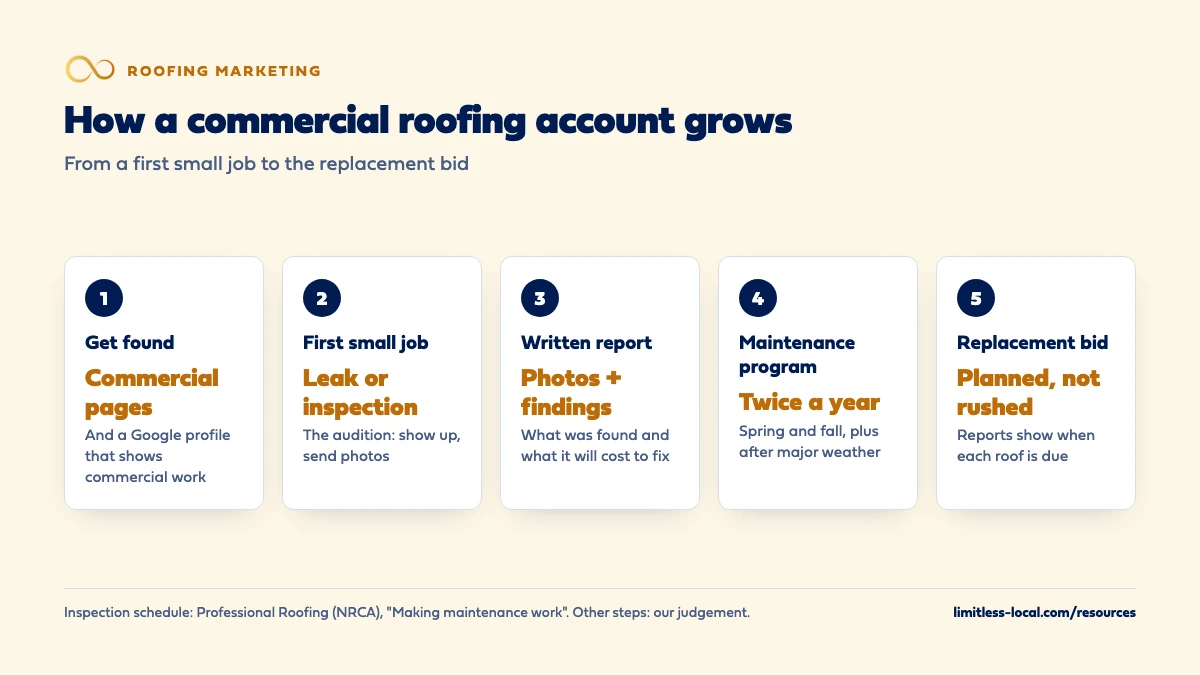
From a marketing point of view, that’s the pitch in one list: a visit every spring and fall, a written report with photos, help keeping the warranty valid, and a plan for when each roof will need replacing. In our judgement, a maintenance program is the most useful thing a commercial roofer can sell, because it turns a one-time repair customer into a relationship and puts you first in line when the replacement comes. Put together, the path usually runs: get found, a first small job, a written report, a maintenance program, then the replacement bid.
Should a roofing company do direct outreach to commercial buyers?
Yes, more than a residential roofer would. In most markets, commercial buyers are a short, knowable list: the property management companies, the larger facilities, the general contractors who build there. Reaching them directly makes sense: a short email or call to the right manager, a visit with your vendor packet, showing up at local property management and building owner association meetings, and a check-in after storms that hit their buildings.
If you use email, the rules apply to business buyers too. This is general information, not legal advice. The FTC says the CAN-SPAM Act covers all commercial messages and makes no exception for business-to-business email. You can’t use false or misleading header information or deceptive subject lines, each message needs your valid physical postal address and a clear way to opt out, and you have to honor an opt-out within ten business days (Federal Trade Commission). In our view, a short note offering a spring inspection after a hard winter is likelier to get a reply than a brochure.
Is government roofing work worth going after?
It can be, but go in with clear eyes. To compete for federal contracts, the SBA says you need to register in the System for Award Management (SAM.gov), which gives you a Unique Entity Identifier, match your services to a NAICS code, and, for contracts reserved for small businesses, meet the size standard SBA assigns to that code (U.S. Small Business Administration).
The SBA is also blunt about the cost: some businesses spend between $80,000 and $130,000 to earn their first contract, and it could take up to two years to start making a return. In our judgement, local public work, such as school districts, cities and counties, is a closer starting point for most roofing companies than federal contracts.
How do I measure commercial roofing marketing?
Not by cost per lead. One commercial lead can be worth more than a month of residential leads, and the sale can take months. In our judgement, the numbers worth tracking are:
- New accounts, and where each one came from: search, outreach, a referral, a general contractor.
- Bid invitations and bids won, by type of buyer.
- Maintenance programs signed and renewed, and the yearly value of each.
- Revenue per account over time, including repairs and replacements that came out of inspections.
- Response time on commercial leak calls, because that’s what keeps you on the vendor list.
Tag commercial leads separately from residential from day one, or the numbers blur together. Tracking which roofing leads turn into signed jobs covers the setup.
Not sure which of these is costing you jobs?
A free visibility audit checks the Google profile, reviews, site and tracking, and shows what to fix first.
What's different for roofers who do both residential and commercial
Storms look different. After hail or high winds, residential roofers fight for homeowner attention. On the commercial side, the first call often goes to the roofer already on the maintenance schedule. The Professional Roofing guide suggests reminding customers to have their roofs inspected after severe weather, which is outreach you can plan before storm season instead of chasing it afterward. Leave insurance questions to the owner’s agent and adjuster.
Crews and scheduling. A commercial job can tie up a crew for weeks, and maintenance programs need slots every spring and fall. Market only as much commercial work as your crews can deliver, or the residential side suffers.
Reviews come slower. In our judgement, facility managers rarely leave Google reviews. Ask commercial customers for a written reference or a short project story you can put on your site, with their permission.
A worked example: what one commercial account can be worth
These numbers are made up to show the math, not a benchmark for your market. Say a request from your commercial page comes from a property manager with six small retail buildings. After a leak repair and an inspection, you sign a maintenance program at $1,200 a year per building, with two inspections a year and a written report after each.
- Maintenance value: 6 × $1,200 = $7,200 a year.
- If the program renews for three years: 3 × $7,200 = $21,600, before any repairs the inspections turn up.
- If the reports show one roof is due and you win that replacement at $85,000, the account is worth $106,600 over those three years.
On a lead report, that’s one lead. A month with one commercial lead looks bad next to a month with thirty residential estimate requests, and it may be worth more. That’s why commercial roofing marketing should be judged by accounts, contract value and renewals.
For context, our Essentials package is $3,500 a month and covers the getting-found side: business listing cleanup, Google Business Profile management, link building, Google Ads management and call tracking, with ad spend paid to Google separately. Whether that’s the right spend for your commercial goals is what a free visibility audit is for.
Frequently asked questions
Should commercial roofing go on the same Google Business Profile as residential?
Usually, if it’s the same company working from the same location. Google says to choose a specific primary category and add a few additional categories for other services, not one for every service.
Do commercial customers leave Google reviews?
Less often than homeowners, in our judgement. Ask anyway, and also ask for a written reference you can share with other property managers, with permission.
How long does a commercial roofing sale take?
A repair can be decided in a day. A replacement often goes through budgets, approvals and several bids, so months is normal.
What is a NAICS code and do I need one?
A NAICS code classifies a business by the products or services it supplies. The SBA says you need to match your services to one to compete for federal contracts, and it assigns a size standard to each code.
Does CAN-SPAM apply to emails I send property managers?
Yes. The FTC says the law makes no exception for business-to-business email, and each separate email in violation can bring penalties of up to $53,088 (FTC). This is general information, not legal advice.
Can a residential roofer move into commercial work through marketing alone?
No. Marketing can bring the requests, but insurance, crews, equipment and the ability to bid accurately have to be in place first. In our judgement, start with commercial repairs and maintenance on buildings your crews can already handle, and grow from there.
Key takeaways
- Market to property managers, facility managers, building owners and general contractors, not homeowners.
- The usual path is a small job, a written inspection report, a maintenance program, then the replacement.
- Give commercial work its own pages, its own form or phone line, and a Google profile that shows it.
- Keep commercial Google Ads narrow, with residential and DIY terms as negative keywords.
- Judge commercial marketing by accounts, contract value and renewals, not cost per lead.
Want a second set of eyes on your setup?
We'll look at how you show up locally and where calls are leaking, then send you a plain-English breakdown.
More in this section
- How do I market a roofing company in the slow season?
- Is door knocking or online marketing better for a roofing company?
- How do I know if my roofing marketing agency is getting results?
- Should my roofing marketing go after repairs or replacements?
- What should a roofing website include to get more estimate requests?
Sources
- Making maintenance work — Professional Roofing (National Roofing Contractors Association)
- Tips to improve your local ranking on Google — Google Business Profile Help
- Manage your business category — Google Business Profile Help
- About negative keywords — Google Ads Help
- CAN-SPAM Act: A Compliance Guide for Business — Federal Trade Commission
- Get started with contracting — U.S. Small Business Administration