
How should roofing marketing change when adding more crews?

- How do I scale roofing lead flow to keep new crews busy?
- How many more leads does a new roofing crew actually need?
- When should marketing ramp up: before or after the crew is hired?
- Should a roofer raise ad budget all at once or in steps?
- Should we add new channels or grow the ones we have?
- How do you expand into new towns without wasting money?
- Does the mix of repair and replacement leads need to change?
- What breaks first when lead volume goes up?
- Should cost per job go up as a roofing company scales?
- When should a growing roofer bring marketing in-house or hire help?
- How should the monthly marketing review change with more crews?
- What's different about scaling marketing for roofing crews
- A worked example: the leads behind one new crew
- Frequently asked questions
- Key takeaways
- More in this section
- Sources
The short version
- Turn crew capacity into a monthly number of signed jobs, inspections and leads you need.
- Raise budget on what already works in steps, a month or two ahead of the new crew.
- Expand towns and job types before adding brand-new channels.
- Add estimators and office help with the crew, or the extra leads leak out.
- Watch cost per signed job; expect it to drift up as you reach further.
For roofing owners adding a second, third or fourth crew who need the lead flow to grow with them, without the cost per job running away.
Get a free visibility audit · Book a growth call
How do I scale roofing lead flow to keep new crews busy?
Work backward from crew capacity: figure out how many signed jobs the new crew needs each month, how many inspections that takes at your close rate, and how many leads that takes, then raise marketing in steps to match, starting a month or two before the crew is ready. Grow what already works first (more budget on your best ad campaigns, more towns in the service area) before adding new channels. Expect cost per job to rise somewhat as you reach further, and add estimator and office capacity at the same time, because more leads with the same people just means more leads lost.
Scaling lead flow is what the third phase of our process is for: improve and scale, month by month, based on calls, leads and revenue. Our marketing packages step up in ad management, locations and Local Services Ads as you grow, and roofing marketing shows how we work with roofers. The roofing marketing guide covers the channels themselves, and the roofing marketing questions library goes deeper on each.
How many more leads does a new roofing crew actually need?
Start from the crew, not the marketing. Work it backward:
- Jobs per crew per month. How many replacements (and repairs) one crew can finish in a normal month, allowing for weather.
- Signed jobs needed. That number, plus a small buffer for cancellations.
- Inspections needed. Signed jobs divided by your inspection-to-signed close rate.
- Leads needed. Inspections divided by your lead-to-inspection rate.
Use your own numbers from the last six to twelve months, not industry averages. If you don’t have them, that’s the first job: tracking which leads turn into signed jobs sets it up. The worked example below shows the math.
When should marketing ramp up: before or after the crew is hired?
Before, by a month or two, in our judgement. Roofing leads take time to become signed work: an inspection, an estimate, a decision, sometimes an insurance process, then a spot on the schedule. If you turn up marketing the week the new crew starts, they’ll stand around for weeks waiting for the pipeline to fill.
Ads are the lever you can time. Ads can bring leads within days of launch, while SEO typically takes three to six months to show meaningful organic growth. So if you’re planning a crew for spring, SEO work for the new towns should start well before, and ad budget increases a month or two ahead.
The flip side: don’t hire the crew on the promise of leads you haven’t seen yet. Ramp marketing, watch the inspection calendar fill, then commit.
Should a roofer raise ad budget all at once or in steps?
In steps. Raise the budget on your best-performing campaigns, give it a few weeks to settle, check cost per lead and lead quality, then raise again. Big jumps make it hard to tell whether results changed because of the money or because of the season.
Know how Google spends a budget. In Google Ads you set an average daily budget, and on busier days Google can spend up to twice that average, while keeping the month within your limit (Google Ads Help). So a higher daily budget may show up unevenly day to day.
If you run Local Services Ads, you can also set an ad schedule and pause ads when you can’t take new work (Local Services Help). Those controls matter more once you have several crews with different schedules. Note that Local Services Ads are moving into Google Ads as Performance Max campaigns with pay-per-lead goals, with roofing in the first phase from August 2026 (Google Ads Help), so where you manage that budget may change.
Should we add new channels or grow the ones we have?
Grow what’s working first. If Google search ads bring signed jobs at a cost you like, more budget on the same campaigns and more towns is usually the cheapest new lead. A brand-new channel starts from zero: setup, learning, testing, and months before you know whether it pays.
Add a channel when the current ones stop scaling: when more budget brings proportionally fewer leads, or you’ve covered every town you want to serve. That’s judgement, and it’s the same principle as which marketing to add first: one change at a time, with a number that decides it.
Curious what your marketing is actually booking?
Get a free visibility audit — no obligation, no sales pitch.
How do you expand into new towns without wasting money?
Expand in rings. Add the towns next to the ones that already work, where your reviews, yard signs and finished roofs give you some recognition. Jumping to a far suburb because it’s big usually means paying more per lead with less trust behind you.
Update the places that define your area. On your Google Business Profile, a service-area business can set up to 20 service areas by city, postal code or other area, not by radius (Google Business Profile Help). Match your ad location targeting to the same towns, and add a page on your website for each new area you want to rank in. A new crew is a good reason to revisit all three.
A second office or yard is a different question from a wider service area, with its own Business Profile rules; check them before you list a new address.
Does the mix of repair and replacement leads need to change?
Often, yes. A new replacement crew needs replacement leads, and repair calls won’t fill its schedule even if your lead count goes up. Look at which campaigns, keywords and pages bring replacements, and put the new budget there.
Repairs still matter: they’re often the first job that turns into a replacement later. But if the crew you’re adding is a replacement crew, measure the new marketing by replacement inspections. Marketing repairs or replacements covers how to weigh the two. If the new crew handles commercial work, that’s its own market with its own buyers.
What breaks first when lead volume goes up?
Usually the people between the lead and the roof, in our judgement:
- The phone. One office person can’t answer twice the calls. Missed calls rise, and response time slips.
- Estimators. Inspections stack up, the gap from call to inspection grows, and homeowners book whoever can come sooner.
- Follow-up on estimates. Busy estimators stop chasing unsigned estimates, and close rate drops.
Plan headcount for each step along with the crew. If the inspection calendar is booked out more than a week, adding leads makes the problem worse, not better. How fast to call back a new lead sets the response standard to hold as volume grows.

Should cost per job go up as a roofing company scales?
Somewhat, and that’s normal. The cheapest leads come first: the best keywords, the closest towns, your own referrals. As you reach further for more volume, each extra lead tends to cost more. That’s our judgement of how paid search usually behaves, not a sourced rule.
The question isn’t whether cost per job rises, it’s whether the extra jobs are still profitable after the crew, materials and overhead. Set a ceiling for cost per signed job before you scale, and stop pushing budget in a channel when the next jobs cost more than they earn. Base the ceiling on your margin per roof, not on what other roofers say they pay.
When should a growing roofer bring marketing in-house or hire help?
When the work outgrows the owner’s evenings. At one or two crews, an owner can often manage a Business Profile and a simple ad account with help. At several crews, with multiple channels, towns and a budget that matters, someone needs to own it every week: an agency, a hire, or both.
The question of hiring someone full-time has its own page: when a roofer is ready for a full-time marketing hire. Either way, keep ownership of your ad accounts, Business Profile and tracking numbers in the company’s name, so a change of person or agency doesn’t cost you your history.
How should the monthly marketing review change with more crews?
It needs to answer one question per crew: is its schedule full for the next few weeks? Review, every month:
- Leads, inspections and signed jobs by source and by town.
- Cost per lead and cost per signed job by channel.
- Time from lead to inspection, and inspections waiting.
- Backlog in weeks of work, per crew.
If backlog is growing, hold or trim spend; if it’s shrinking, raise it. That’s the mirror image of pausing marketing when crews are booked out, where the problem is too much work rather than too little. Tracking by source is the whole basis: the SBA’s advice to small businesses is that tracking results is key to getting the best return from a marketing budget (SBA).
Not sure which of these is costing you jobs?
A free visibility audit checks the Google profile, reviews, site and tracking, and shows what to fix first.
What's different about scaling marketing for roofing crews
Long lead-to-job time. Inspection, estimate, decision, sometimes an insurance process, then a schedule slot. Marketing has to run ahead of crew capacity by weeks, not days.
Weather sets the calendar. Crews can’t work every day, and demand jumps after storms. Plan capacity on normal months and treat storm weeks as a bonus, not the base.
Replacement crews need replacement leads. More calls overall don’t fill a replacement crew if the growth is in small repairs.
Estimators are the hidden bottleneck. In roofing the inspection is where the sale happens. Adding crews without adding inspection capacity is a common way growth stalls, in our judgement.
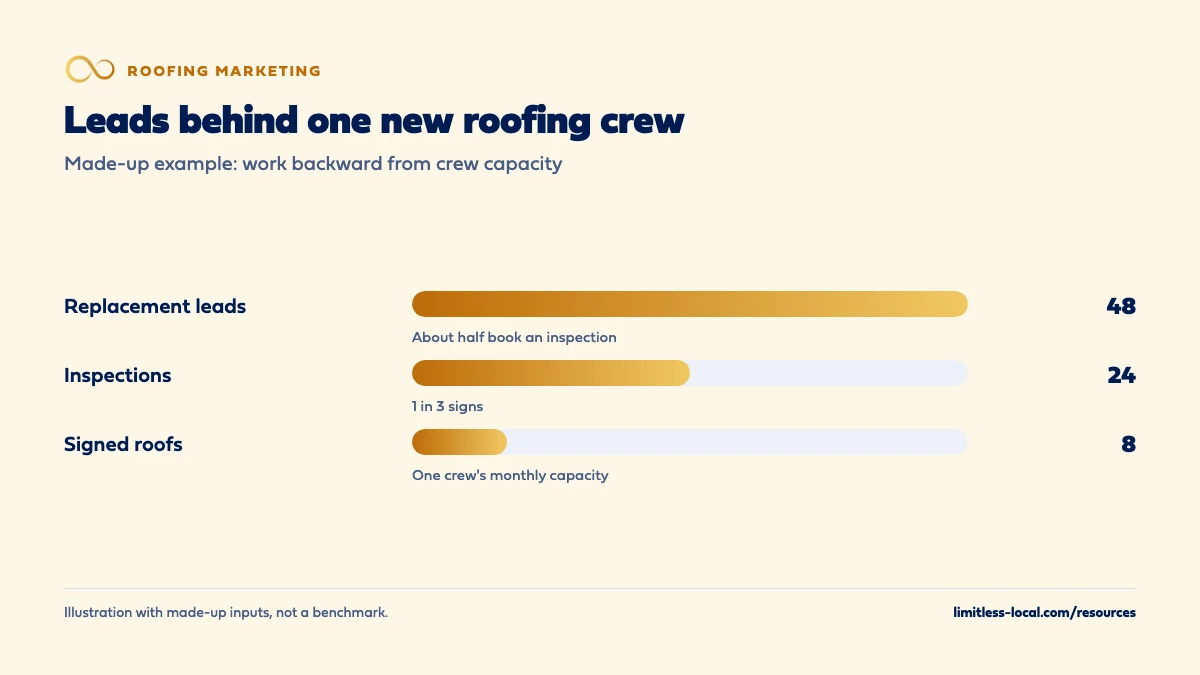
A worked example: the leads behind one new crew
These numbers are made up to show the math, not a benchmark. Use your own.
- A new replacement crew can finish 8 roofs a month.
- The company signs 1 in 3 inspections, so it needs 24 replacement inspections a month (8 times 3).
- About half of replacement leads book an inspection, so it needs 48 replacement leads a month (24 times 2).
If the company’s current cost is $250 per replacement lead, that’s $12,000 a month (48 times $250) in extra lead cost before the crew is busy. And if reaching further pushes the cost of those extra leads to $300, it’s $14,400 (48 times $300). Spread across 8 roofs, that’s $1,500 or $1,800 of marketing per signed roof. Whether that works depends on your margin per roof, which only you know.
The same math shows the people side: 24 more inspections a month is roughly one more estimator’s worth of appointments, which is why the estimator should be hired with the crew.
Frequently asked questions
How far ahead of a new crew should marketing ramp up?
About a month or two for ads, in our judgement, and longer for SEO in new towns, since SEO typically takes three to six months to show meaningful organic growth.
Can I double my ad budget to double my leads?
Rarely in a straight line. The extra leads usually cost more, so raise budget in steps and check cost per signed job after each one.
Do more crews mean I need Local Services Ads?
Not necessarily. They’re one way to add volume. Grow the channels that already produce signed jobs first, then test new ones.
How many towns can I list on my Google Business Profile?
A service-area business can set up to 20 service areas by city, postal code or other area, according to Google.
What if the new crew is for commercial roofing?
Treat it as a separate market with different buyers and longer sales cycles, and plan its lead flow on its own numbers. Commercial leads don’t come from the same ads as residential replacements.
Should I stop marketing when all crews are full?
Usually trim rather than stop, so the pipeline doesn’t go dry when the backlog clears.
Key takeaways
- Start from crew capacity and work back to signed jobs, inspections and leads per month.
- Ramp ads a month or two before the crew starts; start SEO for new towns even earlier.
- Scale what already works, in steps, before adding new channels.
- Hire estimators and office help with the crew, or the extra leads leak out.
- Expect cost per signed job to rise as you reach further, and set a ceiling before you scale.
Want a second set of eyes on your setup?
We'll look at how you show up locally and where calls are leaking, then send you a plain-English breakdown.
More in this section
- What marketing should a roofing company add first to grow?
- Should I pause roofing marketing when my crews are booked out?
- When is a roofing company ready for a full-time marketing hire?
- Which roofing marketing tasks should I do myself or hand off?
- How should a roofing company market commercial roofing?
Sources
- Using Google Ads for online marketing — Google Ads Help
- Manage your service areas for service-area & hybrid businesses — Google Business Profile Help
- About ad scheduling — Google Local Services Help
- Local Services Ads transition to Performance Max campaigns with pay-per-lead goals — Google Ads Help
- How to Get the Most From Your Marketing Budget — U.S. Small Business Administration