
How many hours a week does DIY electrical marketing take?

- How much time should an electrician set aside each week to do their own marketing?
- What does a realistic DIY marketing week look like for an electrician?
- How much time does the Google Business Profile take each week?
- How long does asking for reviews take?
- How many hours does running my own Google Ads take?
- How much website work is there each week?
- How long should the weekly numbers check take?
- How much time does the first month of setup take?
- Can DIY marketing fit around a full schedule of jobs?
- Which tasks can my office manager or techs take over?
- What should I do in a week when there's no time at all?
- When are the hours a sign it's time to get help?
- What's different for electricians
- A worked example: a sample month and the cost of skipped weeks
- Frequently asked questions
- Key takeaways
- More in this section
- Sources
The short version
- The basics (Google profile, reviews, website, a weekly numbers check) take about two hours a week.
- Running your own Google Ads adds about two hours a week, plus a longer monthly review.
- Setup in the first month takes days, not hours.
- Skipped weeks cost more than the time they save, so plan a minimum version for busy weeks.
For electrical contractors doing their own marketing, or thinking about it, who want a real weekly time budget before they commit.
Get a free visibility audit · Book a growth call
How much time should an electrician set aside each week to do their own marketing?
Plan on about two hours a week to keep the basics running for a one-location electrical shop: your Google Business Profile, review requests, website upkeep and a quick check of calls and booked jobs. Running your own Google Ads adds roughly two more hours a week, and Local Services Ads, social media or a new service page each month push it toward five or six. Setup takes far longer than upkeep, often a few full days in the first month. The weekly number matters less than whether those hours still happen in your busiest weeks.
If the hours don’t fit, that’s the work our team takes off your plate: ads, local SEO, listings, the Google profile and tracking, with a real-time dashboard and a monthly report. Onboarding takes your team about 2-3 hours, and then campaigns go live in weeks 1-2. The packages page shows what each tier covers, our electrical contractor marketing page explains how we approach the trade, and the electrical marketing questions library goes question by question.
What does a realistic DIY marketing week look like for an electrician?
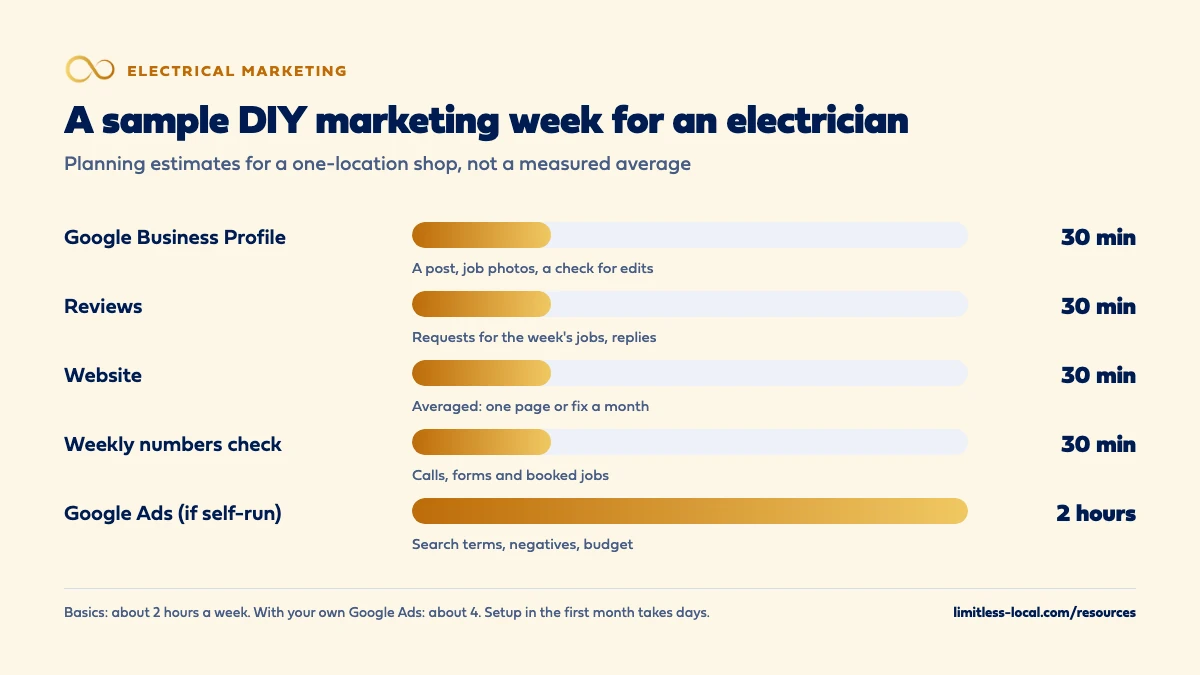
Here’s a sample week for a one-location residential and light commercial shop. These are planning numbers to build a calendar around, not a measured average, and your first few weeks will run slower while you learn the tools.
- Google Business Profile: about 30 minutes. One post, a few new job photos, a look for edits or questions.
- Reviews: about 30 minutes. Sending review requests for the week’s finished jobs and replying to new reviews.
- Website: about 30 minutes on average. Most weeks it’s nothing; one week a month it’s a new page or a fix.
- Weekly numbers check: about 30 minutes. Calls, form requests and which ones became booked jobs.
- Google Ads, if you run them yourself: about two hours. Search terms, negative keywords, budget and a look at what booked.
That’s about two hours a week for the basics and about four with your own Google Ads. Add Local Services Ads, social media posting or a new service page every month, and five or six hours is closer to the truth.
How much time does the Google Business Profile take each week?
About half an hour, once it’s set up. A weekly post about a recent job or a seasonal reminder, three or four photos your techs took that week, and a scroll through the profile to make sure nothing changed. Posts don’t stay up forever: Google’s help on Business Profile posts says posts older than six months are archived unless a date range is set, so a profile you stopped posting to starts to look quiet.
The check matters too. If Google gets reports that your business info isn’t accurate, it may update your profile, and you’ll find an alert in the Edit profile section. Edits you make usually take up to 10 minutes to review, but some take up to 30 days. A weekly look catches a wrong phone number or changed hours before it costs you calls.
How long does asking for reviews take?
Very little, if the ask happens at the job. The electrician who finished the panel swap asks in person, then the office texts the review link that afternoon. Google lets you create a review link or QR code from your profile and share it in thank-you emails or on your receipts, so each request takes a minute or two.
The time adds up in the follow-up: a reminder to the customers who said yes and didn’t post, and a short reply to each new review. Budget about 30 minutes a week, more if a review needs a careful reply. How to get more Google reviews for your electrical business covers the ask itself.
How many hours does running my own Google Ads take?
More than anything else on the list, and it can’t wait for a slow week. Expect about two hours a week: checking the search terms report, which shows the actual searches that triggered your ads, adding negative keywords for searches you don’t want (“how to wire a light switch” is a do-it-yourselfer, not a customer), and checking spend against calls. Then plan an extra hour or two once a month for a deeper look at what booked.
Local Services Ads used to be a separate, mostly hands-off setup. Google is now moving them into Google Ads as Performance Max campaigns with pay-per-lead goals, and electrical is in the first phase that began in August 2026 for select advertisers, so budget some extra hours to learn the new setup if your account has moved. The negative keywords electricians should add first will save you some of that weekly time.
How much website work is there each week?
Most weeks, almost none. A site that loads fast, lists your services and shows your phone number doesn’t need daily attention. The time comes in chunks: a new service page for EV chargers or generators takes two to four hours to write, photograph and publish, and fixes happen when something breaks or your hours change.
Average it out and it’s about 30 minutes a week. If you’d rather work in blocks, take one evening a month for the site and leave it alone the rest of the time. What you shouldn’t do is let a broken contact form or an old phone number sit for weeks because the site isn’t on anyone’s list.
Curious what your marketing is actually booking?
Get a free visibility audit — no obligation, no sales pitch.
How long should the weekly numbers check take?
About 30 minutes, and it’s the part most owners skip. Count the calls and form requests from your Google profile, your website and your ads, then check how many became booked jobs in your field software. That’s the only way to know whether the other hours are working.
Some numbers only move monthly, so don’t chase them weekly. In your Business Profile performance report, the searches metric (the terms people used to find you) updates at the start of each month and can take up to five days to show. What an electrician should check weekly to see if SEO is working lists exactly what to look at.
How much time does the first month of setup take?
Days, not hours. Setup is a different job from upkeep. A rough list for an electrician starting from scratch or close to it:
- Claiming and verifying the Google profile, picking categories, listing services and drawing a service area.
- Fixing your name, address and phone on Apple, Bing, Yelp, Facebook and the other listings that matter.
- Setting up call tracking and making sure every job in your field software records its lead source.
- Building or cleaning up service pages for your main jobs.
- Building a Google Ads account, if you’re running ads: campaigns, keywords, negative keywords, conversion tracking.
Plan on several evenings or a couple of full days spread over the first month, more if the website needs real work. The tools and software an electrician needs for DIY marketing covers what to sign up for.
Can DIY marketing fit around a full schedule of jobs?
It can, but you have to put it on the calendar like a job. The U.S. Bureau of Labor Statistics’ Occupational Outlook Handbook for electricians says almost all electricians work full time, schedules may include evenings and weekends, and overtime is common. For an owner who’s also on the tools, marketing hours come out of evenings, early mornings or office time that would otherwise go to estimates and invoices.
What works: two or three fixed slots a week, such as 30 minutes on Monday and Thursday mornings plus an hour on Friday afternoon, with the same tasks in the same slot every week. Batching beats squeezing it in between calls, because ad accounts and review follow-ups reward consistency more than effort.

Which tasks can my office manager or techs take over?
More than you’d think, which cuts your own hours a lot:
- Techs: taking two or three job photos and asking the customer for a review before leaving.
- Office manager: texting the review link, posting to the Google profile, marking the lead source on every job, and keeping hours and holiday closures current.
- You: the weekly numbers check, decisions on ad budget and which jobs to push, and replies to unhappy customers.
Write each person’s piece down as a short checklist. Most DIY marketing falls apart when the one person who knew the routine gets busy, not because the routine was wrong.
What should I do in a week when there's no time at all?
Have a minimum version ready, about 30 minutes, for storm weeks and stretches when every crew is booked:
- Check Google Ads spend and pause or cap anything running past its budget.
- Send review requests for the week’s jobs.
- Make sure the phone number and hours on your Google profile are right.
Skip the post, the photos and the website for that week. Then pick them back up the next week. One skipped week is fine. Four in a row is how ad accounts drift and profiles go stale.
When are the hours a sign it's time to get help?
When the plan keeps losing to the work. A few signs: you’ve skipped more weeks than you’ve kept in the last two months, your ad spend has grown past what you can check properly in two hours, you’re adding a truck or a town, or you can’t say what a booked job cost you in marketing last month.
None of those means you have to hand everything off at once. Many owners keep the profile and reviews and hand off the ads first. Doing your own marketing first, then hiring an agency lays out that staged path, and whether to hire an agency or DIY your electrical marketing puts a price on your time.
Talk it through with someone who runs this every day
A 15-minute growth call: your market, your numbers, and what a realistic budget looks like. No pressure.
What's different for electricians
The owner is often the licensed electrician on the job. Every marketing hour competes with billable work, permits and inspections, which is why the time has to be scheduled, not found.
Emergency calls interrupt the plan. Outages and storm damage pull you off the calendar with no notice. Put marketing slots where emergencies are least likely to land, like early mornings, and keep the 30-minute minimum version ready for storm weeks.
Service calls and planned jobs need different time. Service calls are won by answering fast and showing up in Maps, which is mostly profile and review time. Panel upgrades, EV chargers and generators are researched purchases, which means service pages and quote follow-up. If your hours only cover one side, the other runs on luck.
Seasonal swings change the load. Generator work before storm season and slower stretches in the off season are good times for the bigger website jobs.
A worked example: a sample month and the cost of skipped weeks
These numbers are made up to show the math, not a benchmark or a forecast. Say you run the basics plus your own Google Ads: about four hours a week. That’s about 17 hours a month (four hours times 4.33 weeks). Add three hours for one new service page and the month comes to about 20 hours.
Now say a busy month comes and you don’t open the ad account at all. Your budget is $1,500 a month, and without anyone adding negative keywords, 15% of it goes to searches that were never going to book a job, like do-it-yourself questions or towns you don’t serve. That’s $225 gone in one month, more than many owners would pay for the hour it took to prevent it.
The point isn’t the exact figure. It’s that DIY marketing is cheap when the hours happen and expensive when they don’t.
Frequently asked questions
Is two hours a week enough to do my own marketing?
For keeping a Google profile, reviews and a simple website in shape, usually yes, once setup is done. It isn’t enough if you’re also running Google Ads or Local Services Ads with real money behind them.
Should I spend my marketing time on social media?
Only after the basics are covered. For most electricians, the Google profile, reviews and website bring in more calls per hour spent, so social media gets whatever time is left.
Can I do all of it once a month instead of weekly?
The website and the deeper ad review, yes. Review requests and ad checks don’t batch well, because reviews are easiest to get right after the job and ad spend can drift in a few days.
Does the time go down after the first few months?
Usually, yes. Once the tools are familiar and your team handles photos and review requests, the weekly basics get quicker. Running ads stays a steady weekly job.
How much of my time does an agency still need?
Less, but not zero. You’ll still answer calls, ask for reviews, share job photos and decide which jobs and towns you want. With our packages, onboarding takes your team about 2-3 hours, and then the team handles the rest.
Key takeaways
- The basics take about two hours a week for a one-location electrical shop.
- Running your own Google Ads adds about two hours a week, and setup in the first month takes days.
- Hand photos, review requests and profile posts to your techs and office to cut your own hours.
- Keep a 30-minute minimum version for weeks when every crew is booked.
- Repeatedly skipped weeks are the clearest sign it’s time to hand some of the work off.
Ready to compare options?
Book a short growth call and we'll walk through the math for your service area, including when we're not the right fit.
More in this section
- Should I hire an agency or DIY my electrical marketing?
- What tools and software does an electrician need to DIY marketing?
- How much should an electrical contractor spend on marketing?
- What should electricians include in their monthly marketing budget?
- What is a good cost per booked job for electrical marketing?
Sources
- Create & manage posts on your Business Profile — Google Business Profile Help
- Understand what happens to your Business Profile edits — Google Business Profile Help
- Create a Google link or QR code to request reviews — Google Business Profile Help
- Understand your Business Profile performance & insights — Google Business Profile Help
- About the search terms report — Google Ads Help
- Local Services Ads transition to Performance Max campaigns with pay-per-lead goals — Google Ads Help
- Electricians: Occupational Outlook Handbook — U.S. Bureau of Labor Statistics