
Can an electrical owner do DIY marketing first, then hire an agency?

- Can I run my own electrical marketing now and switch to an agency as I grow?
- Is it smart to start with DIY marketing before hiring an agency?
- Step 1: What should I set up myself first?
- Step 2: How do I build a review habit that survives a handoff?
- Step 3: What does the website need before anyone else touches it?
- Step 4: How do I track where jobs come from while I'm still doing it myself?
- Should I run my own Google Ads before hiring help?
- What are the signs it's time to hand off?
- What should I hand off first, and what should I keep?
- How do I keep my accounts ready for the handoff?
- What should I give the agency on day one?
- What happens in the first months after I hand off?
- What's different for electricians
- A worked example: when handing off starts to make sense
- Frequently asked questions
- Key takeaways
- More in this section
- Sources
The short version
- Start with the Google profile, reviews, a simple service-page website and lead tracking.
- Open every account in your own business's name from the start.
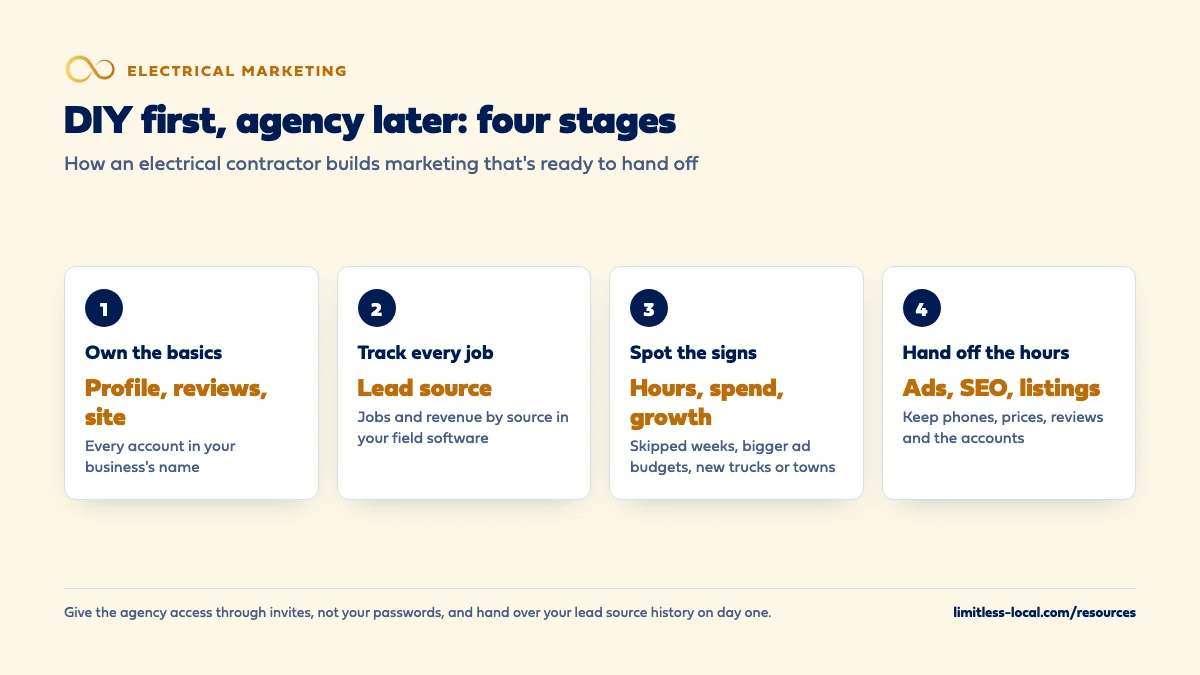
- Hand off when the hours stop fitting, ad spend outgrows you, or you're adding trucks or towns.
- Give the agency your history on day one: jobs by lead source, the work you want and your budget.
For electrical contractors who want to start their marketing themselves and bring in help later, without having to rebuild anything when they do.
Get a free visibility audit · Book a growth call
Can I run my own electrical marketing now and switch to an agency as I grow?
Yes, and for a lot of small electrical shops it’s the smartest order. Do the work that depends on knowing your business first: a verified Google Business Profile in your name, a steady review habit, a simple website with a page for each main service, and a lead source on every job. Hand off when the hours stop fitting, when ad spend grows past what you can check each week, or when you want to grow faster than you can manage. Build every account in your own name from day one, so the handoff is a login invite and not a rebuild.
When you’re ready to hand off, that’s what our team picks up: ads, local SEO, listings and tracking, built on the accounts you already own. Our packages page shows what each tier covers, our electrical contractor marketing page explains how we approach the trade, and the electrical marketing questions library goes question by question.
Is it smart to start with DIY marketing before hiring an agency?
Often, yes. Google’s page on whether you need an SEO says that if you run a small local business, you can probably do much of the work yourself, and that knowing the basics helps you spot it if someone you hire later wants to use a technique that isn’t recommended. Doing it yourself for a while teaches you what your market searches for, which jobs your marketing brings in, and what a booked job is worth to you.
The catch is that DIY marketing done carelessly creates cleanup work later: a profile under an old employee’s email, an ad account no one can log into, a website on a platform you can’t move. The steps below build things so they’re ready to hand over. If you haven’t decided whether to get help at all, whether to hire an agency or DIY your electrical marketing covers that decision.
Step 1: What should I set up myself first?
Your Google Business Profile. It’s free, it’s how you show up on Maps, and nobody knows your services better than you. Verify it in your business’s name, with you as the primary owner, using an email address the business controls rather than a personal or employee account.
Then fill it out like you mean it: the right primary category, a service area you’ll actually drive, hours that match when someone answers the phone, and real photos. Add each job you want more of to the services list. Google’s help on managing services says that when local customers search for an offering you provide, that service may be highlighted on your profile, so “panel upgrade” and “EV charger installation” belong there. How to optimize your electrician Google Business Profile goes field by field.
Step 2: How do I build a review habit that survives a handoff?
Make the ask part of finishing a job, not a marketing task. The electrician asks before leaving, the office texts the review link the same day, and you reply to every review within a few days. That routine works the same way whether you’re doing the rest of your marketing yourself or an agency is.
The reviews themselves live on your Google profile, so they stay with you whoever you hire, as long as the profile is yours. What an agency can add later is the follow-up: automated reminders to customers who said yes and didn’t post, and tracking how many requests turn into reviews.
Step 3: What does the website need before anyone else touches it?
A domain registered in your business’s name, a login you control, and a page for each main service: service calls and troubleshooting, panel upgrades, EV chargers, generators, rewiring, and commercial work if you do it. Each page should say what the job is, which towns you cover, and how to call. That’s enough to rank for some specific searches and to give any agency something to build on.
Timing matters if a rebuild is coming. A great time to hire an SEO is when you’re considering a site redesign or planning to launch a new site, the earlier the better, so the site is built to be search-friendly from the start. If your site needs replacing within the year, that’s a natural point to bring in help instead of building it twice.
Step 4: How do I track where jobs come from while I'm still doing it myself?
Mark a lead source on every job in your field software, every time. If you use Jobber, its lead source report shows which channels bring in leads and the revenue tied to them, based on the first revenue earned from each lead. Whatever software you use, the field just has to be filled in every time. A tracking number on your Google profile and website makes the source more reliable than asking the customer how they heard about you.
This history is the most valuable thing you can hand an agency. Six months of jobs by source tells them where your calls really come from and which work pays, so they start from your numbers instead of a guess. How to track which electrical marketing brings real jobs covers the setup.
Curious what your marketing is actually booking?
Get a free visibility audit — no obligation, no sales pitch.
Should I run my own Google Ads before hiring help?
You can, with a small budget and a narrow focus, such as one high-value job type in the towns closest to your shop. You’ll learn which searches cost money without booking anything, and that’s useful later. Open the account yourself, in your business’s name, with your own card on it.
Keep the budget small enough that you can check it properly every week. Ads are where DIY gets expensive fastest, because money moves every day whether or not anyone is watching. When the budget grows past what you can review in an hour or two a week, that’s usually the first piece to hand off.
What are the signs it's time to hand off?
Usually two or three of these at once:
- You’ve skipped more marketing weeks than you’ve kept in the last couple of months.
- Your ad spend has grown past what you can check carefully each week.
- You’re adding a truck, a crew, a town or a second location, and need calls to arrive on schedule.
- You can’t say what a booked panel upgrade or EV charger install cost you in marketing last month.
- A website rebuild is coming.
- Calls from Maps and your website have stopped growing, and you don’t know why.
If none of these are true and the schedule is full, keep going on your own. How many hours a week DIY electrical marketing takes helps you check whether the time still fits.
What should I hand off first, and what should I keep?
A common order, though your own gaps decide it:
- Google Ads and Local Services Ads, because money moves daily and the platforms keep changing.
- SEO and the website, because they take steady hours and specialist skill to keep growing.
- Listings, tracking and reporting, because they’re tedious and easy to let slide.
Some things never get handed off: answering and booking calls, setting your prices, asking for reviews, and the say on which jobs and towns you want. What an electrician should never hand to an agency covers that list in detail.
How do I keep my accounts ready for the handoff?
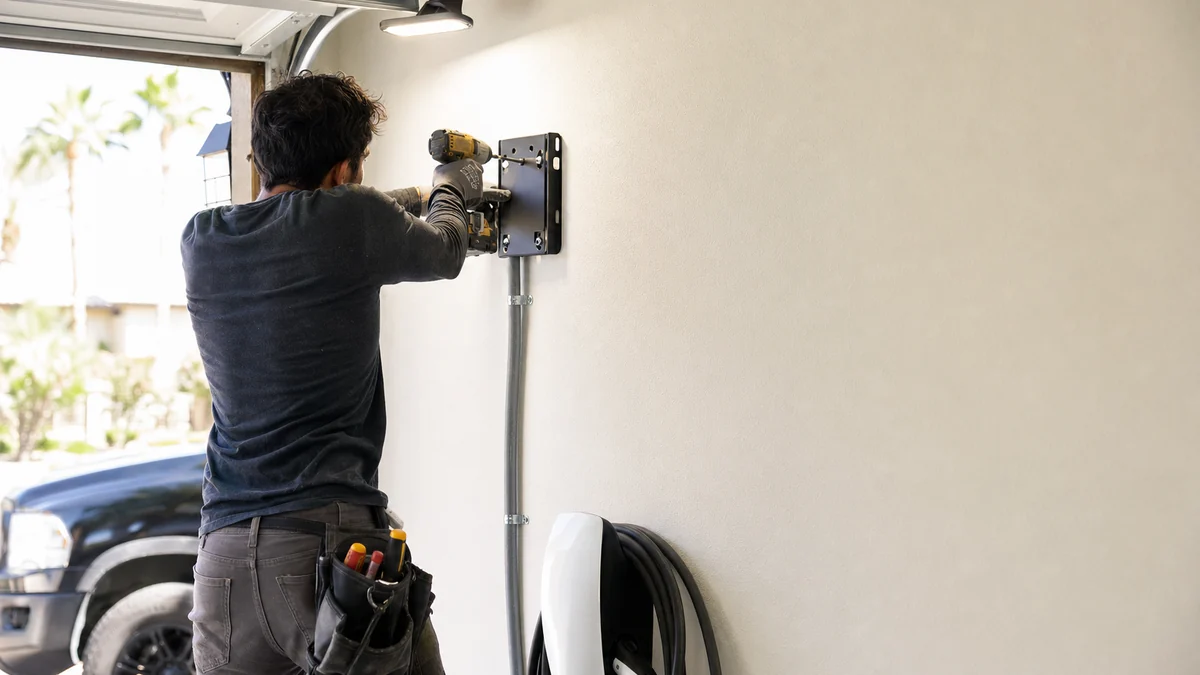
Set each one up so that bringing someone in is an invite, not a transfer:
- Google Business Profile: you stay primary owner and add the agency as a manager. Managers can edit info, post and reply to reviews, but can’t add or remove users or delete the profile, according to Google’s page on owners and managers.
- Google Ads: agencies manage accounts through manager accounts. If a manager creates a new account, it automatically owns it; if it links to an account you already have, it doesn’t get ownership unless you turn it on (ownership of client accounts). Another reason to open the account yourself.
- Search Console: make yourself a verified owner and add the agency as a user. A property needs at least one verified owner, and only owners can grant access (owners, users and permissions).
- Domain, website and call tracking: in your business’s name, with logins you control.
What should I give the agency on day one?
A good handoff saves weeks. Have these ready:
- Access invites to your Google profile, Google Ads, Search Console, website and call tracking.
- The jobs you want more of, ranked, and the ones you’d rather not take.
- The towns your trucks will drive to, and the ones they won’t.
- How many more jobs a week your crews can take on.
- Your monthly budget, with ad spend and fees listed separately.
- Jobs by lead source and average ticket by job type for at least the last six months.
- What you’ve tried that didn’t work, so nobody pays to learn it twice.
- Job photos, your logo and any truck wrap or uniform artwork.
What happens in the first months after I hand off?
With us, it starts with a 15-minute discovery call. Onboarding takes your team about 2-3 hours, campaigns go live in weeks 1-2, and then there are monthly reviews and optimization. Ads can generate leads within days of launch. SEO typically takes 3-6 months to show meaningful organic growth, even when you’ve already done good groundwork yourself.
We don’t guarantee rankings, lead counts or revenue, and nobody honestly can. We ask for three months, written into the contract, but if you want to leave we won’t make you stay. Judge the result on cost per booked job, checked against the lead sources you’ve been recording all along. How to know if your electrical marketing agency is getting results shows what to look for.
Not sure which of these is costing you jobs?
A free visibility audit checks the Google profile, reviews, site and tracking, and shows what to fix first.
What's different for electricians
You know the work better than any marketer. Service pages for panel upgrades, EV chargers and generators are a strong place to start yourself, because you can explain the job, the permit and what the homeowner should expect better than anyone you’d hire.
Residential ads are usually the first handoff. Service and emergency work runs on daily ad and Maps activity, which is exactly the hour-by-hour work that’s hardest to keep up from a job site.
Commercial work stays with you. Builders, general contractors and property managers hire the electrician they know. Marketing can support that with a commercial services page, but the relationships and bids remain yours at every stage.
Crew capacity sets the pace. The right time to hand off is often the month you hire another licensed electrician, because that’s when you need the extra calls to show up on schedule.
A worked example: when handing off starts to make sense
These numbers are made up to show the math, not a benchmark or a forecast. Say you spend five hours a week on your own marketing, about 22 hours a month (five hours times 4.33 weeks). If an hour of your time is worth $100 to the business, that’s $2,200 a month of your time.
Compare that with our Essentials package at $3,500 a month, which covers one location and Google Ads management for up to $2,500 a month in ad spend. Ad spend is paid to Google separately either way. The difference is $1,300 a month.
Now say a booked panel upgrade leaves you $800 in gross profit. The handoff covers that difference if it adds about two booked panel upgrades a month ($1,300 divided by $800 is about 1.6), before counting the 22 hours you get back. That’s the comparison to make with your own numbers, and the lead source history from Step 4 is what makes it possible.
Frequently asked questions
Will an agency redo everything I built myself?
It shouldn’t if the basics are sound. A good agency audits what you have, keeps what works and fixes what doesn’t. Expect changes to ad campaigns and website pages, not a new Google profile.
Can I go back to doing it myself after hiring an agency?
Yes, if the accounts are in your name. You remove the agency’s access and keep the history, the reviews and the pages. That’s why ownership matters from day one.
Should I hire a freelancer first instead of an agency?
It can work for a single piece, such as the website or Google Ads. Ask the same questions you’d ask an agency: who owns the accounts, how results are reported and who covers the work when they’re away.
How long should I do my own marketing before hiring help?
There’s no set time. Some owners hand off in the first year, others never do. Go by the signs: skipped weeks, ad spend you can’t check, and growth plans your current hours can’t support.
Do I need a big budget before an agency is worth it?
You need enough room for the fee plus ad spend, and enough job value that a few extra booked jobs a month cover the difference. Run the worked example above with your own numbers before you call anyone.
Key takeaways
- Doing your own marketing first works well if every account is in your business’s name from day one.
- Start with the Google profile, a review habit, service pages and a lead source on every job.
- Hand off when hours stop fitting, ad spend outgrows you or you’re adding trucks and towns.
- Ads usually go first; phones, prices, reviews and the accounts stay with you.
- Give the agency your lead source history on day one and judge it on cost per booked job.
Want a second set of eyes on your setup?
We'll look at how you show up locally and where calls are leaking, then send you a plain-English breakdown.
More in this section
- Should I hire an agency or DIY my electrical marketing?
- What marketing should an electrician never hand to an agency?
- Will a marketing agency understand the electrical trade?
- How much does a marketing agency cost for an electrician?
- What tools and software does an electrician need to DIY marketing?
Sources
- Do you need an SEO? — Google Search Central
- Manage your services on your Business Profile — Google Business Profile Help
- Manage your Business Profile owners & managers — Google Business Profile Help
- Manager Accounts (MCC): About ownership of client accounts — Google Ads Help
- Managing owners, users, and permissions — Search Console Help
- Lead Source Report — Jobber Help Center