
How long to rank for electrician near me versus specific services?
- How long will it take to rank for "electrician near me" compared with searches for specific electrical services?
- Why do "electrician near me" and service searches rank on different timelines?
- How does Google decide who shows up for "electrician near me"?
- Why can't I rank for "electrician near me" everywhere I work?
- Why do specific service searches usually move first?
- Which electrical services are easiest to rank for first?
- What does a realistic timeline look like for each?
- How do I track progress on "near me" versus service searches?
- What speeds up rankings for "electrician near me"?
- What speeds up rankings for specific services?
- Should I run ads for "electrician near me" while SEO catches up?
- Which should I go after first?
- What's different for electricians
- A worked example: why a service page can pay off first
- Frequently asked questions
- Key takeaways
- More in this section
- Sources
The short version
- Specific service-and-town searches usually move first; "electrician near me" moves last.
- "Near me" results lean heavily on distance, so they're won near your base first and widen slowly.
- SEO typically takes 3-6 months to show meaningful organic growth; nobody can promise a date.
- Track each kind of search separately in Search Console and your Business Profile, not by searching yourself.
For electrical contractors working on SEO who want to know which searches should start paying off first, and why the broad one takes longest.
Get a free visibility audit · Book a growth call
How long will it take to rank for "electrician near me" compared with searches for specific electrical services?
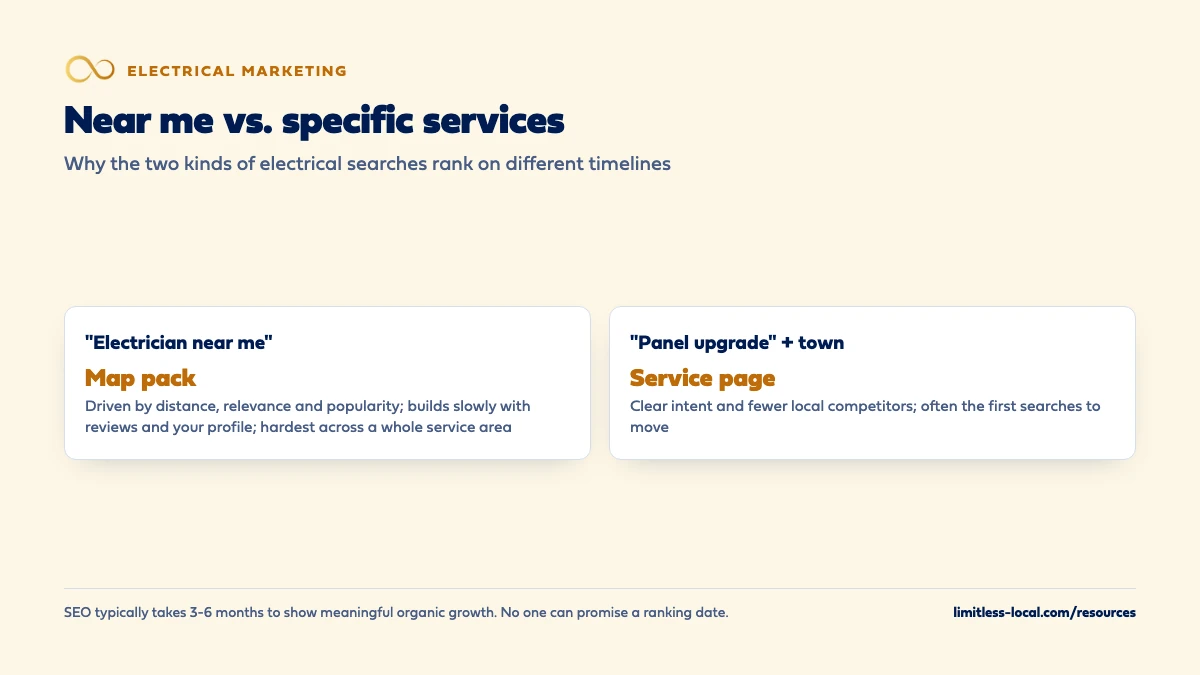
Specific service searches, like “panel upgrade” or “EV charger installation” with your town, usually start showing results before “electrician near me”, because fewer local pages compete for them and one strong service page can rank for them. “Electrician near me” is decided mostly in the map pack, where Google weighs how far you are from each searcher along with relevance and popularity, so it builds slowly with reviews and your profile and is hard to win across a whole service area. SEO as a whole typically takes 3-6 months to show meaningful organic growth, and nobody can promise a date for either kind of search.
That’s how we plan local SEO: service pages for the jobs you want most, a Google profile and review flow for the broad searches, and reporting on calls and booked jobs from both. We optimize for the regular Google results, the Maps 3-pack and AI answers. Our local SEO page explains the work, our electrical contractor marketing page covers the trade, and the electrical marketing questions library goes question by question.
Why do "electrician near me" and service searches rank on different timelines?
Because they’re different contests. Someone typing “electrician near me” could want anything from a dead outlet to a commercial build-out, and every electrician in town is a match. Google answers mostly with the map pack, and who shows up depends on where the searcher is standing. Someone typing “200 amp panel upgrade” plus your town has already decided what they need, fewer local businesses have a page that answers it well, and a single service page on your site can compete in the regular results.
So you’re not waiting on one ranking. You’re building two kinds of visibility at once, and they move at different speeds. Why SEO takes longer than Google Ads for electricians covers why both take longer than paid ads.
How does Google decide who shows up for "electrician near me"?
Through the local results. Google’s tips to improve your local ranking say local results are mainly based on relevance, distance and popularity. Relevance is how well your profile matches the search. Distance is how far you are from the searcher, and if they don’t share their location, Google uses what it knows about where they are. Popularity, which Google also calls prominence, is how well known you are, based partly on how many websites link to you and how many reviews you have.
Notice what’s missing: the words “near me”. Google’s systems recognize when a query has local intent and use the searcher’s location to work out what’s relevant, according to its page on how it ranks results. You don’t rank for “near me” by repeating the phrase; you rank by being relevant, close and well known.
Why can't I rank for "electrician near me" everywhere I work?
Because distance changes with every searcher. When a homeowner near your shop searches, you’re close; when someone 25 minutes across your service area searches, the electricians closer to them have the edge. That’s why a shop often shows in the map pack around its base and fades toward the edges of its area.
Your service area setting doesn’t override that. It tells customers where you go, but it doesn’t make you closer to anyone. What widens your reach over time is the popularity side: more reviews, better ratings, and more local sites that mention and link to you. That’s slow work, which is why “electrician near me” is usually the last search to come around. How to get your electrical company into the Google map pack covers what to work on.
Why do specific service searches usually move first?
Fewer competitors, clearer intent and a page built to match. Look at your town’s results for “EV charger installation” or “whole house generator installation” and you’ll often find directory listings and national sites instead of a local electrician’s page that answers the question. A focused service page from a real local shop can win that spot in the regular results faster than a profile can climb the map pack.
Your Google profile helps here too. Google’s help on managing services says that when local customers search for something you offer, that service may be highlighted on your profile. List each job you want more of as a service, with a short description, and your profile has more ways to match specific searches.
Which electrical services are easiest to rank for first?
Usually the high-value jobs that people search for by name, where local competition is thin:
- Panel upgrades and service upgrades, including specific amp sizes.
- EV charger installation, often searched with the car or charger brand.
- Whole-home and standby generator installation.
- Whole-home rewiring and knob-and-tube replacement, in towns with older housing.
- Surge protection, lighting upgrades and outdoor lighting.
- Commercial work like tenant build-outs or parking lot lighting, if you do it.
Check demand before you build. Keyword Planner, inside Google Ads, shows search volume and forecasts for the keywords you enter, and its help page says forecasts are refreshed daily, based on the last 7-10 days and adjusted for seasonality. Which keywords your electrical website should target covers how to match each search to a page.
Curious what your marketing is actually booking?
Get a free visibility audit — no obligation, no sales pitch.
What does a realistic timeline look like for each?
There’s no fixed schedule, but the order is fairly predictable:
- First few weeks: fixes to your Google profile (categories, services, service area) get picked up, and new service pages get found and start appearing for very specific searches, usually low in the results.
- First few months: service-and-town pages start earning impressions and the occasional call, especially for jobs with little local competition.
- Around three to six months: SEO typically shows meaningful organic growth. Specific service searches are often where it shows first.
- Longer: “electrician near me” map pack visibility widens as reviews and local links build, and in a crowded metro it may never cover your whole area.
Google’s SEO Starter Guide says some changes take effect in a few hours, others can take several months, and in general you’ll want to wait a few weeks to judge whether a change helped.
How do I track progress on "near me" versus service searches?
Separately, and not by searching yourself. Results are specific to the time, place, device and recent history of the person searching, according to Google’s help on the Search Console Performance report, so what you see from your truck isn’t what a homeowner across town sees.
- Search Console: group the Performance report by queries, then filter for words like “panel”, “EV” or “generator” to see impressions, clicks and average position for each service. Filter for “electrician” to watch the broad terms.
- Business Profile performance: the searches metric shows the terms people used to find your profile. It updates at the start of each month, so check it monthly.
- Your field software: the lead source on each booked job tells you which searches actually paid.
What an electrician should check weekly to see if SEO is working turns this into a short routine.
What speeds up rankings for "electrician near me"?
The popularity and relevance side of your Google profile:
- A steady flow of genuine reviews, with replies. More reviews and positive ratings can help your local ranking.
- A complete, verified profile with the right primary category, your services listed and hours that match when someone answers.
- Real job photos, added regularly.
- Mentions and links from local sites: suppliers, builders you work with, local news, sponsorships.
- A website whose homepage clearly says you’re an electrician and names the towns you serve.
None of it is fast, and there’s no way to request or pay for a better local ranking. How many Google reviews an electrician needs covers the review side.
What speeds up rankings for specific services?
Pages that answer the search better than anything else in your area:
- One page per main service, with the service name in the page title and main heading.
- Real detail: what the job involves, the permit and inspection process, how long it takes, what affects the price, and photos of your own installs.
- The towns you serve for that job, named naturally on the page.
- Links to the page from your homepage and related services, so it’s easy to find.
- The same service listed on your Google profile.
Start with the two or three jobs that are worth the most to you and that your crews have room for. A page that ranks for work you can’t schedule doesn’t help.
Should I run ads for "electrician near me" while SEO catches up?
If you need calls from the broad searches now, yes. Ads can generate leads within days of launch, while SEO typically takes 3-6 months. Paid ads let you show up across your whole service area for broad searches that your profile won’t win organically for a while, and you can turn them down as the organic side grows.
Keep the two working together: the search terms in your ad account show which service searches bring calls, and those are good candidates for your next service pages. When organic calls for a service grow, you can spend less on ads for it.
Which should I go after first?
Both, but not equally. Put most of your early effort into service pages for your highest-value jobs, because that’s where results tend to show first and where each booked job is worth the most. At the same time, keep the Google profile and review habit running every week, because “electrician near me” is built slowly and the clock only starts when you do.
The exception: if most of your work is quick service calls from homeowners nearby, the map pack matters more than service pages, and reviews and profile work should come first.
Talk it through with someone who runs this every day
A 15-minute growth call: your market, your numbers, and what a realistic budget looks like. No pressure.
What's different for electricians
Emergency searches are “near me” searches. A homeowner with no power at 9 p.m. searches on a phone and calls whoever is close and answering. Those calls come from the map pack, so the profile and reviews carry them.
Planned jobs are researched. Panel upgrades, EV chargers and generators are bigger purchases. Homeowners search the job by name, read, compare and call later, which is exactly where service pages pay off.
Storms and new EV models create spikes. Generator searches jump around storm season, and charger searches follow new car purchases. A service page that’s already ranking when the spike hits is worth far more than one you start building after.
Commercial buyers rarely search “near me”. Property managers and builders search for specific work or find you through referrals, so commercial service pages and relationships matter more than map pack position.
A worked example: why a service page can pay off first
These numbers are made up to show the math, not a benchmark or a forecast. Say a booked panel upgrade is worth $2,500 in revenue to your shop and a typical service call is worth $250. One panel upgrade is worth ten service calls ($2,500 divided by $250).
Now say your new panel upgrade page starts booking two jobs a month after a few months, while your map pack visibility for “electrician near me” is still limited to the towns around your shop. Those two jobs bring in $5,000 a month, the same as 20 service calls. That’s why specific pages are often the first place SEO shows up in revenue, even while the broad term is still building.
Frequently asked questions
Should I put "near me" on my website pages?
No. Google uses the searcher’s location to handle “near me”; the phrase itself doesn’t help, and stuffing it into pages reads badly. Say what you do and which towns you serve instead.
Will a city page help me rank for "electrician near me" in that city?
It can help you rank in the regular results for that town, if the page has real local detail. It won’t change your distance from searchers, so it won’t put you in that town’s map pack by itself.
Why do I rank for "electrician near me" at my shop but not at home?
Distance. Results depend on where the searcher is, so you’ll look stronger close to your base. Search Console and your Business Profile performance report give a truer picture than spot checks.
How many service pages should I build at once?
Start with two or three for your highest-value jobs and make them good. Add more once those are getting impressions, rather than publishing a dozen thin pages at once.
Do AI search answers change any of this?
The same basics help: clear service pages, a complete Google profile and genuine reviews give AI answers and regular results something accurate to show about you.
Key takeaways
- Specific service-and-town searches usually move before “electrician near me”.
- “Near me” results lean on distance, so they’re won near your base first and widen slowly with reviews and links.
- SEO typically takes 3-6 months to show meaningful organic growth; nobody can promise a date.
- Build service pages for your highest-value jobs first and keep the profile and reviews running weekly.
- Track service searches and broad searches separately in Search Console and your Business Profile.
Ready to compare options?
Book a short growth call and we'll walk through the math for your service area, including when we're not the right fit.
More in this section
- Does shop location or service area affect an electrician Maps ranking?
- Why is a competitor electrician ranking above me on Google Maps?
- What website content helps electrician customers choose me?
- Which local citations and directories matter for electricians?
- How many Google reviews does an electrician need to compete?
Sources
- Tips to improve your local ranking on Google — Google Business Profile Help
- How Does Google Determine Ranking Results — Google Search
- SEO Starter Guide: The Basics — Google Search Central
- Manage your services on your Business Profile — Google Business Profile Help
- Use Keyword Planner — Google Ads Help
- Performance report (Search results): Overview and basic setup — Search Console Help
- Understand your Business Profile performance & insights — Google Business Profile Help